I think you guys are giving yourselves an unfair hard time. Finding funding for
this area of research is difficult to say the least. Take the money where you
find it and publish your results for all to see. The research may someday be
difference between disaster and not.
David Sevier


Carbon Cycle Limited

248 Sutton Common Road

Sutton, Surrey SM3 9PW

England


Tel 44 (0) 208 288 0128

www.carbon-cycle.co.uk


From: [email protected] <[email protected]> On
Behalf Of Cush Ngonzo Luwesi
Sent: 03 November 2022 10:15
To: geoengineering <[email protected]>
Subject: Re: [geo] Economic interests and ideologies behind solar
geoengineering research in the United States


Dear Surprise

This is as well a surprise to our community of researchers, as one could
naively think that there is no conflict of interest in GE research. No wander
that these GE Philosophies hit the wall of negative attitudes from
policy-makers, who do not see their economic interest in our undertakings.
Capitalism, communism, socialism, eugenism, Judaism,  christianism, bouddhism,
shintoïsm, africanism, etc. also have their say in the current context of GE
research. This does ipso facto affect the final result of the researches, which
are still at a early stage of implementation. Shall we keep blaming
policy-makers for not allowing open-door experiments of some forms of GE? Or
shall we first with the ethics of GE, while perfecting our tools and approaches?

This is just food for thought.

Thanks

Prof. Cush Ngonzo Luwesi, PhD
Director of Postgraduate Studies/ Francophone Africa (Dist./Online)
Ballsbridge University
WFG (jombi), Mesing 14, Willemstad, Curacao, The Netherlands
WhatsApp: +243 970 649 946
Website: www.fr-acedu.org <http://www.fr-acedu.org>
E-mail: [email protected] <mailto:[email protected]>


On Mon, Oct 31, 2022, 16:26 Andrew Lockley <[email protected]
<mailto:[email protected]> > wrote:


https://www.solargeoeng.org/economic-interests-and-ideologies-behind-solar-geoengineering-research-in-the-united-states/


Economic interests and ideologies behind solar geoengineering research in the
United States


* KEVIN SURPRISE AND J.P. SAPINSKI
<https://www.solargeoeng.org/author/kevinandjp/>

*  October 27, 2022

Solar geoengineering research – also discussed as solar radiation management or
stratospheric aerosol injection – is often thought of as a futuristic climate
emergency measure, or as a tool of the fossil fuel industry to push back energy
transitions as much as possible. In this post, we show that solar
geoengineering is mostly now supported by interests aligned with technology and
financial sectors, and advanced by researchers as a key part of near-term
climate policy. This blog is based on a recent paper by the authors, which can
be found here <https://journals.sagepub.com/doi/abs/10.1177/03098168221114386>
, with pdf here: Whose climate intervention? Solar geoengineering, fractions of
capital, and hegemonic strategy.
<https://www.academia.edu/89265578/Whose_climate_intervention_Solar_geoengineering_fractions_of_capital_and_hegemonic_strategy>


There is a persistent false dichotomy animating the politics of solar
geoengineering. On one hand, proponents of research and development argue that
solar geoengineering could serve as both a near-term intervention to reduce
climate impacts for the most vulnerable, and a way to “buy time” for
mitigation, adaptation, and carbon removal to take effect. On the other hand,
critics tend to couch solar geoengineering as nothing but a smokescreen to
perpetuate fossil fueled
<https://www.ciel.org/reports/fuel-to-the-fire-how-geoengineering-threatens-to-entrench-fossil-fuels-and-accelerate-the-climate-crisis-feb-2019/#:~:text=Click%20to%20read.-,Fuel%20to%20the%20Fire%3A%20How%20Geoengineering%20Threatens%20to%20Entrench%20Fossil,and%20promoting%20key%20geoengineering%20technologies.>
  <http://www.etcgroup.org/content/big-bad-fix>  business-as-usual. The truth
lies somewhere in between (though critics are much closer to the mark). That
is, solar geoengineering is not a humanitarian endeavor, nor is it a direct
ploy by the fossil fuel industry. It is being advanced – funded, researched,
and governed – by institutions and individuals broadly aligned with or
connected to Silicon Valley and Wall Street, so-called green capitalists within
the technology and financial industries operating under ideologies of
philanthrocapitalism
<https://www.theguardian.com/news/2018/may/24/the-trouble-with-charitable-billionaires-philanthrocapitalism>
  (or effective altruism) and ecomodernism <http://www.ecomodernism.org/> .
Solar geoengineering is being advanced by these interests as a way to “buy
time” for the same staid, gradual, neoliberal climate policies that have failed
for decades <https://www.openbookpublishers.com/books/10.11647/obp.0265> :
market mechanisms, policy tweaks, and technological innovations. There appears
to be a faction within climate politics willing to push for extreme,
potentially dangerous, likely centuries-long technological interventions to
alter the climate system so that we can ultimately change…nothing at all. Or,
more accurately, to actively save capitalism from a climate crisis of its own
making
<https://www.resilience.org/stories/2021-10-13/solving-the-climate-crisis-requires-the-end-of-capitalism/>
 .

We explore this paradox in a recent <https://doi.org/10.1177/03098168221114386>
 paper <https://doi.org/10.31235/osf.io/ebwqn>  examining the funding sources,
political-economic alignments, and ideologies driving the development of solar
geoengineering in the United States. Between 2008 and 2018, total global
funding for solar geoengineering remained relatively low, with European
governments (e.g. the EU, Germany, and the UK) spending US$ 31.3 million on
early research efforts, and private funding (primarily in the U.S.) reaching
approximately US$ 20 million in this time frame (growing in the last several
years with the expansion of the Harvard Solar Geoengineering Research Program
<https://geoengineering.environment.harvard.edu/home>  (HSGRP), new federal
funding, and recent grants from the NGO SilverLining
<https://www.silverlining.ngo/home-> ). We note a marked shift in the
geographical center of research beginning in 2016 with the U.S. coming to
dominate the field, and with it a proliferation of funding from private,
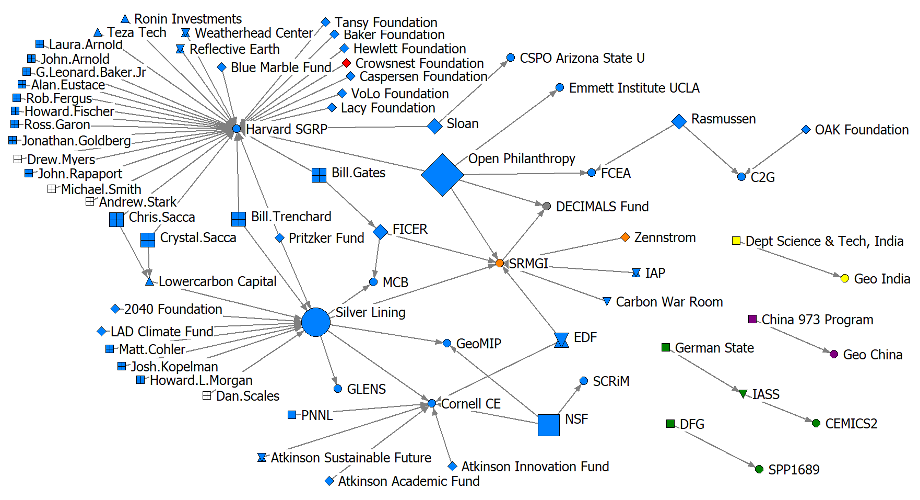
philanthropic, and venture capital sources (Figure 1). This constitutes a shift
not just internationally, but within the U.S. solar geoengineering landscape as
well. Whereas early political interest in solar geoengineering emanated from
climate-denying think tanks and politicians backed by the fossil fuel industry,
recent funding and support derives from foundations and individuals with ties
to technology and financial firms, many of which have a demonstrated record of
environmental philanthropy. Philanthropic funding for solar geoengineering in
the U.S. revolves around a core group of seven organizations that have funded
two or more solar geoengineering research projects in recent years. Table 1
lists these seven organizations, their key corporate connections, and solar
geoengineering initiatives they fund.

  <https://www.solargeoeng.org/wp-content/uploads/2022/10/image.png> Figure 1.
The global network of solar geoengineering funding

Color key: Blue = United States, Red = Canada, Orange = United Kingdom, Green =
Germany, Yellow = India, Pink = China, White = undetermined.
Shapes key: Circle = solar geoengineering research project, Diamond =
philanthropic foundation, Up triangle = private firm, Down triangle = think
tank, Hourglass = NGO or university research center, Square = state, Box =
individual.
Shape size: Number of projects funded.
Sources: Necheles et al.
<https://geoengineering.environment.harvard.edu/blog/funding-solar-geoengineering>
  and authors’ data.

Table 1. Leading private funders of solar geoengineering


Funding organization

Description/Background

Solar geoengineering initiatives fundeda


Open Philanthropy Project

Founded by Dustin Moskovitz (billionaire co-founder of Facebook) with partner
Cari Tuna, and Holden Karnofsky, formerly of hedge fund Bridgewater Associates.
Board includes Divesh Mahkan, founder of ICONIQ Capital, formerly of Goldman
Sachs and Morgan Stanley

– Forum on Climate Engineering Assessment (FCEA)
– HSGRP ($4.5M 2016-17)
– Solar Radiation Management – Governance Initiative (SRMGI)
– DECIMALS Fund
– UCLA Emmett Institute
Total amount: $5.76M


SilverLining

Funded by venture capital firms LowerCarbon Capital and First Round Capital;
staff and board include former executives from Goldman Sachs and JPMorgan Chase
Co.

– GLENS (NCAR)
– Marine Cloud Brightening Project (MCB
– Cornell Climate Engineering
– GeoMIP
– SRMGI
Total amount: $3M


Bill Gates/ FICER

FICER is Bill Gates’ personal fund for energy and geoengineering research,
administered by geoengineering researchers Ken Caldeira and David Keith

– HSGRP ($7.65M 2013-18)
– MCB ($150K)
– SRMGI ($100K)


Environmental Defense Fund (EDF)

Environmental NGO, many corporate ties on board; corporate partnerships, e.g.
Citigroup, GE, McDonald’s, Shell, Tyson, Walmart

– Cornell Climate Engineering
– SRMGI


Pritzker Innovation Fund

Rachel Pritzker, an heir to the multi-billionaire Pritzker family, founders of
the Hyatt Hotels Corporation

– HSGRP
– SilverLining


VK Rasmussen Foundation

Family foundation founded by the Swedish inventor and businessman Villum Kann
Rasmussen; funds a range of environmental groups, some opposed to
geoengineering; raises funds from investment capital

– Carnegie Climate Governance Initiative (C2G) ($5.55M)
– FCEA
– National Academies


Alfred P. Sloan Foundation

Founded by Alfred P. Sloan of General Motors; claims $1.9 billion in assets;
raises funds from investment capital

– HSGRP ($90K)
– CSPO Arizona State University ($300K)

a Amounts indicated when available. Sources: Necheles et al.
<https://geoengineering.environment.harvard.edu/blog/funding-solar-geoengineering>
  and authors’ data. Values in US$.

To understand the alignment of these organizations with various economic
sectors (e.g. industrial, technological, financial, commercial), we trace
board-level interlocks with the corporate community
<https://whorulesamerica.ucsc.edu/wra8.html>  – governance-level connections
<https://osf.io/preprints/socarxiv/7t8c9/> formed when corporate directors sit
on the boards of multiple organizations. One of the board’s roles is to decide
on the broad orientations of a foundation, including the main areas which will
receive funds. Hence, in general terms, foundation boards are charged with
distributing philanthropic capital.
<https://whorulesamerica.ucsc.edu/wra8.html>

Data about board members’ interlocks to different economic sectors thus show
which sector(s) of the economy solar geoengineering funders are most closely
embedded. As shown in Table 2, among the 91 directors of the top seven solar
geoengineering funders, we count a total of 62 corporate interlocks: the
financial sector comprises 38.7% of the links, the commercial and services
sector 24.2% and the high-tech sector 19.4%. Among all corporations, 20
interlocks (32.3%) are to high-tech related firms, including financial or
consulting firms providing services specifically to the high-tech sector. A
mere five interlocks (8.1%) connect solar geoengineering funders to fossil fuel
extractive firms and to carbon-linked sectors such as automotive industries,
aviation, steel production and chemical manufacturing (Table 2).

Table 2. Board-level interlocks between top solar geoengineering funders and
different economic sectors


Economic sector

N

%


Finance, investment and real estate

24

38.7%


Commercial, advisory and misc. services

15

24.2%


Technology, equipment, software, communications

12

19.4%


Other industrial, mediated relation to fossil fuels

6

9.7%


Carbon-linked industrial

4

6.5%


Carbon extraction, processing, distribution

1

1.6%


Total

62

100.0%

Source: Authors’ data.

Another key feature of solar geoengineering funding in the U.S. is the number
of billionaires and billionaire-founded philanthropies involved in the field. A
large part of these individuals’ wealth comes from high-tech firms including
Microsoft, Hewlett-Packard, Google and Skype; only one of 11 billionaires
acquired their fortune through the carbon extractive sector, former Enron
trader John Arnold. In addition to individual billionaires, several high
net-worth individuals also fund solar geoengineering research. For example, key
funders of the Harvard Solar Geoengineering Research Program include: G.
Leonard Baker, Jr., partner at Sutter Hill Ventures (Silicon Valley VC firm);
Howard Fischer, founder of Basso Capital Management; Ross Garon of Millennium
Capital; The Tansy Foundation, founded by Eric Wepsic, an executive at hedge
fund D. E. Shaw; and Teza Technologies, founded by Misha Malyshev, formerly of
hedge fund Citadel Investment Group and McKinsey & Co, among others.

Solar geoengineering funding is thus comprised of a core group of individuals
and organizations with multiple ties to corporate power either directly or via
their boards of directors, primarily in the financial and technology capital
sectors. Among this group, we find at least 11 billionaires or
billionaire-founded philanthropies, as well as a slew of wealthy individuals
with direct ties to venture capital firms and billionaire-led hedge funds.
Solar geoengineering research funding is the province of the financial and
high-tech sectors of the corporate elite, which are interrelated to but
ultimately distinct from the fossil fuel fraction. Hence, we conceptualize
solar geoengineering as a potential strategy for compromise among climate and
fossil
<https://journals.sagepub.com/doi/full/10.1177/0306396819844121?casa_token=QvTJEs2EEeMAAAAA%3AFmVqMR9t8kr3gJDyrKP6ho6gGQvHxpwXUX2opEurIJstv7VEZqV0VsKpAxU6dWotTIrHFW06LBe66Q>
  capital
<https://journals.sagepub.com/doi/full/10.1177/0306396819844121?casa_token=QvTJEs2EEeMAAAAA%3AFmVqMR9t8kr3gJDyrKP6ho6gGQvHxpwXUX2opEurIJstv7VEZqV0VsKpAxU6dWotTIrHFW06LBe66Q>
 : solar geoengineering is being mobilized by the actors outlined above
explicitly to “buy time” for gradual, market-driven climate and energy
transitions. This is of obvious financial interest to the fossil fuel industry,
but also to the banks and financial institutions
<https://capitalmonitor.ai/sector/energy-and-utilities/banks-still-supporting-fossil-fuels-to-the-tune-of-billions/>
  that continue to invest in fossil fuel expansion, as well as wealthy
individuals and big corporations interested in maintaining the political and
economic status quo.

The big picture discussions of funding and economic sectors above can be
fleshed out by examining the economic rationales mobilized by leading solar
geoengineering researchers as they sell this idea to elite economic and
political institutions. As an illustrative example, take a recent paper by
David Keith – perhaps the leading solar geoengineering researcher in the world
– and his co-author John Deutch. Keith is Director of the Harvard
geoengineering program, which, as noted above, is funded largely by billionaire
philanthropies and wealthy individuals. Deutch is Institute Professor of
Chemistry at MIT, former Director of the CIA, former Deputy Secretary of
Defense, has been or is currently on the board of Cheniere Energy, Citigroup,
Raytheon, and Schlumburger (an oil services company), and serves as a member of
the Council on Foreign Relations, the National Petroleum Council, the Secretary
of Energy’s Advisory Board, and the Trilateral Commission. Keith and Deutch’s
paper
<https://www.economicstrategygroup.org/publication/climate-policy-enters-four-dimensions/>
  was written for the Aspen Institute’s Economic Strategy Group
<https://www.aspeninstitute.org/programs/economic-strategy-group/> . The Aspen
Institute is an influential economic and foreign policy think tank based in
Washington, D.C., with a well-connected board. More specifically, Aspen’s
Economic Strategy Group is co-chaired by former Treasury Secretaries, and
comprised of CEOs or CFOs from leading financial corporations.

The paper, titled “Climate Policy Enters Four Dimensions
<https://www.economicstrategygroup.org/publication/climate-policy-enters-four-dimensions/>
 ,” is the concluding chapter of the Economic Strategy Group’s 2020 book,
Securing our Economic Future, wherein Keith and Deutch analyze climate policy
as primarily a question of costs. They begin by arguing that the purpose of
mitigation is to “lower emissions without reducing economic growth” (p. 267,
emphasis added), and adaptation aims to “protect communities, commerce, and
environments.” Dealing with climate change cannot threaten economic growth, and
adaptation must attend to the needs of commerce equally alongside communities
and environments. From this perspective, they argue that decarbonization is
best accomplished through the private market, acknowledging that government
policy to create market incentives is necessary, but should not venture too far
into economic processes in the form of “industrial policy:” “the government
record in advancing innovation is mixed; the government does not have the
expertise that is necessary to make uncertain investment decisions, and the
political system has little tolerance for the failures that inevitably occur
with R&D projects” (p. 284). Hence solar geoengineering becomes rational in a
situation where the “low-carbon economy will require massive amounts of capital
and a very long period of market adjustment until the benefits of
decarbonization are realized (p. 269). In this view, while the market figures
out how to reduce emissions while expanding growth, we need solar
geoengineering as a bridge technology until large-scale carbon dioxide removal
(CDR) comes online. In their models “an optimal policy deploys emission
reduction early and uses carbon removal at large scale only after emissions
have been substantially reduced while [solar geoengineering] is used for an
intermediate period while carbon concentrations are high and is then phased out
as concentrations are reduced by CDR” (p. 282).

They argue that this engineered-Earth approach has clear economic value.
Running various integrated assessment models, they suggest that the added value
derived from including solar geoengineering in near-term climate policy ranges
between US$ 39 trillion and US$ 58 trillion (p. 283). Given this modelling
exercise, they note the following: costs of solar geoengineering appear to be
“quite small, with the global annualized costs perhaps under $20 billion per
year well into the latter half of the century. By comparison, the
damage-reduction benefits could be 100 times this amount. It seems reasonable
that the favorable cost-benefit potential of [solar geoengineering] justifies a
vigorous public R&D effort …” (p. 287). In other words, these are elite
scientists and policymakers connected in various ways to both fossil and
climate capital making an argument for the “rational” inclusion of solar
geoengineering in current climate policy not as a future emergency measure, as
is often assumed – based on narrow goals of economic efficiency and maintaining
market-driven growth, presented to leading figures and institutions within the
economic and political elite. While many proponents of solar geoengineering
frame it as a global humanitarian intervention on behalf of the poor and
climate vulnerable, it is being developed through an extremely narrow, deeply
ideological lens that caters to dominant interests.

With funding from tech and finance-linked philanthropists, a political-economic
logic that pushes management of the climate crisis via interventions into the
climate system, rather than the economy (thus avoiding direct economic
planning), and policy proposals demonstrating tremendous cost efficiency, the
appeal of solar geoengineering to corporations, hegemonic states, and all
manner of elites becomes clear. Solar geoengineering is not a humanitarian
endeavor: it would constitute a massive, potentially dangerous, likely
centuries-long intervention into the climate system in order to maintain the
economic system at the root of the crisis.

Kevin Surprise is a Lecturer in Environmental Studies at Mount Holyoke College.
He researches the political economy of climate change, with a focus on the
politics of solar geoengineering proposals, and serves as co-chair of the
Politics of Geoengineering Working Group
<https://cssn.org/projects/working-groups/the-politics-of-geoengineering/>
with the Climate Social Science Network <http://cssn.org/> .

J. P. Sapinski is Assistant Professor of Environmental Studies at Université de
Moncton, in New Brunswick, Canada. He is interested in how the structures of
capitalism and corporate power mediate the social metabolism between human
societies and the ecosphere, and how we can transform and decolonize this
relationship to make it just and sustainable. He is co-editor, with Holly Jean
Buck and Andreas Malm, of
<https://www.rutgersuniversitypress.org/has-it-come-to-this/9781978809352> Has
It Come to This? Promises and Perils of Geoengineering on the Brink (Rutgers
University Press, 2020).


--
You received this message because you are subscribed to the Google Groups
"geoengineering" group.
To unsubscribe from this group and stop receiving emails from it, send an email
to [email protected]
<mailto:[email protected]> .
To view this discussion on the web visit
https://groups.google.com/d/msgid/geoengineering/CAJ3C-04XT%3D8A18qZagGShNB0iQ17T0PA82huqAGzUNG8n8t5xA%40mail.gmail.com

<https://groups.google.com/d/msgid/geoengineering/CAJ3C-04XT%3D8A18qZagGShNB0iQ17T0PA82huqAGzUNG8n8t5xA%40mail.gmail.com?utm_medium=email&utm_source=footer>
 .

--
You received this message because you are subscribed to the Google Groups
"geoengineering" group.
To unsubscribe from this group and stop receiving emails from it, send an email
to [email protected]
<mailto:[email protected]> .
To view this discussion on the web visit
https://groups.google.com/d/msgid/geoengineering/CAKo_7ao3UbC1mQ9uHVhjMMqXOFDeXsfHPnVT2y%3DqH2sEerdktA%40mail.gmail.com

<https://groups.google.com/d/msgid/geoengineering/CAKo_7ao3UbC1mQ9uHVhjMMqXOFDeXsfHPnVT2y%3DqH2sEerdktA%40mail.gmail.com?utm_medium=email&utm_source=footer>
 .

--
You received this message because you are subscribed to the Google Groups
"geoengineering" group.
To unsubscribe from this group and stop receiving emails from it, send an email
to [email protected].
To view this discussion on the web visit
https://groups.google.com/d/msgid/geoengineering/002201d8efa0%2493008400%24b9018c00%24%40carbon-cycle.co.uk.