*Poster's note: Peer-reviewed, final version of paper *

https://esd.copernicus.org/articles/14/55/2023/
*Northern-high-latitude permafrost and terrestrial carbon response to two
solar geoengineering scenarios *

*Authors*
Yangxin Chen, Duoying Ji, Qian Zhang, John C. Moore, Olivier Boucher, Andy
Jones, Thibaut Lurton, Michael J. Mills, Ulrike Niemeier, Roland Séférian, and
Simone Tilmes

*25 January 2023*

*Citation*: Chen, Y., Ji, D., Zhang, Q., Moore, J. C., Boucher, O., Jones,
A., ... & Tilmes, S. (2023). Northern-high-latitude permafrost and
terrestrial carbon response to two solar geoengineering scenarios. *Earth
System Dynamics*, *14*(1), 55-79.

https://doi.org/10.5194/esd-14-55-2023

*Abstract*

The northern-high-latitude permafrost contains almost twice the carbon
content of the atmosphere, and it is widely considered to be a non-linear
and tipping element in the earth's climate system under global warming.
Solar geoengineering is a means of mitigating temperature rise and reduces
some of the associated climate impacts by increasing the planetary albedo;
the permafrost thaw is expected to be moderated under slower temperature
rise. We analyze the permafrost response as simulated by five fully coupled
earth system models (ESMs) and one offline land surface model under four
future scenarios; two solar geoengineering scenarios (G6solar and G6sulfur)
based on the high-emission scenario (ssp585) restore the global temperature
from the ssp585 levels to the moderate-mitigation scenario (ssp245) levels
via solar dimming and stratospheric aerosol injection. G6solar and G6sulfur
can slow the northern-high-latitude permafrost degradation but cannot
restore the permafrost states from ssp585 to those under ssp245. G6solar
and G6sulfur tend to produce a deeper active layer than ssp245 and expose
more thawed soil organic carbon (SOC) due to robust residual high-latitude
warming, especially over northern Eurasia. G6solar and G6sulfur preserve
more SOC of 4.6 ± 4.6 and 3.4 ± 4.8 Pg C (coupled ESM simulations) or 16.4 ±
4.7 and 12.3 ± 7.9 Pg C (offline land surface model simulations),
respectively, than ssp585 in the northern near-surface permafrost region.
The turnover times of SOC decline slower under G6solar and G6sulfur than
ssp585 but faster than ssp245. The permafrost carbon–climate feedback is
expected to be weaker under solar geoengineering.

[image: https://esd.copernicus.org/articles/14/55/2023/esd-14-55-2023-f01]
<https://esd.copernicus.org/articles/14/55/2023/esd-14-55-2023-f01-web.png>

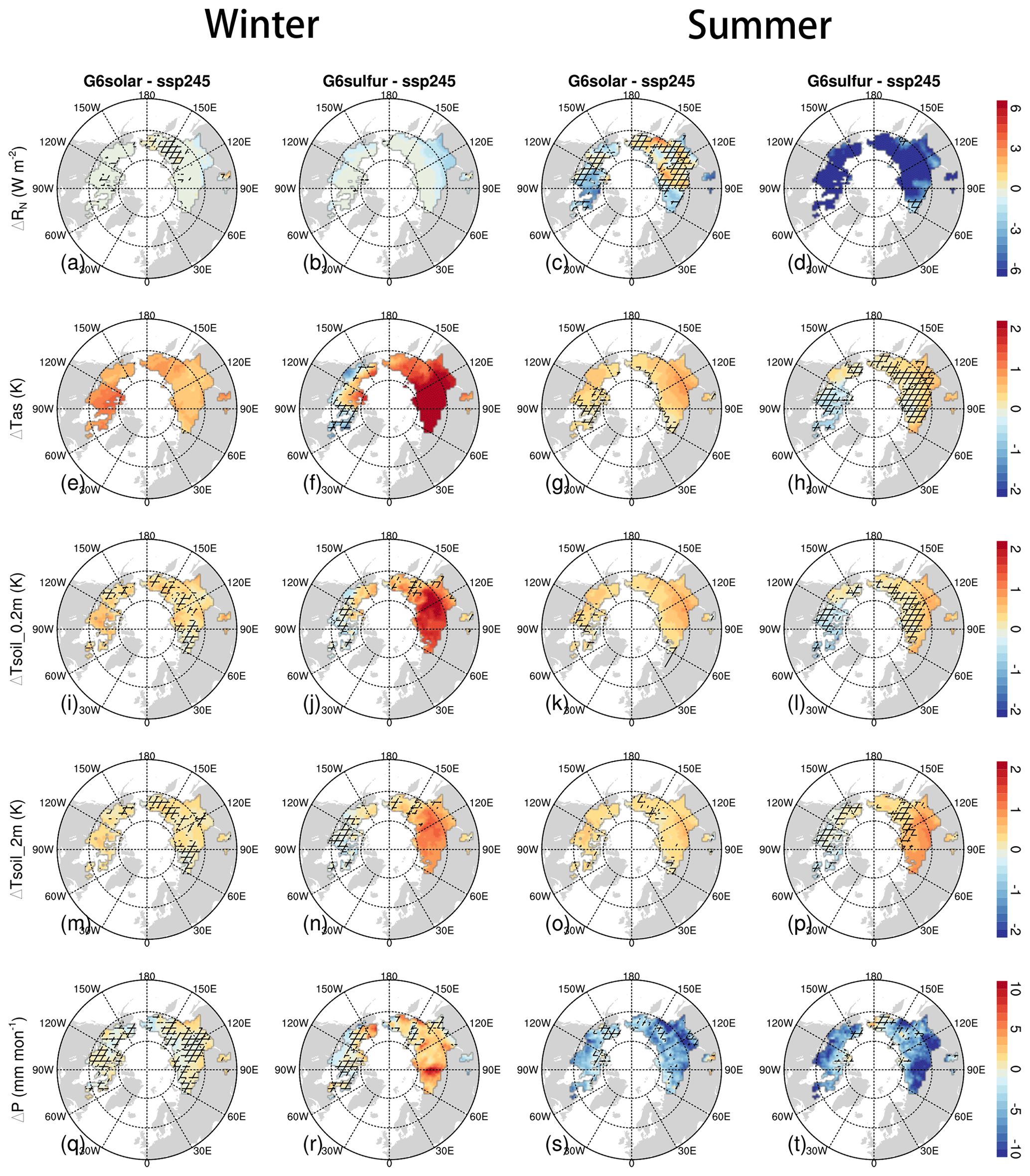
Figure 1The multi-model mean changes in surface-absorbed shortwave
radiation (Δ*R**N*; a, b, c, d), near-surface air temperature (Δ*T*as; e,
f, g, h), 0.2 m soil temperature (Δ*T*soil_0.2m; i, j, k, l), 2 m soil
temperature (Δ*T*soil_2m; m, n, o, p), and precipitation (Δ*P*; q, r, s, t)
under G6solar and G6sulfur relative to ssp245 for the period 2080–2099 over
the baseline PF50 *%* region. The left two columns show changes in winter
(December, January, and February); the right two columns show changes in
summer (June, July, and August). The hatched area in each panel indicates
where fewer than 80 % of the ESMs (four out of five) agree on the sign of
changes.

[image: https://esd.copernicus.org/articles/14/55/2023/esd-14-55-2023-f04]
<https://esd.copernicus.org/articles/14/55/2023/esd-14-55-2023-f04-web.png>

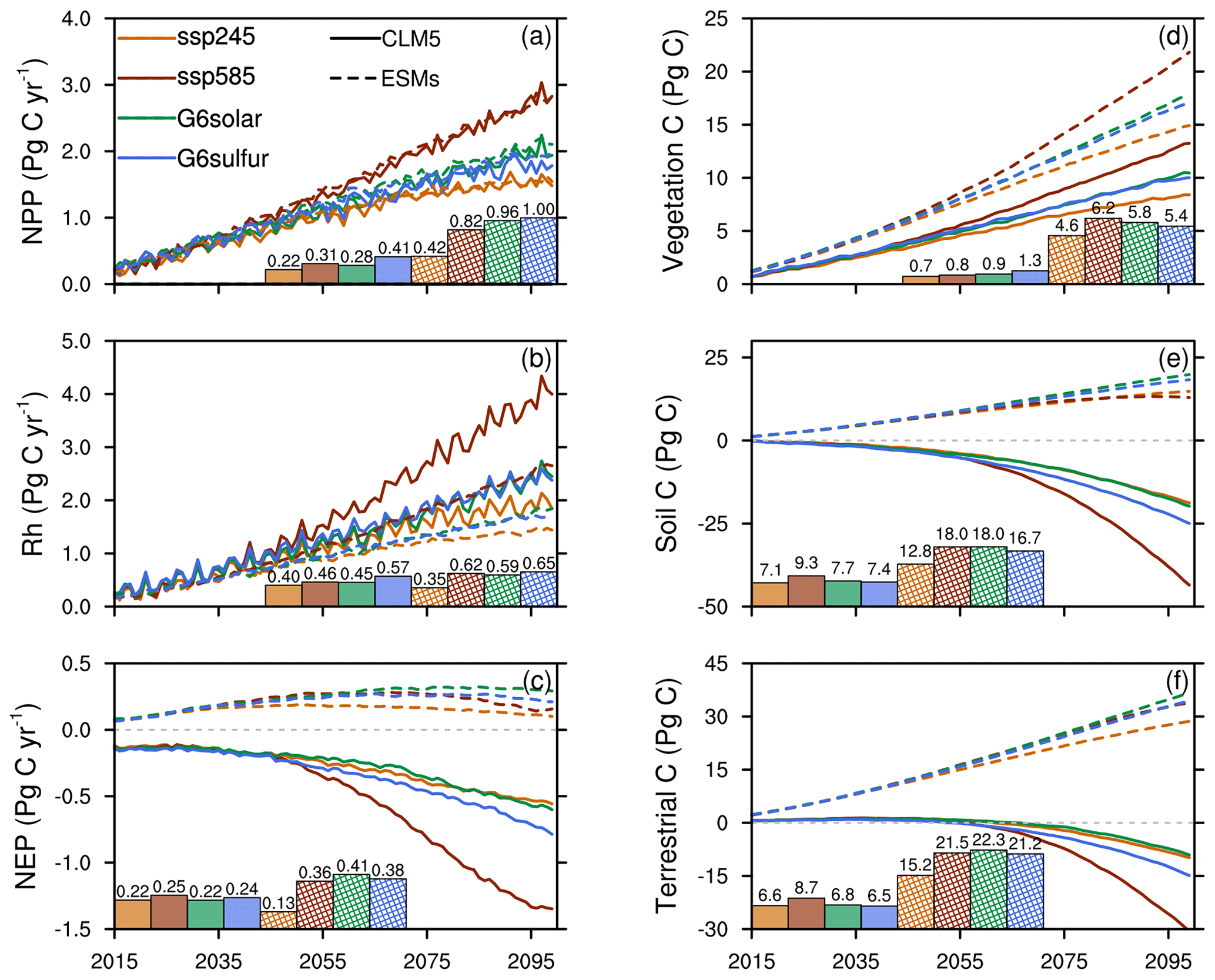
*Figure 4*The multi-model mean changes in terrestrial carbon fluxes and
carbon storages over the baseline permafrost region during the period
2015–2099 relative to the baseline period 1995–2014 under ssp245, ssp585,
G6solar, and G6sulfur. The left column shows changes in NPP (a), *R*h (b),
and NEP (c). The right column shows changes in vegetation (d), soil (e) and
terrestrial (f) carbon storages. In each panel, bar charts denote 1
standard deviation from the multi-model mean averaged over the period
2080–2099, and the number above each bar denotes its magnitude. Solid lines
and filled solid bars represent the anomaly-forcing CLM5 simulations.
Dashed lines and hatched bars represent the ESM simulations. In panel (c),
an 11-year running average is applied to an NEP time series to filter its
large inter-annual variation.

[image: https://esd.copernicus.org/articles/14/55/2023/esd-14-55-2023-f06]
<https://esd.copernicus.org/articles/14/55/2023/esd-14-55-2023-f06-web.png>

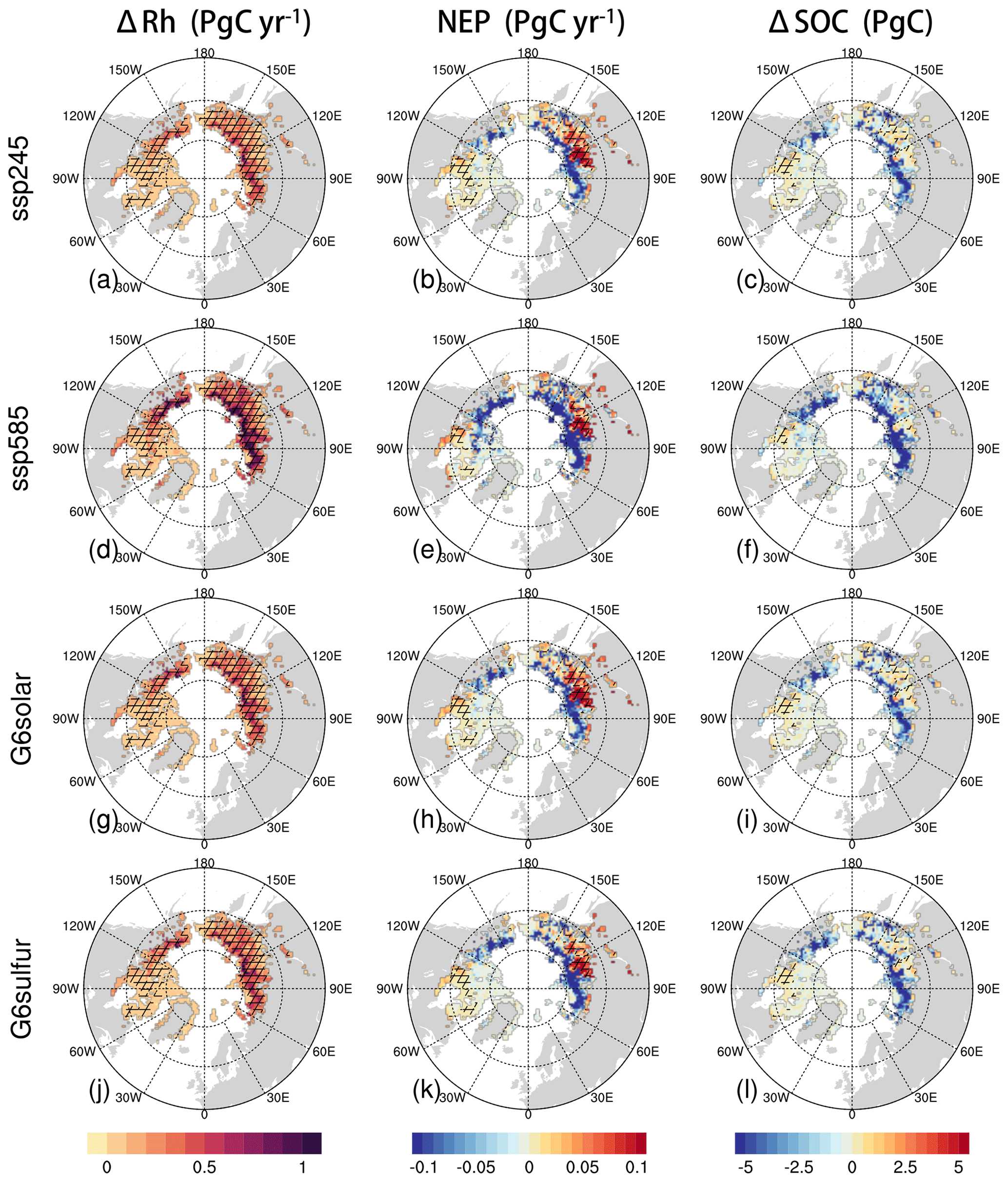
Figure 6The multi-model mean changes in *R*h (left column) and soil carbon
storage (right column) averaged for the period 2080–2099 under ssp245,
ssp585, G6solar, and G6sulfur relative to the baseline period 1995–2014
over the baseline permafrost region in the anomaly-forcing CLM5
simulations. The middle column shows NEP for the period 2080–2099. The
hatched area indicates where the sign of the plotted field is the same for
the anomaly-forcing CLM5 simulations and corresponding ESM simulations in
terms of multi-model mean.

*Source: European Geosciences Union *

--
You received this message because you are subscribed to the Google Groups
"geoengineering" group.
To unsubscribe from this group and stop receiving emails from it, send an email
to [email protected].
To view this discussion on the web visit
https://groups.google.com/d/msgid/geoengineering/CAOyeF5taxRZxwu3pq5Jcp5_YSCVW7CHBZQQy5LrM7%3D3dk7io%3Dg%40mail.gmail.com.