https://tedcross.substack.com/p/the-case-for-geoengineering-solar
*By Ted Cross (Unearthed)*

*27 April 2023*

*Welcome to the twenty-one new subscribers who have joined Unearthed since
the last post! Today, we have a doozy lined up: Geoengineering.*
<https://substackcdn.com/image/fetch/f_auto,q_auto:good,fl_progressive:steep/https%3A%2F%2Fsubstack-post-media.s3.amazonaws.com%2Fpublic%2Fimages%2F0612ce79-220c-48e2-840d-adcd35ddbf2b_695x532.png>

Geoengineering entails the intentional modification of earth’s climate for
human purposes, such as stopping global warming or preventing an ice age.
But, dear reader, this is not a topic for polite cocktail party chatter,
because an intentional intervention into the Earth’s climate is seen as
highly controversial, especially within environmental circles. So why are
top scientists from institutions like Harvard, MIT, and Columbia publicly
arguing for more research into the topic?

After a canny rebranding as “solar radiation modification”, the case for
geoengineering goes like this:

   1.

   Meeting Net Zero goals like the Paris Agreement will entail tremendous
   cost and economic sacrifice. The requirements for electrification alone
   look Sisyphean: how will we possibly be able to double world copper supply
   in the next 10-15 years? What about cobalt
   <https://tedcross.substack.com/p/the-goblin-metal-cobalt-and-the-curse>,
   or lithium?
   2.

   Even if we do meet our goals for electrification, we will struggle to
   meet Net Zero because of the challenge of carbon dioxide removal. This is
   required to offset certain sectors like international air travel for which
   there is no plausible alternative. We simply do not have the technology to
   deliver the needed offsets at scale, at cost.
   3.

   Even if we did manage to hit those targets, with carbon dioxide removal
   at scale, we still face significant risks for passing certain “tipping
   points” like the destabilization of the Greenland Ice Sheet, melting
   permafrost, or changes in North Atlantic ocean circulation.
   4.

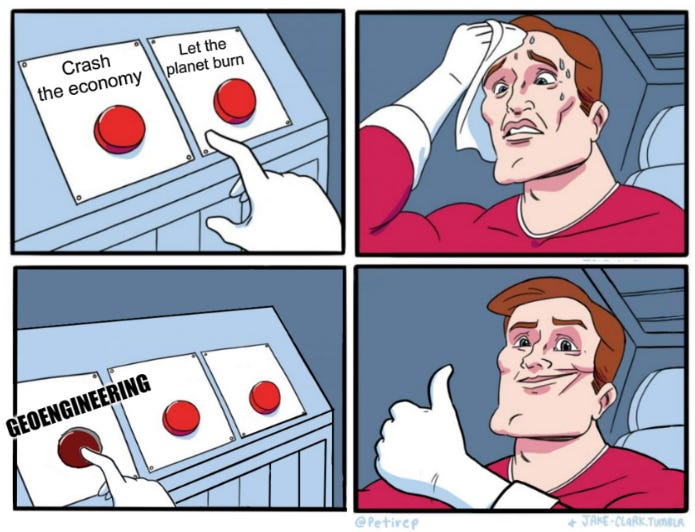
   So what do we do? We can buy ourselves time, cheaply and at scale, by
   mitigating solar radiation through natural solutions like stratospheric
   aerosols or cloud brightening.
   1

<https://tedcross.substack.com/p/the-case-for-geoengineering-solar#footnote-1-116751611>

Solar radiation management is one of those things that provokes guttural
reactions in folks, so I would ask for your patience as I walk through the
above arguments.


The Challenges of Achieving Net Zero GoalsCan we even achieve Net Zero by
2050 if we try? The IMF has identified mining capacity as a tremendous
challenge to climate goals
<https://www.imf.org/en/Blogs/Articles/2021/11/10/soaring-metal-prices-may-delay-energy-transition>,
with the soaring demand required to electrify everything likely leading to
price spikes for critical materials. As Daniel Yergin
2
<https://tedcross.substack.com/p/the-case-for-geoengineering-solar#footnote-2-116751611>
 writes in the WSJ
<https://www.wsj.com/articles/net-zero-will-mean-a-mining-boom-electric-cars-minerals-oil-fossil-fuels-climate-change-policy-cb8d5137?mod=Searchresults_pos1&page=1>
,

…translating the 2050 net zero goals into the equipment and technologies
that will be needed—electric-vehicle batteries and charging stations,
offshore wind, onshore wind, solar panels, battery storage, etc.—adds up to
a doubling of the need for copper by the mid-2030s.

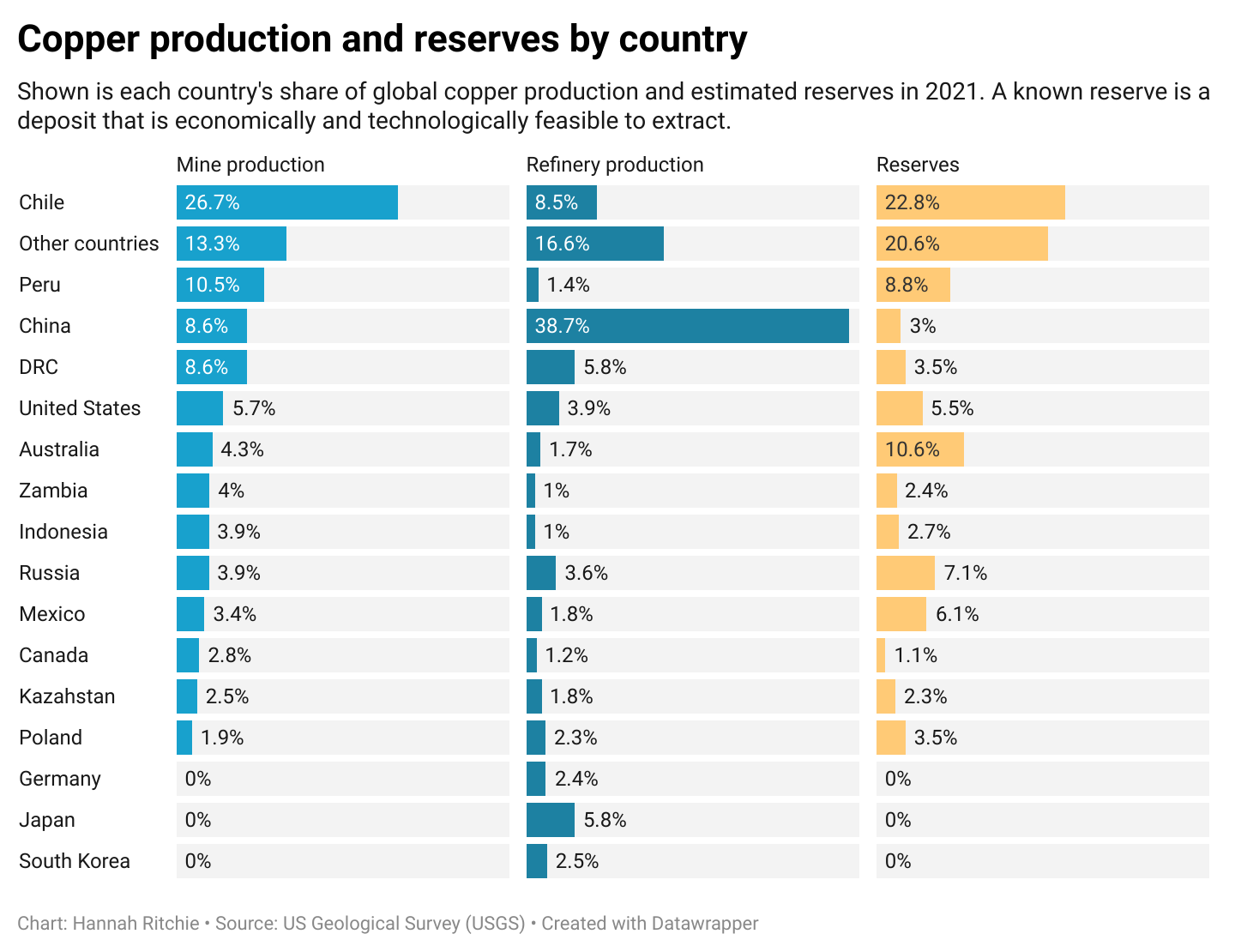
Doubling copper production is no easy task, especially not by the
mid-2030s. Copper mines can take 15-20 years to develop. Current copper
production is dominated by Chile, Peru, China, and the Congo. With the
current political instability in Chile and Peru, our *existing* copper
supply isn’t certain, to say nothing of unprecedented growth.
<https://substackcdn.com/image/fetch/f_auto,q_auto:good,fl_progressive:steep/https%3A%2F%2Fsubstack-post-media.s3.amazonaws.com%2Fpublic%2Fimages%2F2c92ab60-69c1-4ac1-ae04-e113dbfe6989_1440x1110.png>

Even in stable, business-friendly countries like Australia, the US, and
Mexico, passing the permitting process and securing agreements from local
stakeholders has become harder and harder for major new mining projects.

Beyond the copper production issue, there are also major questions about
production of lithium, cobalt, and rare earths. The processing supply
chains for these minerals often go through China, even if the resource
itself is produced elsewhere.
Carbon Dioxide Removal

Transitioning to renewables and electric vehicles is only one part of
achieving Net Zero by 2050. We also have to scale up Carbon Dioxide Removal.

I’ll let Prof. David T. Ho explain from his recent
<https://www.nature.com/articles/d41586-023-00953-x>*Nature
<https://www.nature.com/articles/d41586-023-00953-x>* article
<https://www.nature.com/articles/d41586-023-00953-x>:

Carbon dioxide removal (CDR) is what puts the ‘net’ into ‘net zero
emissions’. All pathways to limit global warming to 1.5–2 °C above
pre-industrial levels that have been assessed by the Intergovernmental
Panel on Climate Change require rapid decarbonization to start now. But
they also require the removal of CO2 from the atmosphere because we won’t
be able to eliminate carbon emissions entirely on the required time scales.
‘Hard to abate’ sectors such as aviation and shipping will remain large
sources of greenhouse gases even in the most optimistic scenarios.

The Biden administration’s planned Direct Air Capture (DAC) hubs are
expected to be able to remove a million tons of CO2 a year—each. While that
sounds like a staggeringly large number (I mean, it is pretty impressive),
it’s only a drop in the bucket against the 40.5 billion tons emitted in
2022. So each DAC hub would offset 13 minutes of global emissions, meaning
we would need over 40,000 to offset 2022. At just under a billion dollars
each…. that’s quite the expense.

Now, of course we can expect dramatic cost improvements through time. But
Professor Ho, a specialist in carbon capture and the carbon cycle, argues
that we simply will not be able to build these fast enough to meet net zero
goals. His conclusion is thus that we need to decarbonize faster, though
another clear line of thought is that we need other, cheaper, more scalable
methods for offsetting warming.
Climate Change Tipping Points

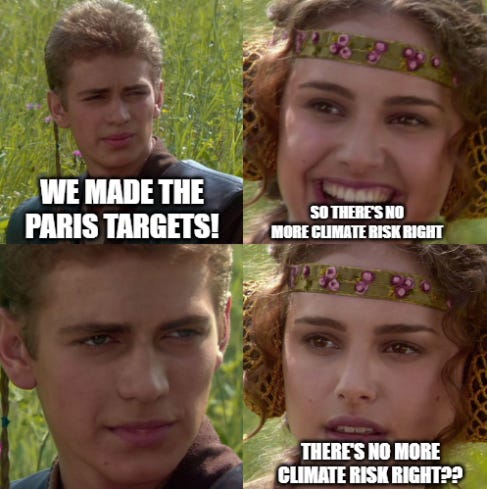
Let’s pretend for a minute that we do manage to hit Net Zero by 2050. We
won’t get crushed by climate change, right? …. right??
<https://substackcdn.com/image/fetch/f_auto,q_auto:good,fl_progressive:steep/https%3A%2F%2Fsubstack-post-media.s3.amazonaws.com%2Fpublic%2Fimages%2Fa97da04f-86a4-440d-bbe8-b099740bf8de_487x489.png>

The Earth’s climate is an incredibly chaotic, difficult-to-model system, in
part thanks to feedback loops. I remember learning about the bewildering
complexity of these in my undergraduate paleoclimatology class. For
example: the planet warms, so glaciers and ice sheets melt. This exposes
bare rock or water, which are both more absorptive of sunlight than ice, so
the planet warms more. The reverse is also true: ice buildups make the
earth more reflective, which further cools it. There are many such feedback
loops, both positive (which accelerate change) and negative (which slow
change).

Much of the risk of climate change is not simply in higher temperatures,
but in triggering a catastrophic feedback loop after passing some tipping
point. Following our above example, if the Greenland Ice melts, we would
face further warming, plus 23+ feet of global sea level rise.

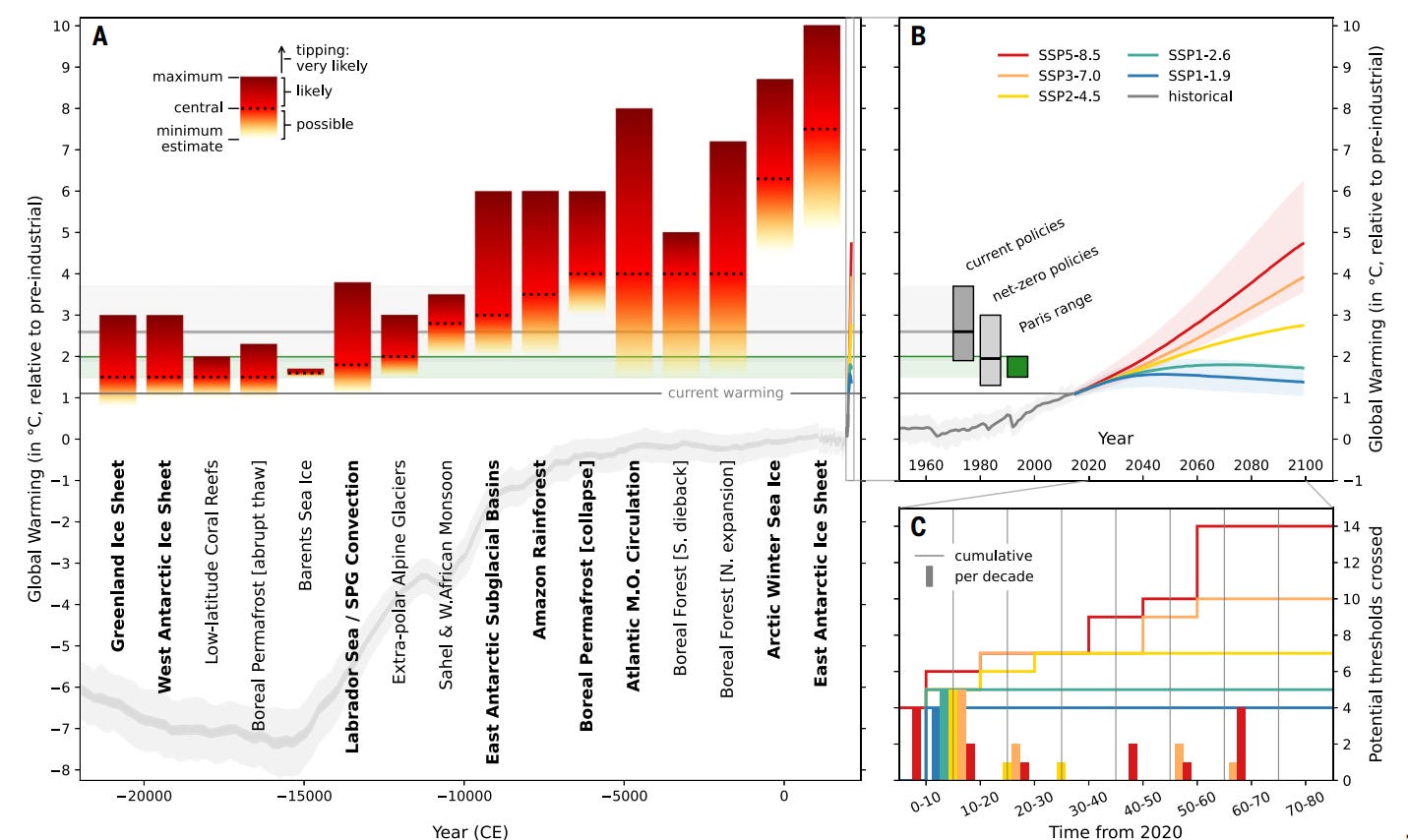
A paper in  <https://www.science.org/doi/10.1126/science.abn7950>*Science
<https://www.science.org/doi/10.1126/science.abn7950> *from last fall
argues that even hitting Net Zero goals to keep warming to 1.5-2°C still
carries significant risk of hitting global tipping points
3
<https://tedcross.substack.com/p/the-case-for-geoengineering-solar#footnote-3-116751611>
. Here is the key graphic. The bar charts show modeled risk envelopes for
different tipping points. The green line shows 2°C warming (which is not
even the upper end of Paris targets). Note that that line is above the
likely tipping point for multiple tipping elements.
<https://substackcdn.com/image/fetch/f_auto,q_auto:good,fl_progressive:steep/https%3A%2F%2Fsubstack-post-media.s3.amazonaws.com%2Fpublic%2Fimages%2Fc309d62a-fa2b-46f2-9c53-fdeb95634d75_1431x854.png>McKay
et al., 2022. *Exceeding 1.5°C global warming could trigger multiple
climate tipping poin*ts. Science.

This gets us to the most persuasive argument for solar radiation
management: *even if we manage to limit warming to 2*°C*, we may still face
catastrophe**.*
The case for Solar Radiation Modification

If we are unable to stop sufficient warming with energy transition or
carbon dioxide removal, we can still offset warming with other methods,
chiefly by making the earth’s atmosphere more reflective to incoming solar
radiation. Over 100 brave scientists have published a letter
<https://climate-intervention-research-letter.org/> arguing for more
research into just how we might accomplish that. The list includes
distinguished professors from the atmospheric sciences, physics, oceanic
studies, and geosciences across the globe, at institutions including MIT,
Harvard, Columbia, the University of Washington, Oxford, the Sorbonne, and
IIS — to name a few.

Their argument follows these simple points:

   -

   The world will continue to warm even if we were to stop emissions today,
   due to the delayed response between CO2 and warming.
   -

   Existing aerosol emissions *already* offset CO2 warming, and we have
   high confidence in their ability to do so at scale, even if we need to do a
   lot more research about how to do that in practice.
   -

   We will not be able to get carbon dioxide removal to scale in time.
   -

   Solar radiation modification, such as stratospheric aerosol injection,
   would likely be incredibly effective and scalable.
   -

   Because of the efficacy of SDRs, we need to research them, today,
   because of their potential impacts, globally and locally.

I will add something that the authors don’t mention: *stratospheric aerosol
injection would be cheap*. Really, really cheap—at least compared to other
methods of reducing warming. Why would it be cheap? You just put some
sulfates into airplanes or rockets or balloons, and launch them into the
stratosphere. That’s it!!! Essentially, you mimic the natural cooling
effect of volcanic eruptions
<https://earthobservatory.nasa.gov/images/1510/global-effects-of-mount-pinatubo#:~:text=In%20the%20case%20of%20Mount,effect%20on%20the%20Earth's%20surface.>,
which are well-studied and well-known. And the effects are reversible — the
aerosols slowly fall out of the atmosphere.

We need more research, but let’s take one ballpark figure from a Harvard
study <https://iopscience.iop.org/article/10.1088/1748-9326/aba7e7?s=09>:
$18 billion a year to offset each degree of warming. Yes, you read that
correctly! Compare that to the Inflation Reduction Act, which will rack up
between $500 billion and $1.2 trillion,
<https://www.wsj.com/articles/inflation-reduction-act-subsidies-cost-goldman-sachs-report-5623cd29>
and
is far from all the expenditure needed to stop warming.

Even if you are skeptical, solar radiation management can buy us time: time
to electrify, time to develop supply chains, time to develop new nuclear
technologies. Furthermore, the cost of sulfate aerosol injection is so low
that individual countries may find the cost-benefit analysis in their
favor. Would Bangladesh or another low-lying country find it a worthwhile
investment to reduce their flooding risk? We need research and global
coordination on this subject.
The radical middle

As I have thought through geoengineering over the years, I have never been
able to shake this simple conclusion:

*The larger the risk of climate change, the stronger the argument for
geoengineering.*

The corollary follows: *the more you believe in the risks of climate
change,* *the stronger you should be arguing for geoengineering.*

Even setting aside cost-benefit arguments, which are overwhelmingly tilted
in favor of solar radiation management, you will arrive at that conclusion
if you acknowledge the latent warming baked into our current CO2 levels and
the impossibility of immediately reversing our emissions.

So *why isn’t there more research into geoengineering*, let alone action?

The biggest arguments against geoengineering include the risk of changing
weather patterns or other unknown consequences. Indeed, we should expect
some minor changes, but compare these to the catastrophic risks of
continued warming. If anything, this is an argument for more research!

I think the resistance to geoengineering mostly comes not from a rigorous
risk-cost-benefit analysis, but instead something deeper. For some, taking
action on climate change is deeply convolved with action on other topics,
like fighting capitalism, colonialism, or inequality
4
<https://tedcross.substack.com/p/the-case-for-geoengineering-solar#footnote-4-116751611>
. Other groups are mentally (or even spiritually) invested in the idea of
the imminent apocalypse, from which only radical sacrifice can deliver us.
And of course, many groups stand to benefit from action on decarbonization,
including financiers, governments, and multinational corporations. It’s the
classic “baptists and bootleggers” combination — true believers allied with
opportunists
5
<https://tedcross.substack.com/p/the-case-for-geoengineering-solar#footnote-5-116751611>
. For these groups, the possibility that climate change could be mitigated
cheaply and effectively represents an existential risk.

I have to applaud the scientists for signing their Solar Radiation
Modification Action Letter. Beyond taking on the unholy baptists and
bootleggers alliance, these scientists are also facing the taboo against
intentional modification of the climate.

Solar radiation modification simply *must be discussed.* We have modified
the climate for thousands of years, through agriculture, grazing, and
city-building. We have burned wood, grasslands, peat, coal, gas, and oil.
We have released various chemicals, intentionally or not, that have altered
our atmosphere and ozone layer. Compared to all those actions, temporarily
putting a small amount of sulfate aerosols into the atmosphere, mimicking
common volcanic eruptions, is natural, effective, and sensible.

I hope you have found this post informative, at a minimum. If you can,
please give it a like, a comment, or share with someone you think needs to
hear about it. It will help others learn about this critical subject.

Of course, there are other thing we can do, though my focus here is on
geoengineering. We can build our resiliency to climate change and extreme
events with improved global wealth and robust infrastructure. We could
increase investment in new technologies for energy production. We could
accept increased risk levels as less costly than the alternatives. We could
deindustrialize and reduce living standards. Personally, I am in the camp
of technology, resiliency, and probably some geoengineering.
2
<https://tedcross.substack.com/p/the-case-for-geoengineering-solar#footnote-anchor-2-116751611>

Vice-chair of S&P Global and generally renowned energy expert and economic
historian. Also author of *The Prize*, which is required reading for anyone
in the oil industry.
3
<https://tedcross.substack.com/p/the-case-for-geoengineering-solar#footnote-anchor-3-116751611>

This presentation has been receiving a lot of attention recently thanks to
a presentation at Davos and the associated social media push. I recommend
looking at this video, which is a little doomery for me, but gives you an
idea:
https://www.linkedin.com/posts/world-economic-forum_wef23-activity-7055420048441516032-GbFU?utm_source=share&utm_medium=member_desktop

Note: be wary of any presentation with a scary map!!
4
<https://tedcross.substack.com/p/the-case-for-geoengineering-solar#footnote-anchor-4-116751611>

For the pessimistic version, take the recent Harper’s Magazine article
<https://harpers.org/archive/2022/12/apocalypse-nowish/>, *Apocalypse
Nowish.* Key quote: “We could build a free society that doesn’t view the
planet as a profit engine. I just really doubt that we will. Climate
disaster, economic collapse, war, resurgent fascism and nationalism,
assaults on basic political freedoms, mass violence: all these mutually
reinforcing in a sinister feedback loop, the structural stresses of
capital’s death throes accelerating ecological catastrophe and exacerbating
reactionary forces, which in turn further stress the structure.” Oof.
5
<https://tedcross.substack.com/p/the-case-for-geoengineering-solar#footnote-anchor-5-116751611>

For more, see the 2022 Unearthed Book of the Year, *Where is My Flying
Car, *by J. Storrs Hall.


*Source: Substack *

--
You received this message because you are subscribed to the Google Groups
"geoengineering" group.
To unsubscribe from this group and stop receiving emails from it, send an email
to [email protected].
To view this discussion on the web visit
https://groups.google.com/d/msgid/geoengineering/CAHJsh9_9Z-ZPOA8zuU236eNbVapEVvwggBG8zY7%3DjfcsoAqP9A%40mail.gmail.com.