https://www.rff.org/publications/working-papers/eliciting-mental-models-for-understanding-reasoning-for-and-against-solar-geoengineering-research/
*May 30, 2023*

*Authors*
Dale S. Rothman, Payam Aminpour, Ilan Chabay, and Jennifer Helgeson

*Publication*
Working Paper

In this paper, the authors develop a fuzzy cognitive map based on the
thinking of 10 experts on solar geoengineering.
Introduction

Solar geoengineering (SG) is a potential approach to reducing global
climate change impacts by counteracting radiative forcing change driven by
increased atmospheric concentration of greenhouse gases (GHGs). This
negative radiative forcing can be produced in many ways, such as painting
roofs white, modifying cloud properties, or installing mirrors in space.
Stratospheric aerosol injection (SAI), where small reflecting particles are
injected into the stratosphere, may be the most feasible and globally
effective approach (NASEM 2012). This is also why it draws the most
attention and stronger disagreements. SAI (henceforth SG) is the focus of
this study. There has been no formal global debate on this topic, with
discussions confined to conference and workshop meetings with limited
international and sectoral representation.

Most people would agree that SG should not be deployed in the near term.
The technology has not reached the stage where it can be seriously
considered, and many fundamental questions, both technical and social,
remain unanswered (NASEM 2012). However, a debate has arisen about whether
we should even use resources to research SG. In the present study, we
explore the latter question by examining expert reasoning concerning SG
research.

Looking at information as a commodity that reduces uncertainty, economists
would suggest that the value of any information is nonnegative. As such,
using an extension of the widely used dynamic integrated assessment model
of climate and economy (DICE), Harding et. al (2022) estimate that the
value of information about the effectiveness of SG is as large as that
about equilibrium climate sensitivity (Harding 2022). They also show that
over- and underconfidence about SG are equally harmful. NASEM (2012) calls
for cautious exploration of SG, which is a recurring theme in discussions
of SG research, rooted in concerns around its procedural aspects and
consequences.

Opposition to SG research takes various forms. Some opponents suggest that
SG is either not needed or unacceptable under any circumstance, so research
is unnecessary (Biermann 2021). A related concern, referred to as the
“slippery slope,” states that research itself increases the likelihood of
SG deployment. This is due, in part, to potential technological and
institutional lock-in, whereby unnecessary and unwarranted deployment may
emerge from research. Similarly, they suggest that research conducted
largely by the Global North would only preserve current inequalities in the
world (Stephens 2020) and further concentrate power among elites (Stephens
and Surprise 2021). Perhaps the most common argument against SG research is
the possibility that even research alone would reduce efforts toward
emissions abatement (Stephens et al. 2021).

In the context of the ongoing climate crisis, proponents of SG research
urge governments to evaluate all action options, including SG (Give
Research into Solar Geoengineering a Chance 2021). They do share several of
opponents’ concerns. Rather than forgoing research, however, they encourage
capacity building in developing countries and argue for a responsible
international program (Keith 2017). Others suggest that the research
program should include safeguards to prevent unwarranted deployment,
including explicit conditions under which deployment is justifiable
(Jamieson 1996). As for deterring emissions abatement, the counterargument
states that SG research may change the perception of how serious climate
risks are, triggering an increase in emissions abatement. In addition,
proponents suggest that even if emissions deterrence occurred, it would be
characterized by increased overall welfare. Finally, proponents argue that
a better understanding of not only the technical but also social,
political, and economic aspects of SG may improve decisionmaking if, and
when, deployment is ever considered. Suppressing SG research may not
prevent future deployment but rather make it less informed and more
dangerous (Parson 2021).

Both sides have some points of agreement, such as the importance of an
international governance mechanism that is just and inclusive. However,
expectations differ significantly. While many proponents believe
international governance would emerge from multilateral agreements and
informal scientific cooperation, many opponents argue that democratic and
fair governance of SG is unattainable (NASEM 2012). Finally, not all
opponents argue for an unconditional moratorium on research. Instead, they
propose a set of conditions that must be satisfied. For example, Biermann
and Möller (2019) suggest that developing countries should lead the
discourse on SG research. Jamieson (1996) calls on the United Nations to
govern SG research that otherwise may be militarized or securitized.

In a nutshell, both opponents and proponents share many concerns; however,
they arise from different base assumptions and reasoning. In addition, both
are typically driven by the principle of precaution, but their
interpretations and conclusions diverge. This warrants an in-depth study of
the underlying reasoning about SG research.

Another important caveat regarding the debate is the difference between
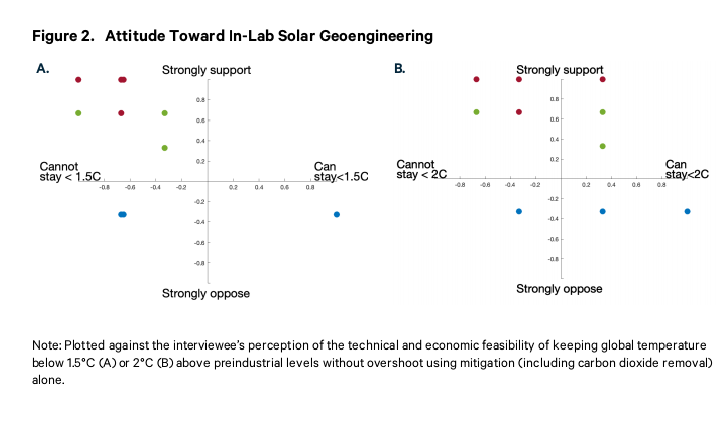
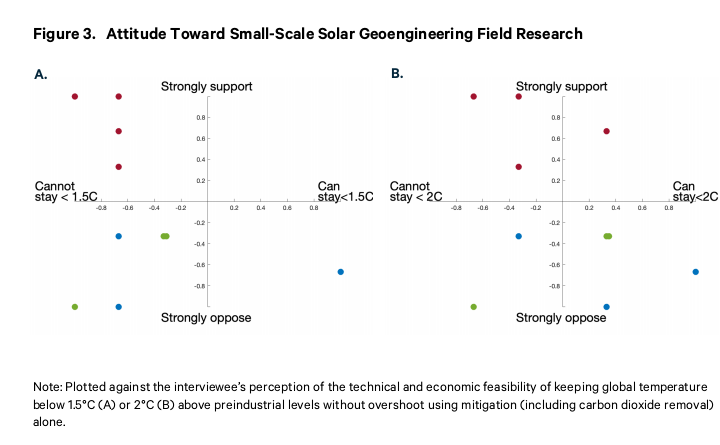
in-lab and small-scale field SG research. By “in-lab research,” following
Parson and Keith (2013), we mean computer simulations, chemistry
experiments in controlled laboratories, and social and political science
research. By “small-scale field research,” we mean activities with trivial
and only local environmental impact that is smaller than common commercial
activities. Thus, the debate is not just between opponents and proponents
of SG research, but between three groups: (a) those who support both types
of research, (b) those who support only in-lab research under current
circumstances, and (c) those who oppose both types.

In the present paper, we extend the existing analyses of the arguments for
and against SG research by having 10 experts complete a questionnaire,
which is used to create a fuzzy cognitive map (FCM) of their thinking
related to this topic. This is followed by an online interview, in which
the initial maps are presented, discussed, refined, and “verified.” Our
contributions are twofold. First, ours is the first study to employ fuzzy
cognitive mapping to analyze attitudes toward SG research. Second, we
explicitly distinguish and systematically compare attitudes toward in-lab
and small-scale field research. Discussions concerning SG do not always
consider these separately. In some cases, arguments are put forward
for/against both in-lab and small-scale field research, although not stated
so explicitly.

The remainder of the paper is organized as follows. The following section
details our methodology. Section 3 presents (preliminary) results
accompanied by a discussion.


<https://substackcdn.com/image/fetch/f_auto,q_auto:good,fl_progressive:steep/https%3A%2F%2Fsubstack-post-media.s3.amazonaws.com%2Fpublic%2Fimages%2Fd902ace9-dea0-488e-8031-69e4d992f278_717x427.png>
<https://substackcdn.com/image/fetch/f_auto,q_auto:good,fl_progressive:steep/https%3A%2F%2Fsubstack-post-media.s3.amazonaws.com%2Fpublic%2Fimages%2F47e554a6-bf8f-441c-be2e-d4a1d625b08b_720x445.png>
<https://substackcdn.com/image/fetch/f_auto,q_auto:good,fl_progressive:steep/https%3A%2F%2Fsubstack-post-media.s3.amazonaws.com%2Fpublic%2Fimages%2F05834b34-2ebd-4cbf-b590-578b0ff7cdb4_621x482.png>

*Source: RFF*

--
You received this message because you are subscribed to the Google Groups
"geoengineering" group.
To unsubscribe from this group and stop receiving emails from it, send an email
to [email protected].
To view this discussion on the web visit
https://groups.google.com/d/msgid/geoengineering/CAHJsh99YdUefEe4T3NpHkymoue6zL8qDqEZ-raeFsF44PEe%3Dtw%40mail.gmail.com.