https://peteirvine.substack.com/p/are-srm-scientists-boosters-or-blockers
Are SRM scientists "boosters" or "blockers"?An analysis of prominent papers
and press releases found a bias towards exaggerating the risks and
downplaying the benefits of SRM, but the bias against SRM also works in
more subtle ways.

*By Pete Irivine*

*Substack: Plan A+*

*20 June 2023*

Are the scientists who study Solar Radiation Modification “boosters” as
some critics suggest
<https://www.tandfonline.com/doi/full/10.1080/00963402.2019.1654255?casa_token=xFfkrOFxtGIAAAAA%3AgvNj-9yVAU_zA41tvxrrbSUsDXOaRO8rFnhbNPFmQCAatU20r0yemZr4ONdHcjv6oeW96ML0AQYETA>?
Do they exaggerate its benefits while downplaying its risks, limitations
and the challenges it presents?

Do they instead display “an unusual self-reflexivity, as they are well
aware of and seriously consider all the technology’s risks” as one analysis
<https://www.sciencedirect.com/science/article/pii/S2214629614000346?casa_token=vJXXVk_s6KwAAAAA:WaeOGBTZIi4sWk-WjpNZmBy4XMb7ihOHVZxBYkc9v8Zb0vVKFLd6GC_BzyH8zhCO8uxZnKBTAM0>
of
the literature found?

Or would it be better to describe them as “blockers”, exaggerating the
risks, limitations and challenges, while downplaying its potential benefits?

There have now been hundreds of studies into the climate effects of
Stratospheric Aerosol Injection (SAI), authored by many tens of individual
scientists, and the picture is mixed. But taken together, it seems clear
that while most scientists and studies are in the self-reflexive middle,
there is some bias towards blocking and against boosting.

Share Plan A+
<https://peteirvine.substack.com/?utm_source=substack&utm_medium=email&utm_content=share&action=share>
Cases of exaggeration in SRM studies and press release

Jesse Reynolds, my co-host on the Challenging Climate Podcast
<https://www.challengingclimate.org/>, published an article last year
analyzing 9 cases where studies or their press releases distorted their
findings to paint an exaggerated picture of the risks and limitations of
SRM. He attempted to find similar cases where the benefits had been
exaggerated, but could not
1
.

Let’s take a look at some of his examples, which all focus on Stratospheric
Aerosol Injection (SAI).
SAI “disrupts” the monsoons and the food supply for billions

Robock et al. (2008)
<https://agupubs.onlinelibrary.wiley.com/doi/full/10.1029/2008JD010050> is
a landmark study in the field. It was the first climate model simulation of
SAI that actually injected sulphate into the model’s stratosphere, and it
made an enormous scientific contribution to the field. It also has had an
enormous impact on the public discussion of SAI because of this line in the
abstract:

*"Both tropical and Arctic SO2 injection would disrupt the Asian and
African summer monsoons, reducing precipitation to the food supply for
billions of people."*

This statement is not wrong, but it is rather leading. The use of evocative
language (“disrupt”), rather than a quantitative description of the
findings, leaves it up to the reader’s imagination how large this reduction
is. The important context that climate change is expected to intensify
monsoon precipitation in these regions is also not mentioned. And the
reference to the "food suply for billions of people” insinuates that there
might be famine, though no analysis of crop productivity is conducted.
SAI (greatly reduces, but) fails to elimate risk of stratocumulus collapse

Schneider et al. (2019) <https://www.nature.com/articles/s41561-019-0310-1> was
the first study to identify a potential atmospheric tipping point that
could accelerate warming in marine stratocumulus clouds. Marine
stratocumulus clouds are low, bright clouds that occur in large patches off
of the continents in the sub-tropics and have a significant cooling effect.

In a small-scale, cloud resolving model Schneider et al. found that very
high CO2 concentrations (>1200 ppmv or >4x preindustrial, compared to
today’s ~1.5x) could lead to a collapse of marine strato-cumulus clouds.
They extrapolated from their findings to the global level and suggested
this collapse could add substantially to global-mean temperatures
2
.

Schneider et al. (2020)
<https://www.pnas.org/doi/abs/10.1073/pnas.2003730117> repeated this study
but with idealized SRM and found that CO2 concentrations would need to
reach even more extreme levels (>1700 ppmv or >6x preindustrial) to lead to
a collapse of the clouds and in this case would lead to a smaller rise in
temperatures. However, their study didn't make this comparison, focusing on
the fact that SRM fails to prevent this tipping point. Their plain language
summary then misleadingly states that SRM “does not mitigate risks to the
climate system that arise from direct effects of greenhouse gases on cloud
cover”
(Sudden changes in) SAI deployment is bad for biodiversity

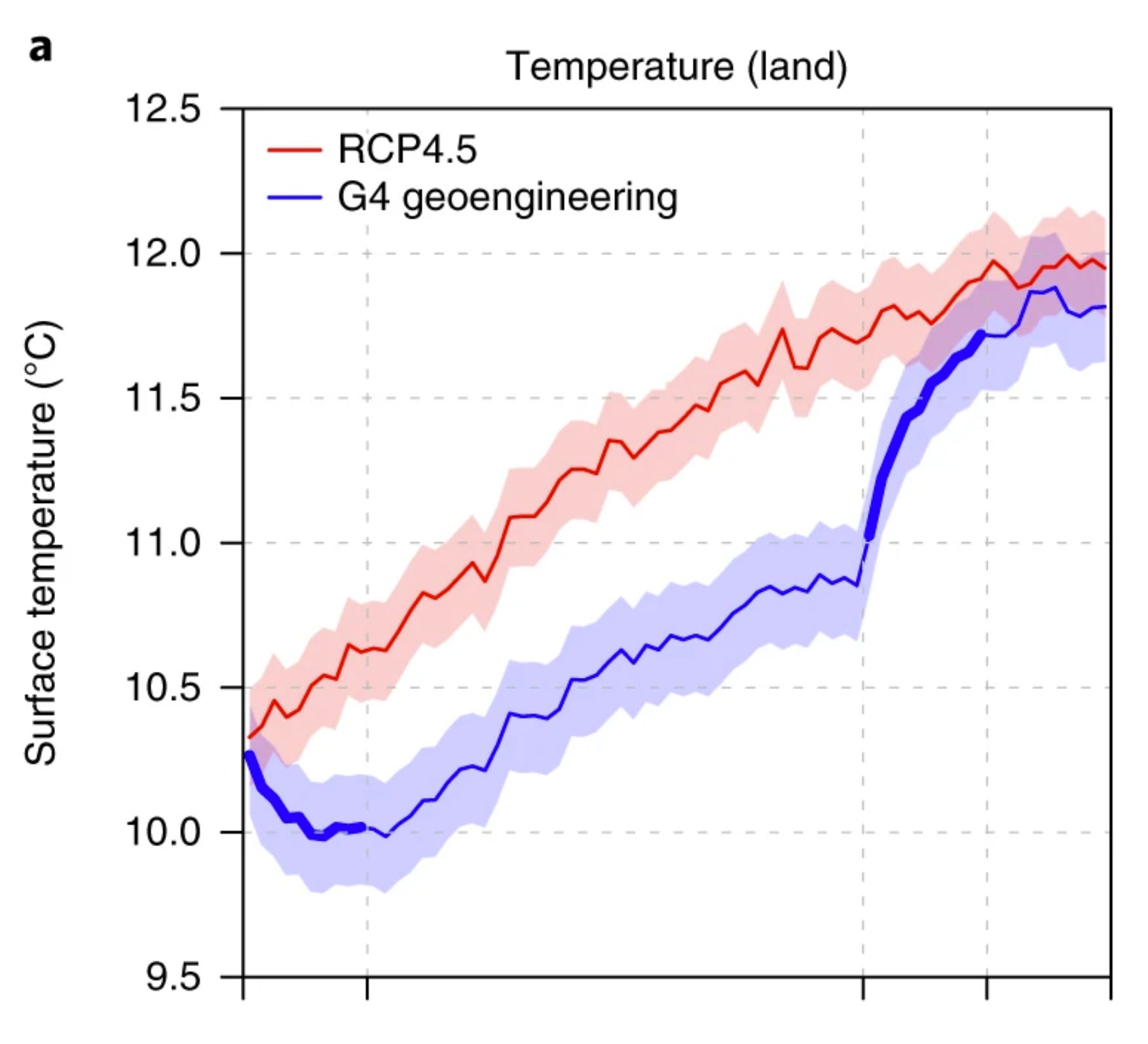
Trisos et al. (2018) <https://www.nature.com/articles/s41559-017-0431-0> report
on the biodiversity impacts of the GeoMIP G4 simulations, an idealized case
where SAI is suddenly turned on and then later turned off. They apply an
environmental niche approach, which assumes that species and ecosystems
thrive within a certain limited range of climate conditions and that if
those conditions change they will be stressed.

They finds that if SAI were deployed continually it would greatly reduce
the magnitude of climate change and its rate of change, reducing the stress
that ecosystems face. While their abstract states that they “assess the
effects of the rapid implementation, continuation and sudden termination of
geoengineering…,” their abstract only reports on the sudden initiation and
sudden termination, highlighting the risks this could pose. Their press
release amplifies and generalizes their claim: "Researchers from the US say
deliberately changing Earth’s climate is more dangerous to ecosystems than
global warming is likely to be..."
<https://substackcdn.com/image/fetch/f_auto,q_auto:good,fl_progressive:steep/https%3A%2F%2Fsubstack-post-media.s3.amazonaws.com%2Fpublic%2Fimages%2F4362836e-6b90-4275-ad5e-2652c5ab57a4_1753x1594.png>

*Figure 1. Shows the global temperature response to the RCP4.5 and G4
scenarios. Figure 1a from Trisos et al. (2018
<https://www.nature.com/articles/s41559-017-0431-0>).*
(Assymetric) SAI could have devastating hydrological impacts

Haywood et al. (2013) <https://www.nature.com/articles/nclimate1857> evaluated
the impact of adding sulphate aerosols into a single hemisphere (whether
from a volcano or as a deployment strategy for SAI) and found substantial
shifts in tropical rainfall towards the uncooled hemisphere. Every year the
Inter-Tropical Convergence Zone (the intense band of rain in the tropics)
tracks the “thermal equator” of the planet, shifting into the warmer
hemisphere in its respective summer. Haywood et al. found that a Northern
Hemisphere-biased aerosol layer would cause a substantial reduction in
rainfall in the Sahel, which could have substantial societal and ecosystem
impacts.

Jones et al. (2017)
<https://www.nature.com/articles/s41467-017-01606-0> followed
up on this study to evaluate the impact of single-hemisphere SAI on
tropical cyclones. They found that northern-hemispheric SAI would suppress
northern hemisphere tropical cyclones, but lead to those substantial shifts
in rainfall patterns noted above. The measured statements in the paper are
not matched in the press release which generalizes from assymetric SAI to
SAI in general and makes strong policy demands:

*"(SAI) could have a devastating effect on global regions prone to either
tumultuous storms or prolonged drought... the team of researchers have
called on policymakers worldwide to strictly regulate any large scale
unilateral geoengineering programmes ..."*
Some other forms of bias in SRM science

Jesse’s study
<https://journals.sagepub.com/doi/full/10.1177/20530196221095569> does a
great job of exploring the biases in particular SRM publications and their
press releases, and if you want to see more case studies or to read his
discussion of the potential drivers for this bias, its well worth checking
out.

Like Jesse, I couldn’t identify any examples from memory where studies of
SAI had exaggerated their benefits, though it is important to note that
there have been many media articles exaggerating its benefits. However,
unlike the press releases prepared for their studies, the framing adopted
in media coverage is beyond the direct control of researchers.

Jesse’s analysis is important but it doesn’t tell the whole story. I think
it’s fair to say that the bias against SRM in climate science runs much
deeper than a skew towards blocking and away from boosting in studies on
SRM and in their press releases. However, many of these forms of bias are
harder to spot.
Burying the good news on SRM

Jesse focused on the exaggerations in published studies and press releases
that had a notable impact on the public discussion of SRM. However, its
practically impossible to spot when researchers choose not to publicize
findings that could be media worthy.

In the early 2010s, I remember most of us working on the climate response
to SAI were surprised (and unsettled) by how well it seemed to work. While
it was clear early on that it had a modest impact on stratospheric ozone,
and imperfectly offset regional rainfall changes, it still reduced the
overall magnitude of rainfall changes. We were all poring over our results
trying to find out if a deal-breaking problem existed.

I remember reading a dry, technical study on the climate effects of SAI in
the mid-2010s that focused on a key potential area where a deal-breaker
might be lurking. They found that SAI was again highly effective at
offsetting the effects of climate change. I thought this was a really big
deal and was surprised that they weren’t making a bigger deal of it.

When a co-author of that paper visited the research institute that I worked
at, they admitted that they were hoping to find negative results and would
have promoted those if they did. They could have potentially presented
their results in a higher impact journal and promoted it with a press
release, but the fact they had broader concerns about SAI led them to bury
their findings where only technically-minded colleagues would find them.

It’s impossible to know how widespread this kind of bias against promoting
good news on SRM is, but I suspect there are several other such examples.
Withholding expertise from SRM

The scientific models, tools, and expertise needed to assess SRM are the
same as those needed to assess climate change. As such, the SRM scientific
community is a sub-set of the broader climate science community. While the
publications on SRM taken together exhibit some bias towards blocking and
away from boosting, it is much harder to see the bias against publishing or
contributing in the first place.

Around the same time as the previous anecdote, I was preparing for an
expert elicitation project on sea-level rise (that never materialized) and
I was arranging meetings with sea-level rise experts. I remember meeting
with one expert and he was clear: he didn’t want to participate as it was
obvious to him that SAI would be highly effective at offsetting sea level
rise. Like the other researcher mentioned before, he had other concerns
about SAI and didn’t want to be involved in work that could make it look
good.
Blocking funding, publication and hiring?

Publication, funding, and hiring decisions are made or strongly influenced
by senior scientists. As it would be very hard to demonstrate biases in
such decision-making, I will let the reader make their own speculations
about the extent to which senior researchers in a field work to promote
ideas they favour and suppress those they dislike.

I’ll also leave it to the reader to guess which way such a bias, if it
exists, leans in this case. However, I will note that several colleagues
I’ve spoken to were warned in no uncertain terms that if they were to focus
their research on SRM it would be career suicide. Several of them took this
advice and relayed it on to me.
Is SRM science being boosted or blocked?

Most of the scientific work on SRM is carried out carefully and
even-handedly, and the researchers involved are well aware of the broader
risks and challenges it raises. This consciousness of the broader
challenges of SRM means that no studies I’m aware of exaggerate SRM’s
benefits or downplay its risks
3
. However, as Jesse demonstrates
<https://journals.sagepub.com/doi/full/10.1177/20530196221095569> some
studies do the opposite, exaggerating its risks and downplaying its
benefits.

As I’ve suggested, the bias against SRM operates not only in the published
literature where it can be seen, but it is likely also working behind the
scenes where it is much less obvious. Researchers who are biased against
SRM can bury good news, withold their expertise and tools, advise junior
colleagues against studying the topic, and can influence publication,
hiring and funding decisions.

As a result of all this, the picture of SRM’s risks and benefits that a
casual observer gets from following the media coverage is distorted. Far
from SRM scientists acting as boosters for this idea, the reluctance of
some and the opposition of others, is blocking the public and policymakers
from forming a clear picture.

I have hope that in the coming years an objective assessment of SRM’s risks
and benefits will be made, but in the mean-time I’ll leave you with a few
questions to ask yourself when reading the next piece of bad news on SRM:

   -

   Have they reported a seemingly dangerous trend under SRM, without
   comparing this against the trend under climate change?
   -

   Have they reported that SRM fails to achieve perfection, downplaying the
   fact that it greatly reduced risks?
   -

   Have they focused on the risks of an extreme scenario, where a more
   sensible one would avoid this risk?

*FIN*

Thank you for reading Plan A+. This post is public so feel free to share it.

Share
<https://peteirvine.substack.com/p/are-srm-scientists-boosters-or-blockers?utm_source=substack&utm_medium=email&utm_content=share&action=share&token=eyJ1c2VyX2lkIjoxMjUyMjU5NjAsInBvc3RfaWQiOjEyODk2MDg5NSwiaWF0IjoxNjg3MzQzOTgxLCJleHAiOjE2ODk5MzU5ODEsImlzcyI6InB1Yi0zNDg4NDkiLCJzdWIiOiJwb3N0LXJlYWN0aW9uIn0.n8w4F11wdI9jMdltcryIB95xOwzrLSWrLOGl7yAiyCQ>
1
<https://peteirvine.substack.com/p/are-srm-scientists-boosters-or-blockers#footnote-anchor-1-128960895>

If you have some examples, please reply letting me know.
2
<https://peteirvine.substack.com/p/are-srm-scientists-boosters-or-blockers#footnote-anchor-2-128960895>

It seems unlikely that we’ll ever reach atmospheric CO2 concentrations so
high, unless future generations make a strong commitment to rapidly
expanding coal use, as is assumed in the unrealistically high emissions
scenarios RCP8.5 and SSP5-8.5.
3
<https://peteirvine.substack.com/p/are-srm-scientists-boosters-or-blockers#footnote-anchor-3-128960895>

The fact that scientists studying SAI and most other forms of SRM have no
commercial interest in the idea is another important reason.

*Source: Substack*

--
You received this message because you are subscribed to the Google Groups
"geoengineering" group.
To unsubscribe from this group and stop receiving emails from it, send an email
to [email protected].
To view this discussion on the web visit
https://groups.google.com/d/msgid/geoengineering/CAHJsh9_dtucuepz5vs5D7UFtjUy65KHyz4s3x9C1rhjHVA3Lsg%40mail.gmail.com.