https://acp.copernicus.org/articles/23/8259/2023/
*Author*
Michael S. Diamond <[email protected]>
How to cite.

Diamond, M. S.: Detection of large-scale cloud microphysical changes within
a major shipping corridor after implementation of the International
Maritime Organization 2020 fuel sulfur regulations, Atmos. Chem. Phys., 23,
8259–8269, https://doi.org/10.5194/acp-23-8259-2023, 2023.

Received: 11 May 2023 – Discussion started: 22 May 2023 – Revised: 20 Jun
2023 – Accepted: 29 Jun 2023 – *Published: 25 Jul 2023*

*Abstract*

New regulations from the International Maritime Organization (IMO) limiting
sulfur emissions from the shipping industry are expected to have large
benefits in terms of public health but may come with an undesired side
effect: acceleration of global warming as the climate-cooling effects of
ship pollution on marine clouds are diminished. Previous work has found a
substantial decrease in the detection of ship tracks in clouds after the
IMO 2020 regulations went into effect, but changes in large-scale cloud
properties have been more equivocal. Using a statistical technique that
estimates counterfactual fields of what large-scale cloud and radiative
properties within an isolated shipping corridor in the southeastern
Atlantic would have been in the absence of shipping, we confidently detect
a reduction in the magnitude of cloud droplet effective radius decreases
within the shipping corridor and find evidence for a reduction in the
magnitude of cloud brightening as well. The instantaneous radiative forcing
due to aerosol–cloud interactions from the IMO 2020 regulations is
estimated as *O*(1 W m−2) within the shipping corridor, lending credence to
global estimates of *O*(0.1 W m−2). In addition to their geophysical
significance, our results also provide independent evidence for general
compliance with the IMO 2020 regulations.
Radiative forcing implications

Assuming that the Terra-based *r*e and *A*cld perturbations are dominated
by the Twomey effect as in D20, it is possible to estimate the
instantaneous radiative forcing due to aerosol–cloud interactions (IRFACI;
Forster et al., 2021) from the IMO 2020 regulations within the shipping
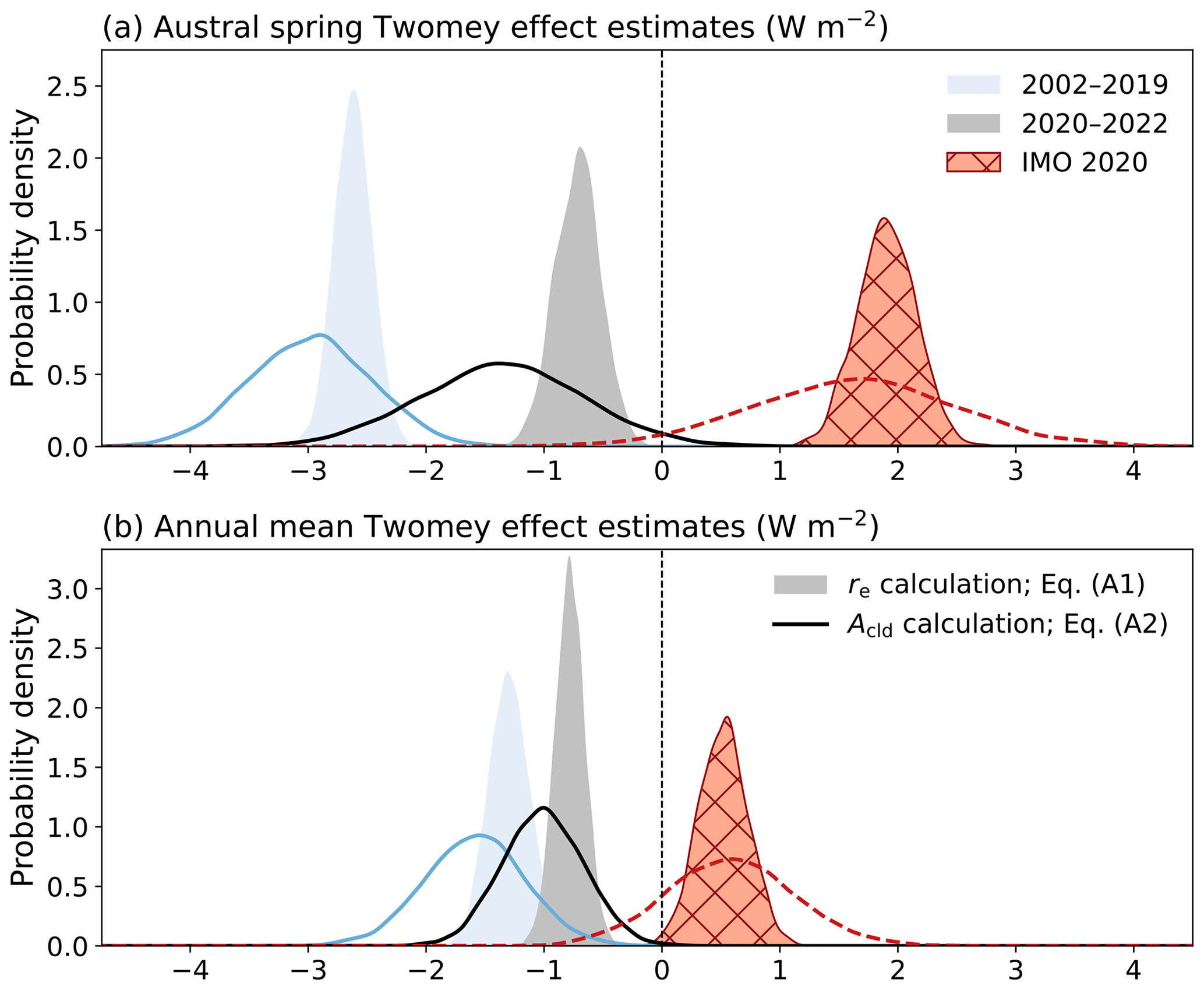
corridor (see Methods in Appendix A). Results are shown in Fig. 5 for the
2002–2019 climatology, 2020–2022, and their difference (interpreted as the
effect of the IMO 2020 regulations). The Twomey effect estimates are much
better constrained for the calculations using *r*e, but those using *A*cld show
consistent results. The IMO 2020 regulations led to a ∼ 2 W m−2 IRFACI within
the shipping corridor during austral spring and a ∼ 0.5 W m−2 IRFACI in the
annual mean. Applying this ∼ 35 %–70 % decline in IRFACI to the −0.1 to −0.6
W m−2 range of forcing due to shipping emissions from climate models
(Capaldo et al., 1999; Lauer et al., 2007; Peters et al., 2013; Righi et
al., 2011; Sofiev et al., 2018), global forcing values of *O*(0.1 W m−2)
due to the IMO 2020 regulations are plausible. The strongest shipping
effect in Lauer et al. (2007) represented 40 % of their global ACI; a 70 %
reduction from that fraction would represent a forcing of 0.2±0.1 W m−2 based
on the currently assessed IRFACI value of 0.7±0.5 W m−2, or 0.3±0.2 W
m−2 including
adjustments (Forster et al., 2021)
[image:
https://acp.copernicus.org/articles/23/8259/2023/acp-23-8259-2023-f05]
<https://acp.copernicus.org/articles/23/8259/2023/acp-23-8259-2023-f05-web.png>

Figure 5Probability densities (via Gaussian kernel density estimation) of
IRFACI for austral spring (a) and the annual mean (b) over the core
shipping corridor calculated using the changes in *r*e (shading) from
Eq. (A1) and *A*cld (lines) from Eq. (A2) for the 2002–2019 pre-regulation
climatology (solid light-blue shading and lines) and 2020–2022
post-regulation period (solid dark-gray shading and lines) due to the
presence of the shipping corridor and the 2020–2022 minus climatology
difference as an estimate of the effect due to implementation of the IMO
2020 regulations (patterned red shading and lines).

*Source: European Geosciences Union*

--
You received this message because you are subscribed to the Google Groups
"geoengineering" group.
To unsubscribe from this group and stop receiving emails from it, send an email
to [email protected].
To view this discussion on the web visit
https://groups.google.com/d/msgid/geoengineering/CAHJsh99O96h%3DaJXDxdrZAOmEoDk17O_YLX4vQRUW617w6-uj%2BQ%40mail.gmail.com.