https://phys.org/news/2023-07-sun-umbrella-tethered-asteroid-mitigate.html
by University of Hawaii at Manoa <http://www.manoa.hawaii.edu/>

*01 August 2023*
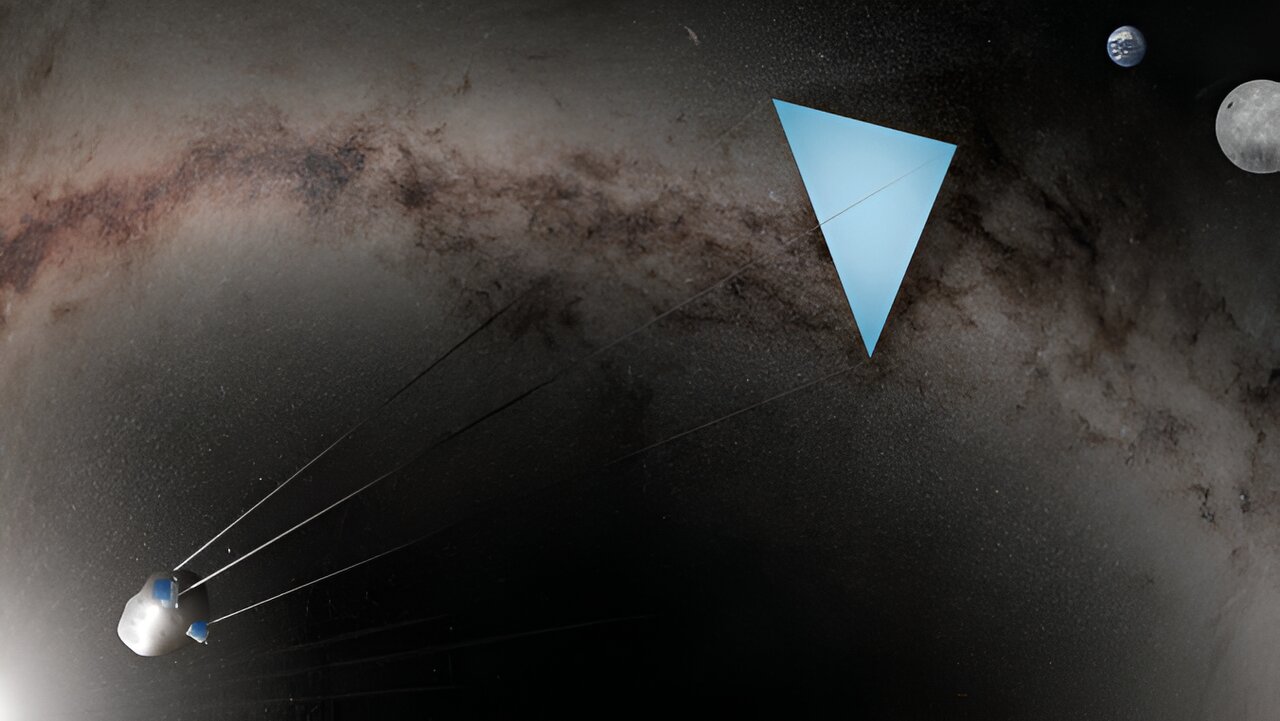
[image: Sun ‘umbrella’ tethered to asteroid might help mitigate climate
change] <https://scx2.b-cdn.net/gfx/news/2023/sun-umbrella-tethered.jpg>

Credit: Brooks Bays/UH Institute for Astronomy

Earth is rapidly warming and scientists are developing a variety of
approaches to reduce the effects of climate change. István Szapudi, an
astronomer at the University of Hawaiʻi Institute for Astronomy, has
proposed a novel approach—a solar shield to reduce the amount of sunlight
hitting Earth, combined with a tethered, captured asteroid as a
counterweight. Engineering studies using this approach could start now to
create a workable design that could mitigate climate change within decades.

The paper, "Solar radiation management with a tethered sun shield
<https://phys.org/tags/shield/>," is published in *Proceedings of the
National Academy of Sciences*.

One of the simplest approaches to reducing the global temperature is to
shade the Earth from a fraction of the sun's light. This idea, called a
solar shield, has been proposed before, but the large amount of weight
needed to make a shield massive enough to balance gravitational forces
<https://phys.org/tags/gravitational+forces/> and prevent solar radiation
<https://phys.org/tags/solar+radiation/> pressure from blowing it away
makes even the lightest materials prohibitively expensive.

Szapudi's creative solution consists of two innovations: a tethered
counterweight instead of just a massive shield, resulting in making the
total mass more than 100 times less, and the use of a captured asteroid as
the counterweight to avoid launching most of the mass from Earth.

"In Hawaiʻi, many use an umbrella to block the sunlight as they walk about
during the day. I was thinking, could we do the same for Earth and thereby
mitigate the impending catastrophe of climate change?" Szapudi said.
Incorporating a tethered counterbalance

Szapudi began with the goal of reducing solar radiation by 1.7%, an
estimate of the amount needed to prevent a catastrophic rise in global
temperatures <https://phys.org/tags/global+temperatures/>. He found that
placing a tethered counterbalance toward the sun could reduce the weight of
the shield and counterweight to approximately 3.5 million tons, about one
hundred times lighter than previous estimates for an untethered shield.

While this number is still far beyond current launch capabilities, only 1%
of the weight—about 35,000 tons—would be the shield itself, and that is the
only part that would have to be launched from Earth. With newer, lighter
materials, the mass of the shield could be reduced even further. The
remaining 99% of the total mass would be asteroids or lunar dust used as a
counterweight. Such a tethered structure would be faster and cheaper to
build and deploy than other shield designs.

Today's largest rockets can only lift about 50 tons to low Earth orbit, so
this approach to solar radiation management would be challenging. Szapudi's
approach brings the idea into the realm of possibility, even with today's
technology, whereas prior concepts were completely unachievable. Also,
developing a lightweight but strong graphene tether connecting the shield
with the counterweight is crucial.

More information: István Szapudi, Solar radiation management with a
tethered sun shield, *Proceedings of the National Academy of Sciences*
 (2023). DOI: 10.1073/pnas.2307434120
<https://dx.doi.org/10.1073/pnas.2307434120>

Journal information: Proceedings of the National Academy of Sciences
<https://phys.org/journals/proceedings-of-the-national-academy-of-sciences/>

*Source: PHYS.ORG <http://PHYS.ORG> *
Solar radiation management with a tethered sun shield
*Author*
István Szapudi <https://www.pnas.org/doi/10.1073/pnas.2307434120#con>
https://orcid.org/0000-0003-2274-0301
[email protected]
July 31, 2023

120 (32) e2307434120

https://doi.org/10.1073/pnas.2307434120
Abstract
This paper presents an approach to Solar Radiation Management (SRM) using a
tethered solar shield at the modified gravitational L1 Lagrange point.
Unlike previous proposals, which were constrained by the McInnes bound on
shield surface density, our proposed configuration with a counterweight
toward the Sun circumvents this limitation and potentially reduces the
total mass by orders of magnitude. Furthermore, only 1% of the total weight
must come from Earth, with ballast from lunar dust or asteroids serving as
the remainder. This approach could lead to a significant cost reduction and
potentially be more effective than previous space-based SRM strategies.

*Source: PNAS*

--
You received this message because you are subscribed to the Google Groups
"geoengineering" group.
To unsubscribe from this group and stop receiving emails from it, send an email
to [email protected].
To view this discussion on the web visit
https://groups.google.com/d/msgid/geoengineering/CAHJsh98cW5Q8OXWR5h5spt40ZwEuB_p1_sZPVa23gP-fHi_BBQ%40mail.gmail.com.