https://phys.org/news/2023-08-viewpoint-guardrails-geoengineering-gamble-potentially.html
Viewpoint: Without more research and guardrails, geoengineering is a costly
gamble, with potentially harmful results

by David Kitchen , The Conversation <https://theconversation.com/>

*22 August 2023*
[image: Without more research and guardrails, geoengineering is a costly
gamble—with potentially harmful results]
<https://scx2.b-cdn.net/gfx/news/2023/without-more-research.jpg>

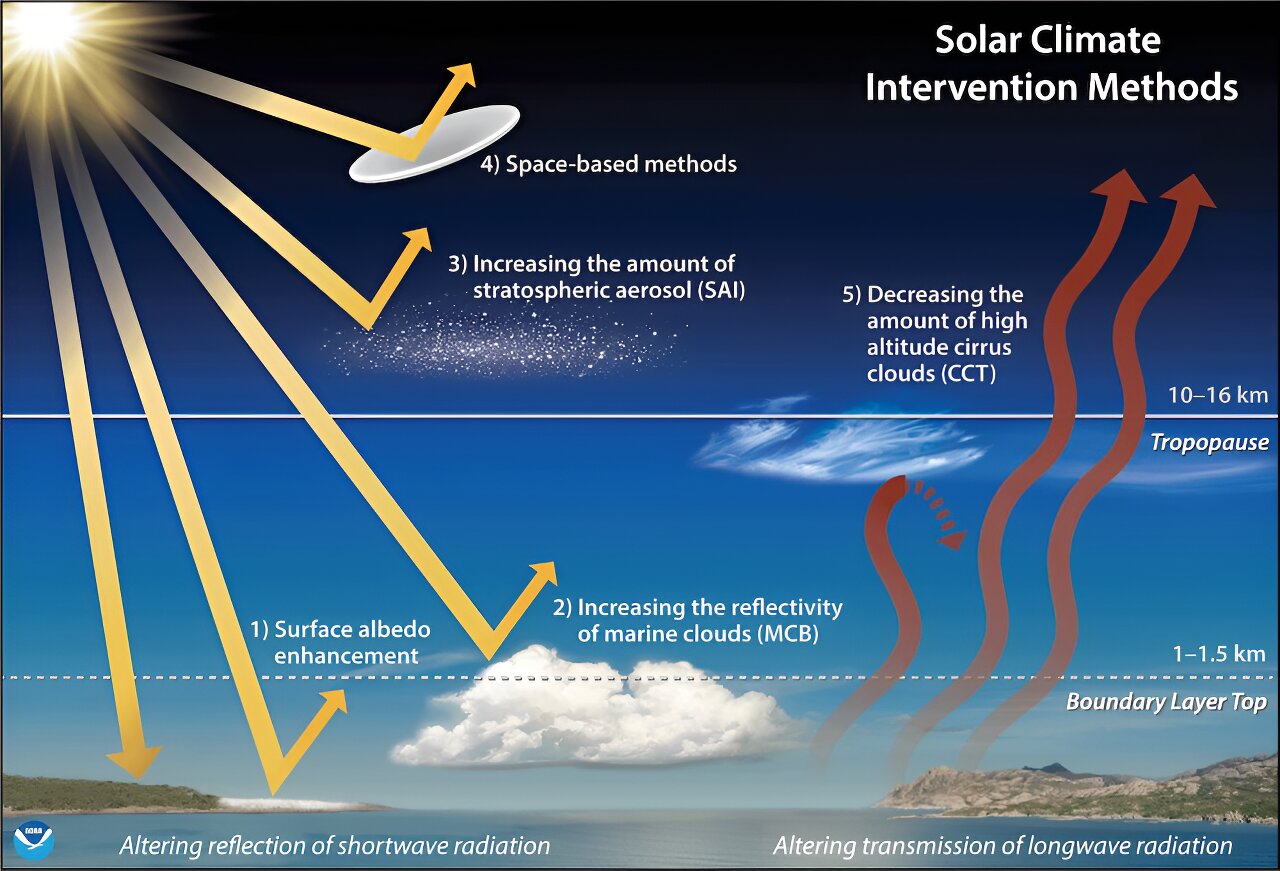
Potential climate interventions involving solar radiation. Credit: Chelsea
Thompson, NOAA/CIRES
<https://commons.wikimedia.org/wiki/File:Illustration_different_solar_climate_intervention_techniques.png>

When soaring temperatures <https://www.ready.gov/heat>, extreme weather and
catastrophic wildfires hit the headlines, people start asking for quick
fixes to climate change. The U.S. government just announced the first awards
<https://www.energy.gov/articles/biden-harris-administration-announces-12-billion-nations-first-direct-air-capture>
from
a US$3.5 billion fund
<https://www.energy.gov/articles/biden-administration-launches-35-billion-program-capture-carbon-pollution-air-0>
for
projects that promise to pull carbon dioxide out of the air. Policymakers
are also exploring more invasive types of geoengineering
<https://csl.noaa.gov/factsheets/climateinterventionsos.pdf> − the
deliberate, large-scale manipulation of Earth's natural systems.

The underlying problem has been known for decades: Fossil-fuel vehicles and
power plants, deforestation and unsustainable agricultural practices have
been putting more carbon dioxide into the atmosphere than the Earth's
systems can naturally remove, and that's heating up the planet.

Geoengineering, theoretically, aims to restore that balance, either by
removing excess carbon dioxide from the atmosphere or reflecting solar
energy <https://phys.org/tags/solar+energy/> away from Earth.

But changing Earth's complex and interconnected climate system may have
unintended consequences. Changes that help one region could harm another,
and the effects may not be clear until it's too late.

As a geologist and climate scientist
<https://spcs.richmond.edu/contact/dkitchen/>, I believe these consequences
are not yet sufficiently understood. Beyond the potential physical
repercussions, countries don't have the legal or social structures in place
to manage both its use and the fallout when things go wrong. Similar
concerns have been highlighted by the Intergovernmental Panel on Climate
Change
<https://www.ipcc.ch/report/ar6/wg2/downloads/report/IPCC_AR6_WGII_SummaryForPolicymakers.pdf>,
the United Nations
<https://www.unep.org/resources/report/Solar-Radiation-Modification-research-deployment>
Environment
Program, the National Academy of Sciences
<https://nap.nationalacademies.org/download/25762> and the National Oceanic
and Atmospheric Administration
<https://sciencecouncil.noaa.gov/wp-content/uploads/2023/06/mCDR-glossy-final.pdf>
, among others <https://www.solargeoeng.org/non-use-agreement/open-letter/>.

The White House
<https://www.whitehouse.gov/wp-content/uploads/2023/06/Congressionally-Mandated-Report-on-Solar-Radiation-Modification.pdf>
Office
of Science and Technology Policy also discussed these concerns in its July
2023 research plan
<https://www.whitehouse.gov/wp-content/uploads/2023/06/Congressionally-Mandated-Report-on-Solar-Radiation-Modification.pdf>
for
investigating potential climate interventions.
Risks of solar radiation management

When people hear the word "geoengineering," they probably picture solar
radiation management. These technologies, many of them still theoretical,
aim to reflect solar energy away from Earth's surface.

The idea of stratospheric aerosol injection
<https://wedocs.unep.org/handle/20.500.11822/41903>, for example, is to
seed the upper atmosphere with billions of tiny particles that reflect
sunlight directly out to space. Cirrus cloud thinning
<https://doi.org/10.3929/ethz-b-000570245> aims to reduce the impact of
high-altitude, wispy clouds that trap energy within the atmosphere by
making their ice crystals larger, heavier and more likely to precipitate.
Another, cloud brightening
<https://research.noaa.gov/2021/10/13/this-solar-geoengineering-idea-has-a-goldilocks-problem/>,
aims to increase the prevalence of brighter, lower-level clouds that
reflect sunlight, possibly by spraying seawater into the air to increase
water vapor concentration.

Some scientists have suggested going further and installing arrays of space
mirrors <https://wedocs.unep.org/handle/20.500.11822/41903> that could
reduce global temperature <https://phys.org/tags/global+temperature/> by
reflecting solar energy away before it reaches the atmosphere.

While theoretically capable of cooling the planet, solar radiation
management could have drastic <https://doi.org/10.1002/2015JD023269> side
effects
<https://www.unep.org/news-and-stories/story/new-report-explores-issues-around-solar-radiation-modification>
by
shifting patterns of global atmospheric circulation that can lead to
more extreme
weather <https://phys.org/tags/extreme+weather/> events. It also does
nothing to reduce harms of excess greenhouse gases, including ocean
acidification <http://doi.org/10.1146/annurev-environ-012320-083019>. A
2022 study published in the scientific journal *Nature*
<https://doi.org/10.1038/s41467-018-05938-3> predicted that stratospheric
aerosol injection could alter global precipitation patterns and reduce
agricultural productivity.

Cloud brightening, while effective in theory, also needs more research
<https://research.noaa.gov/2021/10/13/this-solar-geoengineering-idea-has-a-goldilocks-problem/>
to
make sure that efforts to expand lower-level reflective clouds that can
help cool Earth's surface do not also increase the prevalence of the
high-altitude clouds that warm the planet.

Space mirrors placed between the sun and Earth could theoretically block 2%
<https://wedocs.unep.org/handle/20.500.11822/41903> of incoming solar
radiation and stabilize global temperature. But the technology is at least
20 years away from implementation and would cost trillions of dollars. More
importantly, the overall global impact
<https://wedocs.unep.org/20.500.11822/41903> of shading Earth's surface is
largely unknown. It will decrease regional ocean and air temperatures in
ways that may affect changes
<https://www.swissre.com/institute/research/sonar/sonar2023/solar-radiation-risks-climate-change.html>
in
the jet stream, rainfall, snow cover, storm patterns and possibly even
monsoons. Much more research is needed to clarify these uncertainties.

*Removing carbon dioxide from the air*

Carbon dioxide removal technologies generally carry lower risks than
manipulating solar energy.
https://youtu.be/gXXOkhoki8s
Rising temperatures are raising fears that geoengineering may become
necessary. Credit: NASA.

Carbon capture and storage
<https://www.iea.org/energy-system/carbon-capture-utilisation-and-storage>
removes
carbon dioxide from power plants <https://phys.org/tags/power+plants/> and
factories and stores it underground in deep geological reservoirs. This has
proven potential, but it raises concerns that leaks might contaminate
aquifers, harm public health and ultimately fail to keep carbon out of the
atmosphere.

The technology is also expensive <https://energyandpolicy.org/petra-nova/> and
depends on the proximity of suitable reservoirs for storage.

Direct air capture, designed to pull carbon out of the air, is still in its
early stages
<https://eralberta.ca/wp-content/uploads/2017/05/C110149-Carbon-Engineering-Final-Report-Public.pdf>
but
offers the advantage of being able to reduce existing levels of carbon
dioxide in the atmosphere. This, too, is costly, at upward of $600 per
metric ton
<https://www.iea.org/commentaries/unlocking-the-potential-of-direct-air-capture-is-scaling-up-through-carbon-markets-possible>
 of carbon dioxide <https://phys.org/tags/carbon+dioxide/> captured today,
but innovators are getting funding from the U.S. government
<https://www.energy.gov/articles/biden-administration-launches-35-billion-program-capture-carbon-pollution-air-0>
.

There are also natural ways to remove carbon. Planting trees
<https://doi.org/10.1038/s41467-021-24084-x>, for example, can remove
carbon directly from the atmosphere, but this is not enough
<https://sgp.fas.org/crs/misc/RL34560.pdf>. If all the land available for
reforestation were replanted, it would still not be enough
<https://www.science.org/doi/10.1126/science.aax0848> to reverse current
global warming trends.

Ocean fertilization <https://www.ipcc.ch/srocc/> is another geoengineering
hack intended to boost carbon sequestration, but research is at an early
stage <https://nap.nationalacademies.org/download/26278>. The technique
provides nutrients such as iron to increase the growth of phytoplankton,
which use dissolved carbon from the atmosphere to grow their shells and
tissue. But it may also have unintended effects
<https://www.sciencedaily.com/releases/2020/02/200217162348.htm> for the
food chain that could harm ocean life.
The legal void

Beyond safety, another important question involves accountability.

There's a good chance that geoengineering meant to help one region would
harm others. That's because ocean and weather systems are globally
interconnected.

So, who gets to decide
<https://www.sciencedirect.com/science/article/pii/S0095069623000724> which
projects can go ahead? Right now, that's a legal void.

There is no regulatory framework
<https://www.eceee.org/all-news/news/eu-calls-for-global-talks-on-climate-geoengineering-risks/>
that
can determine who is liable if something goes wrong. Multinational
alliances, individual states, corporations and even rich individuals can
act independently without consulting anyone
<https://www.washingtonpost.com/climate-environment/2023/01/09/make-sunsets-solar-geoengineering-climate/>.
In the event of harm that crosses national boundaries, there is currently
no clear path for recourse.
Striking the right balance

None of this is to say that the world should dismiss geoengineering.

Carbon dioxide removal techniques, such as planting trees and increasing soil
carbon sequestration
<https://www.nature.com/scitable/knowledge/library/soil-carbon-storage-84223790/>—retaining
more organic carbon in fertile soils—may provide additional benefits
to ecosystem
services <https://www.fs.usda.gov/ccrc/topics/ecosystem-services> by
increasing species diversity and boosting agricultural productivity. These
are all positive outcomes and should be part of a global climate response.

Some forms of stratospheric aerosol injection might avoid the destruction
of ozone <https://doi.org/10.1073/pnas.1615572113> and have short life
spans in the atmosphere. However, more rigorous research, transparent
global governance and robust legal and ethical frameworks
<https://legal-planet.org/2023/03/15/solar-geoengineering-in-the-news-again-and-again/>
to
manage risks and ensure equity are needed first.

I believe all the technologies must be complemented by deep and sustained
efforts to reduce emissions
<https://unfccc.int/process-and-meetings/the-paris-agreement> and transform
<https://www.epa.gov/climate-research/energy-transformation-and-climate-change-research>
the
energy system to avoid the global impacts of sea-level rise, soaring
temperature, droughts, storms, floods, fires, famine, species extinction
and increasing human conflict.

As Riley Duren, a systems engineer from NASA
<https://climate.nasa.gov/news/1066/just-5-questions-hacking-the-planet/>,
said in an interview with the space agency: "Geoengineering is not a cure.
At best, it's a Band-Aid or tourniquet; at worst, it could be a
self-inflicted wound."

Journal information: Nature <https://phys.org/journals/nature/>

Provided by The Conversation <https://phys.org/partners/the-conversation/>

*Source: PHYS.ORG <http://PHYS.ORG>*

[image: The Conversation]

--
You received this message because you are subscribed to the Google Groups
"geoengineering" group.
To unsubscribe from this group and stop receiving emails from it, send an email
to [email protected].
To view this discussion on the web visit
https://groups.google.com/d/msgid/geoengineering/CAHJsh9_QEj3BKv3r%2B1uyDZwcz33P%2Bqgv%2B9Ur9aR5DnbOTTdV8Q%40mail.gmail.com.