https://peteirvine.substack.com/p/global-srm-technologies-a-tier-list
What are the main global Solar Radiation Modification (SRM) Technologies
and why?

*By Pete Irvine*

*14 September 2023*
<https://peteirvine.substack.com/p/global-srm-technologies-a-tier-list/comments>

Stratospheric Aerosol Injection (SAI) geoengineering is my main research
focus and the focus of this substack, but why? There are several other SRM
technologies, what makes SAI special?

In this post I’m going to populate a “Tier List” of global SRM technologies
(Figure 1), i.e., I’m going to rank them as means of counteracting global
climate change. Let’s run through a few key criteria and explain how they
count against different technologies.
[image: Tier list - Wikipedia]
<https://substackcdn.com/image/fetch/f_auto,q_auto:good,fl_progressive:steep/https%3A%2F%2Fsubstack-post-media.s3.amazonaws.com%2Fpublic%2Fimages%2Ff952778e-9274-463a-938c-8e1d6fb01bf6_640x640.jpeg>

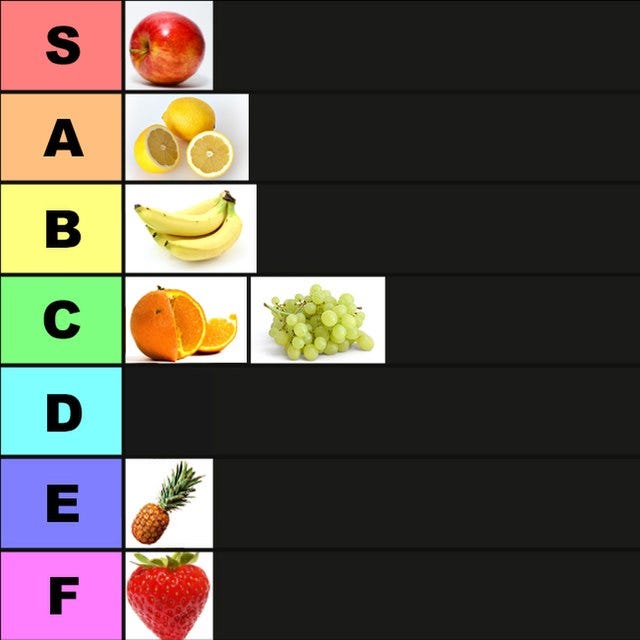
*Figure 1. An example “Tier List” for fruit, which ranks things from S -
Super, through A, B, C, to F - Terrible (wiki
<https://en.wikipedia.org/wiki/Tier_list>). Note, strawberries and
pineapple deserve a far higher ranking than they’ve been given.*
Maximum Potential Radiative Forcing

My first criteria is: “Maximum Potential Radiative Forcing”: could this
idea produce enough of a cooling effect to substantially reduce future
global warming?

This criteria counts out two ideas that might be promising as a form of
local adaptation, but which can’t plausibly reach a sufficient scale to
produce meaningful global cooling: crop albedo enhancement and urban albedo
enhancement
1
.

Crop albedo enhancement as it’s name suggests is a proposal to enhance the
albedo, or reflectivity, of crops. At first, this might seem implausible,
but there are substantial variations in the reflectivity of different crops
and their cultivars, with differences of up to 0.05 (5% more light
reflected) between wheat cultivars
<https://link.springer.com/article/10.1007/BF00024805> and up to 0.08
between maize cultivars
<https://www.sciencedirect.com/science/article/pii/0002157179900220?via%3Dihub>,
which is quite large compared to the typical albedo of grasses of 0.23
<https://iopscience.iop.org/article/10.1088/1748-9326/4/4/045110/meta>.
However, while around a third of the land surface is agricultural land
<https://ourworldindata.org/land-use>, and a quarter of that cropland (11
Million Km^2), that only amounts to ~2% of the global surface area.

A ~5% increase in albedo (before accounting for shading by clouds) over 2%
of the Earth is simply nowhere near enough to produce a substantial global
cooling. While for urban areas there is a greater potential to enhance
albedo
<https://agupubs.onlinelibrary.wiley.com/doi/full/10.1029/2011JD016281>, by
painting roofs white and changing road surfaces, urban areas cover much
less of the Earth and so the conclusion is the same.

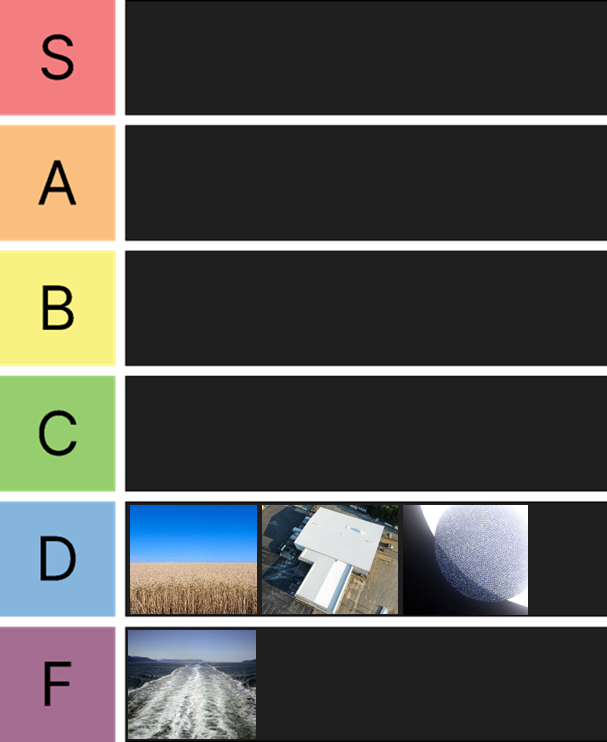
for this reason I give crop and urban albedo enhancement both a ranking of
“D”, they’re not entirely useless but simply can’t produce enough of a
cooling to make much of a difference at the global scale (Figure 2).
<https://substackcdn.com/image/fetch/f_auto,q_auto:good,fl_progressive:steep/https%3A%2F%2Fsubstack-post-media.s3.amazonaws.com%2Fpublic%2Fimages%2F27f7967b-e45f-4689-a77c-a731f0ee2139_607x742.png>

*Figure 2. Global SRM Technology Tier List with Crop and Urban albedo.*
Feasibility and Costs

While several SRM proposals have the potential to achieve substantial
radiative forcings, not all of these are feasible. Some ideas simply will
not work, and others would require far-future technologies or vast
resources to implement.

One proposal that has received some attention in the literature but which
seems completely infeasible is Ocean Albedo Enhancement or Microbubble
geoengineering. In the same way that SAI geoengineering leverages the
enormous surface area of tiny aerosol particles to have an outsized cooling
effect (See post: Archimedes’ Lever
<https://peteirvine.substack.com/p/archimedes-lever>), Ocean albedo
enhancement would aim to leverage the enormous surface area of microbubbles
to produce a substantial cooling effect.

However, while aerosol particles in the stratosphere can persist for years,
tiny bubbles in the ocean don’t last very long at all. The original proposal
<https://link.springer.com/article/10.1007/s10584-010-9965-8> suggests that
sufficiently small bubbles in seawater could persist for days. However, one
of the observational studies
<https://agupubs.onlinelibrary.wiley.com/doi/pdf/10.1029/2007JC004108> the
author cites, the only one conducted in open sea water, explicitly
contradicts that claim and found no bubbles persisted longer than 160
seconds.

I also asked Dr. Helen Czerski, a physicist and oceanographer at UCL who
specializes in the physics of bubbles, about the idea and she was pretty
certain that it’s implausible.

For these reasons, I give Ocean microbubbles a ranking of “F” as it seems
unworkable.

Next up, we have the purest form of SRM: sunshades in space. If we could
place enough reflective objects between the Earth and Sun we could reduce
the amount of incoming light and so cool the climate. There is no limit to
how much cooling could be achieved in principle and there should be no
(non-climatic) side-effects from reducing incoming sunlight.

The trick would be to put this cloud of reflective material in a
qausi-stable orbit at the point between the Earth and Sun where their
gravitational pulls cancel out (The Lagrange L1 point
<https://solarsystem.nasa.gov/faq/88/what-are-lagrange-points/#:~:text=What%20are%20they%3F,position%20with%20minimal%20fuel%20consumption.>).
Well, actually a little nearer the Sun so that the light pressure from the
reflected light is cancelled out by the slightly stronger gravitational
pull from the Sun.

The problem is that you need to get millions of tons of material into
orbit, and doing so is currently extremely expensive. Despite SpaceX’s
advances in re-usability that have slashed the costs of getting to orbit,
it still costs around $2,350 to get each Kg to Low Earth Orbit on
board a Falcon
Heavy rocket <https://en.wikipedia.org/wiki/Falcon_Heavy>.

While Sunshades in space has many advantages, the enormous technical
challenge means that I’ve got to give it a low ranking. However, as there
are rapid developments in space technology, in particular SpaceX’s Starship
<https://en.wikipedia.org/wiki/SpaceX_Starship>
2
, and interesting new suggestions for how it could be done keep emerging (space
bubbles? <https://senseable.mit.edu/space-bubbles/>), I’ve decided to give
this a “D” rather than a “F” (Figure 3). This idea is unlikely to be
practical on a timescale relevant to the climate problem, but it’s worth
keeping half an eye on.
<https://substackcdn.com/image/fetch/f_auto,q_auto:good,fl_progressive:steep/https%3A%2F%2Fsubstack-post-media.s3.amazonaws.com%2Fpublic%2Fimages%2Faa8f67b8-7f1e-44d9-9337-bbe15a6b1740_607x742.png>

*Figure 3. Global SRM Technology tier list with microbubbles and sunshade
added.*
Radiative Forcing Pattern

As I’ve defined it, the goal of global SRM is to offset the anthropogenic
warming effect and so the more similar the radiative forcing of SRM is to
the radiative forcing of Greenhouse Gases (GHG), the better (though, of
course, it needs to be the opposite sign).

Long-lived GHGs like CO2 become well-mixed within a few years, raising
concentrations around the world more-or-less uniformly. These gases trap
heat on its way up from the surface to space, warming the atmospheric
column more than they warm the surface. They generally have a greater
impact in warmer places than cooler places
3
, but they warm round-the-clock and all-year round.

Most SRM proposals increase the amount of light the Earth reflects, most of
which is absorbed at the surface, and so they produce their greatest
cooling effect when and where its sunniest, i.e., during daytime, in the
summer, and in the Tropics.

Despite this mismatch, in idealized sunshade SRM simulations
<https://agupubs.onlinelibrary.wiley.com/doi/full/10.1002/jgrd.50646> where
we simply turn down the sun, we find roughly 90% of GHG warming is offset
during the nights and winters, and at the Poles, while the days, summer and
Tropics, see about 110% of GHG warming offset, i.e., they see a modest
over-cooling. The reason the differences are not much larger is that the
ocean, and to a lesser extent the land and atmosphere, act to redistribute
heat between day and night, Tropics and Poles, etc.

The vertical mismatch in heating, where GHGs warm the atmospheric column
and reduced sunlight cools the surface, is more impactful. It is
responsible for the substantial weakening of the hydrological cycle that we
see in most SRM simulations (More on hydrological changes under SRM in this
post
<https://peteirvine.substack.com/p/less-rain-but-still-wetter-and-greener>).

So “turning down the sun” and SAI are fundamentally imperfect ways to
offset GHG forcing, but some SRM proposals are even worse matches for GHG
forcing.
Desert Albedo Geoengineering (is a really bad idea)

Desert albedo geoengineering
<https://agupubs.onlinelibrary.wiley.com/doi/full/10.1029/2011JD016281> is
a proposal to place reflective materials over vast swathes of “useless”
land, the deserts. Presuming we could overcome the technical hurdles of
installing and cleaning reflective surfaces in dusty, remote and
inhospitable deserts, there’s a really good reason not to pursue this idea.

In Irvine et al. (2011)
<https://agupubs.onlinelibrary.wiley.com/doi/full/10.1029/2011JD016281>, we
simulated raising the albedo of desert areas (1.78% of the Earth’s surface)
from ~0.3 to 0.8 and found that we could lower global temperatures by a
substantial 1.12 °C. However, most of this cooling was concentrated in the
deserts, far from where its needed. Worse still, we found catastrophic
shifts in regional rainfall, including a 45% reduction in Indian rainfall!
A result confirmed in a later study
<https://agupubs.onlinelibrary.wiley.com/doi/full/10.1002/2015JD023269>.

The patchiness of desert albedo’s forcing and the fact that it was only
exerted over the continents, led to these huge shifts in rainfall and
specifically the weakening of monsoon rains. It is also a clear
illustration that patchy radiative forcing is a problematic feature for
global SRM.

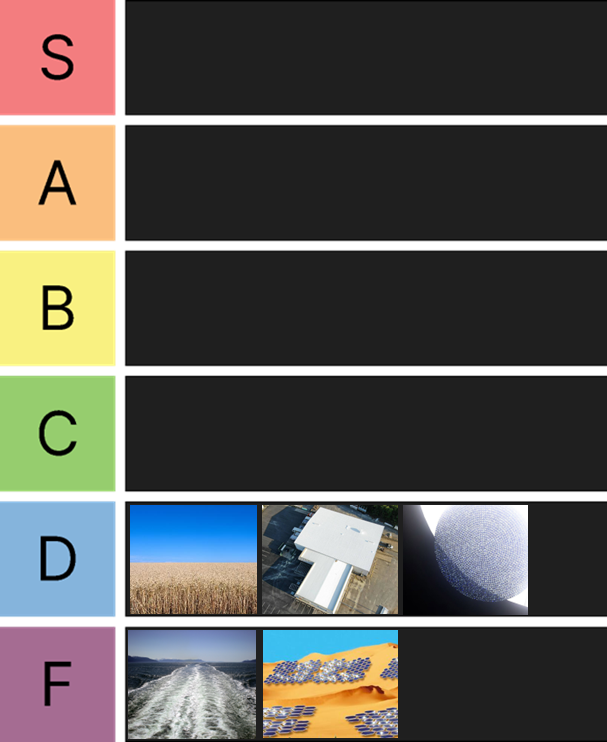
Desert albedo geoengineering is the only SRM proposal for which I feel
we’ve found a deal-breaking negative consequence and as such I give it an
“F” (Figure 4).
<https://substackcdn.com/image/fetch/f_auto,q_auto:good,fl_progressive:steep/https%3A%2F%2Fsubstack-post-media.s3.amazonaws.com%2Fpublic%2Fimages%2Fda80aad9-bd19-41e8-bb59-5c6ee640d92a_607x742.png>

*Figure 4.* Global *SRM Technology tier list with desert albedo
geoengineering added.*
Cirrus Cloud Thinning

Cirrus Cloud Thinning (CCT)
<https://www.science.org/doi/full/10.1126/science.aan3325> is a proposal to
thin high, whispy cirrus clouds which trap more heat than they reflect
light. By adding ice nuclei to susceptible cirrus clouds the hope is that
fewer, larger ice crystals will form that will sediment much faster leading
to fewer, thinner cirrus clouds in targeted areas.

One avantage of this idea is that it would reduce the amount of heat
trapped and so would be a closer analogue to GHG forcing in some ways.
However, as only certain regions at certain times would be susceptible it
would produce an inherently patchy cooling effect
<https://agupubs.onlinelibrary.wiley.com/doi/full/10.1002/2015GL066795>,
raising some concerns.

While there are major uncertainties regarding when and where this seeding
might work, no study that I’m aware of has proposed a feasible means of
implementation. As there are serious doubts around whether this idea is
feasible, I’ve given it a “C”.
Marine Cloud Brightening

Marine Cloud Brightening (MCB)
<https://royalsocietypublishing.org/doi/full/10.1098/rsta.2012.0086> is a
proposal to mimic the cooling effects of ship tracks
<https://en.wikipedia.org/wiki/Ship_tracks>, the white streaks that
polluting ships leave in certain, susceptible clouds. By spraying sea-salt
particles into the undersides of marine stratocumulus clouds, low-lying
clouds that form in the sub-tropics, it is hoped that a substantial
regional cooling could be achieved in several susceptible regions.

This is the most heavily studied SRM proposal after SAI, and several teams
are developing spraying equipment and the first field tests have been
conducted (See this Challenging Climate podcast with Daniel Harrison
<https://www.challengingclimate.org/1873533/12165823-29-daniel-harrison-on-marine-cloud-brightening-and-the-rrap>).
Research consistently suggests this idea could work, but aerosol-cloud
interactions are notoriously difficult to simulate and many uncertainties
remain.

MCB may be able to produce a substantial global cooling, but it is
inherently patchy meaning that we may expect large shifts in rainfall
<https://egusphere.copernicus.org/preprints/2023/egusphere-2023-1611/> that
could be quite different from those seen under climate change, making this
a less than ideal way to counteract global warming. A 2017 study
titled: “Marine
cloud brightening - as effective without clouds”
<https://acp.copernicus.org/articles/17/13071/2017/> found that with much
larger sea-salt particles a substantial cooling could be achieved in
cloudless regions. Such Marine Sky Brightening might help to address the
patchiness issue but questions remain as to whether it is practical.

Overall, MCB looks like it could feasibly achieve a significant cooling,
but its patchiness and aerosol-cloud uncertainties count against it. For
these reasons, I give MCB a ranking of “B”.
SAI and its Side-effects

The final criteria in my ranking is “side-effects”, i.e., the non-climatic
side-effects that would come with SRM technologies. This is not a major
issue for most of the other SRM proposals
4
 and so I’ve not mentioned it yet, but SAI has several notable side-effects
that are worth considering.

First though, let’s review its advantages:

   -

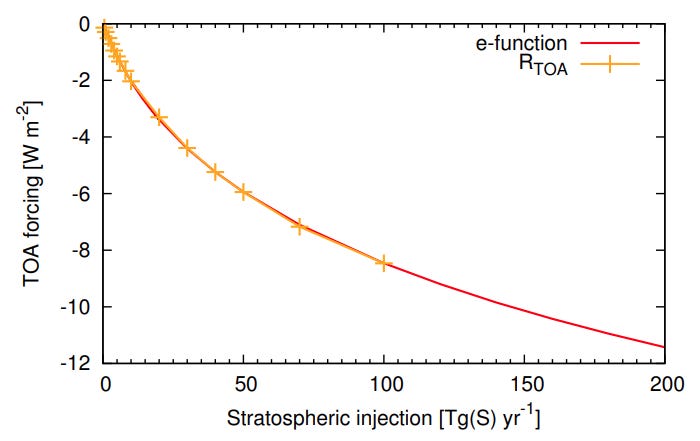
   *Large Radiative Forcing:* Niemeier and Timmreck (2015)
   <https://acp.copernicus.org/articles/15/9129/2015/acp-15-9129-2015.pdf>,
   found that while the cooling efficiency of SAI dropped with increasing
   injection rates, radiative forcings far larger than needed could be
   achieved (Figure 5).
   -

   *Feasible and relatively cheap:* Every engineering assessment to date
   <https://iopscience.iop.org/article/10.1088/1748-9326/aba7e7/meta> has
   concluded that newly designed, high-altitude jets could realize this at a
   cost of a few billion to low tens of billions of dollars.
   -

   *Tailored radiative forcing pattern:* By adjusting
   <https://agupubs.onlinelibrary.wiley.com/doi/full/10.1029/2019JD030329> the
   latitude of injection it should be possible to produce different patterns
   of radiative forcing and closely offset the warming of GHGs.

<https://substackcdn.com/image/fetch/f_auto,q_auto:good,fl_progressive:steep/https%3A%2F%2Fsubstack-post-media.s3.amazonaws.com%2Fpublic%2Fimages%2Fc01a96a5-38d3-44ad-b894-67746b84049d_700x441.png>

*Figure 5. SAI radiative forcing as a function of the rate of injection of
SO2 into the tropical stratosphere. Note, the difference between an
ambitious pathway of emissions cuts and current policies is roughly 2 Wm^-2
by the end of the century. Figure 1, left panel from Niemeier and Timmreck
(2015)
<https://acp.copernicus.org/articles/15/9129/2015/acp-15-9129-2015.pdf>.*

Now, let’s look at its side-effects:

   -

   *It would make the sky appear hazier
   <https://agupubs.onlinelibrary.wiley.com/doi/full/10.1029/2012GL051652>*,
   but for most plausible scenarios of deployment, the effect would be smaller
   than seen after the 1991 Pinatubo eruption.
   -

   *It would add to the acid rain problem
   <https://iopscience.iop.org/article/10.1088/1748-9326/ab94eb/meta>*, but
   this would only contribute a small fraction to the total effect which is
   dominated by other anthropogenic pollution sources.
   -

   *It would delay the recovery of the ozone hole

<https://ozone.unep.org/system/files/documents/Scientific-Assessment-of-Ozone-Depletion-2022-Executive-Summary.pdf>*,
   but it would be unlikely to reduce ozone levels below what was seen at
   their minimum in the 1990s.

While it would be better if SAI didn’t have these side-effects, it seems
clear that these are much less significant than the impacts of climate
change which it could help address. Harding et al. (2023)
<https://media.rff.org/documents/WP_23-23.pdf>, found that the reduction in
heat-related mortality alone would outweigh the health impacts of SAI’s
side-effects by over 50:1.

While it is imperfect, SAI is by far and away the leading global SRM
proposal with a unique potential to offset future global warming and
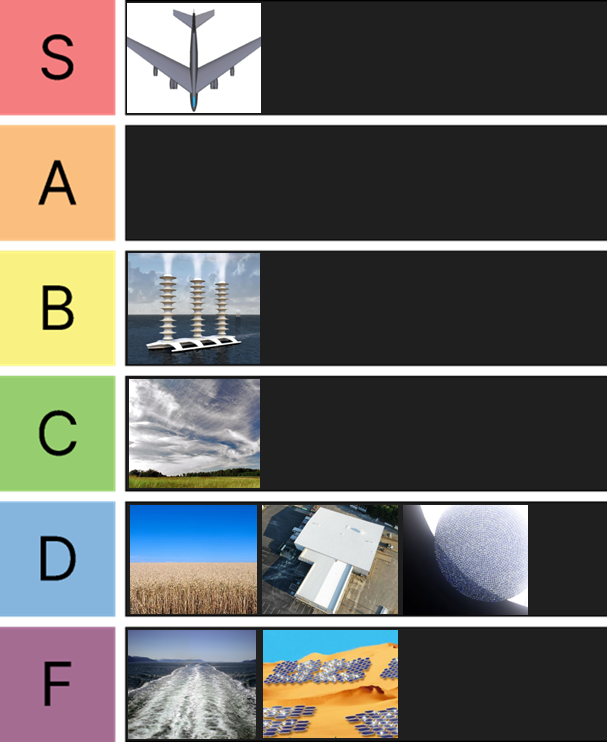
despite its side-effects, I give it the highest ranking of “S - Super”.
The Global SRM Tier List

There you have it, the global SRM Tier List (Figure 6). SAI is by far and
away the leading SRM proposal, MCB has considerable promise but its
patchiness undermines its potential as a means of offsetting global
warming, and CCT is interesting but it is both patchy and of doubtful
feasibility. While there are other ideas, they are either infeasible,
insignificant, or unacceptably risky.

If I was making a different ranking, focused on local applications, MCB
would look much more promising, as would crop and urban albedo. However, if
we are interested in countering global warming at the global scale, SAI is
where we should focus our attention.
<https://substackcdn.com/image/fetch/f_auto,q_auto:good,fl_progressive:steep/https%3A%2F%2Fsubstack-post-media.s3.amazonaws.com%2Fpublic%2Fimages%2F0653624c-70db-4567-8f33-573f9b264e00_607x742.png>

*Figure 6. The definitive Global SRM Tier List. S - Stratospheric Aerosol
Injection geoengineering. B - Marine Cloud Brightening. C - Cirrus Cloud
Thinning. D - Crop Albedo Enhancement, Urban Albedo Enhancement, Sunshades
in space. F - Ocean Microbubbles, Desert Albedo Enhancement.*

*FIN*
1
<https://peteirvine.substack.com/p/global-srm-technologies-a-tier-list#footnote-anchor-1-136813146>

I’m counting Mirrors for Enhancing Earth’s Reflectivity (MEER), the idea of
installing mirrors in urban and agricultural land, under these categories
as plausible deployments of this idea would be similarly small-scale. If
scaled up sufficiently to produce a substantial global cooling effect this
would raise similar issues as desert albedo enhancement.
2
<https://peteirvine.substack.com/p/global-srm-technologies-a-tier-list#footnote-anchor-2-136813146>

Elon Musk has suggested that the cost to launch and refit Starship could be
as little as $1 Million, which would give costs to Low Earth Orbit to below
$7 per Kg. I find this very hard to believe, but it does look like Starship
could slash the cost of launching material to orbit yet again.
3
<https://peteirvine.substack.com/p/global-srm-technologies-a-tier-list#footnote-anchor-3-136813146>

Though this is complicated by the presence of water vapour, the Earth’s
most important greenhouse gas.
4
<https://peteirvine.substack.com/p/global-srm-technologies-a-tier-list#footnote-anchor-4-136813146>

Covering all deserts in reflective material would have substantial impacts
on desert ecosystems, but seems a relatively minor concern compared to its
enormous impacts on regional rainfall.


*Source: Substack (Plan A+)*

--
You received this message because you are subscribed to the Google Groups
"geoengineering" group.
To unsubscribe from this group and stop receiving emails from it, send an email
to [email protected].
To view this discussion on the web visit
https://groups.google.com/d/msgid/geoengineering/CAHJsh9_kAqDDUasny%3DB1hd4EZ0PJ8Z8JTHSmM-VovFbDD6xSeQ%40mail.gmail.com.