scitechdaily.com
/unlocking-climate-secrets-the-hidden-physics-behind-temperature-and-radiation/
<https://scitechdaily.com/unlocking-climate-secrets-the-hidden-physics-behind-temperature-and-radiation/>
Unlocking
Climate Secrets: The Hidden Physics Behind Temperature and Radiation
16/12/2023
------------------------------
*Research in climate science reveals new insights into the relationship
between surface temperature and outgoing longwave radiation, challenging
conventional models and deepening our understanding of Earth’s climate
sensitivity.*

Curious about what drives Earth’s climate sensitivity? A recent study
in *Advances
in Atmospheric Sciences* explores the complex links transforming the
relationship between surface temperature and outgoing longwave radiation
(OLR) from quartic to quasi-linear. Led by Dr. Jie Sun from Florida State
University, this research unravels hidden mechanisms shaping our planet’s
climate, providing fresh insights into why the temperature and OLR relation
deviates from the quartic pattern stated by the Stefan-Boltzmann law.
The Stefan-Boltzmann Law and Climate Dynamics

What is the Stefan-Boltzmann law? Greenhouse gases in the atmosphere create
a contrast between surface thermal emission, linked to the fourth power of
surface temperature, and OLR.

Prof. Xiaoming Hu from Sun Yat-sen University, the corresponding author of
the study, explained, “Vertical convective energy transport acts like an
atmospheric mixer, swirling temperatures within a column. This allows the
relation between surface temperature and OLR to still follow the quartic
pattern by lowering the radiative emission layer.”
[image: Surface Temperature and Outgoing Longwave Radiation]
<https://scitechdaily.com/images/Surface-Temperature-and-Outgoing-Longwave-Radiation.jpg>

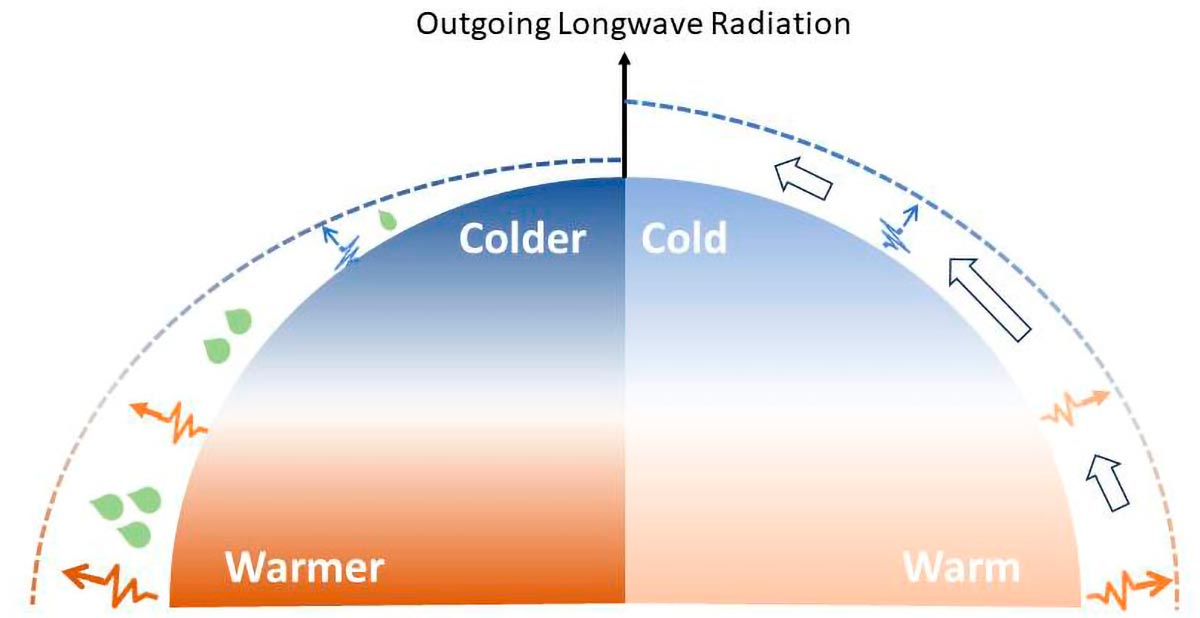
Diagram depicting the two main processes for quasi-linear surface
temperature and outgoing longwave radiation (OLR). Left: enhancement of
meridional surface temperature gradient by the greenhouse effect of water
vapor; Right: Re-routing part of OLR from warm places to cold places by
poleward energy transport. Credit: Ming Cai and Xiaoming Hu Factors
Influencing Surface Temperature and OLR

The study uncovers how various factors influence surface temperature and
OLR. The greenhouse effect of water vapor acts as a magnifier, amplifying
temperature differences across Earth’s surface without altering the
latitudinal variation of OLR. This suppresses the nonlinearity between OLR
and surface temperature.

Poleward energy transport, on the other hand, functions as an equalizer,
harmonizing temperature disparities across different regions of the globe.
One of the by-products of this global heat redistribution is the re-routing
of OLR from warm places to cold places, acting to reduce OLR difference
across different regions. This, in turn, further suppresses the
nonlinearity.

Prof. Ming Cai from Florida State University highlighted, “Understanding
these complex climate interactions is akin to decoding a puzzle. Each piece
brings us closer to deciphering our planet’s climate intricacies.”

By illuminating these connections, scientists make significant strides in
comprehending Earth’s climate and how its intricate components orchestrate
the overall climate sensitivity, namely not only energy output rate but
also where the output takes place.

Reference: “A Quasi-Linear Relationship between Planetary Outgoing Longwave
Radiation and Surface Temperature in a Radiative-Convective-Transportive
Climate Model of a Gray Atmosphere” by Jie Sun, Michael Secor, Ming Cai and
Xiaoming Hu, 25 November 2023, *Advances in Atmospheric Sciences*.
DOI: 10.1007/s00376-023-2386-1
<https://link.springer.com/article/10.1007/s00376-023-2386-1>

Abstract

In this study, we put forward a radiative-convective-transportive energy
balance model of a gray atmosphere to examine individual roles of the
greenhouse effect of water vapor, vertical convection, and atmospheric
poleward energy transport as well as their combined effects for a
quasi-linear relationship between the outgoing longwave radiation (OLR) and
surface temperature (*T**S*). The greenhouse effect of water vapor enhances
the meridional gradient of surface temperature, thereby directly
contributing to a quasi-linear OLR-*T**S* relationship. The atmospheric
poleward energy transport decreases the meridional gradient of surface
temperature. As a result of the poleward energy transport, tropical
(high-latitude) atmosphere-surface columns emit less (more) OLR than the
solar energy input at their respective locations, causing a substantial
reduction of the meridional gradient of the OLR. The combined effect of
reducing the meridional gradients of both OLR and surface temperature by
the poleward energy transport also contributes to the quasi-linear OLR-*T*
*S* relationship. Vertical convective energy transport reduces the
meridional gradient of surface temperature without affecting the meridional
gradient of OLR, thereby suppressing part of the reduction to the
increasing rate of OLR with surface temperature by the greenhouse effect of
water vapor and poleward energy transport. Because of the nature of the
energy balance in the climate system, such a quasi-linear relationship is
also a good approximation for the relationship between the annual-mean net
downward solar energy flux at the top of the atmosphere and surface
temperature.

--
You received this message because you are subscribed to the Google Groups
"geoengineering" group.
To unsubscribe from this group and stop receiving emails from it, send an email
to [email protected].
To view this discussion on the web visit
https://groups.google.com/d/msgid/geoengineering/CAHodn98dojsXya4MChQ%3DmNtL%2B0f3P_jeOAfEKyYZRG%2BHTV5yzg%40mail.gmail.com.