*This item and others will be in the monthly “Solar Geoengineering Updates
Substack” newsletter:* https://solargeoengineeringupdates.substack.com/
-----------------------------------------------------------------
https://kleinmanenergy.upenn.edu/research/publications/a-new-era-of-policy-in-solar-geoengineering/


*SHUCHI TALATI | JANUARY 12, 2024*

With climate impacts rising, concerns over our inability to drastically cut
emissions and scale up carbon dioxide removal are driving a broader
conversation around solar geoengineering. For the first time, the U.S.
released a research plan on this emerging technology. This digest explores
the state of the field, an overview of the report, and recommendations for
how governance and policy can move forward in both a just and
scientifically robust manner.
DOWNLOAD PDF
<https://kleinmanenergy.upenn.edu/wp-content/uploads/2024/01/KCEP-Digest-59-Solar-Geoengineering.pdf>
At a GlanceKEY CHALLENGE
The implications of such a global technology merit a better understanding
of governance for both research and potential deployment.
POLICY INSIGHT
As discussions and activity around SG grow, there must be more clarity
around governance institutions and requirements for research. We must
answer critical questions around the impacts, social dimensions, and
potential viability for SG in the context of climate change.
An Assessment of the 2023 White House Research Plan and Recommendations for
Future Research GovernanceIntroduction

The state of climate impacts on human systems is growing in severity. The
Intergovernmental Panel on Climate Change (IPCC) Sixth Assessment Report
indicates that climate change has adversely impacted water and food
security, public health, and infrastructure across economic sectors (IPCC
2022). These impacts are significantly worsening across regions, amplified
in the most vulnerable regions.

Mounting concerns that reducing emissions and scaling up carbon dioxide
removal (CDR) will be insufficient to limit these severe and worsening
climate impacts are starting to drive a broader conversation around solar
geoengineering.

Solar geoengineering (SG), also known as solar radiation
management/modification (SRM), refers to a set of proposed, large-scale,
deliberate methods to increase the amount of sunlight reflected into space,
which would reduce global mean temperatures. It is a small but growing
field with recent momentum across the public, private, and academic sectors.

Historically, the topic of SG has been deeply controversial in the climate
change community, with extreme hesitancy and taboo surrounding both
scientific and governance engagement in the field. While there is still
reticence, major institutions and organizations with strong influence are
showing signs of a major shift in perception, activity, and interest over
the last two to three years. Research efforts are starting to expand, there
has been a significant increase in focus on SG governance—both domestically
and globally, and press coverage is mounting.

The question of how SG research and governance should proceed is still
fraught with nuance and considerable debate. Yet the diversity of actors
participating in the field has also remained extremely narrow across
geographies and sectors with minimal discussion around how justice
principles intersect with SG.

>From a justice perspective, SG is double-edged. SG may have the potential
to limit harm and suffering from climate change, but it also has the
potential to exacerbate or create new forms of harm and injustice. We don’t
yet know what role SG could play due to the uncertainty of the science, but
also because we don’t yet know what climate-vulnerable communities may want
(Taiwo and Talati, 2021).

This policy brief will provide a summary of relevant terms and the state of
the field, share an analysis of recent U.S. activity, explore the
implications for domestic and international climate policy, and provide
cross-sectoral recommendations for how SG governance and policy can move
forward in both a just and scientifically robust manner.
The Status of Solar Geoengineering

While climate impacts are becoming more severe and frequent, global efforts
to limit warming to 1.5°C are proving to be insufficient. While SG cannot
address the root cause of climate change, it is an approach that may be
able to address some types of climate impacts while mitigation, adaptation,
and carbon dioxide removal are pursued more robustly.

The understanding of what SG impacts might look like, especially *in the
context of* climate change impacts, is extremely limited, and more research
is needed to understand what they may look like across different regions.
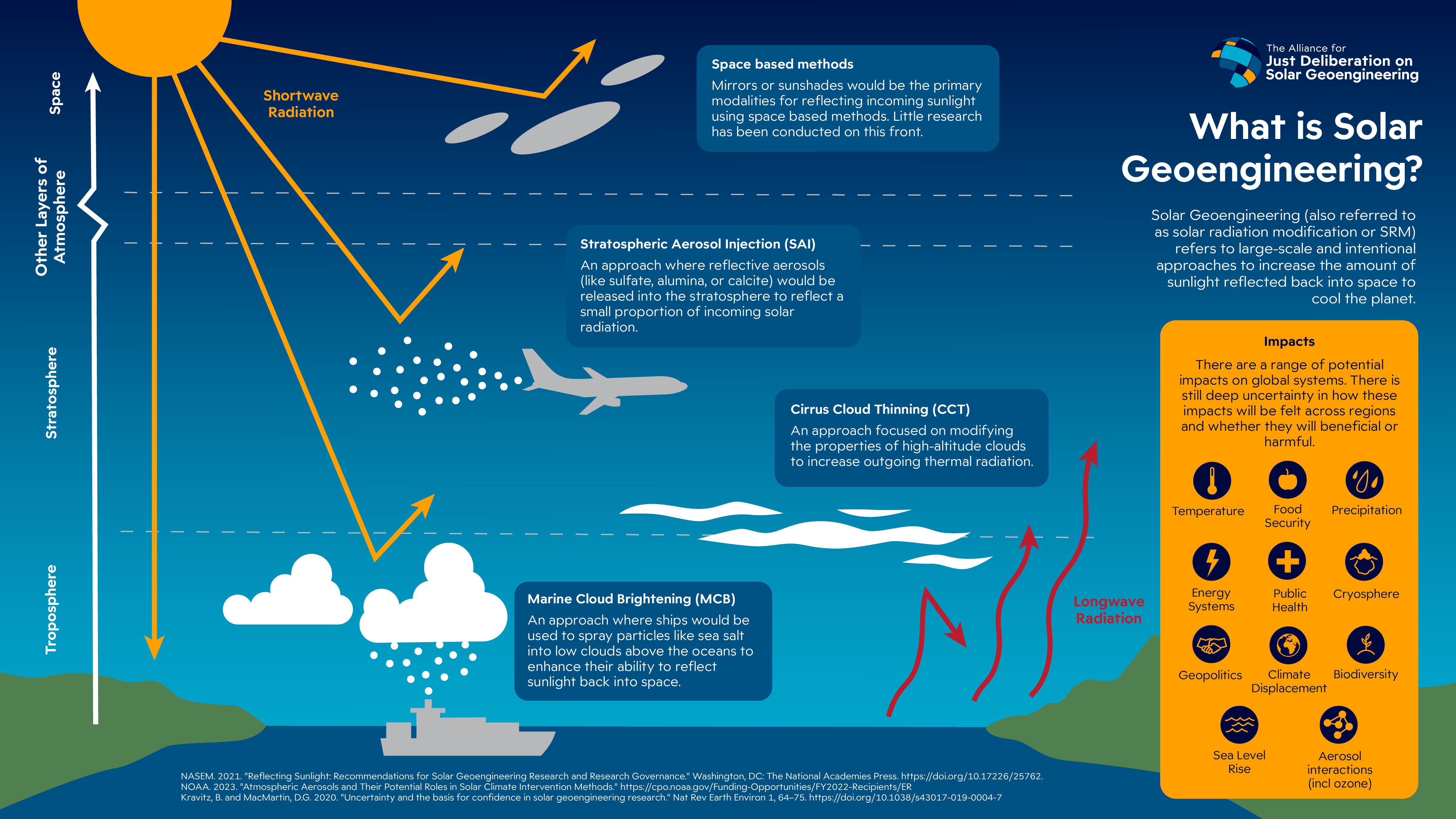
There is an array of approaches, illustrated in Figure 1, and associated
potential impacts (which could be beneficial or harmful) across physical
and social systems. The most prominent of these approaches are
stratospheric aerosol injection (SAI) and marine cloud brightening (MCB).
[image: A representation of different SG approaches, including
stratospheric aerosol injection, marine cloud brightening, cirrus cloud
thinning, and space based approaches. There are a range of potential
impacts on global systems. There is still deep uncertainty in how these
impacts will be felt across regions and whether they will be beneficial or
harmful.]
<https://kleinmanenergy.upenn.edu/wp-content/uploads/2023/12/SGInfographic.png>

The implications of such a global technology merit a better understanding
of governance for both research and potential deployment. Governance is a
complex term. It is not simply oversight or regulation but is defined as
any system of formal or informal rules or voluntary guidelines intended to
affect or influence research or potential deployment (The Alliance for Just
Deliberation on Solar Geoengineering 2023).

This includes the structure of funding, frameworks for transparency and
public engagement, and potential international negotiations or agreements.
Actors in governance are not only governments, but span academia and
research institutions, civil society, and philanthropy. Research governance
specifically is essential to build trust, ensure responsible activity, and
create better research outcomes.

Influential processes and institutions are beginning to engage with the
topic in important and different ways (see some examples in Table 1). There
has also been increasing funding (though on a much smaller scale relative
to other climate funding) from philanthropy as well as the U.S. government,
which is currently approximately $11M/year (U.S. Congress 2023). It is
still important to note, however, that there are still very few civil
society organizations, policymakers, and academic institutions engaged in
the topic, especially in climate-vulnerable regions.
A Major Shift in U.S. Activity

Of recent examples, the congressionally-mandated White House report is
significant as the first U.S. federal policy engagement in SG outside of
appropriations and the first major government report on the topic globally.
Understanding the content of the report, how this report came into being,
and the process by which the report was developed all bear significance for
how policy around SG may evolve in the future.
WHITE HOUSE REPORT ORIGINS AND PROCESS

The report was authored by the White House Office of Science and Technology
Policy (OSTP). It was supported by a cross-agency working group that
included members from the U.S. Global Change Research Program, the National
Oceanic and Atmospheric Administration (NOAA), the Department of Energy
(DOE), the National Science Foundation (NSF), the Department of Defense,
the Environmental Protection Agency (EPA), NASA, and the Department of
State, among others.

The U.S. Congress mandated the White House report in fiscal year 2022
(FY22) appropriations report language with the following relevant sections
(U.S. Congress 2022):

*NOAA is directed to support OSTP, in coordination with DOE and NSF to
provide a five-year plan, not later than 180 days after enactment of this
Act, with a scientific assessment of solar and other rapid climate
interventions in the context of near-term climate risks and hazards. The
report shall include: (1) the definition of goals in relevant areas of
scientific research; (2) capabilities required to model, analyze, observe,
and monitor atmospheric composition; (3) climate impacts and the Earth’s
radiation budget; and (4) the coordination of Federal research and
investments to deliver this assessment to manage near-term climate risk and
research in climate intervention.*

The congressional directive also subsequently requests that OSTP develop a
“research governance framework to provide guidance on transparency,
engagement, and risk management for publicly funded work in solar
geoengineering research.”

Importantly, the authors were very clear that this report was only pursued
due to the congressional mandate, with further major action in this space
unlikely in the near term. The report states:

*The issuance of this report does not signal any Executive Branch policy
decision(s) regarding SRM. The report is only a response to the
Congressional directive. Any future decisions around Federal SRM
activities, including SRM research, must be considered in the broader
context of scientific and societal factors, Administration priorities, and
available resources.*

While this signals that further action from the Biden administration will
likely not be taken until there is a larger push, the congressional
directive does exist, and the report enumerates U.S. government
perspectives that did not yet exist prior to its release.

The external engagement process for the writing of this report is also
important to consider as public participation and inclusion are emphasized
as being critical in this field by major institutions and
researchers—including by this report itself (UNEP 2023; NAS 2023; OSTP
2023).

There was a public comment period, but it was only open for 21 days
(USGCRP, 2022). In addition, only the congressional language was provided
to comment upon rather than a draft of the report. Overall, there was also
minimal formal consultation with the expert community, especially the
governance community, and with international institutions or experts.
WHITE HOUSE REPORT SUMMARY

Substantive highlights of the report include:

Strong support for expanded research, including outdoor experimentation. The
report states that outdoor experiments would be valuable alongside modeling
and lab-based research. Importantly, there is more support from recent
reports and open letters for expanded research (UNEP 2023; Hiar 2023). But
outdoor experimentation remains one of the most fraught areas of SG, with
some coalitions and groups calling for bans on such activities (Bierman et
al., 2021; CAN International 2019).

The report also supports expanded scenario-based research and the
development of monitoring capabilities to detect potential deployment from
other actors. Significantly, the report supported an international
assessment of the state of the SG field—a proposal that was also suggested
by recent assessments this year (UNEP 2023; Climate Overshoot Commission
2023), as well as in a 2019 UN environment assembly resolution that failed,
partly due to the U.S. government (Chemnick 2019).

Strong support for robust research governance, but little discussion on
implementation. Significantly, the report stated that research should
adhere to clear research governance standards, including transparency,
oversight, safety, public consultation, international cooperation, and
periodic review. It also suggested that any research program should be
coordinated by USGCRP and helpfully notes the need for co-evolving
standards as research progresses.

However, the dedicated “initial research governance framework” offered few
details on how to accomplish any of these goals. The recommendations listed
did not draw from existing frameworks nor had tangible next steps or
activities.

Most notably, while there was support for public consultation, there was
also no discussion on how it would be built or funded, who would run and
oversee such activity, and the different needs for which engagement would
be necessary.

Support for international research cooperation. The report discusses a
high-level framework around why international cooperation is necessary,
what cooperation should be on, whom cooperation might be with, and
potential approaches (e.g., type and forum). There is a significant
emphasis on building a culture of collaboration in an international context
for both research and its governance.

The report recognizes that global partnerships can help build the
foundation for a more inclusive field across sectors. However, there is
limited discussion on how to empower the Global South and
climate-vulnerable countries in research and governance processes and what
fora might enable more equitable power distribution.

Support for risk-risk framework. The report supports the use of a risk-risk
framework, an important lens that has become more prevalent in SG
literature. This framework states that the potential risks and benefits
associated with SG must be considered relative to those associated with
climate change. The report states that this framing “would contribute to
the necessary context in which policymakers can consider the potential
suitability of SRM as a component of climate policy”.

Support for an understanding of justice implications, but not holistically. A
discussion of environmental justice included a recognition of the potential
of SG to both reduce or exacerbate inequities and highlighted the risks
facing vulnerable and frontline communities. The report also helpfully
raised issues of procedural justice (fairness in decision-making) as well
as intergenerational concerns.

However, justice was only included as a “gap to inform research” rather
than woven throughout the report as an overarching set of principles to
guide a potential framework, including governance.

Missing pieces. Overall, there were several missing pieces in the report,
including a discussion of the role of civil society, a robust discussion of
the role of the Global South and climate-vulnerable countries, and how to
build transparency beyond a research database.
BROAD IMPLICATIONS

There are considerable high-level implications for SG research and
governance, both domestically and internationally, especially in the
context of volatile political environments.

One of the most consequential aspects is the existence of the report itself
as the first major indication of U.S. federal policy involvement. One major
outcome of such involvement is motivating more participation in SG
discussions and research in other countries and in international bodies.
While it remains to be seen how international governments or institutions
will respond, the report is starting to be included in new discussions.

However, whether U.S. government interest is coming at the right time is a
challenging question considering the political environment of the United
States. SG research, especially outdoor experimentation, remains
controversial. The context of what party is in power has a huge bearing on
how potential federally-led, small-scale experimentation could be perceived.

For many in the SG field, and as stated in this brief, support for robust
mitigation must be a priority and the foundation for potential
consideration of SG. If that is not the case, the legitimacy of any
research outcomes would be in question.

Broadly, the indication of public institutions involving themselves is also
an important one. Public programs are a means of oversight and
transparency. However, the type of public institution (e.g., a science
agency versus a military institution) can drastically impact the level of
public trust. Erosion in public perception of federal bodies could also
create deeper levels of mistrust and misinformation. In this context, the
role of civil society and academic bodies is critical to serve as
institutions that can build accountability, legitimacy, and credibility.
Future Recommendations

As discussions and activity around SG grow, there must be more clarity
around governance, the institutions involved, and requirements for
research. Research will need to answer critical questions around the
impacts, social dimensions, and potential viability for SG in the context
of climate change, but the types and scale of research pursued and under
what frameworks require more focused consideration.

The following are high-level recommendations for SG research governance for
institutions conducting research, building research agendas, or
participating in its governance. Responsible, equitable research is not
possible without well-built, collaborative, and co-evolving governance
mechanisms in place.

   1. Research governance must be anticipatory, built collaboratively
   across sectors, and ultimately widely accepted across institutions.
   Researchers, especially for potential small-scale outdoor experimentation,
   must be able to function within a well-understood environment to be able to
   plan successfully. Further, publics must be able to trust the processes
   that research is functioning within for research outcomes to have
   legitimacy.
   2. Any research agenda must include a robust plan and guidance for
   *meaningful* public participation *and* necessary capacity building.
   Public input cannot be a one-off but rather a much more substantive and
   robust process across a range of publics and stakeholders throughout a
   research process, especially for outdoor experimentation (i.e., from
   development to implementation to analysis and publication).
   3. Clear pathways for legitimate collaboration with climate-vulnerable
   communities and nations must be enumerated, prioritized, and pursued in the
   research enterprise itself—including in the development of research
   questions, relevant scenarios, and the necessary governance frameworks.
   4. Any research program must be created with full transparency
   surrounding guidance, funding, goals, outcomes, and involved actors.
   5. The building and implementation of a research program should not only
   involve academia but also be deeply engaged with civil society. Civil
   society is a key sector in connecting with communities, building inclusion,
   and providing accountability.
   6. Participation from institutions, organizations, or processes in SG
   discussions should not be painted as advocacy. There cannot be a taboo
   placed on organizations or individuals wanting to engage in SG discussion
   and deliberation.
   7. *Source: Kleinman Center for Energy Policy*

--
You received this message because you are subscribed to the Google Groups
"geoengineering" group.
To unsubscribe from this group and stop receiving emails from it, send an email
to [email protected].
To view this discussion on the web visit
https://groups.google.com/d/msgid/geoengineering/CAHJsh9-rwA-z7KR2j-nfmYdAe7759%3DV8_vtG4Lo%2Bx46cAxD%2BOQ%40mail.gmail.com.