*SOLAR GEOENGINEERING WEEKLY SUMMARY (29 APRIL - 05 MAY 2024)*

Subscribe to our newsletter to receive monthly updates on Solar
Geoengineering:
Solar Geoengineering Updates
<https://solargeoengineeringupdates.substack.com?utm_source=substack&utm_campaign=publication_embed&utm_medium=email>
Monthly news summaries about solar geoengineering. Links to scientific
papers, news articles, jobs, podcasts, and videos.
<https://solargeoengineeringupdates.substack.com?utm_source=substack&utm_campaign=publication_embed&utm_medium=email>
By Andrew Lockley
<https://solargeoengineeringupdates.substack.com?utm_source=substack&utm_campaign=publication_embed&utm_medium=email>
------------------------------
RESEARCH PAPERSThe security implications of geoengineering:blame,imposed
agreement and the security of critical infrastructure
<https://sussex.figshare.com/articles/report/The_security_implications_of_geoengineering_blame_imposed_agreement_and_the_security_of_critical_infrastructure/23414003/1>
Nightingale, P., & Cairns, R. (2014). The security implications of
geoengineering: Blame, imposed agreement and the security of critical
infrastructure. *Sussex University: Climate Geoengineering Governance
Working Paper Series*, *18*.

*Abstract*

The prospect of solar geoengineering in response to climate change (on the
basis of its supposedly significantly lower cost and/or more rapid impact
on global temperature than carbon reduction strategies) raises a number of
security concerns that have traditionally been understood within a standard
Geo-political framing of security. This relates to unrealistic direct
application in inter-State warfare or to a securitization of climate
change. However, indirect security implications are potentially
significant. Current capability, security threats and international law
loopholes suggest the military, rather than scientists would undertake
geoengineering, and solar radiation management (SRM) in particular. SRM
activity would be covered by Critical National Infrastructure policies, and
as such would require a significant level of secondary security
infrastructure. Concerns about termination effects, the need to impose
international policy agreement 4 (given the ability of 'rogue States' to
disrupt SRM and existing difficulties in producing global agreement on
climate policy), and a world of extreme weather events, where weather is
engineered and hence blameworthy rather than natural, suggest these costs
would be large. Evidence on how blame is attributed suggest blame for
extreme weather events may be directed towards more technologically
advanced nations, (such as the USA) even if they are not engaged in
geoengineering. From a security perspective SRM is costly, ungovernable,
and raises security concerns of a sufficient magnitude to make it a
non-viable policy option.

The political value of letting hopes die
<https://www.tandfonline.com/doi/full/10.1080/13698230.2024.2344383>

Howard, D. (2024). The political value of letting hopes die. *Critical
Review of International Social and Political Philosophy*, 1-24.

*Abstract*

Much recent philosophical discussion has explored the political value of
holding onto certain hopes for shared ends. This paper considers whether
there is correlative political value of letting go of certain hopes or at
least of refraining from publicly affirming particular hopes for our
collective future. For instance, recently a coalition of scientists and
governance scholars have called on governments, international agencies, and
other actors to agree to a moratorium on a controversial climate-change
mitigation strategy known as solar geoengineering. They argue that there is
no place for hope for a successful global solar geoengineering strategy in
a just and inclusive climate policy portfolio. This paper asks: (i) what
sort of demand are these coalitions making? (ii) Is giving up hopes the
sort of thing that is warranted for people to do on the basis of these
calls? And (iii) is this the sort of thing that can be legitimately
demanded of others? Ultimately, I defend both the political value of our
own letting go of certain hopes as well as the legitimacy of making such
demands on others (at least in certain cases). This is because what I take
people to be doing when they make such demands of others is not necessarily
to get others to create new desires or to be more or less optimistic about
a certain course of action; rather they are making such demands to outline
the terms of continued political engagement as they work towards a shared
future.

Dependency of the impacts of geoengineering on the stratospheric sulfur
injection strategy – Part 2: How changes in the hydrological cycle depend
on the injection rate and model used
<https://esd.copernicus.org/articles/15/405/2024/>

Laakso, A., Visioni, D., Niemeier, U., Tilmes, S., & Kokkola, H. (2024).
Dependency of the impacts of geoengineering on the stratospheric sulfur
injection strategy–Part 2: How changes in the hydrological cycle depend on
the injection rate and model used. *Earth System Dynamics*, *15*(2),
405-427.

*Abstract*

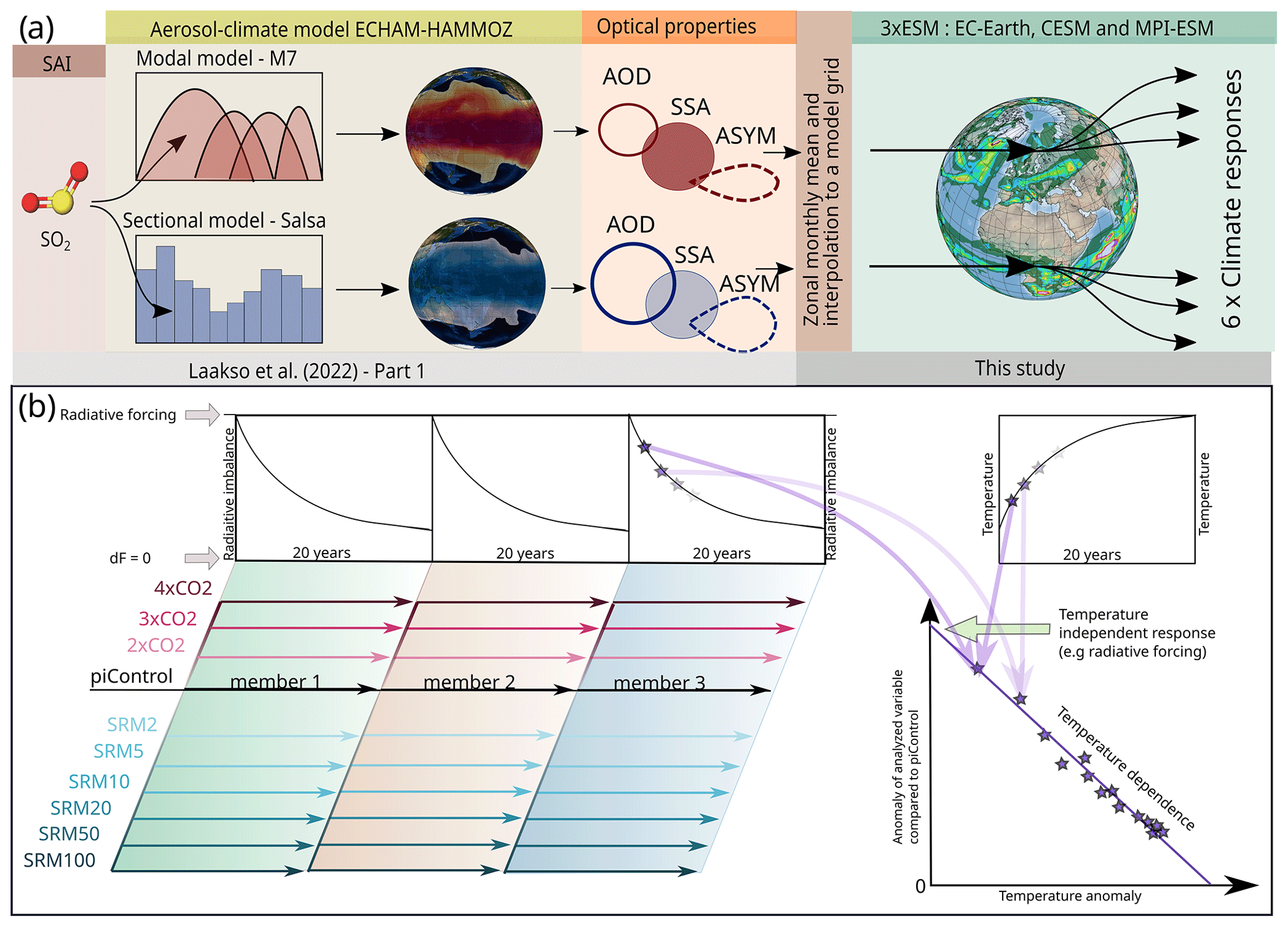
This is the second of two papers in which we study the dependency of the
impacts of stratospheric sulfur injections on the model and injection
strategy used. Here, aerosol optical properties from simulated
stratospheric aerosol injections using two aerosol models (modal scheme M7
and sectional scheme SALSA), as described in Part 1 (Laakso et al., 2022),
are implemented consistently into the EC-Earth, MPI-ESM and CESM Earth
system models (ESMs) to simulate the climate impacts of different injection
rates ranging from 2 to 100 Tg(S) yr−1. Two sets of simulations were run
with the three ESMs: (1) regression simulations, in which an abrupt change
in CO2 concentration or stratospheric aerosols over pre-industrial
conditions was applied to quantify global mean fast temperature-independent
climate responses and quasi-linear dependence on temperature, and (2)
equilibrium simulations, in which radiative forcing of aerosol injections
with various magnitudes compensated for the corresponding radiative forcing
of CO2 enhancement to study the dependence of precipitation on the
injection magnitude. The latter also allow one to explore the regional
climatic responses. Large differences in SALSA- and M7-simulated radiative
forcing in Part 1 translated into large differences in the estimated
surface temperature and precipitation changes in ESM simulations; for
example, an injection rate of 20 Tg(S) yr−1 in CESM using M7-simulated
aerosols led to only 2.2 K global mean cooling, while EC-Earth–SALSA
combination produced a 5.2 K change. In equilibrium simulations, where
aerosol injections were utilized to offset the radiative forcing caused by
an atmospheric CO2 concentration of 500 ppm, the decrease in global mean
precipitation varied among models, ranging from −0.7 % to −2.4 % compared
with the pre-industrial climate. These precipitation changes can be
explained by the fast precipitation response due to radiation changes
caused by the stratospheric aerosols and CO2, as the global mean fast
precipitation response is shown to be negatively correlated with global
mean atmospheric absorption. Our study shows that estimating the impact of
stratospheric aerosol injection on climate is not straightforward. This is
because the simulated capability of the sulfate layer to reflect solar
radiation and absorb long-wave radiation is sensitive to the injection rate
as well as the aerosol model used to simulate the aerosol field. These
findings emphasize the necessity for precise simulation of aerosol
microphysics to accurately estimate the climate impacts of stratospheric
sulfur intervention. This study also reveals gaps in our understanding and
uncertainties that still exist related to these controversial techniques.

<https://substackcdn.com/image/fetch/f_auto,q_auto:good,fl_progressive:steep/https%3A%2F%2Fsubstack-post-media.s3.amazonaws.com%2Fpublic%2Fimages%2Fadc98e80-b447-4785-9709-27bcd0c42add_2067x1487.png>
Laakso,
A., Visioni, D., Niemeier, U., Tilmes, S., & Kokkola, H. (2024). Dependency
of the impacts of geoengineering on the stratospheric sulfur injection
strategy–Part 2: How changes in the hydrological cycle depend on the
injection rate and model used.
<https://esd.copernicus.org/articles/15/405/2024/>*Earth System Dynamics
<https://esd.copernicus.org/articles/15/405/2024/>*,
<https://esd.copernicus.org/articles/15/405/2024/>*15
<https://esd.copernicus.org/articles/15/405/2024/>*(2), 405-427.
<https://esd.copernicus.org/articles/15/405/2024/>
------------------------------
WEB POSTSThe Solar Geoengineering Updates Newsletter (April'2024)
Solar Geoengineering Updates
The Solar Geoengineering Updates Newsletter (April'2024)
<https://solargeoengineeringupdates.substack.com/p/the-solar-geoengineering-updates-19f?utm_source=substack&utm_campaign=post_embed&utm_medium=email>


Read more
<https://solargeoengineeringupdates.substack.com/p/the-solar-geoengineering-updates-19f?utm_source=substack&utm_campaign=post_embed&utm_medium=email>
3 days ago · Andrew Lockley
Veteran climate diplomat to advise geoengineering startup
<https://www.axios.com/2024/05/03/geoengineering-firm-climate-diplomat>
(Axios)SilverLining Announces $20.5 Million in Funding to Advance its
Governance and Equity Initiatives on Near-Term Climate Risk and Climate
Intervention
<https://www.silverlining.ngo/insights/silverlining-announces-20-5-million-in-funding>
(Silver Lining)Toward some Orientation in a Labyrinth of Expectations and
Concerns —Co-CREATE Project
<https://medium.com/@honegger.matthias/toward-some-orientation-in-a-labyrinth-of-expectations-and-concerns-d4b80c864aa7>
(Medium)African scientists gather in Cape Town to develop collaborative SRM
research
<https://www.degrees.ngo/african-scientists-gather-in-cape-town-to-develop-collaborative-srm-research/>
(The Degrees Initiative)Warning that solar geoengineering could cause
unexpected regional heating
<https://www.chemistryworld.com/news/warning-that-solar-geoengineering-could-cause-unexpected-regional-heating/4019406.article>
(Royal Society of Chemistry)NASA Balloons Head North of Arctic Circle for
Long-Duration Flights
<https://www.nasa.gov/centers-and-facilities/wallops/nasa-balloons-head-north-of-arctic-circle-for-long-duration-flights/>
(NASA)
------------------------------
THESISEmerging Anticipatory Governance of Solar Geoengineering: Analysing
Its Nature And Implications <https://edepot.wur.nl/654184>
<https://edepot.wur.nl/654184>
------------------------------
REPORTSolar Radiation Modification (SRM): Intractable Governance and
Uncertain Science
<https://www.umweltbundesamt.de/publikationen/solar-radiation-modification-srm-intractable>

*Abstract*

Solar radiation modification is highly controversial. The implementation of
invasive geoengineering technologies would entail serious and largely
unforeseeable ecological, and geopolitical risks. Considerable scientific
disagreement exists around the extent of the risks, how they relate to
increased risks of climate change, and whether uncertainties could be
resolved. In expert workshops held in 2022 the scientific, technical, and
geopolitical viability and desirability of SRM was discussed. This
discussion paper presents a blended overview of the academic literature on
solar geoengineering and the positions expressed at expert workshops, as
well as personal assessments from the authors.

<https://www.umweltbundesamt.de/publikationen/solar-radiation-modification-srm-intractable>
------------------------------
SURVEYExpert elicitation on meaningful baselines for SRM simulations
<https://substack.com/redirect/ad794f22-2625-4824-8951-5fbf06372ddf?j=eyJ1IjoiMjJrMHl3In0.wQQsFypG52typ8FI2nhnJ8eUoUIIkdCkuhmzxNYKtgE>
------------------------------
*FACT SHEETS*A short summary of our funded projects in Africa, Asia and
Latin America
<https://www.degrees.ngo/wp-content/uploads/2024/05/Fact_Sheets_RegionalV5.pdf>
(The Degrees Initiative)
<https://www.degrees.ngo/wp-content/uploads/2024/05/Fact_Sheets_RegionalV5.pdf>
<https://www.degrees.ngo/wp-content/uploads/2024/05/Fact_Sheets_RegionalV5.pdf>
------------------------------
*UPCOMING EVENTS*(NEW) Climate Interventions: Solar Geoengineering by The
Institute for Science & Policy and The Institute for Responsible Carbon
Removal
<https://institute.dmns.org/events/climate-interventions-solar-geoengineering/>
| 21 May 2024*Fourteenth GeoMIP Workshop | Ithaca, USA
<https://climate.envsci.rutgers.edu/GeoMIP/2024.html> | 10-12 July 2024*

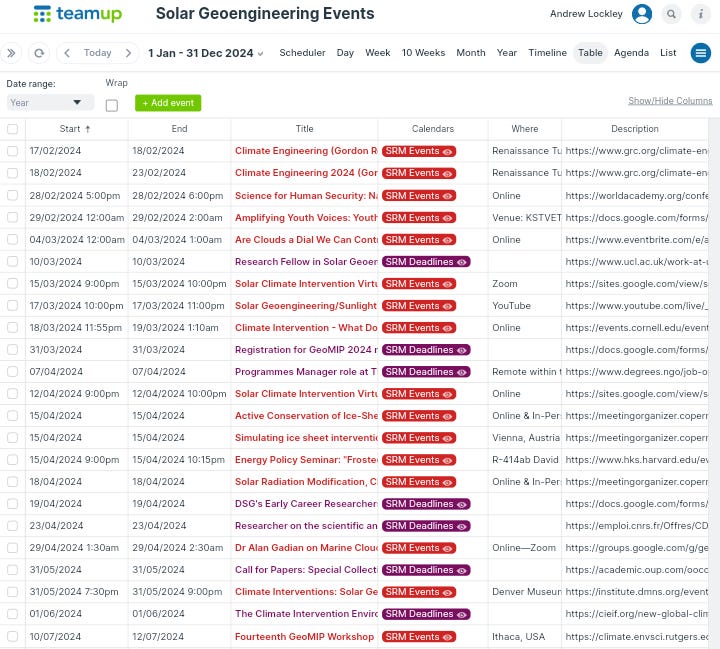
Solar Geoengineering Events Calendar <https://teamup.com/ks64mmvtit583eitxx>

*GUIDELINES:**Sync selected events to your default calendar in these simple
steps:**1) Click on the event you want to sync.**2) Tap the menu icon
(three vertical lines) at the top left.**3) Choose 'Share.'**4) Pick your
default calendar.**5) Save the event.*

*Sync the entire Teamup Calendar to your default calendar with these simple
steps:**1) Tap the menu icon (three vertical lines) at the top right.**2)
Choose 'Preferences.'**3) Click 'iCalendar Feeds.'**4) Copy the URL shown
for 'Solar Geoengineering Events / SRM Deadlines.'’**5) Paste the URL into
your default calendar settings (Open Google Calendar in your web browser if
you are using Gcal).**6) Click 'Subscribe' or 'Add Calendar.'*

*For more detailed instructions,
visit: https://calendar.teamup.com/kb/subscribe-to-teamup-icalendar-feeds/
<https://calendar.teamup.com/kb/subscribe-to-teamup-icalendar-feeds/>*

*You can directly sync all Solar Geoengineering events to your default
calendars by pressing the link below:*

Sync SG Events to your Default Calendar
<https://ics.teamup.com/feed/ks64mmvtit583eitxx/0.ics>
<https://substackcdn.com/image/fetch/f_auto,q_auto:good,fl_progressive:steep/https%3A%2F%2Fsubstack-post-media.s3.amazonaws.com%2Fpublic%2Fimages%2F7937484b-e3c9-46d4-9734-d2dc493abaab_720x649.png>
Solar
Geoengineering Events Calendar <https://teamup.com/ks64mmvtit583eitxx>
------------------------------
*PODCASTS*Warm pool & SAI - Günther (FIXED) | Reviewer 2 does geoengineering

Warm pool & SAI - Günther (FIXED)

Reviewer 2 does geoengineering

1:27:07
<https://podcasts.apple.com/us/podcast/warm-pool-sai-g%C3%BCnther-fixed/id1529459393?i=1000650436323&uo=4>

"Moritz Günther tries valiantly to get @geoengineering1 to understand the
atmospheric dynamics of SAI's impacts on the warm pool, but it's rather
like watching him trying to train a baboon to use Photoshop - there's some
engagement, and the occasional flash of comprehension before it all gets
too much for him.

NB this is the FIXED version - the original had a couple of important
errors of sign from Günther. If you've listen to the old version, pls see
this important author note "the part where I say it's destabilising...
should actually be stabilising... roughly at 1:10:30 - 1:11:00. The part
where I say we would need less aerosol if the Brewer-Dobson circulation
mechanism exists but we would actually need more is around 1:21:30 -
1:22:00." (timestamps from old episode) And BTW, props to him for a)
checking b) fessing up. Science progresses one correction at a time.

Günther, M., Schmidt, H., Timmreck, C., and Toohey, M.: Why does
stratospheric aerosol forcing strongly cool the warm pool?, EGUsphere
[preprint], https://doi.org/10.5194/egusphere-2024-429, 2024."

Controlling MCB - Walker Lee Part 1 | Reviewer 2 does geoengineering

Controlling MCB - Walker Lee Part 1

Reviewer 2 does geoengineering

1:16:35
<https://podcasts.apple.com/us/podcast/controlling-mcb-walker-lee-part-1/id1529459393?i=1000654511490&uo=4>

"What control can we exercise over MCB? Should it be confined to small,
climatically sensitive areas - or expanded at great cost, to minimise
inter-regional disparities? Walker Lee discusses the issue in depth. (See
PT 2 for a discussion on disability and diversity).

Jack's first paper:

https://doi.org/10.22541/essoar.171322700.02512514/v1

Jack's second paper: https://doi.org/10.22541/essoar.171201044.45268441/v1";

Disability & ideological diversity in academia - Walker Lee, Part 2 |
Reviewer 2 does geoengineering

Disability & ideological diversity in academia - Walker Lee, Part 2

Reviewer 2 does geoengineering

28:12
<https://podcasts.apple.com/us/podcast/disability-ideological-diversity-in-academia-walker/id1529459393?i=1000654511567&uo=4>

"We've extracted this very interesting discussion from Walker Lee's new
episode, because a) it's a standalone section and b) the main episode was
already quite long. Here, Walker Lee describes in vibrant and very personal
terms his own academic journey, touching on important issues of ideological
diversity and disability discrimination. It's not trad R2, but we liked it.
Enjoy!"

Shuchi Talati on ethics and governance of solar geoengineering |
Challenging Climate <https://www.challengingclimate.org/1873533/14809487>

"Today’s guest is Dr. Shuchi Talati, a climate technology and governance
expert and the founder of The Alliance for Just Deliberation on Solar
Geoengineering. In this episode, we discuss ethics and governance of solar
geoengineering, the formal cancellation of Harvard’s SCoPEx experiment, and
the UN Environment Assembly deliberations on Solar Radiation Modification."

------------------------------
YOUTUBE VIDEOSSolar Geoengineering (SRM) and a new type of denial | Solar
Geoengineering Advocate <https://www.youtube.com/watch?v=gklYR0Me_fo>

"A few thoughts on SRM and why we will probably need it."

Herb Simmens Presentation on Climate Vocabulary to Healthy Planet Action
Coalition 2 May 2024 | Robbie Tulip
<https://www.youtube.com/watch?v=Dk9UOaw5vuc>

"This discussion features the narrative story in Herb Simmens’ recent book
A Climate Vocabulary of the Future. That segment of the book looks back
from the year 2035. It describes how humanity began to achieve a healthy
climate.

Herb Simmens will present that narrative, and lead a discussion on the
kinds of stories and language that can inform and excite people to embrace
the HPAC vision for a healthy planet.

Herb’s presentation and the subsequent discussion are particularly
stimulating and timely, now that the HPAC Advocacy Task Force is beginning
to explore what an effective and compelling narrative might be developed to
advance our mission."

------------------------------
DEADLINES*Call for Papers: Towards a Risk-Risk-Assessment of Solar
Radiation Modification: Effectiveness, Feasibility, Side effects,
Governance
<https://substack.com/redirect/8984e2ab-dd2f-4b65-ad88-be835e6efe5f?j=eyJ1IjoiMjJrMHl3In0.wQQsFypG52typ8FI2nhnJ8eUoUIIkdCkuhmzxNYKtgE>
|
Deadline for manuscript submissions: 31 May 2024**(NEW) Climate
Intervention Environmental Impact Fund
<https://substack.com/redirect/8cd6566c-1d02-4bf1-9a81-04fc425e074f?j=eyJ1IjoiMjJrMHl3In0.wQQsFypG52typ8FI2nhnJ8eUoUIIkdCkuhmzxNYKtgE>
| *Deadline
for applying: 01 *June 2024*

--
You received this message because you are subscribed to the Google Groups
"geoengineering" group.
To unsubscribe from this group and stop receiving emails from it, send an email
to [email protected].
To view this discussion on the web visit
https://groups.google.com/d/msgid/geoengineering/CAHJsh990z1jcgQaFy%2Bqmx4Wkd9yRrCGUYq-1pnR4c0HYDZmWHQ%40mail.gmail.com.