SOLAR GEOENGINEERING WEEKLY SUMMARY (25 NOVEMBER - 01 DECEMBER 2024)

Subscribe to our newsletter to receive monthly updates on Solar
Geoengineering:
Solar Geoengineering Updates
<https://solargeoengineeringupdates.substack.com?utm_source=substack&utm_campaign=publication_embed&utm_medium=email>
Monthly news summaries about solar geoengineering. Links to scientific
papers, news articles, jobs, podcasts, and videos.
<https://solargeoengineeringupdates.substack.com?utm_source=substack&utm_campaign=publication_embed&utm_medium=email>
By Andrew Lockley
<https://solargeoengineeringupdates.substack.com?utm_source=substack&utm_campaign=publication_embed&utm_medium=email>
------------------------------
RESEARCH PAPERS*Marine emissions of methanethiol increase aerosol cooling
in the Southern Ocean <https://www.science.org/doi/10.1126/sciadv.adq2465>*
Wohl, C., Villamayor, J., Galí, M., Mahajan, A. S., Fernández, R. P.,
Cuevas, C. A., ... & Saiz-Lopez, A. (2024). Marine emissions of
methanethiol increase aerosol cooling in the Southern Ocean. *Science
Advances*, *10*(48), eadq2465.

*Abstract*

Ocean-emitted dimethyl sulfide (DMS) is a major source of climate-cooling
aerosols. However, most of the marine biogenic sulfur cycling is not routed
to DMS but to methanethiol (MeSH), another volatile whose reactivity has
hitherto hampered measurements. Therefore, the global emissions and climate
impact of MeSH remain unexplored. We compiled a database of seawater MeSH
concentrations, identified their statistical predictors, and produced
monthly fields of global marine MeSH emissions adding to DMS emissions.
Implemented into a global chemistry-climate model, MeSH emissions increase
the sulfate aerosol burden by 30 to 70% over the Southern Ocean and enhance
the aerosol cooling effect while depleting atmospheric oxidants and
increasing DMS lifetime and transport. Accounting for MeSH emissions
reduces the radiative bias of current climate models in this climatically
relevant region.

Impacts of Geoengineering Through Stratospheric Aerosol Injection on Global
Weather Patterns <https://hal.science/hal-04778938/>

Al-Qarni, A. (2024). Impacts of Geoengineering Through Stratospheric
Aerosol Injection on Global Weather Patterns.

*Abstract*

Stratospheric Aerosol Injection (SAI) has emerged as a promising
geoengineering strategy to mitigate the impacts of climate change by
reflecting solar radiation and reducing global temperatures. This study
investigates the potential effects of SAI on global weather patterns,
focusing on aerosol dispersion dynamics, temperature reduction, and
precipitation variability. Utilizing advanced climate models and
particle-tracking simulations, the research demonstrates that aerosol
particles achieve near-global coverage within six months of equatorial
injection, with coverage rates stabilizing at 97% after a decade.
SAI-induced cooling was most pronounced in the first ten years, with a peak
global temperature reduction of approximately 0.6°C compared to baseline
scenarios. However, the cooling effects were transient, necessitating
sustained injection to maintain temperature stabilization. Additionally,
significant shifts in precipitation patterns were observed, including
reduced tropical rainfall and increased polar precipitation, highlighting
the complex interactions between aerosols and atmospheric systems. While
SAI shows potential as a climate intervention tool, the study underscores
the need for further research on its long-term environmental impacts,
governance frameworks, and ethical considerations. This work contributes
critical insights into the feasibility and risks of SAI, informing global
discourse on geoengineering strategies.

Scientific models versus power politics: How security expertise reframes
solar geoengineering
<https://www.cambridge.org/core/journals/review-of-international-studies/article/scientific-models-versus-power-politics-how-security-expertise-reframes-solar-geoengineering/55CD8ABEBD95541C933E37599C3130B0>

Corry, O., McLaren, D., & Kornbech, N. (2024). Scientific models versus
power politics: How security expertise reframes solar geoengineering. *Review
of International Studies*, 1-20.

*Abstract*

Persistently rising atmospheric greenhouse gas concentrations challenge
dominant Liberal hopes that science and multilateralism might deliver
rational, global climate outcomes. Emerging Realist climate approaches that
take geopolitics and national interests more seriously have yet to explore
Morgenthau’s concern that ‘scientism’ – exaggerated faith in scientific
rationality to solve political problems – would lead to disastrous
underestimations of power and irrationality. Recently, Realists have mooted
‘solar geoengineering’ designs as a ‘lesser evil’ option to deliberately
cool the Earth independently of emissions reductions. However, assessments
of solar geoengineering prospects barely factor in Realist concerns,
focusing instead on idealised scientific modelling of bio-physical effects
and Liberal governance scenarios. To explore how geoengineering
techno-science would be ‘translated’ into security assessments,
geopolitical logics were elicited through interviews and group discussions
with (mainly Arctic-oriented) national security professionals. Security
experts reframe solar geoengineering in three significant ways: (a) from a
climate ‘global public good’ to a source of geopolitical leverage and
disruption; (b) from a risk-reduction tool to a potential source of
distrust and escalation; and (c) from a knowledge-deficit problem solvable
by more research, to a potential disinformation vector. This expands
Realist scholarship on climate change and identifies serious risks to
ongoing scientific and commercial pursuit of such technologies.

>From informal to formal governance of solar radiation management
<https://www.tandfonline.com/doi/full/10.1080/14693062.2024.2430688#abstract>

Brent, K., Simon, M., & McDonald, J. (2024). From informal to formal
governance of solar radiation management. *Climate Policy*, 1-18.

*Abstract*

There is growing interest in the potential for solar radiation management
(SRM) to address rising global temperatures, both at global and regional
levels. SRM schemes are highly controversial; their governance has come
under close scrutiny from researchers and policymakers. Key challenges
include how best to govern SRM to mitigate risk, promote social
acceptability and encourage responsible research, development, and
deployment. In the absence of formal targeted laws and policies, a
proliferation of academic – and NGO-led voluntary principles have been
proposed, to develop governance norms from the bottom up. In the past
fifteen years, ten prominent governance proposals identified common
principles, including: SRM to be governed as a public good; public
consultation and research transparency; and impact assessment, monitoring
and review. We systematically reviewed and categorized the principles in
these governance proposals, demonstrating that there is a high level of
commonality between the principles they contain. While more informal
governance frameworks are currently being advocated and/or developed, we
argue that further specificity in over-arching principles is not required
because existing frameworks already provide policymakers with a basis for
developing robust domestic instruments to govern SRM research and
development. The priority now is to see these principles incorporated into
more formal instruments, such as institutional research policies and
domestic legislation, and adapted to local and national contexts. This next
step is also necessary to evaluate how these principles operate in
practice, especially in the event where SRM experiments are upscaled, and
promote accountability and oversight.

Effects of Warming and Stratospheric Aerosol Injection on Tropical Cyclone
Distribution and Frequency in a High-Resolution Global Circulation Model
<https://egusphere.copernicus.org/preprints/2024/egusphere-2024-3526/>

Feder, A., Randall, D., & Dazlich, D. (2024). Effects of Warming and
Stratospheric Aerosol Injection on Tropical Cyclone Distribution and
Frequency in a High-Resolution Global Circulation Model. *EGUsphere*, *2024*,
1-35.

*Abstract*

In recent years, as global circulation models (GCMs) have increased in
spatial resolution, increasingly realistic tropical cyclones (TCs) and TC
distributions have emerged from them. Where prior research on TC
climatologies has relied on proxies like Potential Intensity (PI) and
synthetic storm models, the cyclones emerging from the dynamics of newer
GCMs can now be analyzed directly, using native model variables.

Such direct analysis may be particularly useful in studying possible global
storm distributions under radically altered future climates, including
high-emissions warming scenarios, and even those shaped by climate
interventions. These interventions include various directed changes in
global albedo, such as Stratospheric Aerosol Injection (SAI), with only
limited precedent in the historical period. GCMs simulating realistic
climate intervention scenarios, have not as of yet paired storm-resolving
resolution with realistic intervention scenario construction. This has left
gaps in our understanding as to how interventions might affect global
storm/TC distributions.

In this paper, we utilize a new high-resolution model configuration to
conduct experiments examining the effects of SAI, on tropical cyclones and
global storm physics more broadly. These experiments are constructed based
on prior work on SAI, using the GLENS GCM ensemble. Our analysis centers on
3 10-year experiments conducted using 30-km grid spacing. These include a
recent-past calibration run; the Intergovernmental Panel on Climate Change
climate pathway SSP (IPCC, 2021), for the years 2090–2099, with no SAI; and
SSP 8.5, with SAI having begun in 2020 to maintain a global temperature
rise of no more than 1.5 °C, also simulated for the years 2090–2099. With
the resulting data sets, we deploy a novel TC-tracking algorithm to analyze
resulting changes in storm tracks and properties. Based on our results for
these different scenarios, we find that SAI, while in some ways restoring
global storm patterns to a pre-warming state, may also create unique
basin-scale TC distribution features and pose novel related hazards.

Reduced winter-time Clear Air Turbulence in the trans-Atlantic region under
Stratospheric Aerosol Injection
<https://essopenarchive.org/doi/full/10.22541/essoar.173238705.53228461/v1>

Barnes, K., Jones, A. C., Williams, P. D., & Haywood, J. M. (2024). Reduced
winter-time Clear Air Turbulence in the trans-Atlantic region under
Stratospheric Aerosol Injection. *Authorea Preprints*.

*Abstract*

Clear air turbulence (CAT) is a safety threat within the aviation sector
and is projected to worsen under global warming. Stratospheric aerosol
injection (SAI) is a climate intervention strategy that aims to ameliorate
climate change by artificially cooling Earth. Climate model simulations
have found a side-effect of SAI would be a strengthening of the positive
phase of the North Atlantic Oscillation (NAO). This links to a stronger
North Atlantic jet stream and suggests enhanced CAT in the region. Here, we
analyse simulations from the UKESM1 climate model to evaluate the impact of
a realistic SAI application on winter-time trans-Atlantic CAT. We find a 23
% decrease in severe CAT frequency under SAI when compared to a baseline
high-end global warming scenario. Our results indicate that the
amelioration of global warming under SAI has a more dominant impact on CAT
over the North Atlantic than residual impacts to the NAO.

------------------------------
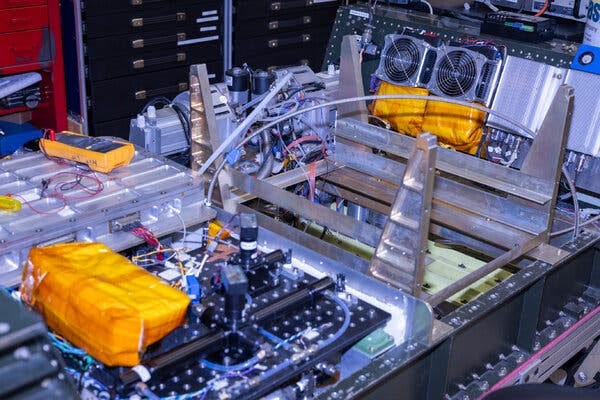
WEB POSTSThe U.S. Is Building an Early Warning System to Detect
Geoengineering
<https://www.nytimes.com/2024/11/28/climate/geoengineering-early-warning-system.html?unlocked_article_code=1.dU4.XxOc.VvLos6mzmdH-&smid=url-share>
(New York Times)Solar Radiation Management
<https://www.givinggreen.earth/climate-interventions/solar-radiation-management>
(Giving Green.Earth)Will Scientists Know if SRM Caused Extreme Weather?
<https://srm360.org/article/will-scientists-know-if-srm-caused-extreme-weather/>
(SRM360)The Importance of Transparent, Unbiased Communication on SRM
<https://srm360.org/perspective/importance-of-transparent-unbiased-communication-on-srm/>
(SRM360)Does International Law Prohibit SRM?
<https://srm360.org/article/does-international-law-prohibit-srm/>
(SRM360)Silicon
Valley is trying to fix climate change with balloons. But will it work?
<https://inews.co.uk/news/science/silicon-valley-fix-climate-change-balloons-3403748>
(iNews)
[image: A large silver rectangular instrument covered in circuits, tubes,
wires and fans.]
<https://substackcdn.com/image/fetch/f_auto,q_auto:good,fl_progressive:steep/https%3A%2F%2Fsubstack-post-media.s3.amazonaws.com%2Fpublic%2Fimages%2F796026b4-4524-4a3e-a735-6652a0c93512_600x400.jpeg>
The
world’s most sensitive device for detecting sulfur dioxide in NOAA’s
Boulder laboratory
<https://www.nytimes.com/2024/11/28/climate/geoengineering-early-warning-system.html?unlocked_article_code=1.dU4.XxOc.VvLos6mzmdH-&smid=url-share>
(The New York Times)
------------------------------
THESISExpert Perceptions on Solar Radiation Modification as a Strategic
Climate Response: Foresight on research and deployment from Finland
<https://helda.helsinki.fi/items/a0a3a863-a280-4717-88d1-08c8af10a7ea>

Haaslahti, E. A. (2024). Expert Perceptions on Solar Radiation Modification
as a Strategic Climate Response: Foresight on research and deployment from
Finland.

*Abstract*

The world is approaching 1.5 C of global average temperature rise which
marks a limit for ever more severe impacts from climate change. In climate
science and policy spheres, Solar Radiation Modification (SRM) is
increasingly being discussed based on its potential to rapidly reduce
negative impacts as a complementary approach with decarbonization.
Different technological approaches have been suggested to increase the
amount of sunlight that is reflected to space. The scientific community is
divided regarding potential benefits, risks and concerns linked to SRM,
which makes it more difficult to foresee future trajectories and create
governance for SRM activities. Understanding how experts perceive SRM
research and deployment in relation to the broader range of climate
response strategies and goals is important as it has critical policy
implications in terms of the future of SRM technologies.

This thesis studies the perceptions of climate change experts in Finland
focusing on two of the most studied SRM approaches: stratospheric aerosol
injection (SAI) and marine cloud brightening (MCB). Real-Time Delphi was
applied to gather data among a small expert panel whose arguments were
examined with qualitative content analysis through a constructive approach.
A process model was produced to describe how 1) scientific and governance
conditions, 2) attitudes, beliefs and feelings, 3) environmental and
technological concerns, and 4) navigating climate scenarios and response
strategies influence expert perceptions on SRM. The experts expressed
consistent support for indoor research and small-scale field experiments
around the two SRM methods arguing for precautionary approaches regarding
climate emergency situations. SRM deployment was largely seen as
undesirable. General pessimism towards global governance systems and
climate action as well as solving justice issues was highlighted in the
study. In the face of such radical uncertainties and social, technical, and
ecological concerns, open dialogue about different perceptions on SRM can
contribute to reflective, anticipatory, inclusive, and responsive policy
making.

------------------------------
JOB OPPORTUNITIESCurrent openings at The Degrees Initiative:
<https://www.degrees.ngo/careers/>
<https://www.degrees.ngo/careers/>

"The Degrees Initiative mission is to change the global environment in
which SRM is evaluated, ensuring informed and confident representation from
developing countries."

------------------------------
PODCASTSAGU SRM research ethics - Felgenhauer | Reviewer 2 does
geoengineering

AGU SRM research ethics - Felgenhauer

Reviewer 2 does geoengineering

1:02:28
<https://podcasts.apple.com/us/podcast/agu-srm-research-ethics-felgenhauer/id1529459393?i=1000678683716&uo=4>

"AGU Ethical Framework Principles for SRM research Tyler Felgenhauer, Duke
University
https://news.agu.org/press-release/ethical-framework-climate-intervention-research/
"

What is SRM? Who is studying it and why? | Climate Reflections: The SRM360
Podcast
<https://www.buzzsprout.com/2421419/episodes/16058399-what-is-srm-who-is-studying-it-and-why>

"In our first themed episode of the Climate Reflections podcast, we present
many different viewpoints from around the world on the role and risks of
sunlight reflection methods (SRM) - proposals to reflect some of the sun's
light back to space in order to cool the planet."

News Roundup: History of SRM | Climate Reflections: The SRM360 Podcast
<https://www.buzzsprout.com/2421419/episodes/16058313-news-roundup-history-of-srm>

"For this first News Roundup episode of Climate Reflections, we look back
over the entire history of SRM and ahead to its future. For this, we are
joined by 4 great guests with extensive experience working on this topic:

-Inés Camilloni, a Professor at the Department of Atmospheric and Ocean
Sciences <https://fundacen.org.ar/en/dcao-unidata/> of the University of
Buenos Aires and a Vice-Chair of the Intergovernmental panel on climate
change’s working group on physical science.

-Govindasamy Bala, a Professor at the Centre for Atmospheric and Oceanic
Sciences <https://caos.iisc.ac.in/> at the Indian Institute of Science who
has worked on SRM longer than almost any other researcher, publishing his
first article on this topic 24 years ago.

-Oliver Morton, the Senior and Briefings editor at the Economist who has
written extensively about SRM, including in his excellent 2016 book “The
Planet Remade
<https://press.princeton.edu/books/hardcover/9780691148250/the-planet-remade?srsltid=AfmBOooiOzZGhbEgQByx6OB4dpmavvWxCdfZaZmlT7VQHeWFJDZpB1ob>
”

-Cynthia Scharf, a senior fellow at the International Center for Future
Generations <https://icfg.eu/>, where she leads their work on SRM. She was
previously senior strategy director for the Carnegie Climate Governance
(C2G) Initiative <https://c2g2.net/>, and served in the Office of the UN
Secretary-General <https://www.un.org/sg/en> as the head of strategic
climate communications."

Should we engineer the climate? Nick Breeze interviews Dr Heidi Sevestre
and Herb Simmens | ClimateGenn hosted by Nick Breeze

Should we engineer the climate? Nick Breeze interviews Dr Heidi Sevestre
and Herb Simmens

ClimateGenn hosted by Nick Breeze

36:50
<https://podcasts.apple.com/gb/podcast/should-we-engineer-the-climate-nick-breeze-interviews/id1515390847?i=1000678326479&uo=4>

"In this Climategenn episode we hear two committed voices non different
sides of the climate engineering debate, make their cases as to why we
should or should not research geoengineering with the intention of
deployment to cool the Earth.

Dr Heidi Sevestre is an internationally renowned polar scientist making the
case against climate engineering (also known as geoengineering) and Herb
Simmens is the founder of an international group called the Healthy Planet
Action Coalition (HPAC). Both interviews were recorded at COP29 and reflect
entrenched positions on both sides of the debate. There are many more
voices and we urgently need to hear them - not least from the vulnerable
communities who maybe severely impacted by such cooling schemes.

The last word goes to Professor Diana Ürge-Vorsatz, Vice Chair of the IPCC,
where she comments on how climate engineering is moving into the main
literature advising the United Nations Framework Convention on Climate
Change (UNFCCC)."

------------------------------
YOUTUBE VIDEOSAdvancing Negative Emissions Technologies and The Governance
of Solar Radiation Modification | Climate Overshoot Commission
<https://www.youtube.com/watch?v=3ZPveYpsYsI>

"Event at Tsinghua University (Beijing, China), with Commissioners Xue Lan
and Pascal Lamy on 4 November."

------------------------------
UPCOMING EVENTS(NEW) Climate Change, Geoengineering, and Risk by Fair Field
Today
<https://todayatfairfield.fairfield.edu/todayatfairfield/eventShow?eventID=1438021>
| 04 December 2024 | Online*SRM Discussion: A Measured Analysis on a
Potential Avenue for Combatting Climate Change by Duke Law School
<https://law.duke.edu/events/srm-discussion-measured-analysis-potential-avenue-combatting-climate-change>
| 04 December 2024 | North Carolina**2025 Solar Radiation Management Annual
Meeting by Simons Foundation
<https://www.simonsfoundation.org/event/solar-radiation-management-annual-meeting-2025/>
| 24-25 April 2025 | New York**The 2025 Degrees Global Forum
<https://substack.com/redirect/8521c00b-652a-4d78-822f-7ae393c57068?j=eyJ1IjoiMjJrMHl3In0.wQQsFypG52typ8FI2nhnJ8eUoUIIkdCkuhmzxNYKtgE>
| 12-16 May 2025 | Cape Town, South Africa**Artic Repair Conference 2025 by
University of Cambridge & Center for Climate Repair
<https://substack.com/redirect/90f81f14-d09c-4418-8d97-c6621d753433?j=eyJ1IjoiMjJrMHl3In0.wQQsFypG52typ8FI2nhnJ8eUoUIIkdCkuhmzxNYKtgE>
| 26-28 June 2025 | Cambridge UK*

Solar Geoengineering Events Calendar <https://teamup.com/ks64mmvtit583eitxx>

--
You received this message because you are subscribed to the Google Groups
"geoengineering" group.
To unsubscribe from this group and stop receiving emails from it, send an email
to [email protected].
To view this discussion visit
https://groups.google.com/d/msgid/geoengineering/CAHJsh9_GUoyFNtu2s_1fQxjGmXJOqV4bUgrRe_p%2BC2ijT3%3D50w%40mail.gmail.com.