Hi Harry,
There is a compression translator in Gerrit which you might be
interested in: http://review.gluster.org/#change,3251
It compresses data (using zlib library) before it is sent out to the
network from the server and on the other side (client; FUSE mount) it
decompresses it. Also, note that it only does it for data transferred as
part of the read fop and the volfiles needs to be hand edited (CLI
support is still pending)
I've not performed any performance run till now but I plan to do so soon.

-Venky


On Friday 14 September 2012 10:25 AM, harry mangalam wrote:
Hi All,

We have been experimenting with 'protocol stacking' - that is, running gluster
over NFS.

What I mean:
- mounting a gluster fs via the native client,
- then NFS-exporting the gluster fs to the client itself
- then mounting that gluster fs via NFS3 to take advantage of the client-side
caching.

We've tried it on a limited basis (single client) and not only does it work,
but it works surprisingly well, gaining about 2-3X the write performance
relative to the native gluster mount on uncompressed data, using small writes.
Using compressed data (piping thru gzip, for example) is more variable - if
the data is highly compressible, it tends to increase performance; if less
compressible, it tends to decrease performance.  As I noted previously
<http://goo.gl/7G7k3>, piping small writes thru gzip /can/ tremendously
increase performance on a gluster fs in some bioinformatics applications.

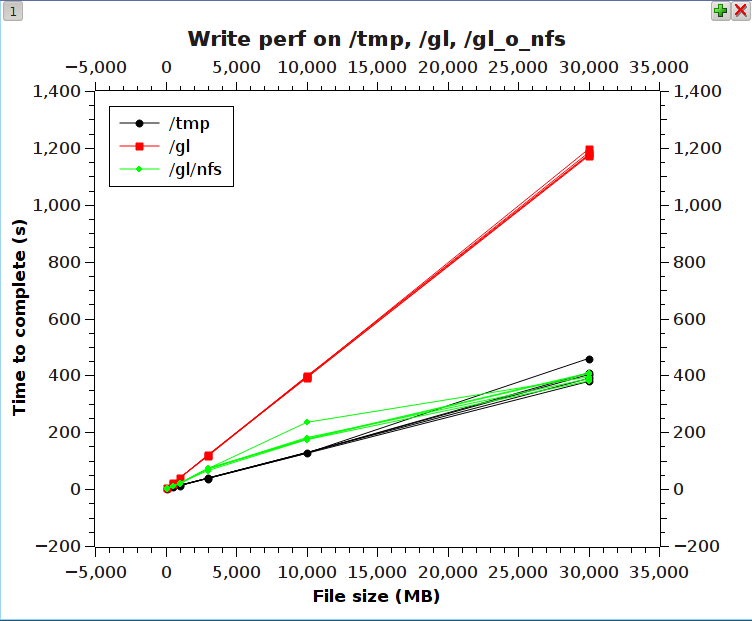
A graph of the performance on various file sizes (created by a trivial program
that does zillions of tiny writes - a sore point in the gluster performance
spectrum) is shown here:

http://moo.nac.uci.edu/~hjm/fs_perf_gl-tmp-glnfs.png

The graphs show the time to complete and sync on a set of writes from 10MB to
30GB on 3 fs's:

- /tmp on the client's system disk (a single 10K USCSI)
- /gl, a 4 server, 4 brick gluster (distributed-only) fs
- /gl/nfs, the same gluster fs, loopback-mounted via NFS3 on the client

The results show that using a gluster fs loopback-mounted to itself increased
performance by 2-3X, increasing as the file size increased to 30GB.

The client (64GB RAM) was otherwise idle when I did these tests.

In addition (data not shown), I also tested how compression (piping the output
thru gzip) affected the total time-to-complete.  In one case, due to the
identical string being written, gzip managed about 1000X compression, so the
eventual file size sent to the disk was almost inconsequential.  Nevertheless,
the extra time for the compression was more than made up for by the reduced
data and adding gzip decreased the time-to-complete significantly.  In other
testing with less compressible data (shown above), the compression time
overwhelmed the write time and all the fs had essentially identical times per
file size.

In all cases, the writes were followed by a 'sync' to flush the cache.

It seems that the loopback NFS mounting of the gluster fs is a fairly obvious
win (overall, about 2-3x times the write speed) in terms of taking avantage of
gluster's fs scaling and namespace with NFS3's client-side caching, but I'd
like to hear from other gluster users as to possible downsides of this
approach.

hjm
_______________________________________________
Gluster-users mailing list
[email protected]
http://gluster.org/cgi-bin/mailman/listinfo/gluster-users