Sounds great. Would it be reasonable to expect that read latencies would be
slightly better due to the datastore being more highly replicated?
On 6 January 2011 10:17, Ikai Lan (Google)
<[email protected]<ikai.l%[email protected]>
> wrote:

> By the way, I should mention that there is no Java SDK. This is *almost*
> completely a server side change.
>
> The Python SDK ships with migration tools for migrating an existing
> application to an HR instance. As of right now, there are no Java tools -
> please use the Python SDK if you need this functionality.
>
>
> --
> Ikai Lan
> Developer Programs Engineer, Google App Engine
> Blogger: http://googleappengine.blogspot.com
> Reddit: http://www.reddit.com/r/appengine
> Twitter: http://twitter.com/app_engine
>
>
>
> On Wed, Jan 5, 2011 at 3:15 PM, Ikai Lan (Google) <
> [email protected] <ikai.l%[email protected]>> wrote:
>
>> Hey everyone,
>>
>> If you don't already subscribe to our blog in your RSS reader, I advise
>> that you do so:
>>
>>
>> http://googleappengine.blogspot.com/2011/01/announcing-high-replication-datastore.html
>>
>> I've embedded the post below. This is a feature that I'm very excited
>> about. Feel free to post to this thread if you have any questions.
>>
>> Announcing the High Replication Datastore for App
>> Engine<http://googleappengine.blogspot.com/2011/01/announcing-high-replication-datastore.html>
>>
>> When App Engine launched over two years ago, we offered a Datastore that
>> was designed for quick, strongly consistent reads. It was based on a
>> Master/Slave replication topology, designed for fast writes while still
>> allowing applications to see data immediately after it was written. For the
>> past six months, as you are probably aware, we’ve been struggling with some
>> reliability
>> issues<http://googleappengine.blogspot.com/2010/06/datastore-performance-growing-pains.html>
>>  with
>> the App Engine Datastore. Over the course of the past few months, we’ve made
>> major strides in fixing these issues. However, our experience with these
>> issues has made us rethink some of our design assumptions. As we promised
>> you in some of our outage
>> reports<https://groups.google.com/group/google-appengine-downtime-notify/msg/e9414ee6493da6fb?pli=1>
>>  earlier
>> this year, we wanted to give you a more fundamental solution to the problem.
>>
>> Today I’m proud to announce the availability of a new Datastore
>> configuration option, the High Replication Datastore. The High Replication
>> Datastore provides the highest level of availability for your reads and
>> writes, at the cost of increased latency for writes and changes in
>> consistency guarantees in the API. The High Replication Datastore increases
>> the number of data centers that maintain replicas of your data by using the
>> Paxos
>> algorithm <http://labs.google.com/papers/paxos_made_live.html> to
>> synchronize that data across datacenters in real time. One of the most
>> significant benefits is that all functionality of your application will
>> remain fully available during planned maintenance periods, as well as during
>> most unplanned infrastructure issues. A more detailed comparison between
>> these two options is available in our
>> documentation<http://code.google.com/appengine/docs/python/datastore/hr/>
>> .
>>
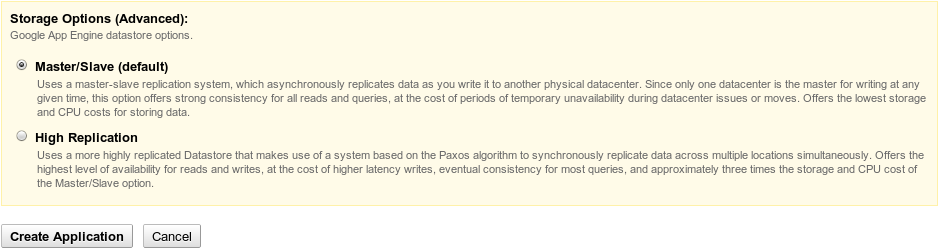
>> From now on, when creating a new application, you will be able to select
>> the Datastore configuration for your application. While the current
>> Datastore configuration default remains Master/Slave, this may change in the
>> future.
>> <http://2.bp.blogspot.com/_dLfQMJsmsaI/TSTL4Cwfg3I/AAAAAAAAAI8/LR_gHxATJto/s1600/hr.png>
>> Datastore configuration options when creating an app.
>>
>> The datastore configuration option can not be changed once an application
>> is created, and all existing applications today are using the Master/Slave
>> configuration. To help existing apps migrate their data to an app using the
>> High Replication Datastore, we are providing some migration tools to assist
>> you. First, we have introduced an option in the Admin Console that allows an
>> application toserve in read-only
>> mode<http://code.google.com/appengine/docs/adminconsole/applicationsettings.html#Disable_Datastore_Writes>
>>  so
>> that the data may be reliably copied between apps. Secondly, we are
>> providing a migration tool with the Python SDK that allows you to copy from
>> one app to another. Directions on how to use this tool for Python and Java
>> apps is documented
>> here<http://code.google.com/appengine/docs/adminconsole/datastoreadmin.html#Copying_Entities_to_Another_Application>
>> .
>>
>> Now, a word on pricing: Because the amount of data replication
>> significantly increases with the High Replication datastore, the price of
>> this datastore configuration is different. But because we believe that this
>> new configuration offers a significantly improved experience for some
>> applications, we wanted to make it available to you as soon as possible,
>> even though we haven’t finalized the pricing details. Thus, we are releasing
>> the High Replication Datastore with introductory pricing of 3x that of the
>> Master/Slave Datastore until the end of July 2011. After July, we expect
>> that pricing of this feature will change. We’ll let you know more about the
>> pricing details as soon as they are available, and remember, you are always
>> protected when pricing changes occur by our Terms of
>> Service<http://code.google.com/appengine/terms.html>.
>> Due to the higher cost, we thus recommend the High Replication Datastore
>> primarily for those developers building critical applications on App Engine
>> who want the highest possible level of availability for their application.
>>
>> Thank you, everyone, for all the work you’ve put into building
>> applications on App Engine for the past two years. We’re excited to have
>> High Replication Datastore as the first of many exciting launches in the new
>> year, and hope you’re excited about the other things we’ve got in store for
>> App Engine in 2011.
>> Posted by Kevin Gibbs, The App Engine Team
>>
>>
>>
>> --
>> Ikai Lan
>> Developer Programs Engineer, Google App Engine
>> Blogger: http://googleappengine.blogspot.com
>> Reddit: http://www.reddit.com/r/appengine
>> Twitter: http://twitter.com/app_engine
>>
>>
>  --
> You received this message because you are subscribed to the Google Groups
> "Google App Engine" group.
> To post to this group, send email to [email protected].
> To unsubscribe from this group, send email to
> [email protected]<google-appengine%[email protected]>
> .
> For more options, visit this group at
> http://groups.google.com/group/google-appengine?hl=en.
>

--
You received this message because you are subscribed to the Google Groups
"Google App Engine" group.
To post to this group, send email to [email protected].
To unsubscribe from this group, send email to
[email protected].
For more options, visit this group at
http://groups.google.com/group/google-appengine?hl=en.