I/II.
http://www.renewableenergyworld.com/rea/blog/post/2010/07/here-at-the-crossover-solar-beats-nuclear
<http://www.renewableenergyworld.com/rea/blog/post/2010/07/here-at-the-crossover-solar-beats-nuclear>Posted
on July 30, 2010

Here at the Crossover, Solar Beats Nuclear

16 cents per kilowatt-hour. It doesn’t sound very profound, but its impact
could be as big as 9-11 or 1776 or E=MC2.

The rap against solar is that it is too expensive, right? Wrong. And the big
deal about nuclear is that it is so cheap, right? Wrong. In this case, 2
wrongs make a right.

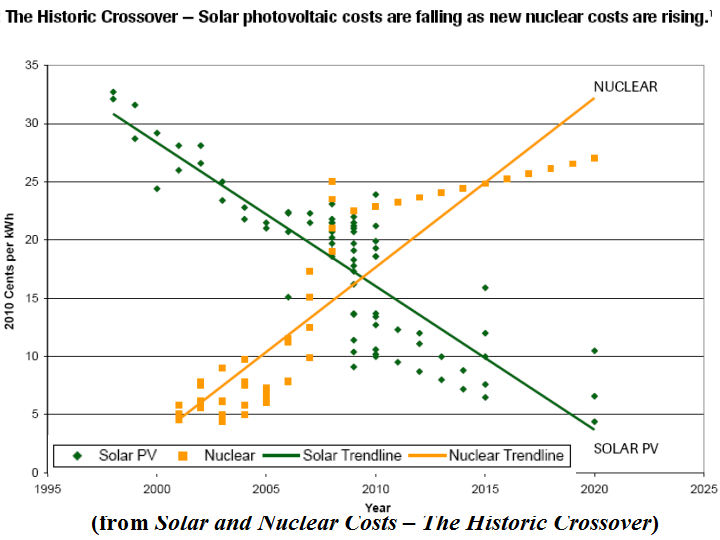
According to Solar and Nuclear Costs – The Historic Crossover; Solar Energy
is Now the Better
Buy<http://www.ncwarn.org/wp-content/uploads/2010/07/NCW-SolarReport_final1.pdf>,
from John O. Blackburn, a Duke University professor of economics, solar
photovoltaic (PV) energy-generated electricity now costs around 14-to-19
cents per kilowatt-hour (kW-hr) and nuclear plants in the planning stages
will not be able to sell their electricity at less than 14-to-18 cents per
kW-hr. That makes NOW the “crossover point” at which solar achieves price
parity with nuclear and it makes "16 cents per kW-hr" the numeric
formulation heralding the arrival of what visionary Hazel Henderson called The
Age of Light <http://www.hazelhenderson.com/ageOfLight.html>.

Nuclear power cost expert Mark Cooper, a senior fellow for economic analysis
at Vermont Law School’s Institute for Energy and Environment, says the cost
of a nuclear power plant went from ~$3 billion per reactor (average) in 2002
to ~$10 billion per reactor (average) in 2010. (Costs are, of course,
somewhat variable by region.) (See THE TOO, TOO COSTLY CASE OF NUCLEAR
POWER<http://newenergynews.blogspot.com/2009/11/too-too-costly-case-of-nuclear-power.html>
)

Opponents of solar PV often say it is only competitive because of subsidies.
But a report in 2000 – when nuclear plants were only enormously expensive
and not prohibitively expensive – found that ~$151 billion in federal
subsidies went to the wind, solar and nuclear industries and 96.3% of it
went to nuclear.

With the price of nuclear energy-generated electricity steadily rising and
the price of solar PV-generated electricity steadily coming down, the
Blackburn study predicts the cost of solar PV will be price-competitive
WITHOUT subsidies by 2020.

In late 2009, both Citigroup Global Markets and Moody’s issued official
statements warning against investments in nuclear. Even nuclear energy
industry advocates can no longer deny the widely reported evidence that
nuclear power plants are more and more expensive to build. Marvin Fertel,
President and CEO of the Nuclear Energy Institute, recently issued a
statement admitting it is not a good time to invest in nuclear.

click to
enlarge<http://2.bp.blogspot.com/_b5hcKABPlGI/TFDezKTnByI/AAAAAAAAhlk/EzTekSUIeT4/s1600/7-2910e.png>

The nuclear industry has devised a couple of strategies to get around the
unaffordable costs of building their plants. One is to shift the risk to the
U.S. government by demanding federal loan guarantees. Another is to shift
the risk to ratepayers by using the “construction work in progress”
financing system that adds a fee to each utility customer’s bill for new
plant construction and keeps them paying for 6-to-12 years before getting
any electricity for their investment.

There are good reasons to reject such multi-hundred billion-to-trillion
dollar schemes in favor of using the money to build more cost-effective
forms of emissions-free electricity generation infrastructure like wind and
solar.

The 1980s nuclear "boom" is now regarded as a managerial disaster and it
cost electricity users an estimated $100 billion.

Nuclear proponents say that will not happen with modern plant designs and
technology but only one of five proposed designs now being considered has
ever been built. New technology, no matter how well thought out and tested,
inevitably introduces unforeseen complications. Cost over-runs, at the very
least, are a veritable certainty on the proposed plants. Cooper said 90% of
those with applications pending have had a delay, a design problem, a cost
increase or some other financing problem.

The only thing that keeps proponets’ dream of a “nuclear renaissance” alive
is global climate change. Nuclear is, at the plant, emissions-free power
generation. Lobbyists have been able to get government attention and
negotiate loan guarantees and tax breaks in compromise deals with New Energy
advocates fighting for a sliver of subsidy money.

But a bad investment is a bad investment and some are finally realizing
there is little point in throwing good money after bad. Loan guarantees make
credit for the billions that go into nuclear plants cheaper but lay all the
risk off onto the taxpayer while retaining all the benefit for investors.

Meanwhile, there are much better ways to use taxpayer money. New Energy (NE)
and Energy Efficiency (EE) grow ever less costly and could easily meet
rising demand for emissions-free electricity generation at a much lower
cost. Only electricity generated by nuclear reactors built before Ronald
Reagan left the Presidency is cheaper than NE and EE.

A calculation from Cooper found that the 100 new plants proposed by the
advocates of a nuclear renaissance would cost taxpayers and electricity
users $1.9 trillion-to-$4.4 trillion more than a similar investment in NE
and EE capacity.

As Cooper pointed out recently, the very fact of the “nuclear renaissance”
PR pitch demonstrates the industry cannot win its way with real numbers.
What th4e nuclear industry is now discovering is that Wall Street knows the
difference between a PR pitch and a good investment. If only Capitol Hill
could make the distinction.

click to
enlarge<http://2.bp.blogspot.com/_b5hcKABPlGI/TFDezvkZn5I/AAAAAAAAhls/62fmp2LqIuA/s1600/7-2910f.png>

This post is based on Nuclear Energy Loses Cost
Advantage<http://www.nytimes.com/2010/07/27/business/global/27iht-renuke.html?src=busln>,
Diana S. Powers (July 26, 2010, NY Times)

II.

http://www.businessweek.com/managing/content/jul2010/ca20100729_102413.htm

VIEWPOINT July 30, 2010, 3:09PM EST
A New Dawn for Nuclear?The U.S. needs to rethink its policies on using
nuclear energy, says NextEra Energy Chief Executive Lew Hay

By Lew Hay <http://www.businessweek.com/print/bios/Lew_Hay.htm>

Recently there's been much talk of a nuclear renaissance in the U.S. And
that's all it is right now: talk. Meanwhile, the rest of the world is
acting. More than 50 new nuclear plants are under construction around the
world, including 24 in China alone. In the U.S. is just one.

Today nuclear power supplies roughly one-fifth of U.S. electricity
needs—safely, reliably, and cheaply. It can continue to do so in the future
and perhaps even expand its share, but only with sensible policies in place.

We must begin by acknowledging the threat from climate change. While the
science of climate change will never be settled to the satisfaction of every
observer, we know enough to say there is a significant risk that global
warming will cause dire consequences. Confronted with risk, prudent
individuals—and prudent societies—take out insurance policies to protect
against potentially catastrophic losses.

What form should this insurance take? One school of thought says we can
achieve all of the greenhouse gas reductions necessary through renewable
energy and the increased efficiency of our homes and offices. "While nuclear
power undergoes yet another face-lift, energy efficiency and renewable
technologies will continue to provide the best opportunity to slow climate
change," says Greenpeace on its "No New Nukes!" blog. As the chief executive
of the nation's largest producer of renewable energy from wind and solar
power, I wish that were true. But the simple fact is that there is no way
renewables and energy efficiency alone will get us where we need to go.
ONLY PARTIAL SOLUTIONS

Every credible analysis finds that renewables and energy efficiency will
provide only a portion of the emissions reductions needed if we are to
"decarbonize" our economy.

For example, a 2009 analysis by the Electric Power Research Institute
(EPRI), the industry's research arm, looked at how much various approaches
would contribute to carbon reduction by the year 2030. Renewables would
achieve 13 percent and energy efficiency would add 6.5 percent. Yet
reasonable estimates suggest we should be targeting reductions in this time
frame of 40 percent to 50 percent.

If we are serious about reducing carbon emissions, we must make use of every
tool in the toolbox to get the job done. Among the major drivers of a
lower-emitting power sector are the commercialization of technology to
capture and store carbon emissions from fossil fuels, the deployment of 100
million plug-in hybrid electric vehicles by 2030, and yes, a significant
expansion of nuclear power.

According to EPRI, not only does the entire current fleet need to remain in
operation—which means a second round of license extensions to bring the
useful lives of nuclear units from 40 to 60 years—but we need to add another
64 reactors for nuclear power to contribute an 11 percent reduction in
carbon emissions. At our Florida utility, we have proposed to build two new
reactors at the site of our existing nuclear plant south of Miami.
WHAT THE U.S. NEEDS

In my view, the U.S. should build at least 50 and as many as 100 additional
nuclear units over the next few decades, at roughly 1,000 megawatts per
reactor. Impossible? Hardly. Over a 19-year period, from 1970 to 1989, we
brought 105 nuclear plants online. And over the past 20 years, the world has
brought 90 nuclear reactors online.

All we need is the political will to do it. The most important economic
incentive policymakers can adopt to make nuclear power viable is to put a
price on the emission of carbon dioxide. Currently, fossil fuels enjoy a
huge implicit subsidy in the form of a lack of carbon pricing. If carbon
were priced, non-emitting power generation sources such as nuclear would be
able to compete on a truly level playing field. By contrast, the lack of a
price on carbon is a thumb on the scale of fossil fuels.

Just as important, policymakers and regulators must ensure that a handful of
antinuclear activists does not abuse the rule of law in order to introduce
delay and uncertainty into the long process of bringing a new unit online.
The argument will always be that nuclear power is not "safe," even though
the number of fatalities from America's most significant nuclear accident,
Three Mile Island, has always been the same: zero.
SERIES OF ROADBLOCKS

Objections can be raised at multiple points during the cumbersome approval
process. First, anyone who wants to build a nuclear facility must get the
state utility regulator to verify the need up to a decade ahead of when the
plant may be needed. If history is any guide, the naysayers will start by
saying the plant is not needed, and then, if regulators verify the need
anyway, they will revert to saying it is not safe.

If you clear the hurdle of state regulatory approval, the Nuclear Regulatory
Commission (NRC) can then take up to four years to grant your combined
construction and operating license. The naysayers can be expected to raise
countless objections to make the process as long and costly as possible.

Next is the cost of as much as $10 billion and five years to build each
reactor, compared with about $1 billion for a natural gas-fired power plant.

And finally, when it's time to turn the key at the end of the process, the
naysayers will be tempted to throw in a last-minute challenge to delay your
startup indefinitely, knowing that delay adds cost and uncertainty.
Policymakers and regulators need the political will to overcome these
tactics. The NRC has promised that as long as plants are built according to
precertified designs, they can start up as soon as they are complete, but
this process is new and has never been tested in the real world.

I believe nuclear is the right answer for the nation. But like Charlie
Brown, those of us in the electric power business have been encouraged to
kick the football before, only to have it snatched away at the last second.
If we're going to try again, policymakers need to convince us—really
convince us—that we won't end up flat on our backs.

Lew Hay is chairman and CEO of NextEra Energy, which operates the nation's
third-largest nuclear fleet.


--
Peace Is Doable

--
You received this message because you are subscribed to the Google Groups
"Green Youth Movement" group.
To post to this group, send an email to [email protected].
To unsubscribe from this group, send email to
[email protected].
For more options, visit this group at
http://groups.google.com/group/greenyouth?hl=en-GB.