http://www.sacw.net/article3870.html
*How our generation sees Shahbagh*

by Khushi Kabir
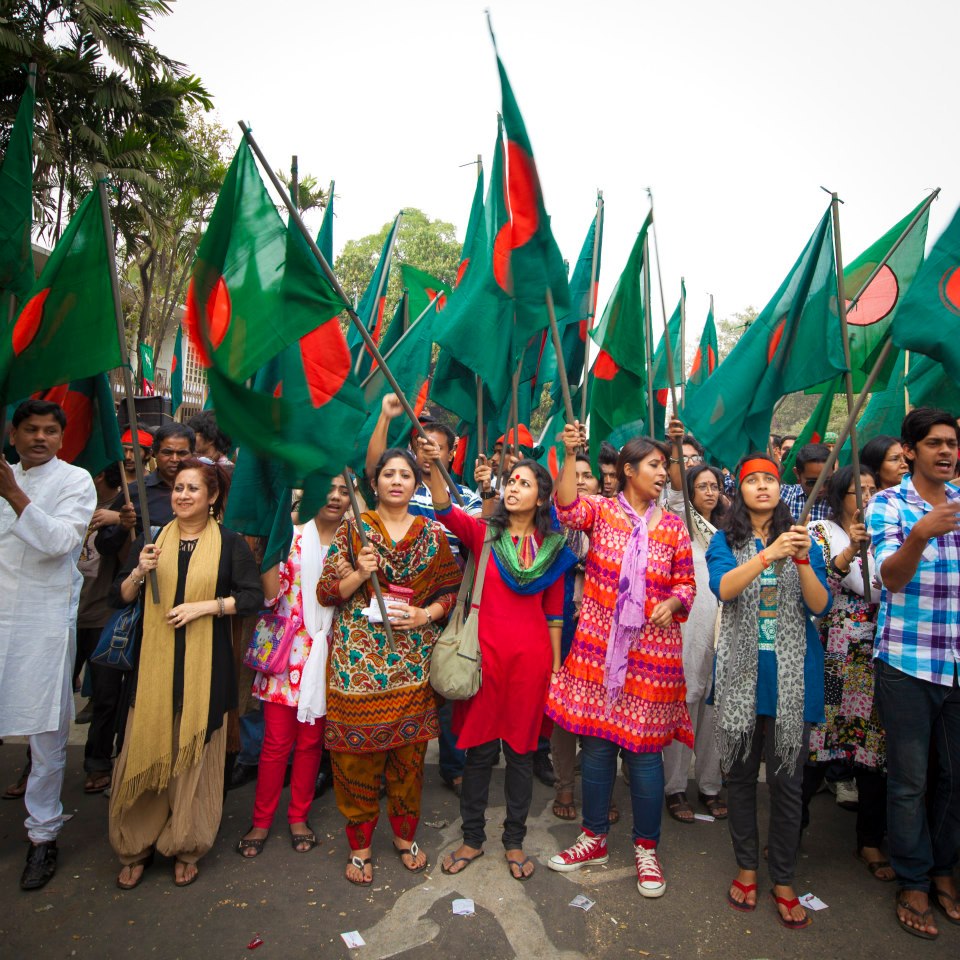
[image: © Arif
Hafiz]<http://alalodulaldotorg.files.wordpress.com/2013/02/arifhafiz_18.jpg>

© Arif Hafiz

*[AoD Editors: This written during the second week of Shahbagh. Though
situation on ground has changed a great deal since then, we are sharing
with bloggers to look at an earlier perspective when the movement first
started]*

I have  several differences with some of my closest friends on this issue,
a) those not participating fully in the movement b) those who pay
occasional visits for a couple of hours at most, c) those who are outside
the country so don’t get the pulse, d) those in the country and never go.
Some differences are on semantics, as well in content, some in regard to
positions taken.  This understanding of what is happening is something that
unless one is part of, it is difficult to describe.

The Shahbagh phenomena grows, it changes, slogans change. It is organic and
developing as per demands of the day.  I have been there from the moment it
began on the 5th February with less than a few hundred gathering, to what
it is now, a national movement of epic size, which *I certainly have not
seen in terms of the numbers gathered at one spot, in the last few decades*and
definitely not in the number of days it has been sustaining itself.

People were skeptical it would not last over a week.  It is now almost one
month.

It is true that it is the generation born after 1971 who are in the lead.
They are trying to ensure that this does not get taken over by the
‘elders’, the known leaders, many of whom hover in the centre everyday.
The ‘elders’,  the cultural activist leaders, the professional’s federation
etc. have started their own programme from yesterday, March 1, as they
always do each year.

Shahbagh belongs to the youth. Women are there in large numbers and are in
the forefront of giving slogans, which has been the mainstay and life of
this movement.

Now to give you and put forward very briefly, how I have seen this
movement.  There is no one single group in leadership.  Though after the
killing of one of the bloggers, one face is now the public face, a Dr.
Imran.  This probably due to security reasons, but he is not the only
decision maker.

It started with a call from a group of bloggers, after the verdict given on
Kader Mollah’s case, who thought they would do a human chain at Shahbagh
crossroad, near the Museum.  A venue popular for human chains, as it is
very central.  On the other side of the long avenue is the Teacher Student
Centre of the Dhaka University. Various student organisations, esp from the
left, decided to join them from the University area with a torch light
procession.  We joined that group and met and merged with the bloggers at
Shahbagh.  By nightfall, the area got crowded and the movement gained
momenturm.

The next day, it grew bigger and bigger.  Now why did this gain such a
momentum? Kader Mollah’s verdict is the second verdict in the tribunal. The
first was Abul Kalam Azad, who was commonly known as Bachu Razakar.*Bachchu
Razakar mysteriously left the country just a couple of days before his
trial began.  *He was found guilty in one case and given death penalty in
absentia. On the other hand, Kader Mollah also known as the butcher of
MIrpur,  is in custody, had witnesses, even now people are stating and
giving eye witness accounts of his role in murder, rape etc. was found
guilty in 5 cases, given life sentence in one and other sentences ranging
from 5 years to 15 years, all concurrently, not consecutively.

This apparently duality in the verdict of both cases is what triggered the
movement. People felt that if Kader Mollah who was one of the main people
behind the genocide of 1971, gets life sentence with enough evidence (*though
some of my friends differ with me on this, but the fact remains that the
Court found him guilty*) then the other more important criminals who are
awaiting trial, and the fear that the verdicts of the others would also be
much less, depending on what position the accused holds.

The message as I understood from people at the movement is this,* it is not
just the fear that the next Government which may well be BNP/Jamaat would
give amnesty, but that they, the gen. public had no faith in the present
Govt. not doing a deal and letting them off. * The young people had enough
of compromises and underhand dealings and wanted to state that though they
were born after the liberation war, they were sick of major political
parties playing politics of convenience with our own history.

As many have mentioned and media has played this up, women are very visible
in this movement.  Parents come with their kids and young teenaged
daughters. Women feel safe walking up and down the streets alone without
fear of being harrassed. Lucky Akter has become a household name as the
best slogan giver able to arouse masses.  People are there day and night.
the masses are there 24/7.

Of course political analysts do not understand how and why ‘the masses’ are
mobilised without a party backing them or funding them.  ‘People of course
can not or do not ever make their own decisions or choices’ can they?  *They
are merely objects, so how can they act?  So, it gives great fodder for
debates, discusions, talk show analysis.*

Regarding demands.  The one demand that hit me as it hits many others is
the demand for ‘phashi’ , hanging.  Talking to people, both those in the
centre, I am just putting forward their explanations, ( though I did say
there is no one leadership, the bloggers, some youth groups, some students
groups sit every evening to discuss next plan of action.  Here I should
state that they have and belong to different ideologies), capital
punishment is being demanded because a) it exists in our laws and they want
the war criminals to get maximum punishment and b) *because they don’t
trust our Governments and fear that after this trial, any chance for the
trials of war criminals will be lost forever.*

*People want to take back the liberation war as their war, not a party or a
military or an Indian war.*

The hero of this movement is Jahanara Imam who had given the call for the
trail of all colaborators.  *She died of cancer, but she is the name, the
picture, the passion behind the movement, not Sheikh Mujibur Rahman. *Her
portrait towers over the centre and is on every wall of the avenue.

The other demand was ‘who am I, who are you, Bangalee, Bangalee’.  Recently
Shathi Chakma gave a call over facebook, emails, sms, blog, went to the
centre, read out a statement as to how alienated this slogan made all
indigenous/adivasis feel.  We all, along with Indigenous leaders from all
communities went with her to ensure that their voices are heard and
registered.

Even if most of those leading the slogans are women, *the slogans
themselves were very male centric.*  Nahid, Rahnuma, Shipra all of us have
started chanting women centric or gender neutral slogans, That too is now
taking on.  We have now taken up the banner of Bikhhubdo Nari Samaj and sit
every evening on the avenue, many young people, both men and women join us
and we talk about how this movement needs more women centric demands.

Our biggest issue being, though women are present in large numbers,* there
is no feminist perspective.* That one of the biggest crimes committed were
the rapes, but that has not been given the priority neither by the
prosecutors, in the trial, nor the media.  That the ‘vcitmisation’ of women
during war is a deliberate and patriarchal ‘weapon’ used against those
being subjugated.

The killing of one of the bloggers and then trying to divert attention by
claiming that the blogger was an atheist has been in my eyes *a big big
negative*, now with people in the centre and periphery trying to prove that
they are all believers.

My advice for what it may be worth to all is, since this is happening, we
don’t know if we will ever witness such a happening again, let us join the
movement, raise our slogans, our voices, our demands and this is the time
that we can bring feminist and secular demands to a mass uprising.

The recent violence all over Bangladesh is now our current worry.  We are
all in need of support and strength to fight this. *Not to allow AL to take
over.*

That is what the Political parties want, to take control.  It would be a
pity if that were to happen.  But the fear remains, as the massacre and
actions against minorities, non Jamatis, police, Awami supoorters has taken
on huge proportions which will need state machinery to fight it. *I will
end by stating that the movement is a political movement but not a partisan
movement.*

*Khushi Kabir was nominated for the Nobel Peace Prize in 2005 for her work
atNijera Kori <http://www.nijerakori.org/>, which has helped organise over
175,000 landless people in Bangladesh’s rural areas since 1980.*

--
Peace Is Doable

--
You received this message because you are subscribed to the Google Groups
"Green Youth Movement" group.
To unsubscribe from this group and stop receiving emails from it, send an email
to [email protected].
To post to this group, send an email to [email protected].
Visit this group at http://groups.google.com/group/greenyouth?hl=en-GB.
For more options, visit https://groups.google.com/groups/opt_out.