http://kractivist.wordpress.com/2013/05/09/
Narendra Modi – Manual Scavenging is a Spiritual
Experience<http://kractivist.wordpress.com/2013/05/09/narendra-modi-manual-scavenging-is-a-spiritual-experience-wtfnews/>

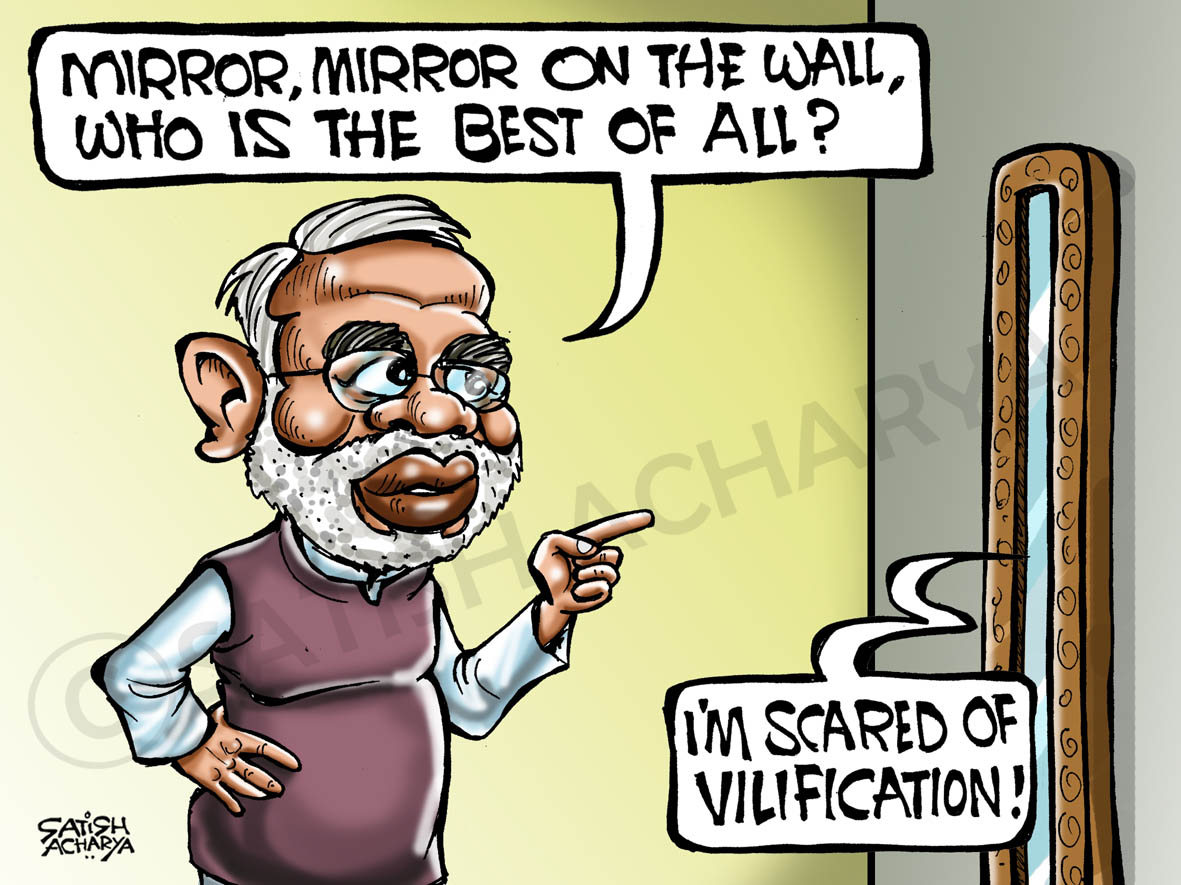
[image: Narandra Modi's Vibrant Gujarat Story: Propaganda vs Fact
#mustread]<http://kractivist.files.wordpress.com/2012/10/140411satish.jpg>

MAINSTREAM, VOL LI, NO 18, APRIL 20, 2013
On Modi’s Social Engineering

Subhash Gatade <http://www.mainstreamweekly.net/auteur70.html>


The system of untouchability has been a goldmine for
theHindus<http://en.wikipedia.org/wiki/Hindu>.
This system affords 60 millions of untouchables to do the dirty work of
scavenging and sweeping to the 240 million Hindus who are debarred by their
religion to do such dirty work. But the work must be done for the Hindus
and who else than the untouchables?

*—**Dr B.R. Ambedkar <http://en.wikipedia.org/wiki/B._R._Ambedkar>*

Can shit collection or cleaning of gutters—which has condemned lakhs of
people to a life of indignity since ages—be considered a ‘Spiritual
Experience <http://en.wikipedia.org/wiki/Religious_experience>’? Definitely
not. Everybody would yell. Well, Mr Narendra Modi<http://www.narendramodi.in/>,
the Chief Minister of
Gujarat<http://en.wikipedia.org/wiki/List_of_Chief_Ministers_of_Gujarat>,
has a different take on this, which he mentions in the book ‘*Karmayog*’
(publication year 2007).

The book is basically a collection of his speeches to high-profile IAS
officials. Herein he discusses the age-old caste-based vocation of the
Valmikis as an “experience in spirituality”. He writes: “I do not believe
that they have been doing this job just to sustain their livelihood. Had
this been so, they would not have continued with this type of job
generation after gene-ration…. At some point of time, somebody must have
got the enlightenment that it is their (Valmikis’) duty to work for the
happiness of the entire society and the Gods; that they have to do this job
bestowed upon them by Gods; and that this job of cleaning up should
continue as an internal spiritual activity for centuries. This should have
continued generation after generation. It is impossible to believe that
their ancestors did not have the choice of adopting any other work or
business.”

Looking at the fact that a section of the Dalits themselves—especially its
upwardly mobile and more articulate section—has joined the *Hindutva*
bandwagon,
it was expected that there would be no angry reaction to his utterances
within the State. A section of the Ambedkarite Dalits and many human rights
activists did protest but their voices got drowned in the cacophony of
voices of Modi supporters. It is a different matter that when Modi’s remark
got published in *The Times of India <http://timesofindia.indiatimes.com/>* in
mid-November 2007, which was later translated in a few Tamil news-papers,
it resulted in a massive reaction of Dalits in Tamil
Nadu<http://maps.google.com/maps?ll=13.09,80.27&spn=1.0,1.0&q=13.09,80.27%20(Tamil%20Nadu)&t=h>.
Not only did they stage protests for calling their menial job a “spiritual
experience” but Modi’s effigies were burnt in different parts of the State.
Sensing trouble Modi immediately withdrew 5000 copies of the book, but
still stuck to his opinion. Two years later, addressing 9000-odd safai
karmacharis, he likened the safai karmacharis’ job of cleaning up others’
dirt to that of a temple priest. He told them: “A priest cleans a temple
every day before prayers, you also clean the city like a temple. You and
the temple priest work alike.”

One was reminded of these ideas of Mr Modi when news came in that the
Budget for the coming year passed by the Gujarat
State<http://maps.google.com/maps?ll=23.2167,72.6833&spn=1.0,1.0&q=23.2167,72.6833%20(Gujarat)&t=h>
Assembly
has allocated a sum of Rs 22.5 lakhs for giving training in *karmkand*
(rituals)
to the safai kamdars themselves. The idea is to train them in scriptures so
that they can perform *puja*. It is clear that the ‘new scheme’, as it was
presented before the people, was just a revised version of its earlier
version wherein members of the Scheduled Castes were given training to
become ‘Gurubrahmins’ so that they could also perform *pujas*. Insiders can
also share with you that the said scheme has miserably failed and people
who were trained to perform *pujas* are still searching for jobs.

It could well be asked that if Modi values safai karmacharis so highly, why
is it that he has begun outsourcing all the menial jobs for a very low pay,
between Rs 3000 and Rs 3500 per month per worker? Why are they not being
employed on a permanent basis? A leading
Dalit<http://en.wikipedia.org/wiki/Dalit>poet
raised an altogether different question: “Why didn’t it occur to Modi that
the spirituality involved in doing menial jobs hasn’t ever been experienced
by the upper castes?”

It is worth emphasising that when the Gujarat Government declared its
intention to train safai kamdars in *karmkand,* supposedly to integrate
them into the mainstream of the Hindu society, it also happened to be the
period when the anti-Dalit stance of the people in power was very much
evident in two clear examples: the manner in which the State officials
tried to cover up the social boycott of Dalits in a village, and the way
they tried to save the guilty police officials involved in Dalit killings;
both of these had already hit the headlines.

Not very many people would have heard about the village Galsana, Dhanduka
tehsil, Ahmedabad district, which is around 100 kms from the city. The
Dalits in the village, who are about 500 in number, are not allowed entry
into any of the five temples in the village. The younger generation of
Dalits protested this ban which resulted in their social boycott. When the
news last came in, the boycott was already a few months old. Incidentally
when officers from the Social Justice Department visited the village, they
did not even acknowledge that Dalits are facing social boycott, forget
asking the police to take action against the guilty.

The other news concerned the arrest of guilty police officials involved in
the gruesome killings of Dalits at Thangarh. (September 2012) After four
months, cop Jadeja and two other accused police officials in the Thangarh
Dalit massacre case were arrested on February 23, 2013. It is reported that
the killings at Thangarh were the fallout of a minor clash between Dalits
and Bharwads over auctioning of stalls at an annual fair organised by the
Thangarh municipality. When the Dalits filed a complaint against the
Bharwads at the police station, the police refused to take any action; the
anger of the Dalits spilled over onto the streets the next day which saw
the participation of Dalits in large numbers and the police resorting to
strong-arm tactics resulting in the killings. Despite knowing the fact that
the infamous police officer had on an earlier occasion also fired upon the
Dalits without any provo-cation, the administration tried every trick in
its kitty to save him and his colleagues. It was only because of judicial
intervention that they were ordered to be arrested.

Galsana and Thangarh can be said to be tip of the iceberg as far as Dalit
deprivation and denial of justice is concerned. In fact much has been
written about the way the Scheduled Castes and Scheduled Tribes (Atrocities
Prevention) Act, 1989 is implemented in the State. One finds that the rate
of conviction of cases under the Prevention of Atrocity Act against SCs/STs
in Gujarat is a mere 2.5 per cent while the rate of acquittal is 97.5 per
cent. A 23-page confidential report submitted by the State Social Justice
Department to the State Chief Secretary and Legal Department provides
glaring examples of ‘mishandling of cases registered under Prevention of
Atrocities Act against SCs/STs’. (*The Indian Express, *September 15, 2006)

The report provides details of how cases are not investigated properly by
the police and the hostile role played by public prosecutors during the
time of trials.

• The Act clearly stipulates that offences which are registered under this
Act cannot be investigated by an officer below the rank of DySP but more
than 4000 such cases have been investigated by the Police Inspector or
Police Sub-Inspector.

• Acquittal of the perpetrator because the victim not identified as a
member of the SC or ST community. Reason: not attaching caste certificate
of the victim with the case papers.

• Public prosecutors’ false claims before the courts that the Act has been
modified by the State Government although it is known that it is a Central
Act.

• Granting of anticipatory bails although there is no such provision in the
Act. Interestingly, the Parliamentary Committee on SC and ST affairs had
also expressed concern over such anticipatory bails granted ‘in atrocity
cases in the State of Gujarat’.

In this backdrop it is worth underlining how little Mr Modi knew about this
important law and its implications. One could rather say that in Gujarat
the Chief Minister is directly responsible for the non-implementation of
the Atrocity Act. As Raju Solanki, the famous poet and Dalit rights
activist, writes in his blog:

*It was on April 16, 2004, that a question was asked to Chief Minister Modi
in the Gujarat Legislative Assembly: “Honourable Chief Minister [Home] may
oblige us to tell, is it true that the DSP is responsible for the
appointment of an officer not below the rank of DySP as investigating
officer in the offences under the Atrocities Act?” The answer of our Chief
Minister was shocking. He said: “No, but there is a provision under rule 7
(1) of SC/ST Act, 1995 to appoint officers not above the rank of DySP to
inquire into all cases booked under atrocities act. It is not the
responsibility of the DSP.”*

“*The officer not above the rank of DySP” means he may be a PSI or PI and
in most of the atrocities cases courts acquit the accused because the
investigation officer is either a PSI or PI. Over 150 such judgments
collected by the Council for Social Justice revealed that in 95 per cent of
the cases, the accused have been acquitted because of negligence on the
part of the authorities. In a number of these cases, while the accused has
been convicted under the IPC section for murder and attempt to murder, he
has gone scot-free on the atrocity charge.*

In the end, one would like to put on record the way the presence of Dalits
in records is being obliterated without any qualims. During the panchayat
elections, Nathu Vadla, a small village of Gujarat with hardly 1000
population, had suddenly hit the headlines. The panchayat election in this
village was to have been conducted on the basis of the 2001 data. The
village has at least 100 Scheduled Caste people and one seat was to be
reserved as per law, but the census data has not been modified since in
2001 the SC population was nil in the village; the election in 2013 was to
have been conducted on the basis of the 2001 census. Here also the courts
had to intervene to stay the election in the village. The Gujarat High
Court stayed the election in the village saying that the electoral exercise
in the circumstances would be a ‘mockery of democracy’.

--
Peace Is Doable

--
You received this message because you are subscribed to the Google Groups
"Green Youth Movement" group.
To unsubscribe from this group and stop receiving emails from it, send an email
to [email protected].
To post to this group, send an email to [email protected].
Visit this group at http://groups.google.com/group/greenyouth.
For more options, visit https://groups.google.com/groups/opt_out.