Buongiorno!

Since this recently came up a bunch of times, I thought it might be a
solid input for us to talk about.  So, what are "constructive comments"
(as they, for example, appear in GCD001), anyways?
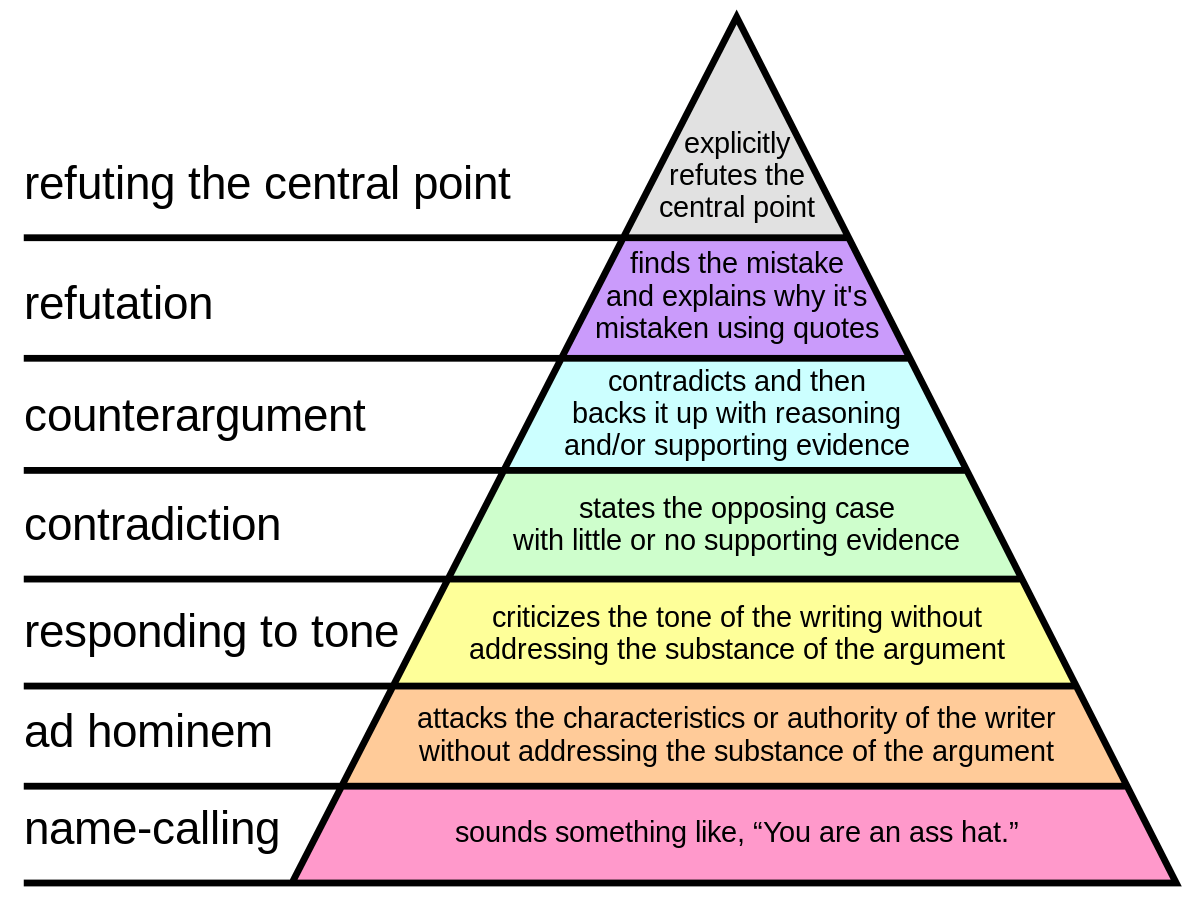
I find some wisdom in the Pyramid of Disagreement¹ (which sadly is just
a triangle), a graphical representation of Graham's Hierarchy of
Disagreement².  According to that I would generally consider comments of
the `counterargument', `refutation' and `refuting the central point'
categories as "constructive".


I think it is important to realize, though, that the "pyramid"
(triangle!) alone is not enough: this classification only works when
participants of a discussion actually (1) have a common
goal/mission/problem they work on/for and (2) the issue at hand is
resolvable in such a discussion (not a hypothetical, a subjective
opinion or multiple problems entangled with each other).


(1) I guess we are all here for one or the other aspect Guix excels in
(yes, there's many!), but maybe, as a project, we should at some point
talk about our greater mission (1)?  `Social Architecture - Building
On-Line Communities'³ (referenced by someone in some discussion, please
excuse my failure to cite adequately) lists having a "Strong Mission" as
the first tool in the toolbox for building such communities.  My
suspicion is that we all /sense/ some mission in the Guix project, but
failing to synchronize and thus state such a greater, common mission can
obviously lead to friction.

So, what exactly do we (want to) achieve with Guix, apart from being the
coolest project doing the best work (obviously)?  (Please start a new or
at least rename the Subject: line of this thread should you want to
start this discussion, if you feel like it)


(2) Being inside of a cluttered discussion (where multiple problems are
entangled) we find ourselves in a position almost impossible to
adequately respond to.  It is simply impossible to `refute the central
point' of an issue that is at least 3 different problems in a proverbial
trench-coat.

And it is impossible to resolve issues about taste or opinion.


That being said, all of this only applies for hard argument exchanges,
not exploratory dialogue.

WDYT?  Is it (much) more complicated than that?


I wish you well (as always)
gabriel / gabber


¹
https://www.jasonscottmontoya.com/images/2024/04/Grahams_Hierarchy_of_Disagreement-tiny.png
² https://paulgraham.com/disagree.html
³ https://hintjens.wdfiles.com/local--files/books/social-architecture.pdf