<snip> Undergarments:
My first dilemma is whether or not I need a set of bodies and a
farthingale. I've read opinions that say yes you need them and I've read
opinions that say no, you can live with a stiffly lined bodice and a
petticoat(s) and that evidence in wardrobe accounts didn't show these
undergarments until after 1540-1550. If I can avoid the corset and
farthingale with period justification, I would be thrilled, as this would
cut a week off the project. I'm a size 28/30 woman (depends on the
clothing) with only a C cup chest, so breast support is not something I
have a great need for, but I do have a couple of fat rolls at my sides.
Is this an automatic "make a corset" proposition then? I think my
canvas-lined Venetians did very well for a smooth line when they fit
(they're both currently too loose to provide any support) and I will have
two gown layers. Anyone here have any experiences with plus-sized late
period garb and corsets or the lack thereof?
You might be interested in my dress diaries on my Tudor gowns
http://au.geocities.com/e_walpole/dress_list.html I personally opt for a
boned kirtle as I think it's a more versatile garment than a corset with
separate petticoat and I'm also convinced from the way you can clearly see
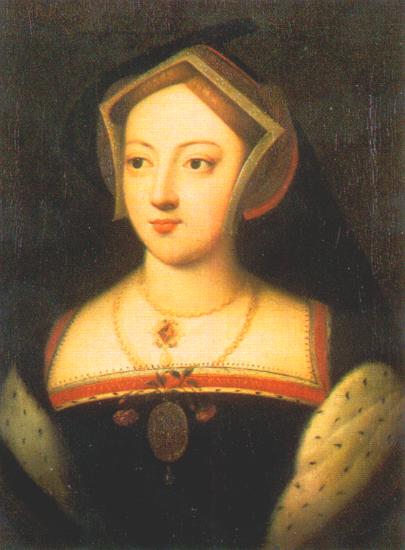
the kirtle and smock necklines above the gown's neckline (e.g.
http://www.tudorplace.com.ar/images/Boleyn,Mary.jpg). I chose to bone mine
as I wanted the rigid noble cone shape, but if you'd prefer the softer line,
which is still evident well into the Tudor period and even into the
Elizabethan period (though the cone shaped bodice gradually moves down the
social ladder over time) Canvas or other stiff fabrics will help keep the
cone shape but without some boning you will not eliminate all the curves. As
you are doing a 1530s gown boning the gown's bodice isn't much of an issue
as the waistline has only a very small dip at the centre front which won't
flip up when you move (a problem I've encountered with my 1540s gown even
though the skirt is attached to it).
I have my Italian chemise, but the sleeves are very full, so I will likely
have to make a new one. I plan on using Drea Leed's smock generator,
unless I find something better. I've heard something about the sleeves
being off, so I'll have to do a mockup first since I've never used her
generator. There's also a basic low-necked smock pattern on
vertetsable.com, but it doesn't use any gores so I'm not sure on its
authenticity.
I personally used Drea's smock pattern but instead of using the tapered
sleeves she suggests I used rectangular sleeves so I could have a little
cuff sticking out of the end of my gown sleeve, however another alternative
would be to have a tapered sleeve and sew on a separate cuff (in the
portrait of Princess Elizabeth http://www.uvm.edu/~hag/sca/tudor/kideliz.jpg
you can see her cuffs are gathered into a narrower band underneath her
brocade sleeves)
Kirtle:
After looking at the evidence, I tend to agree that they wore two
dresses/kirtles/whatever you call them in addition to the chemise instead
of just a forepart skirt. Of course this will add more work, but I'd feel
better about it going this way - not to mention that the false sleeves
will be more secure and I really only have to draft one pattern with
slight modifications.
I wouldn't make a decorative forepart a permanent part of the kirtle, at the
moment I have a forepart skirt but it creates too much bulk at the
waistline, the next one I make will be a panel hand sewn on top of the
kirtle skirt so I can unpick the stitches and wear the kirtle without the
forepart, however you could make your kirtle out of a nice fabric (such as a
silk satin or taffeta) and wear it without a separate forepart.
This layer will be a short sleeved kirtle, consisting of the "good" fabric
for the forepart of the skirt and top of the bodice and a similar weight
cheap fabric for the rest where it won't be seen. If I do a jewelled
neckline, it will be attached to this layer. I have no idea how this is
supposed to lace up yet - front, back, or sides (which I read as one
theory especially if the jewels go all the way around the neck).
Unfortunately I can't really help you too much with where to lace it, except
to say that front lacing is a bit obvious and creates lumps under the gown
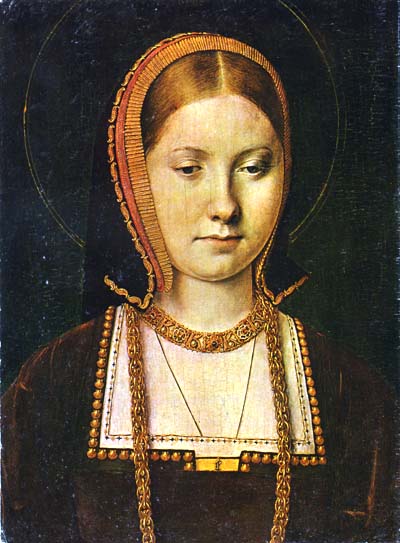
if you use a round cord, but there is also evidence for front lacing
(http://www.uvm.edu/~hag/sca/tudor/aragon.jpg)
I am completely unsure about the "good" fabric to use at this point. Of
the portraits I see, either you have solid/tapestry or print/print. I'm
not a huge tapestry fan. I do have in hand more than enough ivory satin
of a suitable weight to use, but it is plain. I thought about maybe
couching/beading estoiles, which is part of my device, on the false
sleeves and forepart, but this sort of thing wasn't done at this time, as
far as I can see. Would going plain be such a crime or a plausible
non-royalty substitution? Any suggestions for a good contrasting or
complementing color to use? The Tudors loved gold, but I'm not the
biggest fan.
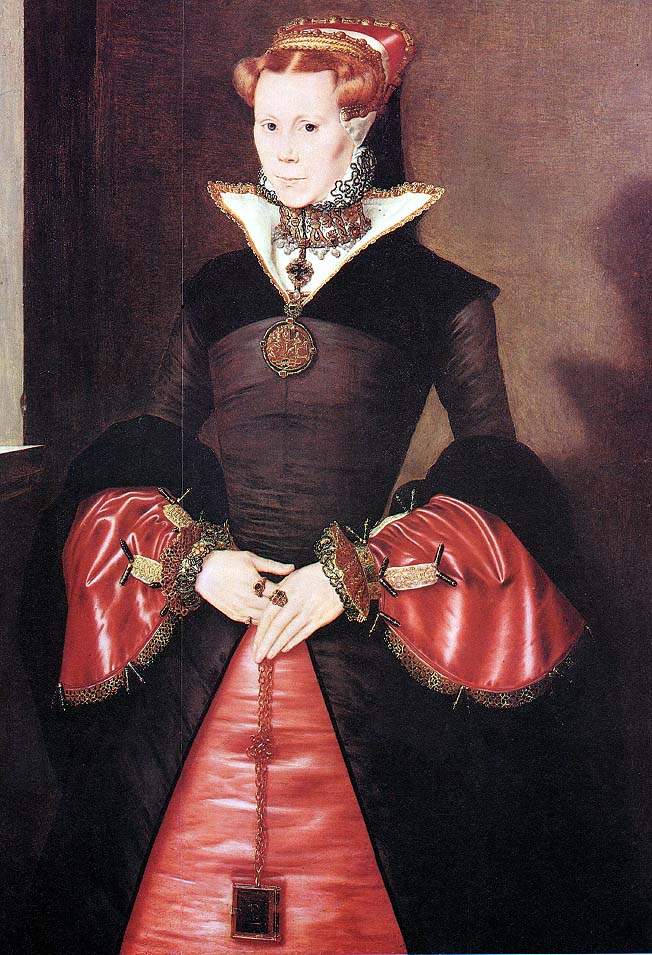
Well, as you can see from this portrait
http://www.uvm.edu/~hag/sca/tudor/blackmary.jpg a plain satin
forepart/undersleeves is also acceptable, If you want to incorporate
estoiles into the dress you might want to see if you can find some small
charms in that shape to decorate the neckline of your kirtle like you see
with scallop shells in http://www.uvm.edu/~hag/sca/tudor/aragon.jpg
The false sleeves would be made of the same good fabric as used for the
kirtle, pinned or attached to the kirtle. If I end up doing a shiny or
iridescent fabric instead of tapestry, I'm tempted to pleat them, like
Lady Guildford's portrait.
Overdress: f
I plan on using red cotton velvet or velveteen - I know velveteen would be
more within my budget, but I'm not sure of the overall look of it yet.
Would it work well? I would like for the foldback sleeves to be the same
color of the dress, as seen with Lady Guildford, but I don't see many
other examples like this until later. Could this also be an acceptable
compromise for someone not of royalty? The front of the skirt will be
split to show off the "good" fabric of the kirtle. If I have a train, it
will only be a slight one.
If you're using velvet for the gown I'd use a brocade to line the sleeves
(which shows when you turn them back) like you see in
http://au.geocities.com/e_walpole/portraitsetc/FitzalanMary.jpg and
http://au.geocities.com/e_walpole/portraitsetc/Mary1545.jpg as these two,
plus the portrait of Jane Seymour are the only portraits showing velvet
gowns I've been able to find (and as I can't obtain gold net like Jane
Seymour's wearing I've opted for brocade, though I'm still looking for a
period looking brocade that will match the colour of my velvet gown).
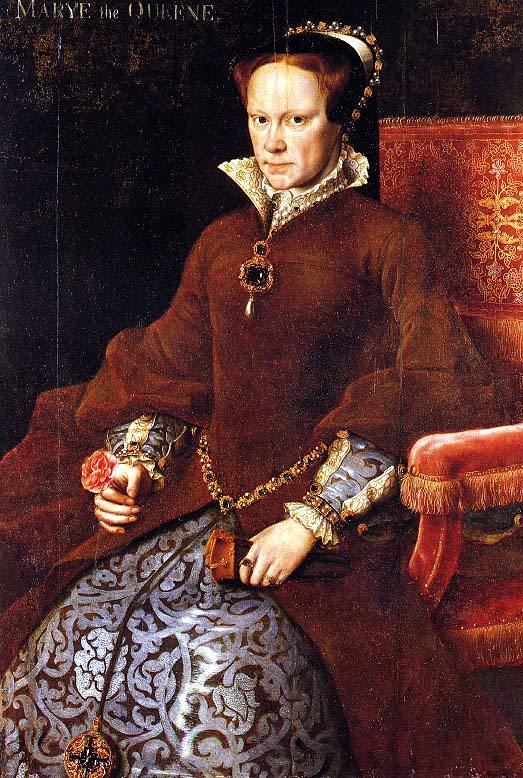
However this portrait of Queen Mary
http://www.uvm.edu/~hag/sca/tudor/marybrown.jpg might be velvet (it's hard
to tell), in which case the sleeves appear to be lined with the same fabric
as the gown.
Accessories:
Jewelry will be simple. Since I don't really like gold, is silver an
acceptable substitute? I notice from the Mary Tudor portrait that they
didn't see a problem with mixing gold and silver. I probably will use
plenty of glass pearls. I will have the two standard necklaces and a
girdle, not sure yet about any brooches. I'll work on that after I finish
the dresses.
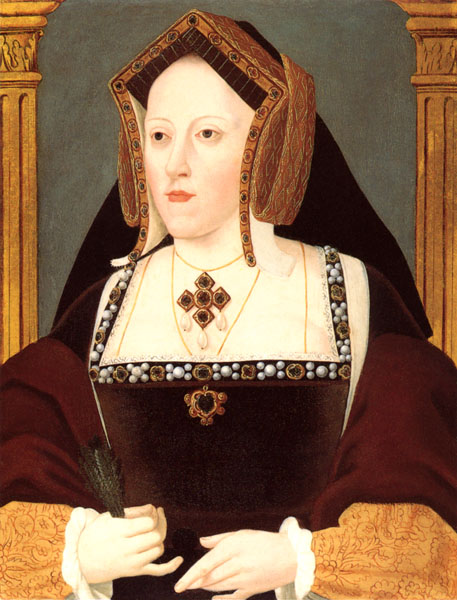
A brooch is not absolutely essential, and a sash as a girdle was only just
beginning to be old fashioned in the 1530s (if you look at this portrait of
Catherine of Aragon
http://www.tudorplace.com.ar/images/Aragon,Catalina05.jpg you can just make
out what could be the knot of a sash between her hands)
My french hood will be of more of a curved design, but not overly fancy.
I'm not sure which fabric to use for my crescent, as I've seen fabric used
from the overdress, the folded back sleeves, or the forepart/false sleeve.
I guess whichever fabric I prefer. This is also a lower priority at this
point of the project.
The hood could match your dress, but it isn't necessary and I'd be wary of
using any colours but black white and red (though there's a miniature of
Catherine Howard where it's so encrusted in jewels it looks gold). My French
Hood is based on Drea Aleed's instructions but with a 'muffin cap' (also
using Drea's instructions but with the front section cut to follow the line
of the French hood so only the pleated gold ruffle sticks out)
Stockings are an extremely low priority at this point, as I could live
without them, and I have some Mary Jane-style shoes that will pass.
So, what do you think? I have done so much reading that my head is
spinning with details. I don't see a lot of recreation in 1530, moreso in
the 1540 range, where there are some changes. I wish I had more non-royal
sources as I really don't need to be that high of class and I'd like to
know where I can legitimately skimp on the details. I'm just looking for
some feedback and corrections as needed because I want to go fabric
shopping within the week.
--
Elinor Salter
Well 1540s is popular because you have more portraits which are more
detailed so it's easier, plus the fact that the pointed waistline emphasises
the vertical which is often something 16th century costumers want.
Once you've got started let us know how it's going and hopefully we'll be
able to help some more.
Elizabeth
--------------------------------------------
Elizabeth Walpole
Canberra Australia
ewalpole[at]tpg.com.au
http://au.geocities.com/e_walpole/

_______________________________________________
h-costume mailing list
[email protected]
http://mail.indra.com/mailman/listinfo/h-costume