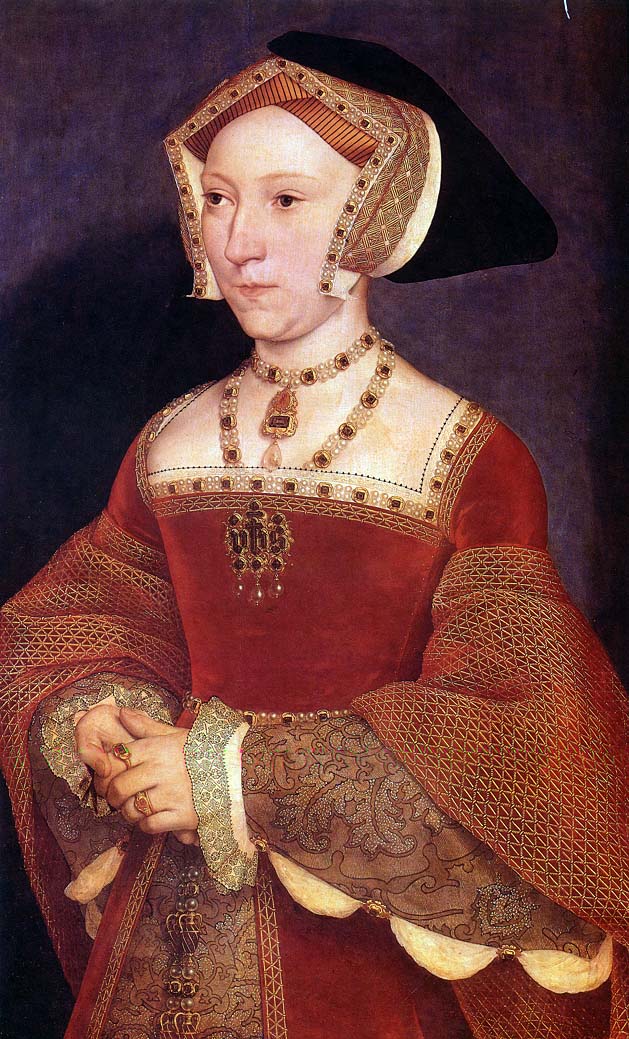
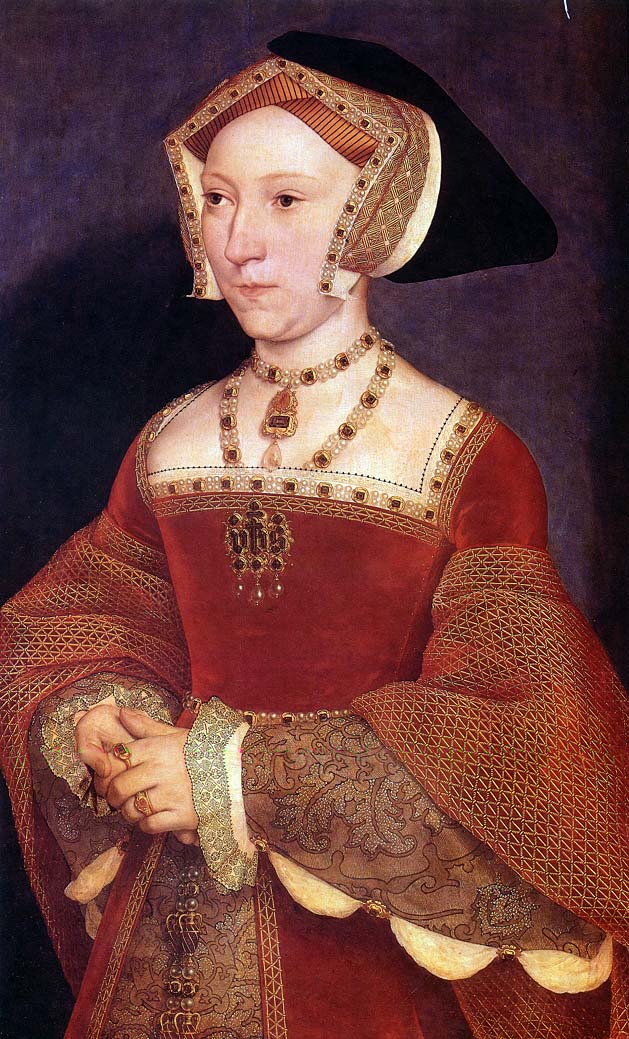
If it hasn't been posted already,
http://www.uvm.edu/~hag/sca/tudor/redjane.jpg
<http://www.uvm.edu/%7Ehag/sca/tudor/redjane.jpg>, this picture clearly
shows the attachment on the sitters left side (our right) where the
placard is pinned. Also, though Ninya's interpretation clearly works,
there is no reason that the under lacing must meet in the middle. If
the person is wearing a corset, the lacing can sit well off to the
sides. If you look at the woman on the far left and the two women
sitting on the floor on the far right you will see gowns where the
distance between the lacing sides is well apart and the neckline is
below the gown underneath. As can be seen, if worn underneath another
gown, or covered by a placard, there will be no unbroken neckline. This
is the same method I used in this gown:
http://www.saragrace.us/images/Elizabeth/Events/122704/OG2.jpg
If you look at the gown "all put together," you cannot see the lacing at
all.
http://www.saragrace.us/images/Elizabeth/Dress_Practice/full%20ensemble1.jpg
My interpretation is that this is how the later stomacher developed.
Looking for alternative ways to get in and out of a gown, you can
imagine someone switching the lacing to the front; since they are always
frugal in fabric use, they don't make the lacing meet in the middle.
Then they begin to see how the opening can be used to show off
contrasting fabrics, so they sometimes wear the open front without the
placard. Someone recognizes the illusion of a slimmer silhouette
possible by the unbroken (by lacing) front and the stomacher is born....
Just another alternative.....

Sg
As my favorite historian said "If you thought of it, they probably
thought of it."
_______________________________________________
h-costume mailing list
[email protected]
http://mail.indra.com/mailman/listinfo/h-costume