Zuzana Kraemerova wrote:
Hi,
a friend of mine has asked me to sew a viking apron dress for her.  But the
thing that makes me wonder is that she wants it to be fitted, which would most
certainly mean a fastening. Now that's the trouble: I've never heard of any
viking fastening but of a brooch or something. Do you know something about
that? Were all viking dresses so loose that they didn't need any fastening? If
not, what would the fastening be?
Hi,
The underdress/smock and the dress are basically 2-4 gored dresses,
that pull over your head. While they can be somewhat tight, they still
have to go over the bust and not rip when you bend or move your arms.
Some men's styles of sleevs were tight enough that it was a woman's job
to sew the sleeves ends closed once the men were dressed, not sure if
the women's were ever that tight. If you made a keyole neckline, there
was usually a small brooch to hold it closed, although scoop necks were
also known.
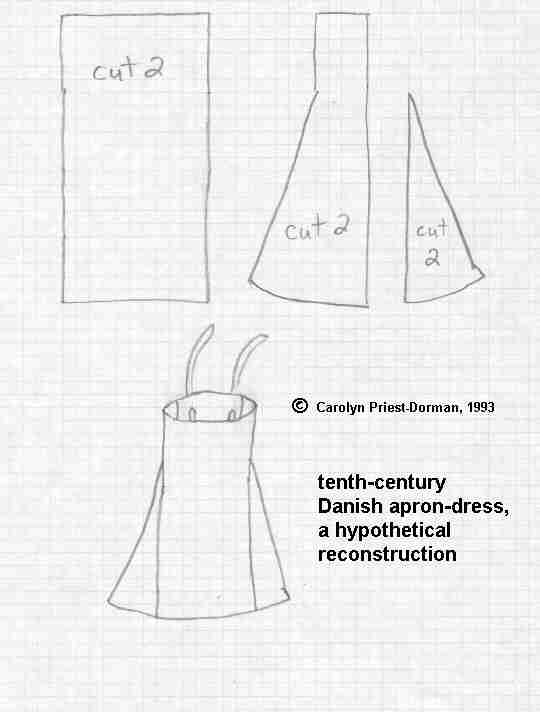
The apron-dress is a layer on top of the dress. Yes, it does involve 2
brooches that attach spaghetti-strap loops from the back to tiny loops
on the front. The apron dress again goes over the head, but the top
edges is about armpit level. Does it have to be a shapeless bag? nope.
There are many styles of apron-dresses, but if you make it out of
rectangular panels with gores inserted in between
<http://www.cs.vassar.edu/~capriest/image/apdress.jpg> you can do a bit
of tailoring to still make it fit tightly at the upper body and flow
nicley over the hips. Also, there is some evidence that Inga Hagg
mentions in her Hedeby book, about long darts at the side, which would
have run from the top edge to about the waste, and they would create
more tailoring.
I usually made my apron-dresses by measuring from bust point to bust
point and making that my panel width. Figuring than how many panels it
would take to go around me, and adding in gores in between. There was
usually some bagginess at the top, but those side darts could take a lot
of that out. As long as you can still get out of it! Others prefer make
their panel width more dependant on fabric width and figure how many of
those it would take to wrap around. I figure they were working on a
warp-weighted loom and would weave whatever width they darn well wanted.
Because of my particular shape, I prefered the additional in gores.
Many people who are thinner prefer the gores calculated into the panels
creating fewer seams (I can't get that out of my fabric).
        Hope this helps,
        -Judy Mitchell
_______________________________________________
h-costume mailing list
[email protected]
http://mail.indra.com/mailman/listinfo/h-costume