The shrinking, the rage Patel demand for reservation is an eruption against
growth that has not been inclusive or accommodative.
 9  49
   - Comments (5)

<http://indianexpress.com/article/opinion/columns/the-shrinking-the-rage/#comments>
   -

<http://indianexpress.com/article/opinion/columns/the-shrinking-the-rage/99/print/>

Written by Ghanshyam Shah
<http://indianexpress.com/profile/columnist/ghanshyam-shah/> | Updated:
August 28, 2015 4:20 am
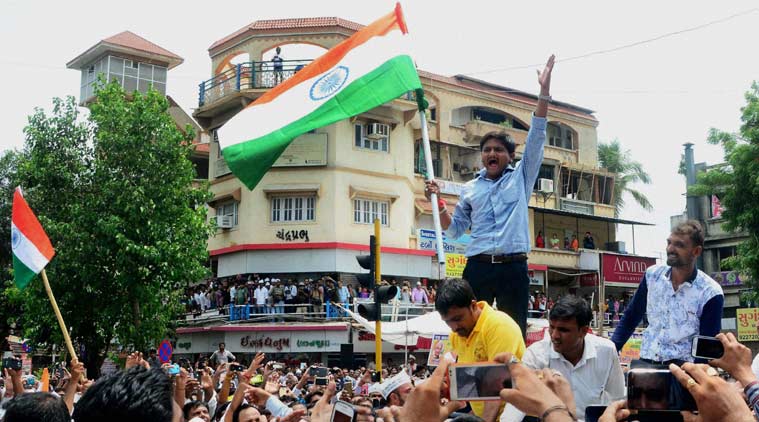
[image: Hardik Patel, Patidar agitation, Gujarat]
<http://images.indianexpress.com/2015/08/hardik1.jpg> Patidar community
leader Hardik Patel leading a rally for reservation in Ahmedabad on
Tuesday. (Source: PTI)

The vast and unprecedented mobilisation of young, middle-class Patels, or
Patidars, as seen at the Kranti Rally on August 25, is a symptom of the
unrest simmering in a globalised Gujarat. The government’s repeated
projection of Gujarat as a state where “all is well” has been undermined by
the scale and strength of this protest, which took the government,
political parties and the media by surprise. Among all the castes in
Gujarat, the unity of the Patidars — which often publicly manifests as
caste patriotism — is taken as a given in the public discourse. This
perception has been reinforced by the half-million strong demonstration
organised on Tuesday, where Patidars from all parts of the state came
together to shout slogans like “Jai Sardar” and “Jai Patidar”. They demand
that the government either extend OBC reservations to Patidars or abolish
the caste-based reservation system altogether. It should be noted here that
the Patidars were the first community in India to launch anti-reservation
movements against the Dalits and Adivasis, and later against Gujarat’s
OBCs, in 1981 and 1985. Later, community leaders, under the guidance of the
RSS and VHP, shrewdly diverted the agitation, so it morphed into one
against Muslims. Non-resident Gujaratis who live abroad have also extended
moral and material support, much as they did to the Sangh Parivar’s
Hindutva agenda.

The upsurge comprises the well-off and dominant Leuva and Kadva Patidars.
They constitute around 12 per cent of the state’s population and are the
single-largest community among rich and middle-class peasants. Since the
last quarter of the 19th century, well-off Patidars have been investing
their agricultural surpluses in business, industry and also in skill
development. High rates of migration in the community, first to Africa and
later to the UK and the US, have added to their prosperity. Indeed, in that
sense they are a model community others have tried to emulate. There is an
almost universal aspiration among Patidars to go to the US for economic
purposes. Those who cannot settle abroad look to get white-collar jobs or
become industrialists.

However, in urban areas, except for a few well-established professionals
and entrepreneurs, the majority are white- or blue-collar employees, or
self-employed or casual, skilled labourers in textile or diamond factories.
The diamond industry has been a mainstay of the community — eight in 10
diamonds in the world are said to be cut and polished in Surat and in other
towns and villages in Gujarat. But for the last several months, the
industry has been in deep crisis. Several units have closed down, and a
large number of diamond workers have been retrenched, which has contributed
to the current unrest in the Patidar community.

Similarly, though advances in irrigation have meant that agricultural
growth in Gujarat over the last decade has been high at around 8 per cent
per annum, this growth has not been inclusive. Small and marginal farmers
have been left behind, and the head of every third Patidar household is a
small and marginal farmer, and/ or a landless labourer. He grapples with
the constant tension of high aspirations and wretched living conditions.
Poor farmers don’t have enough resources to invest in farming and incur
debt. Hardik Patel, the leader of the agitation, highlighted cases of
farmer suicide. The government has been guilty of ignoring the phenomenon.
The poor have desperately tried to get non-farm employment in nearby urban
areas and dream of joining the urban middle class. But urban growth, though
impressive, has been unable to absorb and accommodate these rising
aspirations. It is true that economic growth, largely in the manufacturing
sector, is higher than in many other states. But the quality of available
employment does not meet the expectations of young people. The growth in
employment comes largely from the informal sector, where there is no social
security. Wages in Gujarat are lower than in most other states. Even in the
formal sector, more often than not, employment is casual or contractual.
Insecurity haunts most young employees. In such a situation, government
employment is perceived by frustrated young Patidars as the only secure and
dignified position available. In fact, the number of these government
positions is also shrinking, though paradoxically many sanctioned posts
remain vacant for years. But these young people want simply to claim
something that they perceive others, lower in caste status, are entitled to.

The aspirational young want admission in professional courses, particularly
in medicine or information technology, at well-reputed institutions, so
they can acquire status and wealth. The grouse of the angry and agitated
Patidar youth is that he is deprived of that opportunity, because these
“others” with less marks are admitted to these institutions because of
quotas. His grievance is that he has to pay high fees to attend private
colleges because government offices are closed to him. The number of
government-aided institutions has also stagnated over time, while the
number of self-financed colleges has increased. Seats in government
colleges increased 31 per cent from 2001 to 2015, while in self-financed
colleges, the proportion of seats increased over 600 per cent during the
same period. Fees in the latter are six to seven times those in the former,
at an average of Rs 6,000 for a government college and around Rs 4 lakh for
a private college. It is beyond the reach of most middle-class families,
unless one incurs debt. So the Patidar envies those who get admission on
reserved seats.

Moreover, Patidars have harboured ambitions of migrating to the US for
years. Their relatives settled there and improved their social status, and
they wish to imitate that advancement. But the opportunities for that, too,
are sinking, which adds fuel to the fire. Then, in the last year, the Narendra
Modi <http://indianexpress.com/profile/politician/narendra-modi/>
government’s promise of “achhe din” and jobs does not seem to have been
fulfilled, further exacerbating their anger.

*The writer is former national fellow, Indian Council of Social Science
Research (affiliated to the Centre for Social Studies, Surat), 2013-15*
- See more at:
http://indianexpress.com/article/opinion/columns/the-shrinking-the-rage/#sthash.pUWVaHGk.dpuf

--
You received this message because you are subscribed to the Google Groups
"humanrights movement" group.
To unsubscribe from this group and stop receiving emails from it, send an email
to [email protected].
To post to this group, send email to [email protected].
Visit this group at http://groups.google.com/group/humanrights-movement.
For more options, visit https://groups.google.com/d/optout.