"Selfless Patriot" <https://newsclick.in/selfless-patriot>
Whether the Real Shyama Prasad Mukherjee would ever Stand Up ?
Subhash Gatade <https://newsclick.in/author/Subhash%20Gatade>
(https://newsclick.in/selfless-patriot)

<https://www.facebook.com/sharer/sharer.php?u=http://newsclick.in/selfless-patriot>

<https://twitter.com/intent/tweet?text=%22Selfless%20Patriot%22&url=http://newsclick.in/selfless-patriot>
<?subject=%22Selfless%20Patriot%22&body=NewsClick%20-%20http://newsclick.in/selfless-patriot>
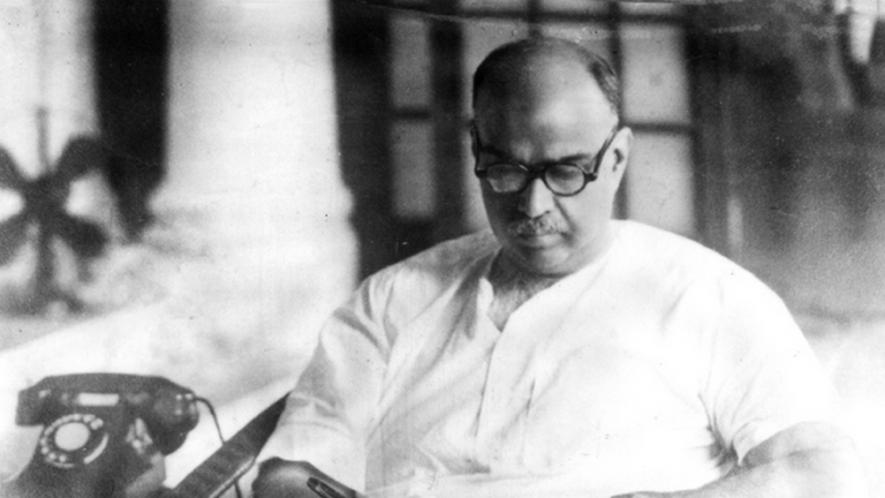
[image: Shyama Prasad]
<https://newsclick.in/sites/default/files/2018-07/Dr.-shyama-prasad-mookerjee.jpg>

“*It has been said with good reason that the Jana Sangh resulted from a
combination of a partyless leader, Syama Prasad Mookerjee, and a leaderless
party, the RSS”.*

*(The Jana Sangh: A Biography of an Indian Political Party, by Craig Baxter
p. 54) *


*In Search of the "Selfless Patriot"*

An untimely death of a political leader — whose career is just blossoming —
is always a loss to the party they belong to, the ideology they espouse, or
the cause(s) they pursue. It also leaves the field open for political
pundits of different shades to make all sorts of speculations, or to
involve themselves in endless deliberations about what would have been the
future of the formation if the said person hadn’t died.

The death of Shyama Prasad Mukherjee (06 July 1901 – 23 June 1953), founder
of Bharatiya Jana Sangh (precursor to the BJP), at the relatively young age
of 52 years, can be considered one such loss for the project he had
undertaken. One cannot stop thinking about how the party he helped found
after resigning from Hindu Mahasabha would have developed had he remained
alive. His differences with the Hindu Mahasabha, which he even led in 1944,
were political in nature, and stemmed from the considered opinion that it
abandoned its exclusivist character.

However, to his legatees, who are always bothered very little by the
nuances and niceties, he is a leader who provides them a fig leaf to
counter the criticism that they had played no role in freedom struggle, or
had no place in the comprehensive list of 'makers of modern India'. Their
ascension to the citadel of power has provided them with ample opportunity
to project him as a key figure in the 'Making of India'. (https://thewire.in
/politics/search-syama-prasad-mookerjee-true-patriot)

In addition to that, by repeatedly claiming that 'history failed to serve
justice to Mukherjee,' they are able to easily target Jawaharlal Nehru, the
first Prime Minister of India, who played the key role in
institutionalising democracy after the assassination of Mahatma Gandhi and
early demise of Sardar Patel, and was aware that any leeway to Hindu
Supremacist ideology would lead India into becoming a mirror image of
Pakistan — a Hindu Pakistan.

Questions remain as to whether Shyama Prasad Mukherjee was really the
‘selfless patriot’ his legatees want us to believe, or if the rulers then
had paid heed to Mukherjee’s advice, would Kashmir really have been a
different place by now.

Perhaps a perusal of his life and related events can throw some light on
how to look at, or remember him.

Any such query would no doubt leave many uncomfortable questions for the
saffrons themselves, regarding Shyama Prasad Mukherjee’s own political
journey before independence and their continuous valorisation of his legacy
without paying any heed to it.

If they take this arduous journey at all, they would also be confronted
with his altogether different take on article 370 itself, and his emphasis
on ‘abandoning communal composition of formations’ when Pakistan had become
a reality.

*2. **A 'POLICY OF RESPONSIVE COOPERATION' WITH THE BRITISHERS*

Born in 1901, Shyama Prasad Mukherjee started his political career in 1929,
and became a member of the Bengal Legislative Council. He joined the Hindu
Mahasabha in 1939 to espouse the cause of the Hindus in India and was a
close associate of Savarkar. He was the opposition leader in the state when
a coalition government led by Krishak Praja Party-Muslim League coalition
was in power 1937-41. Later, he joined the Ministry headed by Fazlul Haq as
the Finance Minister and continued to be in power during the tumultuous
times of the Quit India Movement, when the Britishers faced a mortal
challenge to their rule. The experiment to share power with Muslim League
then was not limited to Bengal alone, it was extended to Sind, as well as
to NWFP (North West Frontier Province), and was part of a conscious policy
adopted by the Hindu Mahasabha.

Prof Shamsul Islam, in his well-researched book ‘Religious Dimensions of
Indian Nationalism : A Study of RSS’ (Media House, Delhi, 2006) describes
how ‘[H]indu Mahasabha and the Muslim League had a coalition government in
the North Western Frontier Province (NWFP) also’ (Page 313). He quotes
Baxter :

‘In the Frontier, Sardar Aurangzeb Khan formed a ministry which combined
Muslim Leaguers, Sikh Akalis and Mahasabhaites, and placed the Congress led
by Dr Khan Sahib temporarily in the opposition. The Mahasabha member of the
Cabinet was Finance Minister Mehar Chand Khanna.’ (Craig Baxter, The Jana
Sangh: A Biography of an Indian Political Party, (Philadelphia: University
of Pennysylvania Press, 1969, P. 20)).

It is now history, how in 1942, when the Britishers were engaged in World
War II and the Congress’s call for Quit India reverberated throughout
India, thousands of people engaged in government jobs including police and
military left their jobs to protest continuation of British regime, the
formations espousing the cause of Hindutva adopted a compromising attitude.
While the RSS preferred to keep itself aloof from the Quit India Movement,
Savarkar, then Supremo of Hindu Mahasabha, went one step further. At the
time, Savarkar opted to tour India, asking Hindu youth to join the military
with the call ‘Militarise the Hindus, Hinduise the nation,’ thus
strengthening British efforts to suppress the rising tide of people’s
movement.

Savarkar’s address to the twenty fourth session of Hindu Mahasabha at
Kanpur, where he outlined Hindu Mahasabha’s ‘policy of responsive
cooperation’ with the British rule, is worth quoting:

The Hindu Mahasabha holds that the leading principle of all practical
politics is the policy of responsive cooperation. And in virtue of it, it
believes that all those Hindu Sangathanists who are working as councillors,
ministers, legislators and conducting any municipal or any public bodies
with a view to utilise those centres of government power […] are rendering
a highly patriotic service to our nation. [...] The policy of responsive
cooperation which covers the whole gamut of patriotic activities from
unconditional co-operation right up to active and even armed resistance,
will also keep adapting itself to the exigencies of the time, resources at
our disposal and dictates of our national interest.

( V. D. Savarkar, Samagra Savarkar Wangmaya Hindu Rasthra Darshan
(Collected works of V. D. Savarkar) Vol. VI, Maharashtra Prantik
Hindusabha, Poona, 1963, p 474)

In fact, Savarkar was of the opinion that with banning of Congress in 1942
and its removal from “..[t]he political field as an open organisation… the
Hindu Mahasabha alone was left to take up the task of conducting whatever
‘Indian National’ activities lay within its scope.’ (do – Page 475)

Defending the power sharing in different provinces Savarkar had famously
said:

…in practical politics also the Mahasabha knows that we must advance
through reasonable compromises. Witness the fact that only recently in
Sind, the Sind Hindu Sabha on invitation had taken the responsibility of
joining hands with the League itself in running coalition government.The
case of Bengal is well known. Wild Leaguers whom even the Congress with all
its submissiveness could not placate grew quite reasonably compromising and
socialble as soon as they came in contact with the Hindu Mahasabha and the
Coalition government , under the premiership of Mr Fazlul Haq and the able
lead of our esteemed Mahasabha leader Dr. Shyama Prasad Mookerji,
functioned successfully for a year or so to the benefit of both the
communities.

(V. D. Savarkar, Samagra Savarkar Wangmaya Hindu Rasthra Darshan (Collected
works of V. D. Savarkar) Vol. VI, Maharashtra Prantik Hindusabha, Poona,
1963, p 479-480)

As a close associate of Savarkar, Shyama Prasad Mukherjee, who later became
the president of Hindu Mahasabha in 1944, was a party to all these
decisions, and had no qualms agaiinst British efforts to suppress people’s
movement against the British rule. In his book ‘History of Modern Bengal,’
Ramesh Chandra Mazumdar provides details of his letter to the then Bengal
Governor, suggesting measures against the Quit India Movement. According to
him

“[S]hyama Prasad ended the letter with a discussion of the mass movement
organised by the Congress. He expressed the apprehension that the movement
would create internal disorder and will endanger internal security during
the war by exciting popular feeling and he opined that any government in
power has to suppress it, but that according to him could not be done only
by persecution…. In that letter he mentioned item wise the steps to be
taken for dealing with the situation …. ” (Ramesh Ch. Mazumdar, History of
Modern Bengal, Part II, pp. 350-351).

He was clearly of the opinion that

…Anybody, who during the war, plans to stir up mass feeling, resulting
internal disturbances or insecurity, must be resisted by any Government
that may function for the time being” (Prabhu Bapu (2013), Hindu Mahasabha
in Colonial North India, 1915–1930: Constructing Nation and History.
Routledge. pp. 103–. ISBN 978-0-415-67165-1)

He even promised the British government that the government led by them
would make every effort to suppress the movement in Bengal. :

“The question is how to combat this movement (Quit India) in Bengal? The
administration of the province should be carried on in such a manner that
in spite of the best efforts of the Congress, this movement will fail to
take root in the province. It should be possible for us, especially
responsible Ministers, to be able to tell the public that the freedom for
which the Congress has started the movement, already belongs to the
representatives of the people. In some spheres it might be limited during
the emergency. Indian have to trust the British, not for the sake for
Britain, not for any advantage that the British might gain, but for the
maintenance of the defense and freedom of the province itself. You, as
Governor, will function as the constitutional head of the province and will
be guided entirely on the advice of your Minister. (Abdul Gafoor Abdul
Majeed Noorani (2000), The RSS and the BJP: A Division of Labour, LeftWord
Books, pp. 56–, ISBN 978-81-87496-13-7)

*3. **Time for Hindu Mahasabha to abandon its 'communal composition’*

What is noteworthy, is that with independence approaching, or with the
partition becoming a reality, Mukherjee seemed to have realised the need
for (majority) community based parties to shed their exclusiveness and
become inclusive. If one goes into details of what prompted Shyamaprasad
Mukherjee to leave Hindu Mahasabha, and what was his vision for the party
which he founded with due support from RSS, we come across interesting
facts that have not come to the fore earlier.

Mukherjee, who became president of Hindu Mahasabha after Savarkar resigned
from the post in 1944, was of the opinion that after independence,
membership of Hindu Mahasabha should not be restricted to Hindus alone
(Statesman, 23 Nov 1948, Press Statement, (Calcutta), 24th Nov 1948, quoted
in *Hindu Nationalism and Indian Politics - The Origins and Development of
Bharatiya Jana Sangh,*B. D. Graham, Cambridge University Press, 1990).
After Gandhi’s assassination, when public hostility was further directed
towards Mahasabha, he declared on 6th February 1948 that

…[i]n my considered judgement the Hindu Mahasabha has today two
alternatives before it. The first is that it can break away from its
political activities and confine its attention to social, cultural and
religious matters alone, it being open to its members to join such
political parties as they may choose. The other alternative is for the
Hindu Mahasabha to abandon its communal composition, to reorient its policy
and throw its doors open to any citizen, irrespective of religion, who may
be willing to accept its economic and political programme

( Mukherjee, Statement of 6th Feb 1948, Statesman, 7th Feb 1948, pp. 1 and
7, quoted in *Hindu Nationalism and Indian Politics - The Origins and
Development of Bharatiya Jana Sangh,* B. D. Graham, Cambridge University
Press, 1990)

Initially, it appeared that the Hindu Mahasabha was contemplating to
revisit its overall policy, and also thinking about suspending political
activities and concentrating on socio- cultural work, but it proved to be
eyewash. The Working Committee meeting held in Delhi (6-7 Nov 1948) not
only decided to resume political activities but also decided to restrict
the membership to Hindus alone. Mukherjee resigned from the said committee
on 23rd November, and his resignation was ratified by a meeting of the All
India Committee on 26th December ( Statesman (Calcutta) 9th Nov 1948, 24th
Nov 1948 and 27th December 1948, -do-)

And the manner in which he explained his position at the time of his
resignation made it further explicit that there was no basis to form
exclusive organisations of Hindus in Independent India

In the India of today more than 85 per cent of her people are Hindus and if
they are unable to protect their own economic and political interests or
India’s inherent rights through the working of a fully democratic
constitution, no separate political party which would confine its
membership to the Hindu fold alone could ever save Hindus or their country.

On the other hand, if the majority community itself retains its political
exclusiveness it would inevitably encourage the growth of communal
political organisations representing the interests of various minority
groups within the country itself, leading to highly prejudicial results.

(Mukherjee, Press Statement, 23 Nov 1948, Statesman ( Calcutta) 24 th
November 1948, p. 7, -do-)

These words no doubt would appear blasphemous to anyone who believes in
Hindutva Supremacist worldview.

Mukherjee’s untimely death while the party he wanted to build was still in
the stage of infancy, rather abruptly brought an end to the differing
approaches vis-à-vis building of the organisation.

The unfolding debate around article 370 provides a glimpse of the
differences which existed between them.

*4.* *Article 370, Shyama Prasad Mukherjee and Bharatiya Jana Sangh*

Not a day passes when name of Shyama Prasad Mukherjee, founder of Bharatiya
Jana Sangh, is not invoked by BJP to oppose Article 370 which guarantees
special status to Jammu and Kashmir. With new facts coming to the fore,
this claim is under question now. It is being now said that Mukherjee, who
died in 1953 under mysterious circumstances, after being arrested for
opposing the special status to Kashmir, had initially accepted the
inevitability of Article 370.

In fact, A. G. Noorani’s important book ‘Article 370: A Constitutional
History of J and K’ (OUP, 2011, Pages 480) is able to clear many confusions
about the tumultuous era post-independence, pertaining to Jammu and Kashmir.

Basing himself on authentic documents, letters, memorandums, white papers,
proclamations and amendments, the author, a constitutional expert himself,
has not only provided fresh insights into the period, but has also tried to
bring forth an important summary of the developments then, and the role
played by different stakeholders. While we have been witness to a process
of erosion of the article 370 today, the book underscores the politics
behind its erosion, which was negotiated between Prime Ministers Jawaharlal
Nehru and Sheikh Abdullah, and had a stamp of approval from Sardar Patel
and Shyama Prasad Mukherjee.

It is well known that ... Sardar Patel played an important role in getting
the provision for J&K’s special status cleared by our Constituent Assembly.
Contrary to the BJP-propagated opinion, Patel intervened in a dispute
between some Congress party members opposed to the special status and
Jawaharlal Nehru’s minister (without portfolio but entrusted with the task
of dealing with the issue) Gopalaswamy Ayyangar to ensure the smooth
passage of Article 370 (called 306 then).

(http://www.firstpost.com/politics/bjps-kashmir-conundrum-article-370-is-
stronger-than-partys-ambitions-1812089.html)

No doubt, for the BJP, this exposure that the said Article had full
approval from Mukherjee, as well as then Home Minister Sardar Patel, is
nothing but blasphemous. Despite its important bearing on its overall
posturing, one is yet to come across any strong rebuttal from the saffron
quarters to this claim till date, barring its usual rhetoric which says
that it is an “[a]ttempt to distort history at the behest of separatist
friendly pseudo-secularists and pseudo-intellectuals.” Interestingly, while
lashing out at the contents of the book, Mr Jitendra Singh, the then
spokesperson of BJP for J & K, and its National Executive Member, had
rather indirectly acknowledged what the author wanted to convey by stating
that “[T]he late leader had suggested to first Prime Minister Jawaharlal
Nehru to put a time-bound rider on ‘Article 370’ and specify for how long
it was being envisaged,” (http://www.siasat.com/english/news/shyama-prasad-
mukherjee-never-endorsed-article-370).

It is worth mentioning that this is not the first time that Dr Mukherjee’s
consent to full autonomy to Kashmir has come up. In his article in ‘The
Greater Kashmir’ (http://www.greaterkashmir.com/news/2010/aug/8/leaf-from-
the-past-4.asp), Mr Balraj Puri, the veteran journalist from the state, has
provided further details about the same:

“[S]hyama Prasad’s prolonged triangular correspondence with Nehru and
Sheikh Abdullah on the status of the State, which was published at that
time by the party, is the most authentic evidence of his stand on the
issue. In his letter dated January 9, 1953 to both of them, for instance,
he wrote: “We would readily agree to treat the valley with Sheikh Abdullah
as the head in any special manner and for such time as he would like but
Jammu and Ladakh must be fully integrated with India.” While Nehru rejected
the idea straightway warning against its repercussions in Kashmir and its
international implications, Abdullah sent a detailed reply in which he,
inter alia, said. “You are perhaps not unaware of the attempts that are
being made by Pakistan and other interested quarters to force a decision
for disrupting the unity of the State. Once the ranks of the State people
are divided, any solution can be foisted on them.”

He further added that the prolonged correspondence is concluded with Dr.
Mukherjee’s letter to Pandit Nehru on February 17, 1953, in which he
suggested.

1. “Both parties reiterate that the unity of the State will be maintained
and that the principle of autonomy will apply to the province of Jammu and
also to Ladakh and Kashmir Valley.

2. Implementation of Delhi agreement—which granted special status to the
State—will be made at the next session of Jammu and Kashmir Constituent
Assembly.”

Nehru replied to that by saying that the proposal for autonomy to the three
provinces had been accepted by him and Abdullah in July 1952. If Mukherjee
had realised his mistake, he should have withdrawn the agitation
unconditionally. Mukherjee was unwilling to do so, as it amounted to
surrender. The deadlock prolonged over some way which could provide, what
may be called, a face saving to the Jana Sangh.

It is important to note that after the sudden death of Mukherjee, Nehru had
appealed to the people of Jammu to withdraw their agitation as their demand
for regional autonomy had been conceded. The State government endorsed the
appeal on July 2, when Praja Parishad leaders were released, went to Delhi
and met Nehru on July 3. Thus, the Praja Parishad agitation was withdrawn
on the assurance of regional autonomy and immediate implementation of the
Delhi Agreement.

But there are number of ifs and buts. One factor which prevented its
implementation was that Praja Parishad and Jana Sangh backed out of it.
According to Balraj Madhok, who later on became the president of the Jana
Sangh, the party withdrew its commitment to the State autonomy and regional
autonomy under the directive from Nagpur (the RSS headquarters).The party
continued a ceaseless campaign against regional autonomy and Article 370.

((http://www.greaterkashmir.com/news/2010/aug/8/leaf-from-the-past-4.asp))

Till date the BJP maintains that if the government then had paid heed to
Mukherjee’s opposition of the said Article, Kashmir would have been in a
different situation right now, but it still has not gathered enough courage
to admit that he had conceded to the proposal in writing, earlier.

--
You received this message because you are subscribed to the Google Groups
"humanrights movement" group.
To unsubscribe from this group and stop receiving emails from it, send an email
to [email protected].
To post to this group, send email to [email protected].
Visit this group at https://groups.google.com/group/humanrights-movement.
For more options, visit https://groups.google.com/d/optout.