[image: search]

[image: menu]
Politics <https://www.newsclick.in/articlelist/Politics>
India <https://www.newsclick.in/articlelist/India>

International <https://www.newsclick.in/articlelist/International>
Even Germany Should Wonder Why Lindner Visited RSS
<https://www.newsclick.in/even-germany-wonder-why-lindner-visited-RSS>
The German envoy’s visit to the Nagpur headquarters of the Rashtriya
Swayamsevak Sangh has worrying implications for both India and Germany.
Silence on what transpired at the meet can only make matters worse.
Subhash Gatade <https://www.newsclick.in/author/Subhash%20Gatade>

23 Jul 2019
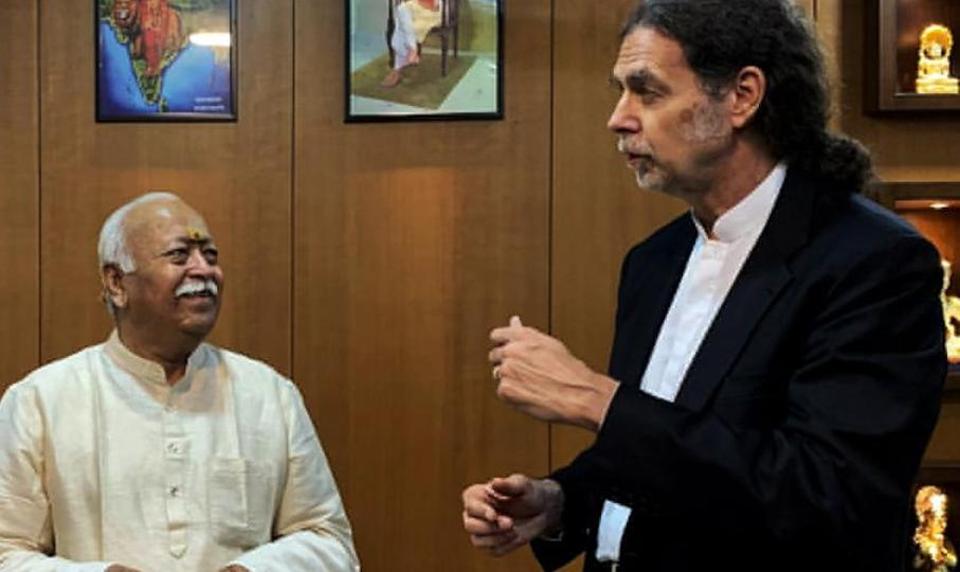
[image: The German Ambassador to India, Walter J Lindner, met RSS chief
Mohan Bhagwat at the RSS headquarters in Nagpur]
<https://www.newsclick.in/sites/default/files/2019-07/rss%20%26%20germany.jpg>
Image Courtesy: ANI

*‘…The burden of National Socialist crimes **accompan**ies Germany to this
day.*

*Immediately after the war ended in 1945, and in following decades,
confronting the crimes committed under National Socialism shocks people...*

*Many Germans did not want to deal with this recent past and their
complicity.*

*Only in the 1960s does a broad social debate begin, primarily with the
younger generation calling for a vigorous reappraisal of the past.*

*The consequences of National Socialism and the Holocaust continue to shape
Germany’s self-perception.’*

*Our History: Germany Since 1945* is a permanent exhibit that opened a
quarter-century ago at the *Haus **der** Geschichte* or House of History, a
museum in Bonn, western Germany. The very first item on display here is *The
Ever-Present Past*, which is excerpted above.

No visitor passing through *Germany Since 1945* can miss seeing this
display. *The Ever-Present Past* is a stark reminder of Germany’s
continuing effort to make amends with its troubled past. For the rise of
Adolf Hitler and the ethnic cleansing it unleashed, Germany has apologised
and spent billions on reparations for the victims of Nazism. On 7 December,
1970, the German Chancellor Willy Brandt made history by dropping to his
knees at the Warsaw Ghetto in Poland, seeking atonement for this past.

When refugees poured into Europe in 2015, Germany accommodated around
8,90,000 of them. To this gesture is often ascribed the German people’s
continuing urge to make amends for their inglorious past. It is this
desire, it is often said, which had prompted Angela Merkel’s government to
welcome Syrian refugees who were fleeing from the Islamic State.

It was also not lost on political observers and the public everywhere that
no equivalent gesture came from the Muslim-dominated petro-dollar nations.
The world had watched ordinary German citizens welcome, with much fanfare,
the refugees as they arrived in batches.

To be sure, the third world has witnessed its share of genocide and mass
killing. It has also been remiss—whether or not their responses are
refracted through the example set by post-war Germany—in displaying
collective guilt for past occurrences. Unlike Germany, in many parts of the
world perpetrators and chief executioners of such crimes have even received
political victories.

Yet, a recent meeting
<https://www.telegraphindia.com/india/german-ambassador-in-rss-corner/cid/1694846?ref=search-page>
between
Walter J. Lindner, Germany's envoy to India, and Mohan Bhagwat, the
*sarsanghchalak* or supremo of the Nagpur-headquartered Rashtriya
Swayamsevak Sangh (RSS) has still invited great concern and surprise.

The reason for the opprobrium is that the RSS promotes Hindutva, a deeply
controversial world view. One of the most prominent leaders of the RSS had,
for instance, lauded the ethnic cleansing of Jews in Germany. Could there
be a greater irony, at least from the point of view of Germany, that
Lindner should visit such an organisation, which has not distanced itself
from those views. In fact, the RSS had propounded the theory that similar
methods as the Nazis should be deployed in India, in order to settle the
‘minority question’.

Lindner is no ordinary career diplomat. He is a darling of the German
media. He has been a spokesman for Joschka Fischer, the former German Vice
Chancellor and Foreign Minister. He has even served as Secretary of State
when Heiko Maas became Foreign Minister in 2018. A polyglot who understands
German, French, Turkish and English, a trained flautist and a guitarist
with two albums under his belt: With all these accomplishments, Lindner is
surely no stranger to the RSS and its affinity with National Socialism.

Had Lindner’s visit to the RSS headquarters remained private, it is still
conceivable that objections to it would have been muted or absent. But the
ambassador chose to tweet about his visit extensively. He has tweeted the
details of his visit to Bhagwat along with his other more mundane
activities in Nagpur, which included riding a bicycle around Nagpur,
supporting a programme to fight leprosy in the region and so on. His tweets
were followed by similar remarks on twitter from the RSS, which gives the
entire affair an official air.

Those perturbed by Lindner’s visit immediately raised a series of petitions
and protests. One of them was initiated by a South Asian analyst on the
popular website for such petitions, change.org. In it, Pieter Friedrich, a
South Asia analyst, has demanded Lindner’s resignation or recall. By Sunday
night, the petition secured almost 1,800 signatures, including by prominent
academicians from around the world. The petition refers to the
paramilitary, ideological and institutional inspiration that the RSS has
drawn from European fascism and emphasises that Germany must “in no way
demonstrate any tolerance” for its ideology.

It is no secret that RSS’s second supremo, Madhav Golwalkar, had
controversially proposed a vision for India as an ethno-state, in the
principal document he wrote, titled *We or Our Nationhood Defined.*

In Golwalkar’s conception, religions that do not have their holy land in
India—that is, Islam and Christianity—would have to “lose their separate
existence to merge into the Hindu race”. Else, they would get no rights or
privileges as citizens and would be “wholly subordinated to the Hindu
nation.”

Not just that. Golwalkar, who believed that Judaism was “an intolerant
faith”, had praised Germany’s Holocaust. He had referred to it as a
manifestation of “race pride at its highest”.

It perhaps need not be said that there is a deep irony in the German
Ambassador paying a visit to the group, one of whose tallest leaders had
considered it “impossible” for different “races and cultures” to be
“assimilated into one united whole”. One who had proclaimed the Nazi policy
towards the Jews as “a good lesson for us in Hindustan to learn and profit
from.”

The timing of the publication of this book by Golwalkar is equally
relevant: This was done in 1939, just a year after Kristallnacht, the first
Nazi pogrom against the Jews. It was published only four years after the
Nazis had passed the Nuremberg Laws, in September 1935. The two principal
legislations that formed the Nuremberg Laws began stripping the Jews of
their citizenship, forbade employment of German women under 45 and
prohibited marriages between German Jews and non-Jews.

The timing of Golwalkar’s writings would perhaps have troubled the
Ambassador, had he taken note of the series of recent incidents in his own
country. These events portend how deeply the ultra-right viewpoint has
penetrated a section of German society. Surely these incidents are against
the spirit of *Kniefall von Warschau*, or Genuflection at Warsaw, the
popular German phrase that refers to Willy Brandt’s historic penance in
Poland.

That legitimacy for neo-Nazi viewpoints is growing in Germany is apparent
from the fact that a former German spy chief, Maassen, who is a member of
the ruling Christian Democratic Union (CDU) party, recently shared far-right
tweets
<https://www.theguardian.com/world/2019/jul/15/former-german-spy-chief-georg-maassen-alarm-sharing-far-right-tweets>,
sparking outrage.

Maassen was forced to step down just last year, for underplaying an
incident in Chemnitz, one of eastern Germany’s most prominent cities, where
far-right protesters had violently chased down migrants.

Roughly a month before Maassen’s controversial tweet, a prominent
politician, Walter Lübcke, also a member of the CDU, was assassinated
<https://www.theguardian.com/world/2019/jun/03/german-local-politician-from-angela-merkel-party-found-dead>
by
the neo-Nazi Stephan Ernst for his pro-refugee stance. In 2015, when Merkel
faced criticism for how she was handling the refugee crisis, Lübcke had
defended her decision not to close German borders, which had angered far
right activists.

There were protest marches in Kassel, where Lübcke was killed, against
increasing right wing violence. One demonstration was attended by over
10,000 people; though calls by Haas for more demonstrations were largely
ignored.

“Why are the people of my country not flooding to the streets in disgust?”
columnist Hatice Akyün asked in the *Der Tagesspiegel*
<https://www.tagesspiegel.de/politik/von-solingen-bis-zu-walter-luebcke-warum-demonstriert-niemand-warum-ich-nicht/24481216.html>
newspaper.
“Now, after the death of Walter Lübcke … After death threats against
Cologne mayor Henriette Reker and dozens of other politicians.”

Meanwhile the far right Alternative für Deutschland (AfD), has managed to
win seats in Parliament and seems to be getting bolder. Thomas Haldenwang,
the chief of the German Verfassungsschutz (Federal Office for the
Protection of the Constitution) has already warned of growing threats from
violent right wing extremists. (It is estimated that there are nearly
13,000 violent Right-wing extremists living in Germany.) Worryingly,
Haldenwang has also said, at a press conference
<https://www.theguardian.com/world/2019/jun/18/nearly-13000-violent-rightwing-extremists-now-living-in-germany>,
that there are so many Right wing extremists that “…it’s difficult to have
an eye on them all.”

One is yet to hear the German Embassy in Delhi explain exactly what purpose
Lindner’s visit to the RSS headquarters served. What is certain is that he
has made history of quite another kind, with the potential to reverberate
not just India but in Germany too.

(https://www.newsclick.in/even-germany-wonder-why-lindner-visited-RSS)

--
You received this message because you are subscribed to the Google Groups
"humanrights movement" group.
To unsubscribe from this group and stop receiving emails from it, send an email
to [email protected].
To view this discussion on the web visit
https://groups.google.com/d/msgid/humanrights-movement/CAJGPqcaHT-W-5r14o_sm2swaS-nqu4KwLv%3D1gTBFmss6ix1B7Q%40mail.gmail.com.