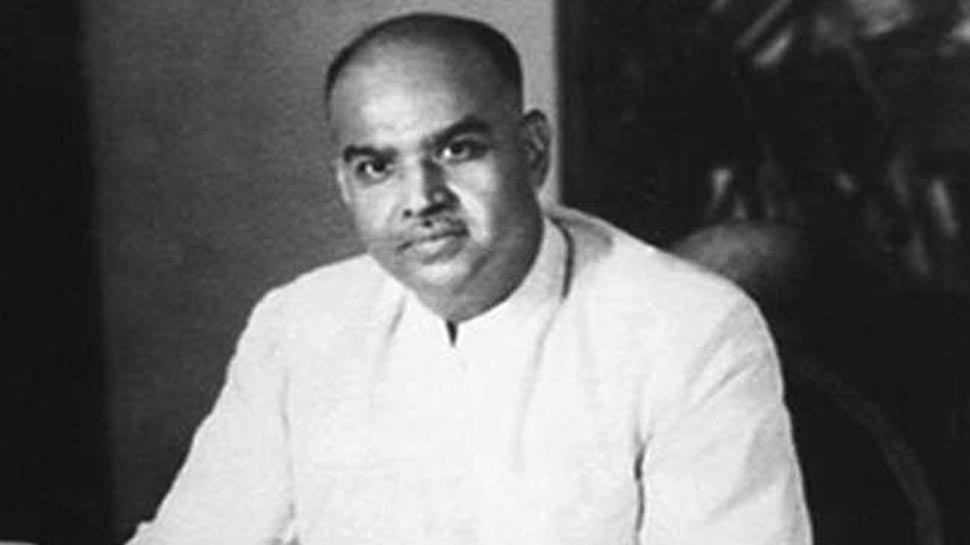
Shyama Prasad Mukherjee’s Role: Official Myths on J&K Busted
<https://www.newsclick.in/index.php/shyama-prasad-mukherjees-role-official-myths-jk-busted>
Dear Prime Minister, nothing about Jammu & Kashmir is as your party sees
it.
Subhash Gatade <https://www.newsclick.in/author/Subhash%20Gatade>
11 Aug 2019
[image: Syama Prasad]
<https://www.newsclick.in/sites/default/files/2019-08/Shyama%20Prasad%20Mukherjee_1.jpg>

Economist and activist Jean Dreze, who has co-authored books with Nobel
laureates, such as Amartya Sen and Angus Deaton, was in the headlines for a
placard he carried to a protest rally in Delhi earlier this week. His
placard challenged the government's most critical justification for its
controversial move to scrap Article 35A and read down Article 370 in Jammu
and Kashmir (J&K). The placard displayed statistics that compare J&K with
Gujarat, which is Prime Minister Narendra Modi and Home Minister Amit
Shah’s home state. Dreze clearly showed how Gujarat lags
<https://www.telegraphindia.com/india/jean-dreze-contests-amit-shah-with-gujarat-data/cid/1696457>
behind
J&K on a raft of development indices.

Although Dreze’s data beautifully punctures the government's claim that
J&K’s special status was a hindrance to its progress, Modi in his address
to the nation on Wednesday night repeated the same argument, based on
dubious claims. For instance, his claim that J&K lags behind other Indian
states in matters of health services, education and so on, is patently
incorrect.

Figures recorded in the National Family Health Surv
<https://www.bbc.com/hindi/india-49279020>ey (NFHS) has extended the debate
further and shown that J&K already excels many other Indian states on
several human development counts. Once again, this underlines that all talk
about how “development” will reach J&K after Article 370 is made redundant
is sheer humbug.

The propagation of false information brings home the fact that the
government has gone very far to generate legitimacy for its decisions in
J&K. In his address to the nation, Modi also said that his government had
“fulfilled the dreams of [BR] Ambedkar as well as [the then Home Minister
Vallabhbahi] Patel”.

Did Patel and Ambedkar really oppose Article 370?

First of all, the very idea that a few members of a previous Cabinet can be
singled out by later-day historians or politicians to prove a point is
flawed, considering that a Cabinet is supposed to function on the principle
of collective responsibility. The alleged opposition of Ambedkar and Patel
to Article 370 is an unsustainable defence for any step taken by today’s
Cabinet, simply on this ground.

Second, documentary evidence
<http://archive.indianexpress.com/news/the-disputed-legacy-of-vallabhbhai-patel/1188943/>
shows
that the then Cabinet led by former Prime Minister Jawaharlal Nehru worked
on mutual consultations on the Kashmir issue. Besides, in Nehru’s day, all
powers were not centralised and concentrated in the Prime Minister’s
Office, as has become the norm today. Patel’s biographer Rajmohan Gandhi
points out: ‘Mahatma Gandhi, Nehru and Patel formed a crucial trimuvirate
that agreed that independent India would not be a Hindu Rashtra but one
that offered equal rights to all. After Gandhi’s departure and until
Patel’s death, Patel and Nehru differed on several matters but not on some
fundamentals. With the help of others including Ambedkar, Maulana Azad,
Rajendra Prasad and Rajaji, they entrenched secularism and equality in the
Constitution.”

Forget Nehru for a moment. Even independent scholars and journalists admit
that Patel
<https://theprint.in/opinion/ironical-that-bjp-wants-article-370-revoked-sardar-patel-was-its-architect/74804/>
was
himself the “architect” of Article 370.

Indeed, when India gained Independence, the future of three princely
states, namely Junagadh, Hyderabad and Kashmir, remained unclear as far as
their accession to India and Pakistan was concerned. Documents that have
been declassified, including Cabinet and defence committee meeting records,
have now shown how Nehru and Patel worked closely to handle these three
states. Apart from the external aspects of the Kashmir issue, on internal
aspects too, “Nehru and Patel worked closely together despite their
differing emphases.”

This is apparent if we revisit the process of drafting Article 370 of the
Indian Constitution which accorded special status to J&K as well. NG
Ayyangar, a Cabinet minister without portfolio, who was also a former dewan
of Kashmir, and the first Prime Minister of Kashmir, Sheikh Abdullah, and
his senior colleagues conducted the actual negotiations for Kashmir over
several months in 1949. No doubt, these negotiations were difficult, but
Nehru seldom took a step without Patel’s concurrence.

“When Ayyangar prepared a draft letter from Nehru to Abdullah summarising
the broad understanding reached, he sent it to Patel with a note: “Will you
kindly let Jawaharlalji know directly as to your approval of it? He will
issue the letter to Sheikh Abdullah only after receiving your approval,”

Patel Crucial to Special Status for J&K

Besides, Patel played an important role in getting J&K’s special status
cleared by the Indian Constituent Assembly. Contrary to the BJP-propagated
opinion, Patel intervened in a dispute between some Congress party members
who were opposed to the special status and Gopalaswamy Ayyangar, another
minister without portfolio who had been entrusted to deal with the issue,
was asked to ensure smooth passage of Article 370
<http://www.firstpost.com/politics/bjps-kashmir-conundrum-article-370-is-stronger-than-partys-ambitions-1812089.html>,
which was then called 306.

Further, not only Patel but even Ambedkar’s positions on Pakistan and the
Partition have been twisted into half-truths in order to strengthen the
position of today’s government. Any thorough reading of Ambedkar's speeches
<https://www.youthkiawaaz.com/2019/05/article-370-and-dr-ambedkar-a-factcheck/>
and
writings on both these issues, and the Constituent Assembly debates make it
clear that it contained no authenticated writing on Article 370, nor did
any document from his exhaustive literature.

A quote attributed to him is in circulation but the claim it makes that he
had “refused to draft Article 370” is false. The quote in circulation,
which reads as if Ambedkar is addressing Kashmir, is as follows: “You wish
India should protect your border, build roads in your areas, supply food
and grains and that Kashmir should get equal status as India. But the
government of India should have only limited powers and Indian people
should have no rights in Kashmir. To give consent to your proposal, would
be treacherous thing against the interest of India and I, as a Law Minister
of India, will never do.”

What is the Veracity of This ‘Quote’?

Author and Ambedkarite scholar Pratik Tembhurne points out shocking
details: “The earliest ‘refusal to draft’ statement can be found in an
editorial in Tarun Bharat, mouthpiece of the Rashtriya Swayamsevak Sangh
(RSS) in 1991. It cites a verbal account by Balraj Madhok, an RSS veteran,
about Ambedkar and it emerged four decades after his death.”

It would be the height of innocence to believe a verbal account by an RSS
ideologue on an issue that Ambedkar's own writings are silent about.

Velivada
<http://velivada.com/2019/08/05/what-ambedkar-had-really-said-about-kashmir-issue/>,
an Ambedkarite web journal has similarly exposed the fake quote attributed
to Ambedkar. “It is almost on the same lines as BJP/RSS said [that] oh, Dr
Ambedkar also wanted demonetisation, which is an utter lie once again.”

Syama Prasad Mukherjee’s role

Modi in his speech to the nation had even emphasised that the scrapping of
Kashmir’s special status fulfils a dream of one of the Jana Sangh’s
founding fathers, Dr Syama Prasad Mukherjee. As we all know, Mukherjee died
in 1953 under mysterious circumstances after being arrested for opposing
the special status to Kashmir.

What is normally missed is that Mukherjee
<https://www.newsclick.in/selfless-patriot> had initially accepted the
inevitability of Article 370.

The noted lawyer and constitutional expert AG Noorani’s important book,
Article 370: A Constitutional History J&K, published by Oxford University
Press in 2011, clears many a confusion pertaining to J&K during the
tumultuous post-Independence era. It also examines Mukherjee's initial
consent to the article.

No doubt, for the BJP, Noorani’s finding that Article 370 had the full
approval of Mukherjee as well as Patel is nothing short of blasphemy.
Interestingly, Jitendra Singh
<http://www.siasat.com/english/news/shyama-prasad-mukherjee-never-endorsed-article-370>,
the J&K spokesperson of the BJP and member of its national executive, had
lashed out at the contents of the book but even so, he had ended up
indirectly acknowledging that what the author had conveyed. Singh had said,
“The late leader had suggested to first Prime Minister Jawaharlal Nehru to
put a time-bound rider on Article 370 and to specify for how long it was
being envisaged.”

It is worth emphasising that this was not for the first time that
Mukherjee’s consent to full autonomy to Kashmir had come up. In his
write-up in The Greater Kashmir, Balraj Puri
<http://www.greaterkashmir.com/news/2010/aug/8/leaf-from-the-past-4.asp>,
the veteran journalist from the state, had provided further details on the
issue: “Shyama Prasad’s prolonged triangular correspondence with Nehru and
Sheikh Abdullah on the status of the State, which was published at that
time by the party, is the most authentic evidence of his stand on the
issue. In his letter dated 9 January 1953 to both of them, for instance, he
wrote, ‘We would readily agree to treat the valley with Sheikh Abdullah as
the head in any special manner and for such time as he would like but Jammu
and Ladakh must be fully integrated with India.’

While Nehru rejected the idea, straightway warning against its
repercussions in Kashmir and its international implications, Abdullah sent
a detailed reply in which he said, “You are perhaps not unaware of the
attempts that are being made by Pakistan and other interested quarters to
force a decision for disrupting the unity of the State. Once the ranks of
the State people are divided, any solution can be foisted on them.”

He further added that the prolonged correspondence is concluded with
Mukherjee’s letter to Nehru on February 17,1953, in which he suggested:
“Both parties reiterate that the unity of the State will be maintained and
that the principle of autonomy will apply to the province of Jammu and also
to Ladakh and Kashmir Valley. Implementation of Delhi Agreement—which
granted special status to the State—will be made at the next session of
Jammu and Kashmir Constituent Assembly.”

Nehru replied that he had agreed to the proposal for autonomy to the three
provinces (with concurrence of Abdullah) in July 1952. If Mukherjee had
realised his mistake, he should have withdrawn the agitation
unconditionally. Mukherjee was unwilling to do it as it amounted to
surrender. The deadlock was prolonged in order to provide what may be
called a ‘face-saving’ to the Jana Sangh.

It is important to note that after the sudden death of Mukherjee, Nehru had
appealed to the people of Jammu to withdraw their agitation as their demand
for regional autonomy had been conceded. The state government endorsed the
appeal on July 2, when Praja Parishad leaders were released. These leaders
then went to Delhi, where they met Nehru on July 3. Thus, the Praja
Parishad agitation was withdrawn on the assurance of regional autonomy and
immediate implementation of the Delhi Agreement.

But there are a number of ifs and buts: One factor which prevented its
implementation was that the Praja Parishad and Jana Sangh backed out of it.
According to Madhok, who later became the president of the Jana Sangh, the
party withdrew its commitment to autonomy following a directive from
“Nagpur”—a reference to the RSS headquarters, which are located in Nagpur.
The party continued a ceaseless campaign
<http://www.greaterkashmir.com/news/2010/aug/8/leaf-from-the-past-4.asp>
against
regional autonomy and Article 370.

Till date, the BJP maintains that if the government had then heeded
Mukherjee’s opposition to Article 370, the Kashmir situation would have
been very different, but still the party has not gathered the courage to
admit that Mukherjee had conceded to the proposal in writing.

First published here :
https://www.newsclick.in/index.php/shyama-prasad-mukherjees-role-official-myths-jk-busted
)

--
You received this message because you are subscribed to the Google Groups
"humanrights movement" group.
To unsubscribe from this group and stop receiving emails from it, send an email
to [email protected].
To view this discussion on the web visit
https://groups.google.com/d/msgid/humanrights-movement/CAJGPqcZ3PFA79vPSFm4psZHsBQue9%3D5CXvFpqEhWRHPuWJ4OiQ%40mail.gmail.com.