Who Needs Romila Thapar’s CV?
<https://www.newsclick.in/Romila-Thapar-CV-JNU-Historian-Hindutva-Brigade-Indian-History>
Thapar questioned imperialist versions of Indian history, which the
Hindutva Brigade still goes by.
Subhash Gatade <https://www.newsclick.in/author/Subhash%20Gatade>
02 Sep 2019 (
https://www.newsclick.in/Romila-Thapar-CV-JNU-Historian-Hindutva-Brigade-Indian-History
)
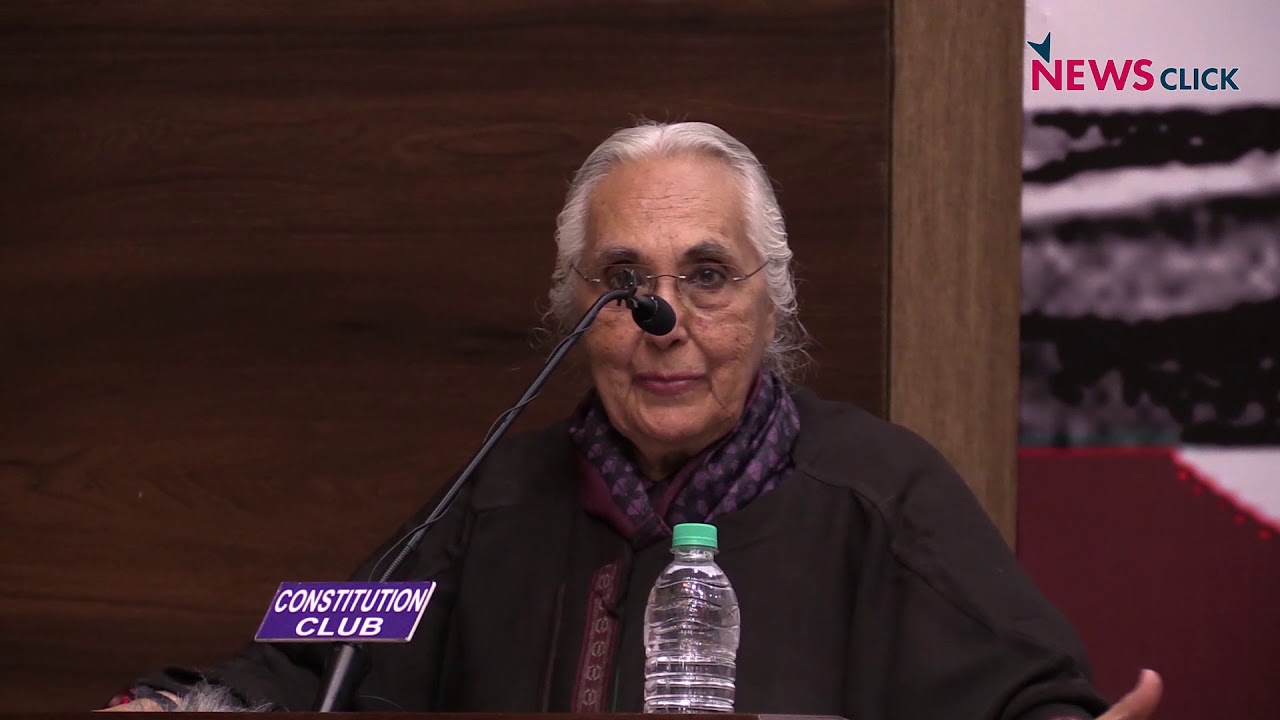
[image: Romila Thapar]
<https://www.newsclick.in/sites/default/files/2019-09/Romila_Thapar.jpg>

*...an historian who is indefatigable in the pursuit of knowledge and
prolific in its publication, and who is above all a devoted partisan of the
truth. ... The early history of the country has been illuminated by
Professor Thapar, whom I now present, more than by almost any other
scholar. An historian of that period who seriously wishes to refute
accepted fictions and dispel the general darkness will need several high
qualities. *(From a citation presented by Oxford University to Romila
Thapar while conferring on her an honorary Doctorate of Letters in 2002.)

It was 1960, when Romila Thapar, a young historian at the time, wrote a 400
plus-page monograph on *Asoka and the Decline of the Mauryas*. According to
Oxford University Press, which published it in 2017, it tried to “trace
virtually the entire span of Indian history.” The monograph is considered a
classic today.

Thapar’s scholarly journey continues unabated at the age of 88. She is
among the world’s foremost intellectuals, known for path-breaking work on
Indian ancient history, as this <http://sacw.net/article10455.html> interview
acknowledges. Undoubtedly, her work has informed and inspired at least
three generations of history students.

It hardly needs mention that Thapar has prestigious prizes to her credit
for the scores of books and academic papers she has published. Twice, she
declined the Padma Bhushan, the highest civilian award granted by the
government.

Now Thapar is in the news because of a strange query from the Jawaharlal
Nehru University (JNU) administration, where she has held teaching and
administrative positions for roughly three decades. Thapar was instrumental
in setting up JNU’s prestigious department of modern history. This is the
department she is still associated with as Professor Emerita after she
retired in 1993. Now the university wants her CV, or curriculum vitae, so
as to “review” her status and contribution as an honorary emeritus
professor.

It is no wonder then that academic circles are up in arms, for they have
rightly construed it as one more effort to “denigrate the teaching and
learning traditions of JNU” and Thapar herself. An emeritus professorship
is simply an honorary position, a status accorded to scholars an
institution regards as valuable. The JNU Teachers Association (JNUTA) has
said
<https://www.telegraphindia.com/india/jnu-babus-smarter-than-benjamin-franklin/cid/1701962?ref=top-stories_home-template>
that
it is unquestionably the university’s honour that scholars such as Thapar
are associated with it.

Before asking Thapar to send her CV, JNU’s administration (it later said 11
others had been sent similar letters) could have checked what the American
Philosophical Society, considered one of the most learned societies in the
United States (US), thinks about her work. Set up by Benjamin Franklin, one
of the founding fathers of the US 276 years ago, this society selected
Thapar as its member in June.

In 2008, Thapar was awarded <https://www.loc.gov/item/prn-08-225/> the $1
million Kluge Prize for the Study of Humanity, along with the historian
Peter Brown, who is also an emeritus professor at Princeton University. For
the benefit of JNU’s administrators, this prize is regarded as the Nobel
that honours disciplines not covered by the Nobel Prize itself.
Fortunately, the possibility of being declared ‘intellectuals’—a
disparaging term in the populist discourse that prevails in India—did not
bother the administrators of the Kluge Prize.

The custodians JNU, exposing their anti-intellectual position, want to
convey to Thapar and other scholars a message that their work beyond
academics (Thapar has played a stellar role as a public intellectual who
never shies away from speaking truth to power) is neither welcome nor
acceptable to the present dispensation.

In an interview just before the parliamentary elections this year, Thapar
had boldly stated that minorities feel alienated
<http://en.maktoobmedia.com/india/2019/04/21/modi-concentrated-on-what-brings-him-publicity-romila-thapar/>
living
under the rule of [Prime Minister Narendra] Modi. She also commented on how
India’s governing party is rewriting history to justify
<https://www.nytimes.com/2019/05/17/opinion/india-elections-modi-history.html>
its
Hindu nationalist ideology. It is these clear-cut positions, and not the
achievements listed in her CV, that seem to be the real stumbling block for
JNU.

Thapar’s academic work has always been seen as ‘controversial’ by the
Hindutva lobby, for her research is grounded in professional methods of
investigation rather than pet theories of Hindu extremists based on
extrapolation from Sanskrit texts
<https://www.newsclick.in/india/gopalaswami-panel-recommendations-teaching-regressive-science-sanskrit>.
Thapar’s documentation of early India is at odds with the Hindutva
preference for a mythical past replete with orthodoxies. To them, India is
a purely Hindu civilisation; and the political advantages of this approach
hardly need to be detailed in contemporary India. Regressive positions, the
Right hopes, will cement its popular position even if it comes at the cost
of valuable research and scholarship.

Thapar has for decades questioned the historical theories that are
expounded by the Hindutva brigade. In her *Communalism and the Writing of
Ancient Indian History*, brought out by Popular Prakashan in 1969, the
Right’s flawed reliance on assumptions that date back to 19th century
colonial history-writing are exposed. Again, while delivering the Athar Ali
Memorial Lecture  <https://www.countercurrents.org/comm-gatade120703.htm>at
the Aligarh Muslim University in February 2003, Thapar makes it clear why
the Hindutva brigade dislikes her.

The reason is the colonial interpretation of history, which was craftily
composed and propagated by the British over the 19th century. It is this
history that the Hindutva brigade still goes by and readily accepts
<https://www.newsclick.in/NCERT-Removes-3-Chapters-Class-10-History-Books>,
and thus their dislike for Thapar and other proponents of modern
historiography.

As Thapar said, by 1823, the *History of British India* by James Mill was
available and widely read in India and had become a standard text of
British imperialists. In it, Mill slotted Indian history into three
‘periods’—Hindu civilisation, Muslim civilisation and the British period.
This periodisation was accepted in India largely without question through
the 19th century (Mill died in 1836).

Thus the effects of this book lasted on Indian historiography and research
for 200 years. Mill had argued in it that ‘Hindu civilisation’ was stagnant
and backward, that the ‘Muslim’ era was only marginally better and that it
is the British colonial power that became an agency of progress of India.

The Hindutva version of Indian history, tragically, accepts this
periodisation even today. As Thapar has pointed out, the Hindu Right only
changed the colours of each of these phases: It regards the Hindu period as
a golden age, the Muslim period as a black and dark age of tyranny and
oppression, and the colonial period as a grey zone of near-marginal
importance.

What is being done by JNU is by no means Thapar’s first brush with the
Hindutvadis. Nor is she the only scholar to suffer its abuse. Two decades
ago, the Bharatiya Janata Party’s (BJP) assumed power at the Centre and set
about rewriting the educational curriculum, giving it its own chauvinistic
flavour. As the project gained momentum, intellectuals and academics who
were at odds with the Sangh Parivar’s view of history came under attack.
Again, various pretexts were used to make their life difficult or humiliate
them.

It stalled the Indian Council of Historical Research-sponsored *Towards
Freedom *project, which was being edited by Sumit Sarkar of the University
of Delhi and KN Panikkar of JNU. The National Council of Educational
Research and Training also went all out to exlcude from the curriculum all
influences of—in the words of the then chief of the Rashtriya Swayamsevak
Sangh KS Sudarshan—“anti-Hindu Euro-Indians”.

In 2001, when NCERT was deleting passages from school textbooks on the
grounds that they “hurt” the sentiments of one community or the other, a
delegation of Arya Samajists met Murli Manohar Joshi, then human resource
development minister, and demanded that Thapar and historians such as Delhi
University’s RS Sharma
<https://www.outlookindia.com/website/story/history-as-told-by-non-historians/214554>
and
Arjun Dev of NCERT, be arrested. Joshi had reiterated time and again his
pet thesis that “academic terrorists” are more dangerous than armed ones.

Manufactured controversies, such as demanding Thapar’s CV, also remind one
of the malicious campaign of Hindutva acolytes in the Indian diaspora, who
launched a vitriolic campaign in 2002 when she was honoured by the US
Library of Congress. The Library wanted to appoint her as its first Kluge
Chair of ‘Countries and Cultures of the South’.

While this honour was welcomed by serious students of history,
Right-wingers found it “a great travesty”, and gathered over 2,000
signatures to demand that it be revoked
<http://www.petitiononline.com/108india/petition.html>. Political
commentator, late Praful Bidwai, had then argued at the time that the
campaign represented the “rebirth of McCarthyism.”

The matrix of political conditions in 1950s’ America and present-day India
(and the outlook of many in the Indian diaspora) is similar
<https://www.newsclick.in/indian-mccarthyism-new-modes-witch-hunting>.
Hindu nationalists, both in India and abroad, are sensitive to India’s
position in the world and see themselves as fierce defenders of the Indian
nation against ‘dangerous’ elements, typically constructed as Muslim and
also at times as communist/Marxist.”

Bidwai’s was a fitting comparison, for the American conservative had
denigrated his political and ideological opponents by fostering deep-seated
religion-led suspicion of left-wing ideologies. He had advanced a powerful
and dangerous cocktail of nationalism in the US, which was grounded in
so-called Christian values, whose hallmark was unquestioning support for
the conservatism and its political reflections and institutions.

Clearly, the more things change
<https://timesofindia.indiatimes.com/home/education/session-on-but-ncert-yet-to-print-many-books/articleshow/68972806.cms>,
the more they remain the same
<https://www.newsclick.in/rewriting-history-focus-hindu-first>.

--
You received this message because you are subscribed to the Google Groups
"humanrights movement" group.
To unsubscribe from this group and stop receiving emails from it, send an email
to [email protected].
To view this discussion on the web visit
https://groups.google.com/d/msgid/humanrights-movement/CAJGPqcY4JhzoCE0%3DfmEPcdvyUvj1smBXEm159RUV%2B%2B30s027Og%40mail.gmail.com.