Humko Savarkarich Mangta <https://www.newsclick.in/humko-savarkarich-mangta>
Jinnah propounded his two-nation theory in 1939—exactly two years after
Savarkar presented it.
Subhash Gatade <https://www.newsclick.in/author/Subhash%20Gatade>
(
https://www.newsclick.in/humko-savarkarich-mangta)
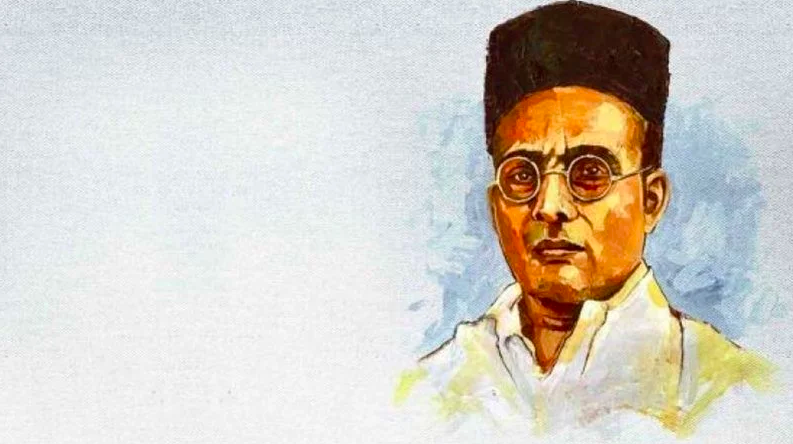
[image: Savarkar]
<https://www.newsclick.in/sites/default/files/2019-09/Savarkar.png>

Who could have been the best prime minister of independent India?

Nehru or (Vallabhbhai) Patel?

For more than last five years, we have been a witness to this manufactured
debate—courtesy Bharatiya Janata Party (BJP), which has tried all the
tricks in its kitty to create a false binary between these leading
stalwarts of independence movement, who called themselves 'Gandhi's
sipahis'.

Anyway, thanks to the differences of perception within the saffron
fraternity, a new competitor to Sardar Patel seems to have emerged from
within the Hindutva Brigade who is being projected as someone who would
have been a “better PM”.

Uddhav Thackreay, chief of Shiv Sena and at present, a junior ally of the
BJP in Maharashtra, recently made his choice clear by stating that if Veer
Savarkar would have become
<https://www.telegraphindia.com/india/thackeray-claims-no-pakistan-if-savarakar-was-pm-twitterati-find-it-hard-to-digest/cid/1705873>
the
prime minister, “Pakistan would not have come into existence”. At a book
release event, he even refused to call Nehru a Veer (courageous), making a
rather provocative statement: ‘I would have called Nehru brave if he would
have survived jail for 14 minutes against Savarkar who stayed in the prison
for 14 long years.'

Definitely, the fact that Nehru spent more than nine years in different
jails of the colonialists without ever compromising his basic
principles—whereas, the 14 years spent by Savarkar
<https://thewire.in/history/bhagat-singh-and-savarkar-a-tale-of-two-petitions>
were
interspersed with mercy petitions
<https://frontline.thehindu.com/static/html/fl2207/stories/20050408001903700.htm>
sent
by him to the British, wherein he had even expressed his readiness to
'serve the government in any capacity they like’—did not bother him at all.

What is rather worrisome is that it was no mere expression of an alternate
viewpoint. Thackeray even asked the gathering  'to beat
<https://www.indiatoday.in/india/story/uddhav-thackeray-mani-shankar-aiyar-veer-savarkar-controversy-1600297-2019-09-18>
[Mani
Shankar Aiyar] with shoes for showing disrespect to Savarkar'. Senior
Congress leader Aiyar had openly said last year that it was Savarkar who
himself had proposed the two-nation theory and had coined the term
‘Hindutva’. This had infuriated Uddhav Thackeray to no end. However, it is
a fact that Savarkar, in his presidential address in Ahmedabad at the 19th
session of the Hindu Mahasabha in 1937, had openly declared that India
comprises of two nations. According to him,

“..[T]here are two antagonistic nations living side by side in India,
several infantile politicians commit the serious mistake in supposing that
India is already welded into a harmonious nation, or that it could be
welded thus for the mere wish to do so.These our well-meaning but
unthinking friends take their dreams for realities. That is why they are
impatient of communal tangles and attribute them to communal organizations.
But the solid fact is that the so-called communal questions are but a
legacy handed down to us by centuries of cultural, religious and national
antagonism between the Hindus and Moslems ... India cannot be assumed today
to be a unitarian and homogeneous nation, but on the contrary there are two
nations in the main: the Hindus and the Moslems, in India..”

(V.D.Savarkar, Samagra Savarkar Wangmaya Hindu Rasthra Darshan (Collected
works of V.D.Savarkar) Vol VI, Maharashtra Prantik Hindusabha, Poona, 1963,
p 296)

A year later, he said: “The Hindus are the nation in India—in Hindusthan,
and the Moslem minority a community’(Page 25, Savarkar and Hindutva, A G
Noorani, Leftword, 2003). Remember Jinnah propounded his two-nation theory
in 1939—exactly two years after Savarkar presented it. It was a reflection
of the political ambience then that R C Majumdar, a historian with
pro-Sangh parivar views, acknowledged that there was ‘one important factor
which was responsible to a very large extent for the emergence of the idea
of partition of India on communal lines. This was the Hindu Mahasabha.” (R
C Mazumdar (General Editor), Struggle for Freedom, Bhartiya Vidya Bhavan,
Mumbai, 1969, p. 611)

It would be political naivety to think that this euologisation of Savarkar
by the Shiv Sena supremo on the eve of elections was spontaneous. On the
one hand, it was an attempt to raise an emotive issue to garner a few more
votes and on the other hand, this projection of a Marathi icon was Shiv
Sena's oblique way of getting even with its 'senior ally' BJP, which has
used name of Sardar Patel—a Gujarati—to further its anti-Nehru propaganda.
This, in a way, also conveys discreetly that BJP's “love” for Savarkar has
been a very recent phenomenon.

It should be recalled that Savarkar’s plaque was removed from Port Blair’s
cellular jail (in 2004) where Savarkar had served his jail term. Vikram
Savarkar—Savarkar’s own nephew—in an interview to a national daily had
exposed BJP’s lack of interest in his uncle and had castigated them for
their sudden love for him. The report read: “It may be noted that he had
accused the senior leaders of the BJP for ‘keeping mum despite noticing the
removal of his uncle’s quotations from Port Blair’s Cellular Jail’.
According to him, Ram Kapse, the then incumbent Lt. governor of Andaman and
Nicobar and former M.P Ram Naik ( both BJP workers) ‘did not utter a word
when the plaque was removed’.”

The report further says that he is not surprised at the BJP’s lack of
interest in Savarkar. “We know very well that the BJP and RSS did not
appreciate his (Savarkar’s) philosophy.” Vikram then claims that BJP’s
sudden love for the legend is an eyewash. “It is an effort to woo voters
for the Assembly elections in Maharashtra,” he is quoted as saying.
 (Savarkar nephew hits out at BJP, August 30, 2004, Indian Express)

No doubt the debate around Savarkar's ‘greatness’ cannot be reduced to the
internecine squabbles within the Hindutva fraternity and there is an urgent
need to unpack the whole issue for a wider interaction.

One can clearly see two phases in his life.

First phase which lasted till a few years after he was transported for life
to Andamans, when he was all for Hindu-Muslim unity. However, in the second
phase, he emphasised Hindu unity and propounded the theory of Hindu nation.

Born on May 28, 1883, to a Marathi Brahmin family, Savarkar was attracted
towards anti-British movements and was even instrumental in establishing
Abhinav Bharat Society (Young India)—drawing inspiration from Mazzini’s
‘Young Italy’ during school days. He went to England to study law where he
got further involved in radical political activities. Inspired by the 1857
uprising against British and with the aim to communicate with the dormant
masses he even a wrote a book in Marathi titled ‘The Indian War of
Independence of 1857’, which talked in glowing terms about the Hindu-Muslim
unity displayed during this war. Later, he was arrested for instigating
radical/violent activities in London as well as for his connection to the
similar activities back home in India and was sentenced to two life
sentences and was sent to Cellular Jail in Andamans. It appears that the
tough life in the jail—which was endured by other prisoners without any
compromise—broke his spirit and he sent petitions to the British government
for early release. After a long time, British government conceded to his
request and sent him home, put restrictions on him and asked him to not to
participate in political activities. He was finally released when there
were provincial elections in India and Congress party-led government came
to power in the then Mumbai province.

Coming back to the present debate about whether there is any merit in
Thackeray’s claim that India would have remained united if Savarkar would
have become PM. Question immediately arises whether Savarkar was really for
united India. Definitely not. This original proponent of the two-nation
theory had this to say at a media conference in August 1943 which was
quoted by Congress on its official
<https://www.telegraphindia.com/india/congress-sheds-poll-time-savarkar-caution/cid/1705930>Twitter
handle shedding its normal ambivalence about Savarkar:

“For the last 30 years we have been accustomed to the ideology of
geographical unity of India and the Congress has been the strongest
advocate of that unity but suddenly the Muslim minority, which has been
asking one concession after another, has, after the Communal Award, come
forward with the claim that it is a separate nation. I have no quarrel with
Mr Jinnah’s two-nation theory. We, Hindus, are a nation by ourselves and it
is a historical fact that Hindus and Muslims are two nations.”

Thus, Uddhav's hypothesis is itself superfluous/meaningless. It is like
saying that Jinnah could have led a united India after independence.

But what was Savarkar's own situation in early 1940s when anti-imperialist
forces led by Congress and other radical sections of society were waging a
‘do or die’ struggle against the British? It is now history how the
formations espousing the cause of Hindutva adopted a compromising attitude.
It is worth noting that while the RSS preferred to keep itself aloof from
the ‘Quit India Movement’ and concentrated on its divisive agenda,
Savarkar, the pioneer theoretician of the project of Hindu Rashtra went one
step further. He toured India asking the Hindu youth to join the military
with a call ‘Militarise the Hindus, Hinduise the nation’—thus strengthening
efforts of the British to suppress the rising tide of the people’s
movement.

When Congress party asked the state governments led by it in different
provinces to resign, Hindu Mahasabha under Savarkar’s leadership had no
qualms in running coalition governments in Sind and Bengal sharing power
with Muslim League and justifying this compromise.

“..in practical politics also the Mahasabha knows that we must advance
through reasonable compromises.” (V.D.Savarkar, Samagra Savarkar Wangmaya
Hindu Rasthra Darshan ( Collected works of V.D.Savarkar) Vol VI,
Maharashtra Prantik Hindusabha, Poona, 1963, p 479-480

What is interesting to note is that despite the fact that Hindu Mahasabha
was sharing power with Muslim League and a few other parties to run
provincial governments in Bengal and Northwest province, and despite the
services offered to the British empire, he was a ‘spent force’ for the
British. A G Noorani, constitutional expert and political commentator, in
his book ‘Savarkar and Hindutva’ (Page 92, Left Word, 2002), shares details
of the minutes of the then Head of the Political Department in the India
Office named John Percival Gibson. According to him, he minuted on August
1, 1944 that ‘he did not consider it necessary to acknowledge’ a cable
Savarkar had sent to the Secretary of State for India, Leopald S Amery on
July 26, 1944. It had claimed that the Mahasabha was ‘the only all-India
representative body of Hindus’. Noorani notes that Savarkar adopted the
same tactics normally adopted by fading politicians to remain in the news,
which comprised not only issuing regular statements to the press, but to
see to it that they are more and more rabid.

Definitely, the present Shiv Sena supremo would not be even aware of the
fact that Savarkar had no qualms in hurriedly applauding Aiyar, the Dewan
of Travancore, when he had exhibited the audacity of declaring the state
independent. Qutoed in Frontline, A.G.Noorani says:

Sir C.P.Ramaswamy Aiyar, the Dewan of Travancore, had declared the state
independent of India! The perfidy did not stop there. He gallantly and
speedily appointed an ambassador from Travancore to Jinnah’s Pakistan, thus
affirming once more his credentials as an inveterate enemy of India free
and whole.And, for this treason, who lustily applauded Aiyar in all of
India? Who else but “Veer” Savarkar?

And last but not the least, this iconisation of Savarkar by the Shiv Sena
appears at variance with the own track record of the first government led
by Shiv Sena-BJP in mid nineties, (with Shiv Sena as the senior partner)
when Uddhav's father Bal Thackreay used to boast that he has the remote
control of the government with him. Uddhav will have to explain why never
once they (neither Shiv Sena nor BJP) thought of putting Savarkar's
portrait in the state assembly.

Why were they careful enough to keep themselves aloof from Savarkar's now
‘cherished legacy’?

--
You received this message because you are subscribed to the Google Groups
"humanrights movement" group.
To unsubscribe from this group and stop receiving emails from it, send an email
to [email protected].
To view this discussion on the web visit
https://groups.google.com/d/msgid/humanrights-movement/CAJGPqcbrb7wM-8J0dNsu73QUeMbiU7g7RDLwZ4QPJNkWoS_W2w%40mail.gmail.com.