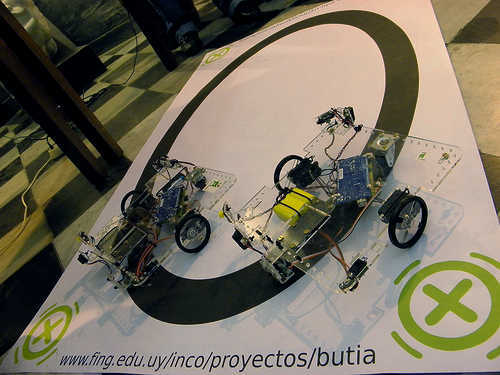
> Date: Thu, 27 Sep 2012 16:24:56 -0400
> From: [email protected]
> To: [email protected]
> CC: [email protected]; [email protected]; [email protected];
> [email protected]
> Subject: Re: [IAEP] [Butia-list]  XO robotics
>
> Hi,
>
> I would love to see you at the SF meeting to explain Butia to that audience.
+1 Caryl
>
> It was my understanding in Montevideo, that the robot is controlled
> directly from Turtle Art. For me, the really great thing you have done
> is to strap the laptop on the robot platform. This is not for cute
> pictures, it is really exciting for the student to see the robot obeying
> his or her instructions (right or wrong). The fact that the laptop is
> riding on the robot vehicle means that its movement is not limited by an
> umbilical cord.
>
> As Yama states, we really need (for me, in English) a parts list and set
> of instructions for building the robot so that it can be done by any
> deployment. I had hoped that such a session would be conducted in SF as
> I would dearly love to be able to set up a robot at the Saint Jacob
> school in Kigali in December. Naturally, we will also need some lesson
> plans for use of the robot to further the mandated curriculum in Science
> (and mathematics).
>
> My example would be to have the student program the robot to approach a
> wall as closely as possible without touching it. This would involve some
> understanding of the ratio of the wheel diameter to its circumference,
> the number of degrees the wheel advances for each forward step, and
> whole lot of other interesting concepts. For example, such a contest
> could lead to the issue of feedback; how to use a sensor so the robot
> knows when it is close. Should this be visual (camera) or acoustic or
> the bending of a wire or ....
>
> Tony
>
> On 09/27/2012 02:08 PM, Jorge wrote:
> > On 27/09/12 13:35, Yama Ploskonka wrote:> 1) I wouldn't say better...
> > rather, complementary, and certainly
> >  > cheaper. Visiting the Butiá pages, the only picture I see showing an MCU
> >  > http://www.fing.edu.uy/inco/proyectos/butia/images/pistaButia.jpg is
> >  > showing an Arduino. Add a motor driver, and we are well above $30, plus
> >  > shipping. The USBButiá board is maybe cheaper IF done in quantity by
> >  > experts (then add labor).
> >
> > Besides the microcontroller the USBButiá board provides standard
> > connectors for attaching sensors. It allows autodetecting what sensor
> > you connected and were (something like the NXT brick, but with a wider
> > spectrum of attacheable stuff, more connectors, easier to hack, and
> > plug&play).
> >
> > We sidestepped the motor driver issue using digital servos.
> >
> >  > MSP430 + (L293D OR some darlington array) can be "free" if you get them
> >  > as samples from TI, or less than $5 when purchased, /plus shipping/, the
> >  > old bane. the advantage of using a darlington driver is that then you
> >  > may use plain DC motors, which can be free if lucky with old electronic
> >  > parts (beautiful gear system available in old CDROM drives)
> >  >
> >  > 2) yop - the XO "drives" the vehicle with the MSP430 option also. Now, I
> >  > put quote marks as I have no idea - yet - on how to send data direct
> >  > realtime from the XO to the robot, bypassing the MCU. What seems to be
> >  > happening is that Butiá depends on sending code/program to the Arduino,
> >  > and the the 'duino does the brains of the robot.
> >
> > Nop, the control runs fully on the XO. MCU only interfaces
> > sensors&motors and supports the plug&play functionality. No user logic
> > runs on the MCU.
> > The user programs on the XO access sensors/actuators connected the MCU
> > and whatever the XO provides (mic, cam, accelerometer if there is one)
> > transparently. The most frequent programming environment is TurtleArte
> > (kisds already know it), but there are also Python and Lua environments
> > for when the problem or the user outgrows Turtle Art.
> >
> > In my opinion, what MCU is used is not actually important. What is
> > important is the programming environment, how it interfaces with
> > whatever your robot offers, and the mechanism you provide for adapting
> > your robot for solving different problems.
> >
> > Jorge
> > .
> >
>
> _______________________________________________
> IAEP -- It's An Education Project (not a laptop project!)
> [email protected]
> http://lists.sugarlabs.org/listinfo/iaep
_______________________________________________
IAEP -- It's An Education Project (not a laptop project!)
[email protected]
http://lists.sugarlabs.org/listinfo/iaep