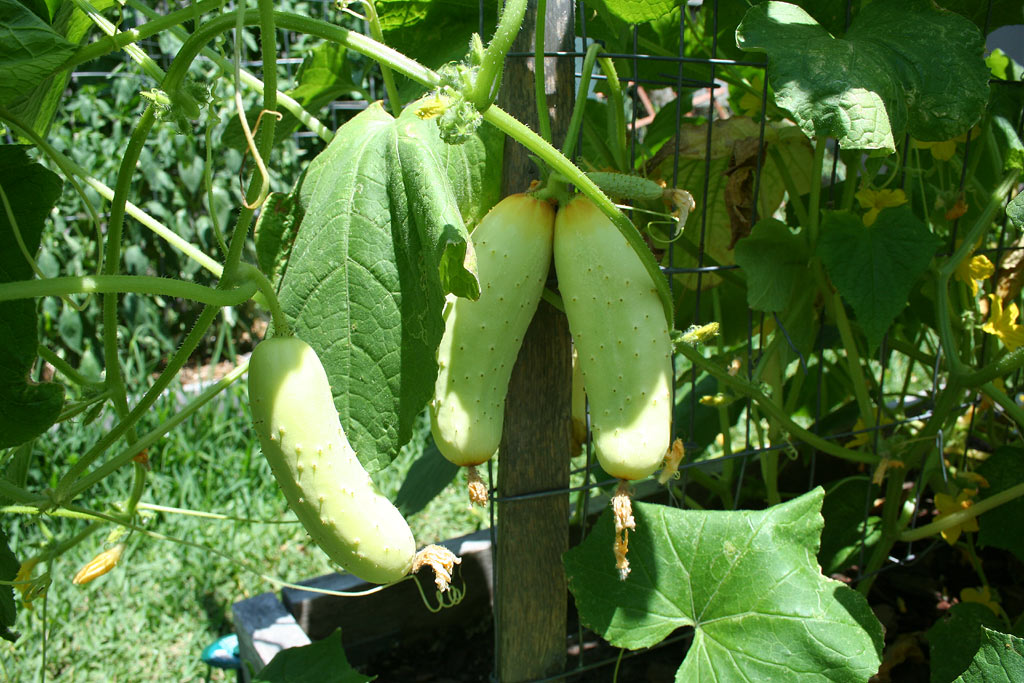
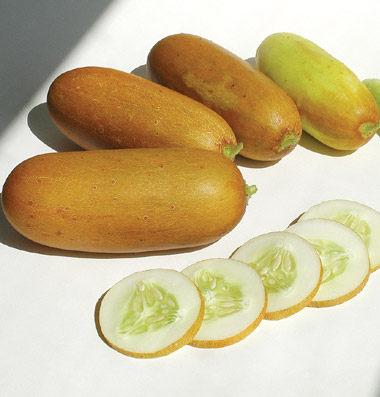
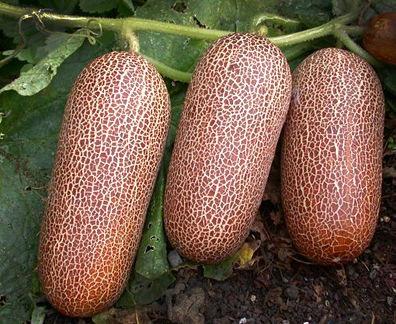
It is Poona khira or Puneri cucumber
There are two cultivars light green when young and nearly white when young,
both turning almost brown when nearing maturity and brown with cracks when
nearly mature.
Young tender fruits are best for salads, even brown without cracks. those
with cracks have ripe seeds.
--
Dr. Gurcharan Singh
Retired  Associate Professor
SGTB Khalsa College, University of Delhi, Delhi-110007
Res: 932 Anand Kunj, Vikas Puri, New Delhi-110018.
Phone: 011-25518297  Mob: 9810359089
http://www.gurcharanfamily.com/
http://people.du.ac.in/~singhg45/

On Sat, Aug 17, 2013 at 12:14 PM, J.M. Garg <[email protected]> wrote:

> Forwarding again for any assistance in the matter please.
>
>
> ---------- Forwarded message ----------
> From: English Rose Garden <[email protected]>
> Date: 17 August 2013 01:46
> Subject: [itpmods:7089] poona kheera or puneri khira
> To: [email protected]
> Cc: [email protected]??
>
>
>
> Im radha from usa. Im south indian.
>
> at my farmers market they sell poona kheera or some say puneri khira.
>
> When is the correct stage to harvest and eat it and is it really an indian
> cucumber? I asked other indians at the market and they dont know what it is.
>
> I see it sold in various stages
>
> Harvest?
> http://www.feldoncentral.com/garden/photos/d/9728-1/IMG_8297-poonakheera.jpg
>
> Ripe?:http://www.cherrygal.com/images/PoonaKheeraCuke.jpg
>
> Totally overripe and suitable only for saving seeds:
> http://gardenerd.com/wp-content/uploads/2013/06/cucumber_poona_kheera.jpg
>
>
>
> cream
> light green
> gold
> brown
> brown with crackles
> small
> fat
> smooth
> bumpy
> semi bumpy
>
> do we eat the skin?
> Do we eat the seeds?
> How do they usually prepare it?
>
>
> --
> You received this message because you are subscribed to the Google Groups
> "ITPmods" group.
> To unsubscribe from this group and stop receiving emails from it, send an
> email to [email protected].
> To post to this group, send an email to [email protected].
> Visit this group at http://groups.google.com/group/itpmods.
> For more options, visit https://groups.google.com/groups/opt_out.
>
>
>
> --
> With regards,
> J.M.Garg
> http://en.wikipedia.org/wiki/User:Jmgarg1
> 'Creating awareness of Indian Flora & Fauna'
> The whole world uses my Image Resource of more than a *thousand species*&
> eight thousand images of Birds, Butterflies, Plants etc. (arranged
> alphabetically & place-wise):
> http://commons.wikimedia.org/wiki/Category:J.M.Garg. You can also use
> them for free as per Creative Commons license attached with each image.
> For identification, learning, discussion & documentation of Indian Flora,
> please visit/ join our Efloraofindia Google e-group (largest in the world):
> http://groups.google.co.in/group/indiantreepix (more than 2135 members &
> 1,61,500 messages on 31/7/13) or Efloraofindia website:
> https://sites.google.com/site/efloraofindia/ (with a species database
> of more than 8500 species & 1,70, 000 images).
> Also author of 'A Photoguide to the Birds of Kolkata & Common Birds of
> India'.
>

--
You received this message because you are subscribed to the Google Groups
"efloraofindia" group.
To unsubscribe from this group and stop receiving emails from it, send an email
to [email protected].
To post to this group, send email to [email protected].
Visit this group at http://groups.google.com/group/indiantreepix.
For more options, visit https://groups.google.com/groups/opt_out.