Thanks, Ashwini ji.
I think one of the most confusing genus.

On 07-Aug-2017 10:18 AM, "Ashwini Bhatia" <[email protected]> wrote:
> The long-tube pedicularis species, which is very common here above 3000m,
> has confused me. I have followed the excellent discussion between Dr Singh,
> Tabish ji and other senior members and have at times concluded that the
> plants here are *P. siphonantha* but another doubt nags me and I start
> looking at the characteristics again.
>
> Looking at the sketch uploaded by Tabish ji here
> <https://08511630493324166816.googlegroups.com/attach/e36d7a85e0216671/Pedicularis.jpg?part=0.1&view=1&vt=ANaJVrEtAptdaht5u2Pj-lcsDLZouMjVcxlJXpSBVs1GmC-hjQBpsFN3snYDVjCrDzlVfJDAcNq5AQ68UVg36SH3zpKVYbfLC8ls6wH-4nBhb2NUrJKOn0g>,
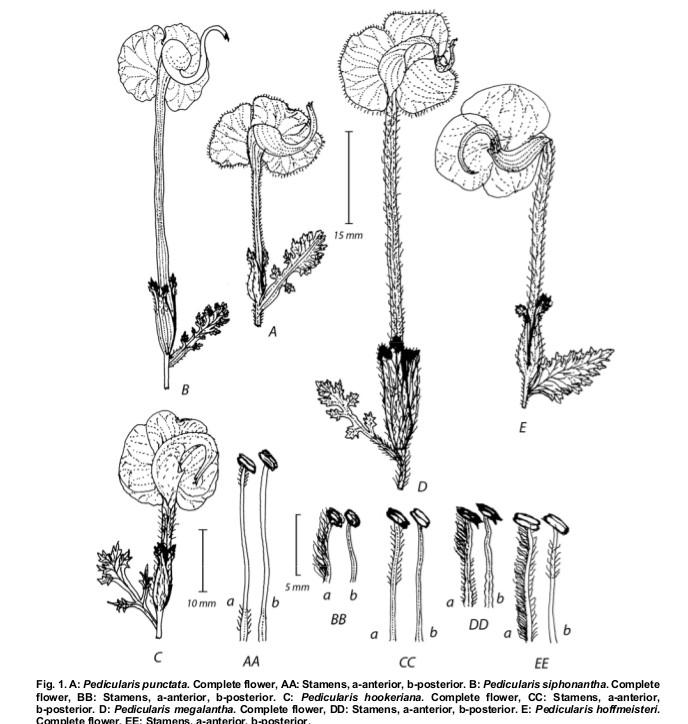
> I would say that flowers of our plants are closer to *P. punctata* than *P.
> siphonantha* (tube length and its ratio with the calyx). I have included
> a photo of our flower (without calyx) on a ruler for comparison below.
> Accounting for the absence of calyx in the photograph, the tube length
> matches with figure A and so does the shape of the galea.
>
> However, the lower lip on our flower is narrow (about 7-8mm) while *P.
> punctata* should have a broader, 15mm, lower lip.
>
> The number of lobes on the lower leaves is higher than 6 (see photo). The
> petiole is long and not winged. This would suggest *not* *P. punctata*
> again.
>
> Dr Singh had suggested *P. hookeriana* which was described briefly by
> Kletter and Kriechbaum here
> <https://books.google.co.in/books?id=ODrIXj-48RsC&pg=PA171&lpg=PA171&dq=pedicularis+hookeriana&source=bl&ots=gUvRh-j7Jt&sig=vv_ReidCDSUxF3FLKEUVghwAg9g&hl=en&sa=X&ved=0ahUKEwjZ5tP1nsTVAhUEuI8KHRLiB5UQ6AEITzAN#v=onepage&q=pedicularis%20hookeriana&f=false>
> in their 2001 discussion of *P. punctata *but it was concluded that since
> the drawing in the 2009 paper shows shorter tube length, *P. hookeriana*
> was not a possibility. But the tube length of *P. siphonantha* in the
> drawing does not match our sample either.
>
> Most of the images of *P. siphonantha* available online show a higher
> ratio of tube-length to calyx than our flowers here.
>
> Our plant is gregarious at 3200m with many clumps of flowers. I have tried
> to include photos to show that.
>
> I would request my seniors to look at this species again and advise. I am
> at a loss as to which source takes precedence. I apologise for requesting
> to open this discussion yet again and hope that you will find merit in
> doing so.
>
> Thanks and regards,
> Ashwini
>
>

--
You received this message because you are subscribed to the Google Groups
"efloraofindia" group.
To unsubscribe from this group and stop receiving emails from it, send an email
to [email protected].
To post to this group, send an email to [email protected].
Visit this group at https://groups.google.com/group/indiantreepix.
For more options, visit https://groups.google.com/d/optout.