Thank you Mr. Garg

Saroj Kasaju
On Thu, 28 Nov 2019 at 11:29 am, J.M. Garg <[email protected]> wrote:

> I could not find keys listing all three species as mentioned in Checklist
> of Nepal
> <http://www.efloras.org/florataxon.aspx?flora_id=110&taxon_id=105483>,
> either in Flora of Pakistan
> <http://www.efloras.org/florataxon.aspx?flora_id=5&taxon_id=105483>, or
> in Flora of China
> <http://www.efloras.org/florataxon.aspx?flora_id=2&taxon_id=105483> or in
> Flora of Bhutan.
>
> Keys did not become clear until I saw the specimens in GBIF (with specimen
> link) as below:
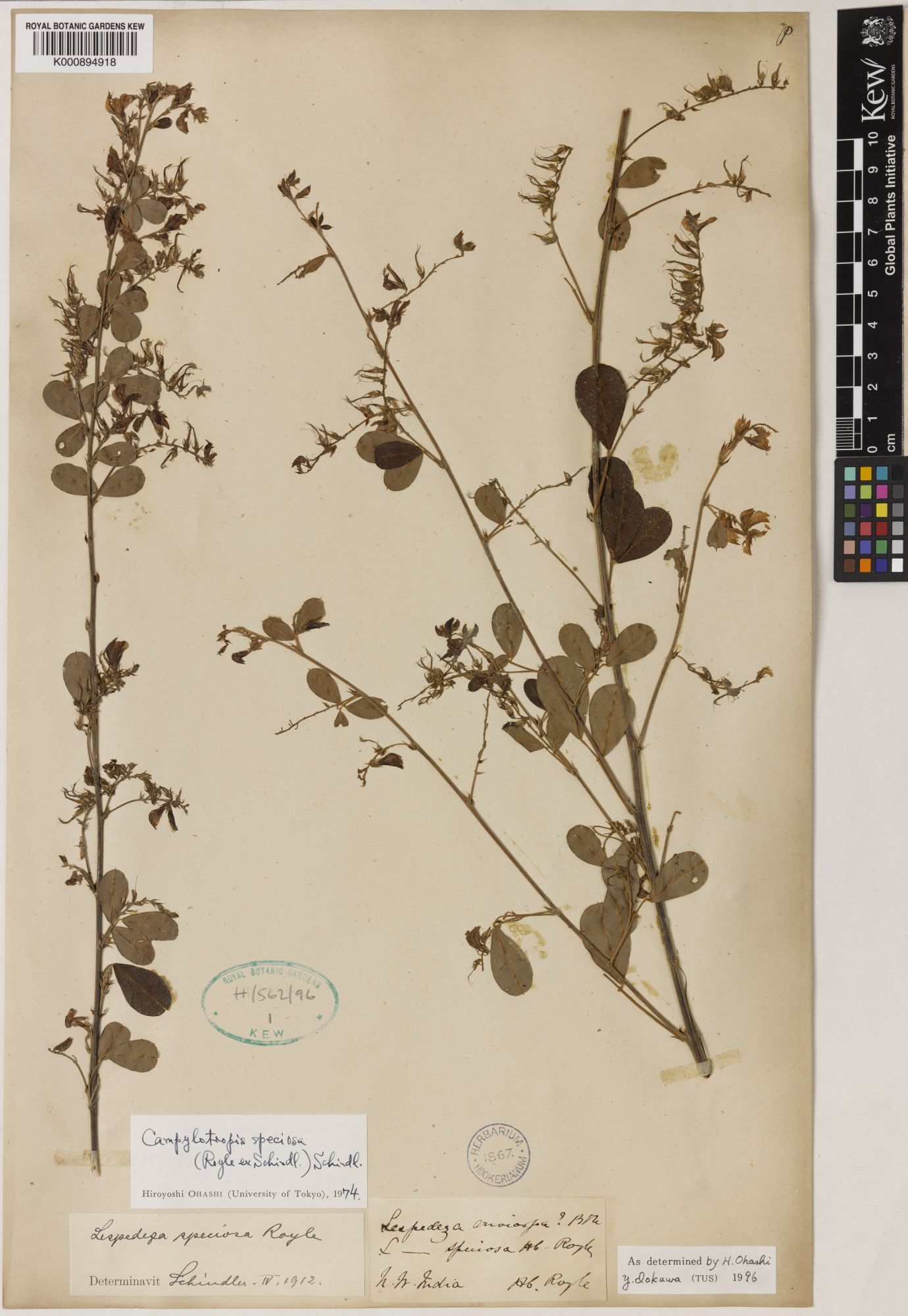
> *Campylotropis speciosa *(Royle ex Schindl.) Schindl.
> <https://www.gbif.org/species/5349818> (
> https://api.gbif.org/v1/image/unsafe/http%3A%2F%2Fwww.kew.org%2Fherbcatimg%2F523137.jpg
> )
> *Campylotropis stenocarpa *Schindler
> <https://www.gbif.org/species/5349845> (
> https://api.gbif.org/v1/image/unsafe/http%3A%2F%2Fmedialib.naturalis.nl%2Ffile%2Fid%2FL.2053502%2Fformat%2Flarge
> )
> *Campylotropis macrostyla *(D.Don) Lindl. ex Miq.
> <https://www.gbif.org/en/species/5349859> (
> https://api.gbif.org/v1/image/unsafe/http%3A%2F%2Fmediaphoto.mnhn.fr%2Fmedia%2F1445412789991CRYfApAlMVsPZ1kK
> )
>
> Flora of Pakistan
> <http://www.efloras.org/florataxon.aspx?flora_id=5&taxon_id=105483> gives
> the following keys [added important keys from description]:
> 1 *Raceme sessile*, (bracts persistent) [*Inflorescence axillary raceme,
> c. 3.8 cm long*
> <http://www.efloras.org/florataxon.aspx?flora_id=5&taxon_id=242421034>]
> *Campylotropis
> stenocarpa*
> <http://www.efloras.org/florataxon.aspx?flora_id=5&taxon_id=242421034>
> + *Raceme pedunculate*   (2)
> <http://www.efloras.org/florataxon.aspx?flora_id=5&taxon_id=105483#KEY-1-2>
>
> 2 (1)
> <http://www.efloras.org/florataxon.aspx?flora_id=5&taxon_id=105483#KEY-1-1>
> Stipules
> 3.5-6.5 mm long, bract c. 2 mm long. Fruit with a persistent style base 2.5
> mm long   Campylotropis meeboldii
> <http://www.efloras.org/florataxon.aspx?flora_id=5&taxon_id=250065463>
> + Stipules c. 3 mm long, bract c. 2.5 mm long. Fruit with a persistent
> style base 7-10 mm long [*Inflorescence axillary pedunculate racemes
> appearing like panicle in the fruiting stage; peduncle 3-8 mm long*
> <http://www.efloras.org/florataxon.aspx?flora_id=5&taxon_id=242421028>]
> *Campylotropis
> macrostyla*
> <http://www.efloras.org/florataxon.aspx?flora_id=5&taxon_id=242421028>
>
> Flora of China
> <http://www.efloras.org/florataxon.aspx?flora_id=2&taxon_id=250094357> for
> *Campylotropis* *speciosa* (Royle ex Schindler) Schindler *subsp.*
> *eriocarpa* (Schindler) Iokawa & H. Ohashi (syn: *Campylotropis eriocarpa*
> Schindler) mentions *racemes 2.5-20 cm;* rachis and pedicels densely
> appressed or ascending shortly hairy. Flora of Bhutan mentions *racemes
> many flowered , 5-12 cm*. There seems to be some confusion w.r.t. its
> nomenclature as Check list of Nepal gives *Campylotropis speciosa* (Royle
> ex Schindl.) Schindl. (syn: *Campylotropis* *eriocarpa* Schindl.
> <http://www.efloras.org/florataxon.aspx?flora_id=110&taxon_id=242421027>;
> *Campylotropis* *macrostyla* var. *eriocarpa* (Maxim.) H. Ohashi
> <http://www.efloras.org/florataxon.aspx?flora_id=110&taxon_id=242421029>)
> almost same as in Flora of Bhutan. Catalogue of Life mentions only two: 1.
> *Campylotropis
> eriocarpa *(DC.) Schindl.(
> <http://www.catalogueoflife.org/col/details/species/id/fb9a00ab56dd0d81c5c2e301270fca07>
> syn:  *Lespedeza eriocarpa* DC.; *Lespedeza indica* Schindl.) based on
> ILDIS <http://www.legumes-online.net/ildis/aweb/td115/td_24276.htm> with
> distribution in India only.  2. *Campylotropis speciosa *
> (Schindl.)Schindl.
> <http://www.catalogueoflife.org/col/details/species/id/3396c71cff7203cd19418bcffc9d2f70>
> (syn: *Campylotropis macrostyla* var. *eriocarpa* (Maxim.)H.Ohashi; *Lespedeza
> eriocarpa* auct. non DC. (ambiguous synonym); *Lespedeza speciosa*
> Schindl. (ambiguous synonym)) based on ILDIS
> <http://www.legumes-online.net/ildis/aweb/td115/td_24283.htm> with
> distribution in Bhutan, India &  Nepal only;
>
> In view of above, I take this post as *Campylotropis speciosa* (Royle ex
> Schindl.) Schindl.
>
> ---------- Forwarded message ---------
> From: Saroj Kasaju <[email protected]>
> Date: Mon, 28 Oct 2019 at 16:09
> Subject: SK 2254 28 October 2019
> To: efloraindia <[email protected]>, J.M. Garg <
> [email protected]>
>
>
> Dear Members,
>
> Location: Phulchoki, Lalitpur
> Date: 16 September 2019
> Elevation: 2318 m.
> Habit : Wild
>
> Indigofera sp. ??
>
> Thank you.
>
> Saroj Kasaju
>
>
> --
> With regards,
> J.M.Garg
>
> 'Creating awareness of Indian Flora & Fauna'
> <http://en.wikipedia.org/wiki/User:Jmgarg1>
>
> Winner of Wipro-NFS Sparrow Awards 2014 for efloraofindia
> <https://sites.google.com/site/efloraofindia/award-for-efloraofindia>.
>
> For identification, learning, discussion & documentation of Indian Flora,
> please visit/ join our Efloraofindia Google e-group
> <https://groups.google.com/forum/#!forum/indiantreepix> (largest in the
> world- more than 3,000 members & 3,00,000 messages on 23.8.18) or
> Efloraofindia
> website <https://sites.google.com/site/efloraofindia/> (with a species
> database of more than 13,000 species & 3,00,000 images of which more than
> 2,00,000 images are directly displayed on 30.8.19).
>
> The whole world uses my Image Resource
> <http://commons.wikimedia.org/wiki/Category:J.M.Garg> of more than a
> thousand species & eight thousand images of Birds, Butterflies, Plants etc.
> (arranged alphabetically & place-wise). You can also use them for free as
> per Creative Commons license attached with each image.
>
> Also author of 'A Photoguide to the Birds of Kolkata & Common Birds of
> India'.
>
--
Thank you.

Saroj Kasaju

--
You received this message because you are subscribed to the Google Groups
"efloraofindia" group.
To unsubscribe from this group and stop receiving emails from it, send an email
to [email protected].
To view this discussion on the web, visit
https://groups.google.com/d/msgid/indiantreepix/CAEf%3DytS-sazY0jnuPuf%3Dyv-PcOh4ky3Rbzz%3DQzrOvRfuqJYE-w%40mail.gmail.com.