Thanks for the inputs, Garg-ji and Rajbhar-ji.
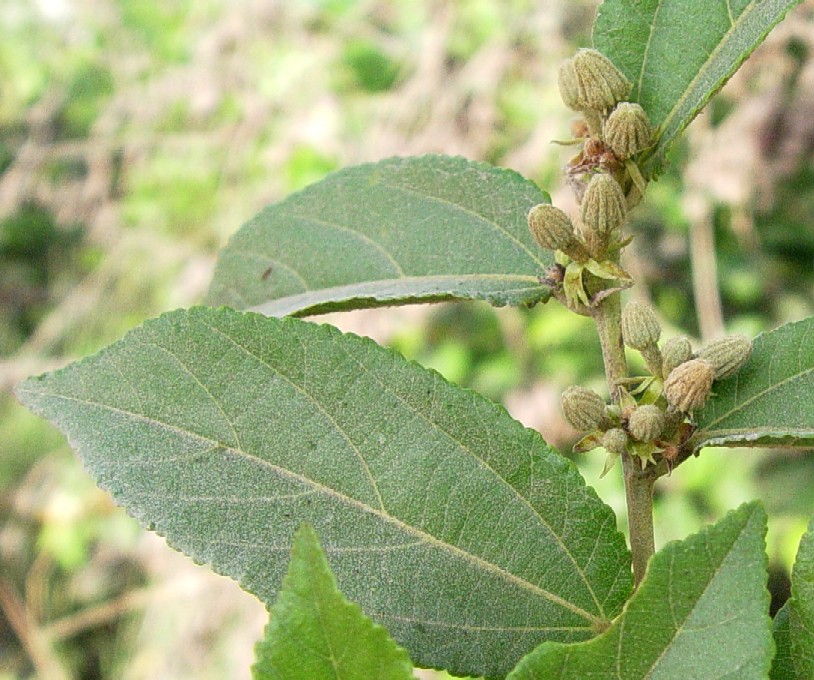
Here's another image to show size of flowers, The bug is one of those samll
spider types about 3.5 mm
*
*The best image match is for *
G.orientalis * sometimes described as a synonym of G. oxyphylla , is
illustrated at
http://plantillustrations.org/illustration.php?id_illustration=129562&language=287
The deeply ridged buds and sahpe of calyx  are distinctive .   I dont ahve
access to a description of  g.orientalis.  If someone could share, that
might decide it.

*G.hirsuta* description of  Efloras of China and the images avlbl on
Efloraof India, and FOI differ in following

Leaves long-elliptic or lanceolate; , sepals lanceolate; Flower as seen on
 EFOI and other images  are much smaller, nearly 1/5  to 1/8 of leaf size;:

https://groups.google.com/forum/?hl=en&fromgroups#!topic/indiantreepix/WF5pY-KC1DU
*G.oxyphylla *has the closest desc.  I have seen,  from Australian web
site, except  there the petals are  described as being recurved, which is
definitely not so in the plant I had observed, and the fruit as being
densely hairy, while i had seen the fruit with a thin covering of soft
stellate hairs and few long ones.


regards
A.Sinha


On Wednesday, May 16, 2012 6:08:20 PM UTC+5:30, JM Garg wrote:
>
> A reply from Anil Rajbhar ji:
> "Grewia hirsuta..."
>
> On 16 May 2012 17:57, jmgarg1 <[email protected]> wrote:
>
>> Forwarding again for Id confirmation or otherwise please.
>>
>>
>> ---------- Forwarded message ----------
>> From: greenearth <[email protected]>
>> Date: 8 May 2012 21:35
>> Subject: [efloraofindia:115965] Which Grewia ? -- AS_080512
>> To: [email protected]
>>
>>
>>
>> Please help ID the Grewia species:
>> shrub found growing wild in outskirts of Chennai: A medium sized
>> straggling shrub, stems about 3 to 4  m long, growing along a storm water
>> ditch.
>>
>> Maybe serrulata, but am not sure if the fruit and flower match.
>>
>> Thanks.
>> A.Sinha
>>
>> *Grewia sp*
>>
>> <https://lh5.googleusercontent.com/-ahSnWnQzilw/T6lD7_PE-II/AAAAAAAAAIA/4cFk6CLejK8/s1600/AS-Grewia.Q.Fl.jpg>
>>
>>
>> <https://lh4.googleusercontent.com/-ixVjtNCkZUo/T6lDIkjYRwI/AAAAAAAAAH4/bgSyUJCelns/s1600/AS-Grewia.Q.LInfl.jpg>
>>
>> Leaves oblong / lanceolate,  4 to 6” long,  margin  non-uniformly
>> serrulate
>> 3 basal veins,Inflorescence axillary cymes;  The flowers 1.5 to 2” wide ,
>> white with greenish tinge in stamens and stigma, sepals 1.5 cm, deeply
>> furrowed  and light green outside; white glabrous inside,  bent with
>> knee ;      petals about a third as long as sepals,  not bent , having
>> prominent ovate gland at base;   fruit  brownish yellow glabrous with
>> few hairs,  an obscurely bi-lobed drupe with fibrous rind.and two
>> 'stones'
>>
>>
>>
>>
>> --
>> With regards,
>> J.M.Garg
>> http://en.wikipedia.org/wiki/User:Jmgarg1
>> 'Creating awareness of Indian Flora & Fauna'
>> The whole world uses my Image Resource of more than a *thousand species*&
>> eight thousand images of Birds, Butterflies, Plants etc. (arranged
>> alphabetically & place-wise):
>> http://commons.wikimedia.org/wiki/Category:J.M.Garg. You can also use
>> them for free as per Creative Commons license attached with each image.
>> For identification, learning, discussion & documentation of Indian Flora,
>> please visit/ join our Efloraofindia Google e-group:
>> http://groups.google.co.in/group/indiantreepix (more than 1860 members &
>> 1,15,000 messages on 30/4/12) or Efloraofindia website:
>> https://sites.google.com/site/efloraofindia/ (with a species database
>> of more than 6500 species).
>> Also author of 'A Photoguide to the Birds of Kolkata & Common Birds of
>> India'.
>>
>>
>
>
> --
> With regards,
> J.M.Garg
> http://en.wikipedia.org/wiki/User:Jmgarg1
> 'Creating awareness of Indian Flora & Fauna'
> The whole world uses my Image Resource of more than a *thousand species*&
> eight thousand images of Birds, Butterflies, Plants etc. (arranged
> alphabetically & place-wise):
> http://commons.wikimedia.org/wiki/Category:J.M.Garg. You can also use
> them for free as per Creative Commons license attached with each image.
> For identification, learning, discussion & documentation of Indian Flora,
> please visit/ join our Efloraofindia Google e-group:
> http://groups.google.co.in/group/indiantreepix (more than 1860 members &
> 1,15,000 messages on 30/4/12) or Efloraofindia website:
> https://sites.google.com/site/efloraofindia/ (with a species database
> of more than 6500 species).
> Also author of 'A Photoguide to the Birds of Kolkata & Common Birds of
> India'.
>
>