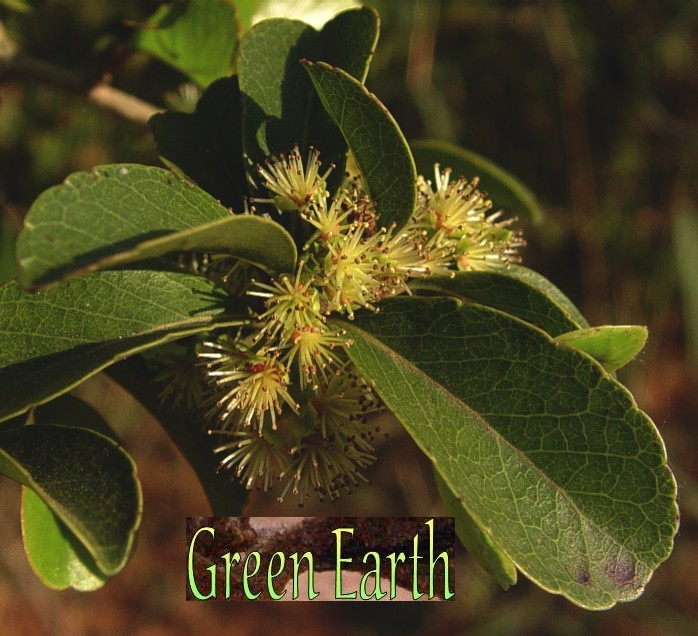
Flacourtia jangomas or F. indica ??

Hello Friends, Prasad-ji,

 After checking as per Prasad-jis pointer to Flacourtia jangomas,  I think
this may be Flacourtia indica, not jangomas.  It also matches with the Wiki
image, for indica
   1. The leaves are mostly oblong/elliptic, with obtuse  not acute or
   acuminate apex,  seem more  stiffly coriaceous compared to the shiny leaves
   of jangomas.
   2. The immature fruit size was only 3.5 mm long.,
   3. The style branches are about one-third  as long as the globose base (
   ovary  ?),

As per efloras of China:

F.jangomas :

*Pistillate flowers: ovary bottle-shaped to globose, 2-3 mm; styles 4-6,
united into a distinct column ca. 1 mm, not or slightly free at their
apices; ... Fruit brownish red or purple,....1.5-2.5 cm in diam.,*

*F.indica**
*

*Pistillate flowers: ovary globose, placentas 5 or 6; styles 5 or 6, united
only at base, radiating, 1-2 mm, slender. Fruit dull to blackish red,
globose, 8-10 mm in diam*
Experts may please validate and if a key to Indian species can be shared
that would be very helpful.

Thanks and regards,

A.Sinha

On Thursday, November 29, 2012 6:51:30 PM UTC+5:30, greenearth wrote:
>
> Thanks for the reply.   It surely looks like  Flacourtia,  which is not
> well known to me.
>  I will check it further, and we can wait for more inputs.
>
> Pani-amla is again one of those wonderful fruits, becoming unknown and
> unavailable to city people.
>
> A.Sinha
>
> On Wednesday, November 28, 2012 3:01:56 PM UTC+5:30, Prasad Dash wrote:
>>
>> Please check Flacourtia jangomas. Nice capture.
>>
>> Regards
>>
>> Prasad
>>
>> On Wed, Nov 28, 2012 at 2:50 PM, greenearth <[email protected]> wrote:
>>
>>> Hello Friends
>>>
>>> Another spinous plant , growing in the wild, outskirts of bangalore:
>>> Shrubs 4 to 6 ft height, fruiting and flowering in November.
>>> The 1st and 2nd images are of two different  plants , very similar ,
>>> bearing separately male and female flowers
>>> but there might have been one male plant also having fruit.
>>> The fruit turns black on ripening; it has 3 or 4 seeds.
>>>
>>> Thanks in advance for any help in identification.
>>>
>>> A.Sinha
>>>
>>>
>>>
>>>
>>> <https://lh4.googleusercontent.com/-v4Baiw2Pj0g/ULXVgZpxBgI/AAAAAAAAAOM/IaRWOheAnUs/s1600/GE-Sp-FemFlr%2BFrt.jpg>
>>>
>>>
>>> <https://lh5.googleusercontent.com/-qqkmXj8SUSM/ULXV5bbmlXI/AAAAAAAAAOU/SUe-TKV6zgk/s1600/GE-Sp-MaleFlr.jpg>
>>>
>>>
>>> <https://lh6.googleusercontent.com/-nW2B2EKVJBE/ULXXNO1o_RI/AAAAAAAAAOk/64oU67aEPK0/s1600/GE-Sp-Sps.jpg>
>>>
>>>
>>>
>>>
>>>
>>>
>>>
>>>
>>>
>>>
>>>  --
>>>
>>>
>>>
>>>
>>
>>
>>
>> --
>> Dr. Prasad Kumar Dash
>> Ecologist, Odisha, India
>> email: [email protected]
>> ph. 09437444241
>>
>

--