--- Begin Message ---
Thanks to Dave Aichelman, Roy Barstow, and Bill Nollman on the Cape Cod DXers
list and also Nick Hall-Patch, Colin Newell, Bruce Portzer, Chuck Hutton, Guy
Atkins, and Ken Brookner on the IRCA list for the many useful suggestions about
temporary antenna supports.
The info request certainly garnered a lot of sage advice that will not only
benefit me but (most likely) quite a few other DXers too.


Besides supporting various sorts of wire loops, temporary vertical antennas
(including those for multi-element arrays) would be another reason to try out
different support poles.


I am going to check out the numerous links in the suggestions, likely purchase
one or more pieces, try them out, and put together a webpage with
recommendations.  I may wish to include some of the comments recently offered.
If anyone does not want his comments or name included, let me know.


Before finalizing the online article I will do some additional browsing of ham
and MW DX publications and web content to see what I can find in construction
articles, DXpedition / Field Day reports, and other comments.


Most likely I'll have some sort of rough draft article up before the end of
October even if things I order have not yet arrived.  This will reference
suggestions just made, as noted below, and other information I read later.
Eventually that same link will point to the final-version article which I hope
to be a valuable resource on the topic.


Mark Connelly, WA1ION
South Yarmouth, MA, USA


<<
Hi Mark, you may remember my 7.5' tent pole loops, used for my 1st trip to
Kawaii back in 2012. I still use them and instead of bungee cords to hold them
together, I now use plastic 'antenna plates' from DXE cut to size to secure the
'X' shape. My poles are 9mm thick, but there are 11mm poles out there that
would allow a much larger loop to be built. Using the plastic antenna plates
also means that you can change the shape of the loops and put mounting brackets
on each loop to suspend them higher in the air. The best part is they collapse
down to a small form factor for travel, movement and fitting through small
spaces. The 'daiche' files, next to last file, is a picture of 2 of them as
originally designed. Now they have the rigid plastic antenna plate as a center
support. I use these loops as bi-directional, flag and as phased pairs.


Regards,


Dave Aichelman     N7NZH     Grants Pass, Oregon
__._,_.___
Posted by: [email protected]
>>


<<
Check out,


Max-Gain Systems, Inc.
221 Greencrest Ct.
Marietta, GA.
30068-3825


Phone (770) 973-6251


They have fiberglass poles of different sizes, length, thickness, etc.


I have been using them for many years now and like them.


The sections telescope to get what height one needs.


For my truck mobile I use 2 sections that are 3ft. long that extend to 6ft.
With 3ft. long I always keep them in the back behind the seats. The wire is
attached to the poles and takes about 10 to 15 minutes to set up my system and
ready to record. I can leave the house at 6:30 PM and in 1/2 hour at Menauhant
beach be ready to go for 7 PM capture.


Take care,


Roy


__._,_.___
Posted by: [email protected]
>>


<<
I like the Jackite fiberglass poles. They twist lock quite easily (but stay
locked when upright) and you can buy them in many sizes up to 31 feet long. If
the picture comes through below you can see my setup from this summer in North
Dakota. That’s about 23 feet at the top and maybe 60 feet wide, much bigger
than you want but that’s ok, you can buy the shorter poles or buy the 31’ and
just open what you need. In my case I don’t use the top 2 sections because they
are much too thin. I also like that a standard guy ring stays put nicely about
10 feet above the ground with no other hardware needed. That’s where I have the
white ropes attached. These poles collapse down to 46 inches and if you break a
section you can buy just the section(s) you need from Jackite.
https://www.jackite.com/online-store/Windsock-Flying-Poles-c21767998


Bill Nollman


Farmington, CT.
>>


<<
I think you might be a little surprised at the telescoping poles, Mark.


32' telescoping fiberglass pole collapses to <4'
long: http://tmastco.com/main/page_products_telescopic_poles.html


This company provides a 13.5' pole that collapses to 20", carry-on
luggage dimensions:
https://www.sotabeams.co.uk/mini-telescopic-mast-4-1-m-13-5-ft/
They also provide a mount.


I notice DXEngineering now carries them
too: https://www.dxengineering.com/parts/sbm-mini-poles


best wishes,


Nick
>>


<<
I use bamboo poles - one or two sections lashed together giving me 26? lengths
that last for 2 or 3 DX seasons - they tear down easily and transport well...
survive nasty weather... very rustic as well... non conductive... cheap. Don?t
contribute to global warming...


They are what hold up my Flags and End-fed for the Amateur bands.


Colin Newell - Victoria - B.C. CANADA -
>>


<<
I also use bamboo poles at home.? Many years ago, a next door neighbor
planted some bamboo in their back yard.? Fast forward to 2018, and I now
have an infinite amount of the stuff growing on my side of the fence.?
It spreads rather aggressively and lends a whole new meaning to the word
sustainability.? At least I'm able to use some of the taller bamboo
plants for antenna supports after I chop them down.


Bruce
>>


<<
I'd not think of using the painter;s extension poles. They are a bit flimsy and
too short for a DKAZ or flag/loop.


The Jackite poles are fairly common in ham circles. I've owned 4 of them for at
least 10 years without problems.


I also own a handful of other fiberglass poles and they have all been OK except
an MFJ product. They collapse to approximately 4 feet.


Two of my poles with the bases at https://chuckhuttonblog.wordpress.com/


form the 18 x 18 corner fed loop I use at Rockworks. It can be assembled in 10
minutes in total darkness (with a flashlight). The concrete bases are thick
enough to withstand moderate coastal windstorms and might be a bit heavy for a
several hour DXpedition.


Chuck


=====


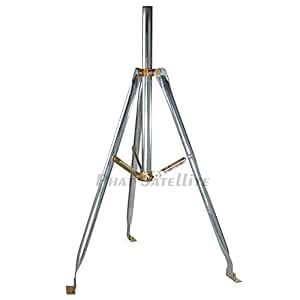
And here is another option : the satellite dish stands that RV'ers use.


Here is a link to one on Amazon, although I have seen them a little cheaper..


https://www.amazon.com/Satellite-Tripod-Directv-Network-Mount/dp/B00TXSND8G/ref=sr_1_14?ie=UTF8&qid=1537510091&sr=8-14&keywords=rv+satellite+dish+mount


[https://images-na.ssl-images-amazon.com/images/I/41u61ro81tL._SY300_QL70_.jpg]<https://www.amazon.com/Satellite-Tripod-Directv-Network-Mount/dp/B00TXSND8G/ref=sr_1_14?ie=UTF8&qid=1537510091&sr=8-14&keywords=rv+satellite+dish+mount>


Amazon.com: Satellite Tripod for Directv or Dish Network 2
...<https://www.amazon.com/Satellite-Tripod-Directv-Network-Mount/dp/B00TXSND8G/ref=sr_1_14?ie=UTF8&qid=1537510091&sr=8-14&keywords=rv+satellite+dish+mount>
www.amazon.com
Buy Satellite Tripod for Directv or Dish Network 2" & 1 5/8" OD Satellite Mount
work on FTA as well: Satellite Television - Amazon.com FREE DELIVERY possible
on eligible purchases


>>


<<
I concur with all the comments about fiberglass poles, especially Chuck's..
he knows whereof he speaketh.


I'll mention that I'm fond of "pro audio speaker stands", such as this one
(I own three):
https://www.amazon.com/Pyle-Universal-Speaker-Stand-Holder/dp/B000E0PPG0/ref=sr_1_3?ie=UTF8&qid=1537502614&sr=8-3&keywords=pro+speaker+stand
The pricing is very reasonable and the stands can hold anything from
fiberglass poles to Wellbrook loops. For the Wellbrook loops I add one of
these mounts:
https://www.amazon.com/Speaker-Mounting-Adapter-Bracket-Tripod/dp/B00IGGRXT6/ref=sr_1_3?ie=UTF8&qid=1537502847&sr=8-3&keywords=pro+speaker+stand+mounting+bracket


While the stands won't weather high winds on the Rockwork cliffs, they will
hold up better in moderate wind if you add some weight like wrap-around leg
weights (such as used for exercising).


73,


Guy Atkins
Puyallup, WA
>>


<<
There are nested poles that collapse to a bit more than a foot in length
for backpackers and SOTA ops.? I don't have a link handy, but if you
look around the QRP and SOTA sites you'll probably find them.? They come
in various extended lengths--probably not inexpensive, though...


You'll probably find ideas and gadgets for quick release antenna
supports and such.? The goals of the field QRP and SOTA ops are close to
yours--fast set up and tear down..


Ken NS7V
Lummi Island, WA
>>


original message:


Recently I have been experimenting with small form Flag, Kaz, SuperLoop, and
DKAZ antennas.


My first throw at moveable support poles has been with sections of PVC pipe
mounted in heavy duty patio umbrella bases.


Typically I will use a 6 to 7 ft. (~2m) piece that fits snugly in the umbrella
stand and then a skinnier piece of similar height that is inserted a short way
(less than a foot) into the bottom PVC section.  1/4-20 hardware with a wingnut
connects the lower and upper PVC sections a few inches below the upper edge of
the lower PVC piece.


This allows a 10 ft. / 3m side antenna height above the bottom wire height of 2
ft. / 0.6m (= top of antenna 12 ft. above ground).  With the Flag design, the
center insulator on each side (where a transformer or termination resistor
would be installed) is about 7 ft. above ground.


By moving the umbrella stand pole assemblies about on the lawn, different null
directions can be selected.  Distance between the poles is typically set about
20 ft. / 6m for Flag and SuperLoop antenna types.  Nylon mason's twine attached
to a cinder block or brick is attached to each pole just below the top to act
as a guy rope opposing the pole bending caused by wire tension.  That keeps
each pole roughly vertical.


With the rather small loop dimensions of 10x20 ft. / 3x6m, a moderate amount of
low-noise amplification is recommended at the shack end of the feedline.  The
DX Engineering RPA-1 or a W7IUV amp would be a good choice.


The present design is OK for use in my own yard but a bit clunky for road trips
to beach DXpedition sites since the hardware needs to be removed from the lower
+ upper PVC sections junction to allow loading into the car.  Then the antenna
has to be reassembled on site and knocked down again when departing.  7 ft. is
about the greatest length I can accommodate with the trunk closed on my Subaru
Forester.


Ideally I would like to use poles that can be scoped down to about 6-7 ft. and
extended well above 14 ft.  I have read a number of articles recommending
telescoping fiberglass poles of various types.  I looked around Home Depot and
found a few candidates but was unsure if they were completely non-metallic, an
important consideration for various types of terminated loops.  Also it seemed
that anything that would extend much more than 12 ft. would not scope down to
much less than 8 ft.: likely too long to fit in the car.


Many of you are using various painter's poles, lineman's poles, fishing rods,
etc. to deploy loops (both terminated cardioid and conventional figure-of-eight
types) at field sites.


Given the idea of non-metallic material and a maximum scoped-down length of 7
ft., what are everyone's ideas?


These things don't have to tolerate years of bad weather but they should not
self-destruct during a few hours in high winds typical of seashore or
mountaintop sites.


The suggestion box is open.  Fire away!


Mark Connelly, WA1ION
South Yarmouth, MA
--- End Message ---