[
https://issues.apache.org/jira/browse/SPARK-4672?page=com.atlassian.jira.plugin.system.issuetabpanels:all-tabpanel
 ]
Reynold Xin updated SPARK-4672:
-------------------------------
    Comment: was deleted

(was: User 'JerryLead' has created a pull request for this issue:
https://github.com/apache/spark/pull/3537)

> Cut off the super long serialization chain in GraphX to avoid the
> StackOverflow error
> -------------------------------------------------------------------------------------
>
>                 Key: SPARK-4672
>                 URL: https://issues.apache.org/jira/browse/SPARK-4672
>             Project: Spark
>          Issue Type: Bug
>          Components: GraphX, Spark Core
>    Affects Versions: 1.1.0
>            Reporter: Lijie Xu
>            Priority: Critical
>             Fix For: 1.2.0
>
>
> While running iterative algorithms in GraphX, a StackOverflow error will
> stably occur in the serialization phase at about 300th iteration. In general,
> these kinds of algorithms have two things in common:
> # They have a long computing chain.
> {code:borderStyle=solid}
> (e.g., “degreeGraph=>subGraph=>degreeGraph=>subGraph=>…=>”)
> {code}
> # They will iterate many times to converge. An example:
> {code:borderStyle=solid}
> //K-Core Algorithm
> val kNum = 5
> var degreeGraph = graph.outerJoinVertices(graph.degrees) {
>               (vid, vd, degree) => degree.getOrElse(0)
> }.cache()
>
> do {
>       val subGraph = degreeGraph.subgraph(
>               vpred = (vid, degree) => degree >= KNum
>       ).cache()
>       val newDegreeGraph = subGraph.degrees
>       degreeGraph = subGraph.outerJoinVertices(newDegreeGraph) {
>               (vid, vd, degree) => degree.getOrElse(0)
>       }.cache()
>       isConverged = check(degreeGraph)
> } while(isConverged == false)
> {code}
> After about 300 iterations, StackOverflow will definitely occur with the
> following stack trace:
> {code:borderStyle=solid}
> Exception in thread "main" org.apache.spark.SparkException: Job aborted due
> to stage failure: Task serialization failed: java.lang.StackOverflowError
> java.io.ObjectOutputStream.writeNonProxyDesc(ObjectOutputStream.java:1275)
> java.io.ObjectOutputStream.writeClassDesc(ObjectOutputStream.java:1230)
> java.io.ObjectOutputStream.writeOrdinaryObject(ObjectOutputStream.java:1426)
> java.io.ObjectOutputStream.writeObject0(ObjectOutputStream.java:1177)
> {code}
> It is a very tricky bug, which only occurs with enough iterations. Since it
> took us a long time to find out its causes, we will detail the causes in the
> following 3 paragraphs.
>
> h3. Phase 1: Try using checkpoint() to shorten the lineage
> It's easy to come to the thought that the long lineage may be the cause. For
> some RDDs, their lineages may grow with the iterations. Also, for some
> magical references,  their lineage lengths never decrease and finally become
> very long. As a result, the call stack of task's
> serialization()/deserialization() method will be very long too, which finally
> exhausts the whole JVM stack.
> In deed, the lineage of some RDDs (e.g., EdgeRDD.partitionsRDD) increases 3
> OneToOne dependencies in each iteration in the above example. Lineage length
> refers to the  maximum length of OneToOne dependencies (e.g., from the
> finalRDD to the ShuffledRDD) in each stage.
> To shorten the lineage, a checkpoint() is performed every N (e.g., 10)
> iterations. Then, the lineage will drop down when it reaches a certain length
> (e.g., 33).
> However, StackOverflow error still occurs after 300+ iterations!
> h3. Phase 2:  Abnormal f closure function leads to a unbreakable
> serialization chain
> After a long-time debug, we found that an abnormal _*f*_ function closure and
> a potential bug in GraphX (will be detailed in Phase 3) are the "Suspect
> Zero". They together build another serialization chain that can bypass the
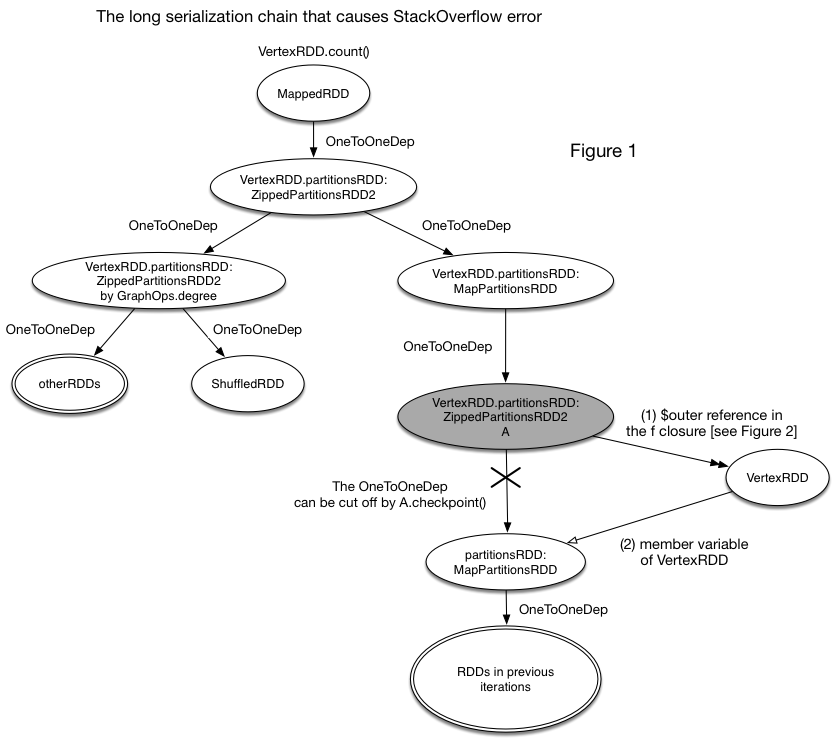
> broken lineage cut by checkpoint() (as shown in Figure 1). In other words,
> the serialization chain can be as long as the original lineage before
> checkpoint().
> Figure 1 shows how the unbreakable serialization chain is generated. Yes, the
> OneToOneDep can be cut off by checkpoint(). However, the serialization chain
> can still access the previous RDDs through the (1)->(2) reference chain. As a
> result, the checkpoint() action is meaningless and the lineage is as long as
> that before.
> !https://raw.githubusercontent.com/JerryLead/Misc/master/SparkPRFigures/g1.png|width=100%!
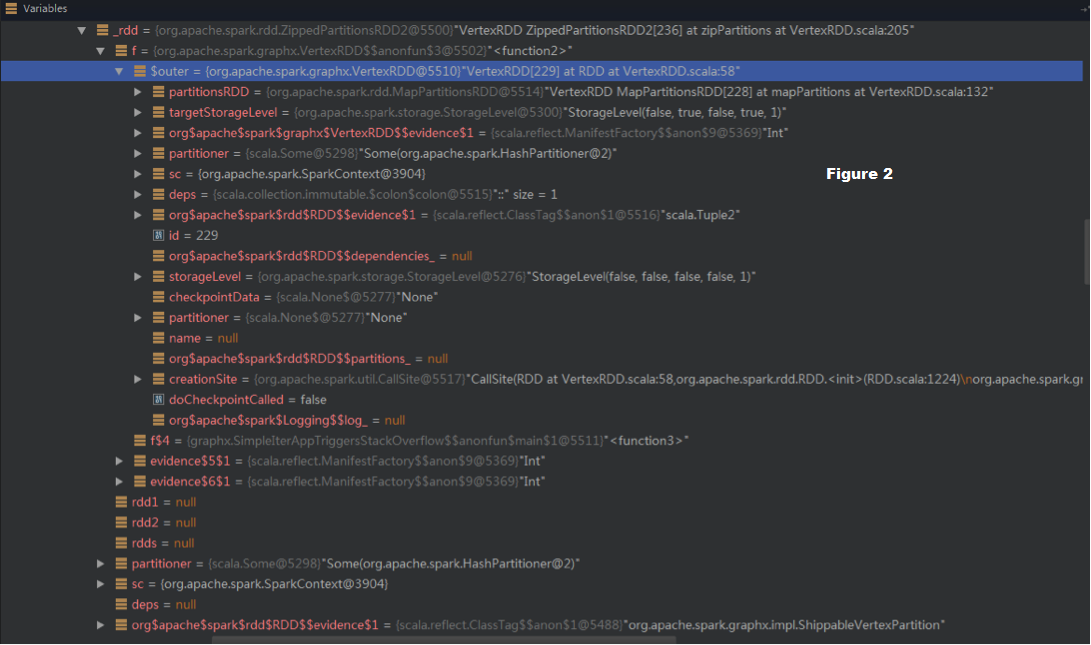
> The (1)->(2) chain can be observed in the debug view (in Figure 2).
> {code:borderStyle=solid}
> _rdd (i.e., A in Figure 1, checkpointed) -> f -> $outer (VertexRDD) ->
> partitionsRDD:MapPartitionsRDD -> RDDs in  the previous iterations
> {code}
> !https://raw.githubusercontent.com/JerryLead/Misc/master/SparkPRFigures/g2.png|width=100%!
> More description: While a RDD is being serialized, its f function
> {code:borderStyle=solid}
> e.g., f: (Iterator[A], Iterator[B]) => Iterator[V]) in ZippedPartitionsRDD2
> {code}
> will be serialized too. This action will be very dangerous if the f closure
> has a member “$outer” that references its outer class (as shown in Figure 1).
> This reference will be another way (except the OneToOneDependency) that a RDD
> (e.g., PartitionsRDD) can reference the other RDDs (e.g., VertexRDD). Note
> that checkpoint() only cuts off the direct lineage, while the function
> reference is still kept. So, serialization() can still access the other RDDs
> along the f references.
> h3. Phase 3: Non-transient member variable of VertexRDD makes things worse
> "Reference (1)" in Figure 1 is caused by the abnormal f clousre, while
> "Reference (2)" is caused by the potential bug in GraphX: *PartitionsRDD is a
> non-transient member variable of VertexRDD*.
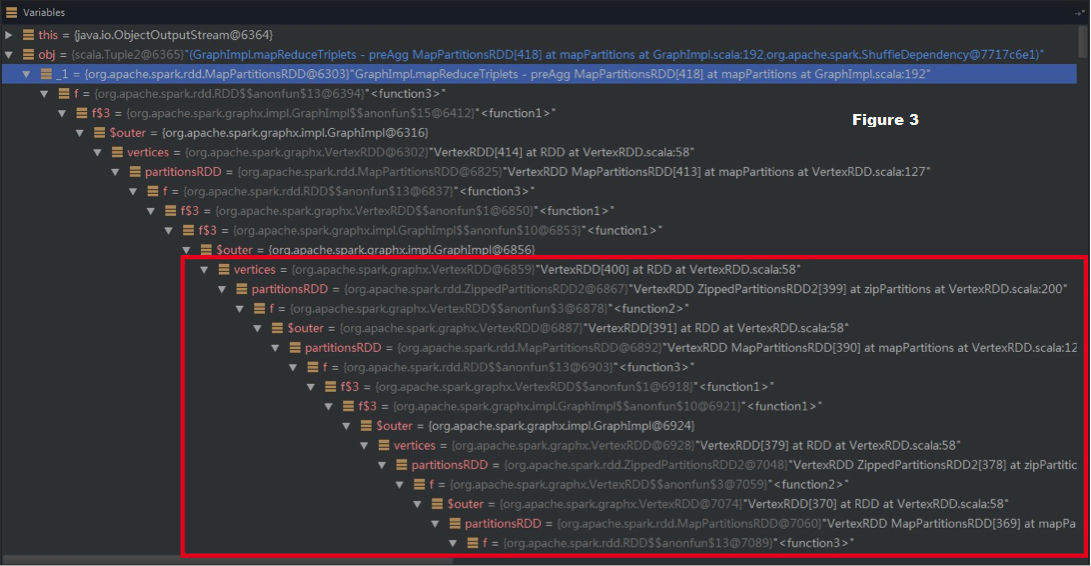
> With this _small_ bug, the f closure itself (without OneToOne dependency) can
> cause StackOverflow error, as shown in the red box in Figure 3:
> # While _vertices:VertexRDD_ is being serialized, its member _PartitionsRDD_
> will be serialized too.
> # Next, while serializing this _partitionsRDD_, serialization() will
> simultaneously serialize its f’s referenced $outer. Here, it is another
> _partitionsRDD_.
> # Finally, the chain
> {code:borderStyle=solid}
> "f => f$3 => f$3 => $outer => vertices: VertexRDD => partitionsRDD => … =>
> ShuffledRDD"
> {code}
> comes into shape. As a result, the serialization chain can be as long as the
> original lineage and finally triggers StackOverflow error.
>
> !https://raw.githubusercontent.com/JerryLead/Misc/master/SparkPRFigures/g3.png|width=100%!
> h2. Conclusions
> In conclusion, the root cause of StackOverflow error is the long
> serialization chain, which cannot be cut off by _checkpoint()_. This long
> chain is caused by the multiple factors, including:
> # long lineage
> # $outer reference in the f closure
> # non-transient member variable
> h2. How to fix this error
> We propose three pull requests as follows to solve this problem thoroughly.
> # PR-3544
> In this pr, we change the "val PartitionsRDD" to be transient in EdgeRDDImpl
> and VertexRDDImpl. As a result, while _vertices:VertexRDD_ is being
> serialized, its member _PartitionsRDD_ will not be serialized. In other
> words, the "Reference (2)" in Figure 1 will be cut off.
> # PR-3545
> In this pr, we set "f = null" if ZippedPartitionsRDD is checkpointed. As a
> result, when PartitionsRDD is checkpointed, its f closure will be cleared and
> the "Reference (1)" (i.e., f => $outer) in Figure 1 will no exist.
> # PR-3549
> To cut off the long lineage, we need to perform checkpoint()  on
> PartitionsRDD. However, current checkpoint() is performed on VertexRDD and
> EdgeRDD themselves. As a result, we need to override the checkpoint() methods
> in VertexRDDImpl and EdgeRDDImpl to perform checkpoint() on PartitionsRDD.


--
This message was sent by Atlassian JIRA
(v6.3.4#6332)

---------------------------------------------------------------------
To unsubscribe, e-mail: [email protected]
For additional commands, e-mail: [email protected]