Tomb of the
Blessed Virgin Mary

The tomb of the
Blessed Virgin is venerated in the Valley of Cedron, near Jerusalem. Modern writers hold, however, that
Mary died and was buried at Ephesus. The main points of the question to be
taken into consideration are as follows.
Testimony in favor of
Jerusalem
The apocryphal works of
the second to the fourth century are all favourable to the Jerusalem tradition.
According to the "Acts of St. John by Prochurus", written (160-70) by Lencius,
the Evangelist went to Ephesus accompanied by Prochurus alone and at a
very advanced age, i.e. after Mary's death. The two letters "B. Inatii missa S.
Joanni", written about 370, show that the Blessed Virgin passed the remainder of
her days at Jerusalem. That of Dionysius the Areopagite to the Bishop
Titus (363), the "Joannis liber de Dormitione Mariae" (third to fourth century),
and the treatise "De transitu B.M. Virginis" (fourth century) place her tomb at
Gethsemane. From an historical
standpoint these works, although apocryphal, have a real value, reflecting as
they do the tradition of the early centuries. At the beginning of the fifth
century a pilgrim from Armenia visited "the tomb of the Virgin in the
valley of
Josaphat", and about 431
the "Breviarius de Hierusalem" mentions in that valley "the basilica of Holy
Mary, which contains her sepulchre". Thenceforth pilgrims of various rites
repaired thither to venerate the empty tomb of Mary. St. Gregory of Tours, St.
Modestus, St. Sophronius, Patriarch of Jerusalem, St. Germanus, Patriarch of
Constantinople, St. Andrew, bishop of Crete, John of Thessalonica, Hippolytus of
Thebes, and Venerable Bede teach this same fact and bear witness that this
tradition was accepted by all the Churches of East and West. St.
John Damascene, preaching on the feast
of the Assumption at Gethsemane,
recalls that, according to the "Euthymian History", III, xl (written probably by
Cyril of Scythopolis in the fifth century), Juvenal, bishop of Jerusalem, sent
to Constantinople in 452 at the command of the Emperor Marcian and Pulcheria,
his wife, the Shroud of the Blessed Virgin preserved in the church of Gethsemane
(P.G., XCVI, 747-51). The relic has since been venerated in that city at the
Church of Our Lady of Blachernae.
Testimony in favor of
Ephesus
There was never any
tradition connecting Mary's death and burial with the city of Ephesus. Not a single
writer or pilgrim speaks of her tomb as being there; and in the thirteenth
century Perdicas, prothonotary of Ephesus,
visited "the glorious tomb of the Virgin at Gethsemane", and describes it in his poem (P.G., CXXXIII,
969). In a letter sent in 431 by the members of the Council of Ephesus to the clergy of
Constantinople we read that Nestorius "reached the city of Ephesus where John
the Theologian and the Mother of God, the Holy Virgin, were separated from the
assembly of the holy Fathers", etc. Tillemont has completed the elliptical
phrase by adding arbitrarily, "have their tombs". He is followed by a few
writers. According to the meditations of Sister Catherine Emmerich (d. 1824),
compiled and published in 1852, the Blessed Virgin died and was buried not at
Ephesus but
three or four leagues south of the city. She is followed by those who accept her
visions or meditations as Divine revelations. However, St. Brigid relates that
at the time of her visit to the church of Gethsemane the Blessed Virgin appeared to
her and spoke to her of her stay of three days in that place and of her
Assumption into Heaven. The
revelations of Ven. Maria d'Agreda do not contradict those of Catherine
Emmerich.
The Church of the Sepulchre of
Mary

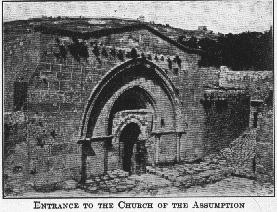
As the soil is
considerably raised in the Valley of the Cedron, the ancient Church of the
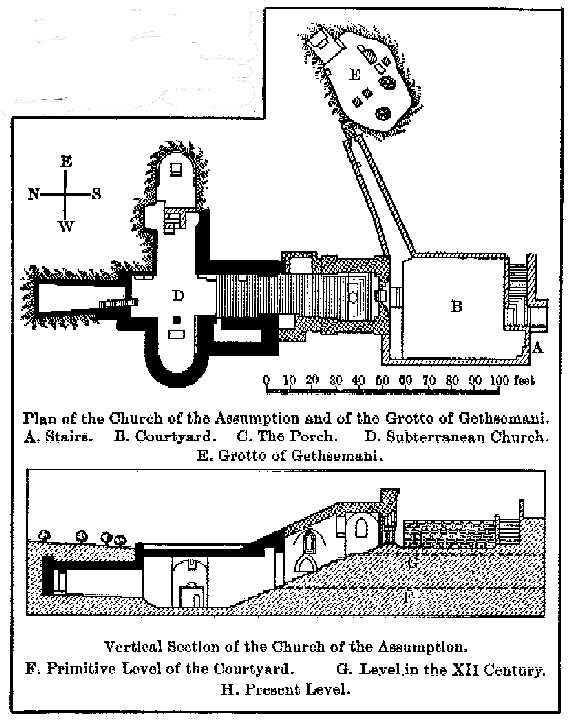
Sepulchre of Mary is completely covered and hidden. A score of steps descend
from the road into the court (see
Plan: B), at the back of which is a beautiful
twelfth century porch (C). It opens on a monumental stairway
of forty-eight steps. The twentieth step leads into the Church built in the
fifth century, to a great extent cut from the rock. It forms a cross of unequal
arms (D). In the centre of
the eastern arm, 52 feet long and 20 feet wide is the glorious tomb of the
Mother of Christ. It is a little room with a bench hewn from the rocky mass in
imitation of the tomb of Christ. This has given it the shape of a cubical
edicule, about ten feet in circumference and eight feet high. Until the
fourteenth century the little monument was covered with magnificent marble slabs
and the walls of the church were covered with frescoes. Since 1187 the tomb has
been the property of the Muslim Government which nevertheless authorizes the
Christians to officiate in it.
BARNABAS
MEISTERMANN
Transcribed by Scott Anthony Hibbs
The Catholic Encyclopedia, Volume
XIV
Copyright © 1912 by Robert Appleton Company
Online Edition Copyright ©
1999 by Kevin Knight
Nihil Obstat, July
1, 1912. Remy Lafort, S.T.D., Censor
Imprimatur. +John Cardinal Farley,
Archbishop of New
York