Dear Bob

> Brian, which of these appeal to you?
>
> http://skuld.bmsc.washington.edu/raster3d/html/rastep_options.gif
>
> Can we use PDB format?
>
> http://nist.rcsb.org/robohelp/files_formats/structures/pdb/coordinate_file_description/anisou.htm
>
> I see 1AL4 has these codes, so I could start with that.
> What I need is a primer on how to translate the U matrix information to
> axes a, b, and c of the drawn thermal ellipsoid.
I'm delighted to have caught your enthusiasm on this. I shall ask some
authors of crystallographic graphics programs to provide help on this
(though any experts on the list are welcome to chip in first).

In the CIF world, you will be looking for data names of the sort

_atom_site_aniso_U_11 _atom_site_aniso_U_12 _atom_site_aniso_U_13
_atom_site_aniso_U_22 _atom_site_aniso_U_23 _atom_site_aniso_U_33

defined in the core CIF dictionary as

   These are the standard anisotropic atomic displacement
   components in angstroms squared which appear in the
   structure-factor term

   T = exp{-2pi^2^ sum~i~ [sum~j~ (U^ij^ h~i~ h~j~ a*~i~ a*~j~) ] }

   h = the Miller indices
   a* = the reciprocal-space cell lengths

   The unique elements of the real symmetric matrix are
   entered by row.

In mmCIF the tokens are very similar:

_atom_site_anisotrop.U[1][1] _atom_site_anisotrop.U[1][2]
_atom_site_anisotrop.U[1][3] _atom_site_anisotrop.U[2][2]
_atom_site_anisotrop.U[2][3] _atom_site_anisotrop.U[3][3]

Note also that you may find B values, named similarly:

_atom_site_aniso_B_11 _atom_site_aniso_B_12 _atom_site_aniso_B_13
_atom_site_aniso_B_22 _atom_site_aniso_B_23 _atom_site_aniso_B_33

They are a multiplicative constant of 8 * pi^2 times the corresponding
U values: B_ij = (8 * pi^2) * U_ij

Roughly, the ellipsoids plot surfaces of constant probability of finding
atomic positions displaced from their mean location. This occurs when
the matrix equation x^T * U^-1 * x = constant, where x is the vector of
displacement of the atom from its mean position and U is the inverse
of the symmetric matrix described above by the U_ij components. See
http://www.iucr.org/iucr-top/comm/cnom/adp/finrep/node13.html

So, the desideratum is for a representation that allows the user to select
the level of probability desired, and consequently the extent of the
ellipsoid. A quick glance at some of our articles suggests that 50%
probability may be a suitable default value, but I'll check that with
colleagues tomorrow.

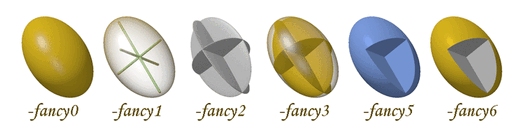
The style of the ellipsoids: ideally, we should have both solid
ellipsoids (fancy0) and ellipsoids with an octant removed (fancy6 looks
good, but fancy5 would be acceptable too). It might also help the eye to
have a variant of fancy0 where the equatorial lines normal to each
principal direction are drawn. Note that the versions with missing
octants arise from the desire to show the effect more clearly in
two-dimensional projection in a plane figure. Arguably they're not
needed for 3-D visualisation; but (a) we do use Jmol to generate
2-D static views in our enhanced figures; and (b) people have got
quite used to them and will expect them anyway.

I agree that there should be an option for displaying H atoms as small
spheres, ignoring any quoted U values. You may also need to parse files for
equivalent isotropic U's on individual atoms, and display those as spheres
(I guess scaled in the same way as the anisotropic ellipsoids).

I have another suggestion that would also be most useful. Crystallographers
often use the eccentricity of the ellipsoids to diagnose disorder, undue
flexibility or ill-refined parts of a model. It would be nice to have a
colour scheme colouring the ellipsoids differently according to their
elongation, with a dazzlingly bright colour highlighting very eccentric
axes. I could ask around to see whether some smooth gradation would do, or
whether there are thresholds that would prompt highly contrasting colour
changes.

Examples: just about any small-molecule CIF from Acta Cryst.
Sections B, C or E should have anisotropic U's. They're free to download
from the contents of each issue (http://journals.iucr.org). They might
be a good starting point since they are often very small molecules; but
you'll certainly want to test the performance on proteins as well.

Best wishes
Brian

-------------------------------------------------------------------------
This SF.net email is sponsored by the 2008 JavaOne(SM) Conference
Don't miss this year's exciting event. There's still time to save $100.
Use priority code J8TL2D2.
http://ad.doubleclick.net/clk;198757673;13503038;p?http://java.sun.com/javaone
_______________________________________________
Jmol-users mailing list
[email protected]
https://lists.sourceforge.net/lists/listinfo/jmol-users