Great work Bob. Difficult to keep up with you. But your server:
http://www.chemapps.stolaf.edu/jmol/docs/examples-11/Jmol-11_5.jar
(even when I remove the superfluous "www" :-) seems to have reverted to a
version of 28 slightly earlier than the one I had earlier, and I couldn't
find 29 with the features shown on your new.htm page. BTW, Firefox tends
to hang on new.htm and MSIE spends a lot of time with its fancy phishing
filter; in the absence of understanding I turned it off :-)
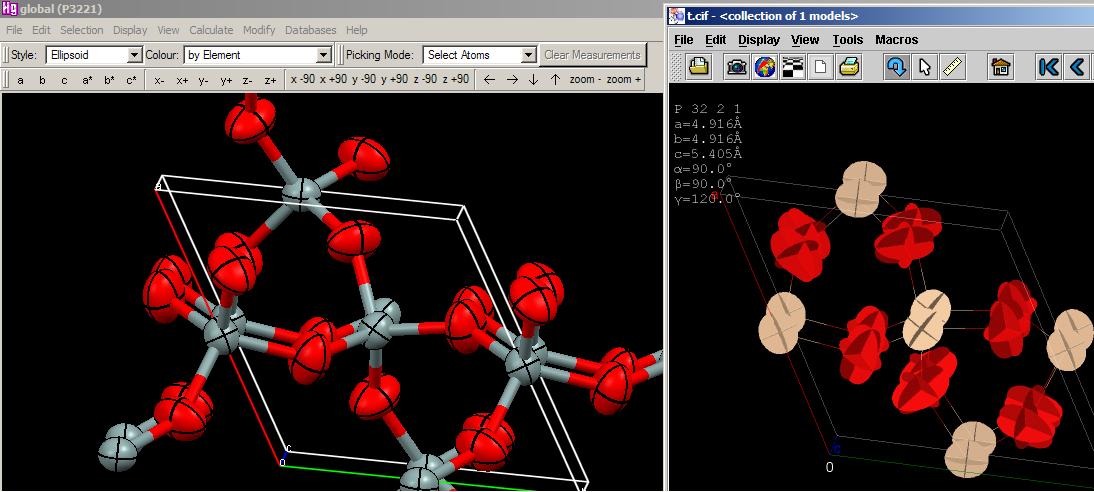
Now about the ellipsoid display. Dot surfaces indicating probability is a
great idea even if it gets a little confusing when ellipsoids overlap. OK,
one can use ellipsoidFill which contains more information than footballs
dotted or plain, but I still miss the old football option that you already
show in fig.1 of
http://chemapps.stolaf.edu/jmol/docs/examples-11/img/ellipsoids.jpg
maybe with an option for the black ellipse lines on/off.

Yes, footballs can be done with other apps like Mercury, but Mercury is
not really made for inorganic structures; jmol has become uniquely
powerful there, with its polyhedra, isosurfaces etc and now anisotropic
temperature factors. For such small structures, solid surfaces for Uij,
like your very attractive isosurfaces, should perhaps not take too long?

I will take a look at your x4 scale factor, but as you say it's probably
the 1/2 squared left out in the definition of Uij, that I'm sure Mercury
has right. Not too important compared to the relative magnitudes and
directions of the ellipsoid axes.

Again, very impressive! Thanks. Alan.

Bob Hanson said:
> OK, Alan, that's great. I look forward to hearing about your user
> feedback.
>
> Rendering. I think you are going to like this. It is NOT your typical
> football rendering -- but I will argue that you can get that with other
> programs, and maybe Jmol should do better.
>
> Football dots. Pointilist footballs? The dots that form the football
> twinkle with model manipulation -- suggestive, perhaps of their
> probabilistic reference. You can set how many dots -- the default is
> 200, but 500 looks pretty cool, I think. (And I've hit a brick wall
> trying to figure out how to efficiently calculate the ellipse created by
> the intersection of a plane with an arbritrary ellipsoid.) So, here you
> go...
>
> see http://www.chemapps.stolaf.edu/jmol/docs/examples-11/new.htm
> and
> http://www.chemapps.stolaf.edu/jmol/docs/examples-11/Jmol-11_5.jar
>
> # new features for ellipsoid rendering [default settings in brackets]:
> #
> #  set ellipsoidAxes     [false]
> #  set ellipsoidArcs     [false]
> #  set ellipsoidFill     [false]
> #  set ellipsoidDots     [true]
> #  set ellipsoidDotCount [200]
> #
> #  [dots|stars|spacefill] ADPMIN [percent]
> #  [dots|stars|spacefill] ADPMAX [percent]
> #
>
> The combination I think is really interesting -- to my eye FAR more
> informative than a football -- is this:
>
> set ellipsoidDots off
> set ellipsoidFill on
> wireframe on;spacefill ADPMIN 50; ellipsoids 50
>
> What this gives is a nice-looking solid sphere at the 50% level for the
> minimium displacement (the shortest axis) and elliptical planes slicing
> out of it in the directions of the other two axes. I can very quickly
> see the problems with mega displacements, and I can detect slight
> differences in the two minor axes as well. Something to think about.
>
> I still need someone to take a very close look at the 50, 75, 100% sizes
> and tell me if I have that right. Does it scale properly? There's a
> factor of 4 there I had to throw in to make it match Mercury, but I
> don't know why I had to do that. Doesn't surprise me -- I probably left
> it out of the U-->B conversion or something like that.
>
> I've changed the temperature to be
>
>   (U11 * U22 * U33)^(0.333)
>
> This is only set if the atomic Bfactors are NOT set. Atomic Bfactors
> take precedence (for compatibility with previous versions).
>
> Oh, and by the way, when you set
>
>   spacefill ADPMIN 100
>
> the atom's radius parameter reads off the minimum axis length.
>
>   spacefill ADPMIN 100
>   print {*}.radius # average
>   print {*}.radius.min  # minimum
>   print {_O}.radius.max  # maximum for oxygen
>
>  select {radius > 0.4}; color yellow;label "OH,OH"
>
> I think this may have potential.
>
> *Bob
> --
> Robert M. Hanson
> Professor of Chemistry
> St. Olaf College
> Northfield, MN
> http://www.stolaf.edu/people/hansonr
>
>
> If nature does not answer first what we want,
> it is better to take what answer we get.
>
> -- Josiah Willard Gibbs, Lecture XXX, Monday, February 5, 1900
______________________________________________
Dr Alan Hewat, NeutronOptics, Grenoble, FRANCE
<[EMAIL PROTECTED]> +33.476.98.41.68
      http://www.NeutronOptics.com/hewat
______________________________________________


-------------------------------------------------------------------------
This SF.net email is sponsored by the 2008 JavaOne(SM) Conference
Don't miss this year's exciting event. There's still time to save $100.
Use priority code J8TL2D2.
http://ad.doubleclick.net/clk;198757673;13503038;p?http://java.sun.com/javaone
_______________________________________________
Jmol-users mailing list
[email protected]
https://lists.sourceforge.net/lists/listinfo/jmol-users