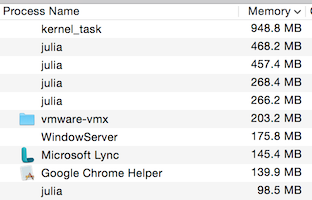
Your concern about the OS capability to do memory management (or show info
about it) is misleading people!
I did the same experiment on a CentOS 6.5, and the memory usage shown by
'top' is:

<https://lh5.googleusercontent.com/-1kr66hoaQJ0/VFrYDJv-QLI/AAAAAAAABlE/jZEcQQKhAgA/s1600/mem.png>
As you can see, the exact problem is been duplicated on a Linux.


On Wednesday, November 5, 2014 7:38:25 PM UTC+8, Stefan Karpinski wrote:
>
> This looks like an OS X screenshot – do processes on OS X ever relinquish
> memory back to the kernel? I'm not sure that they do.
>
> On Wed, Nov 5, 2014 at 9:47 AM, Amit Murthy <[email protected]
> <javascript:>> wrote:
>
>> Could you try:
>>
>> @everywhere gc()
>> @everywhere Base.flush_gc_msgs()
>> @everywhere gc()
>>
>>
>>
>> On Wed, Nov 5, 2014 at 2:07 PM, Seth Yuan <[email protected]
>> <javascript:>> wrote:
>>
>>> Hi Amit,
>>>
>>> Thanks for the response, I tried Base.flush_gc_msgs(), the result is
>>> shown below:
>>>
>>>
>>> <https://lh5.googleusercontent.com/-bEVLUYu-DPk/VFnhFUh28CI/AAAAAAAABk0/WNl3ukSetUk/s1600/mem.png>
>>> It did free some memory on some workers, but not quite. I think the
>>> acceptable number for workers would be around 100MB (like the master is).
>>>
>>> So what's wrong with DArrays?
>>>
>>>
>>> On Wednesday, November 5, 2014 2:32:42 PM UTC+8, Amit Murthy wrote:
>>>>
>>>> Distributed objects are currently gc'ed asynchronously.
>>>>
>>>> You may force this using an internal function flush_gc_msgs like this:
>>>>
>>>> @everywhere Base.flush_gc_msgs()
>>>> @everywhere gc()
>>>>
>>>>
>>>> The above is an internal function and is not meant for general use. It
>>>> will be great if you could open an issue on github requesting a feature to
>>>> force gc of distributed objects.
>>>>
>>>>
>>>>
>>>> On Wed, Nov 5, 2014 at 9:01 AM, Seth Yuan <[email protected]> wrote:
>>>>
>>>>> I did a test on deallocations, and the behavior is not what I expected.
>>>>>
>>>>> The code I ran is:
>>>>>
>>>>> @everywhere using Ops
>>>>>
>>>>> function test_allocation()
>>>>>   a = drand(10000, 10000)
>>>>>   b = 2a
>>>>>   readline()
>>>>> end
>>>>>
>>>>> test_allocation()
>>>>> @everywhere gc()
>>>>> readline()
>>>>>
>>>>> Ops module defined the '*' operator (where a new DArray is created). I
>>>>> can see that master's memory went down after the gc() call, but the
>>>>> workers' memory remained unchanged.
>>>>>
>>>>>
>>>>> <https://lh5.googleusercontent.com/-qo7SKwkoya0/VFmZrIWL0EI/AAAAAAAABkk/FctwkEcQWnk/s1600/mem.png>
>>>>> So the question is: "how to really free a DArray? Both master and
>>>>> workers!"
>>>>>
>>>>>
>>>>> On Thursday, October 16, 2014 10:18:42 PM UTC+8, Amit Murthy wrote:
>>>>>>
>>>>>> meant to say  "all references  from all processes are removed"
>>>>>>
>>>>>> On Thu, Oct 16, 2014 at 7:47 PM, Amit Murthy <[email protected]>
>>>>>> wrote:
>>>>>>
>>>>>>> Yes, it is gc'ed just like any other object, when all references to
>>>>>>> it from any process is removed.
>>>>>>>
>>>>>>> On Thu, Oct 16, 2014 at 2:59 PM, Seth Yuan <[email protected]>
>>>>>>> wrote:
>>>>>>>
>>>>>>>> Now, I know by reading the documentation how a DArray is created,
>>>>>>>> but I'm not sure when a DArray is deallocated.
>>>>>>>>
>>>>>>>> Is it GC able when the master looses all references of it? Does
>>>>>>>> somebody know the answer to this question?
>>>>>>>>
>>>>>>>
>>>>>>>
>>>>>>
>>>>
>>
>