On Wed, Jan 11, 2012 at 09:01:10PM +0100, Stephan Bärwolf wrote:
> On 01/11/12 20:09, Marcelo Tosatti wrote:
> > On Tue, Jan 10, 2012 at 03:26:49PM +0100, Stephan Bärwolf wrote:
> >> >From 2168285ffb30716f30e129c3ce98ce42d19c4d4e Mon Sep 17 00:00:00 2001
> >> From: Stephan Baerwolf <[email protected]>
> >> Date: Sun, 8 Jan 2012 02:03:47 +0000
> >> Subject: [PATCH 2/2] KVM: fix missing "illegal instruction"-trap in
> >> protected modes
> >>
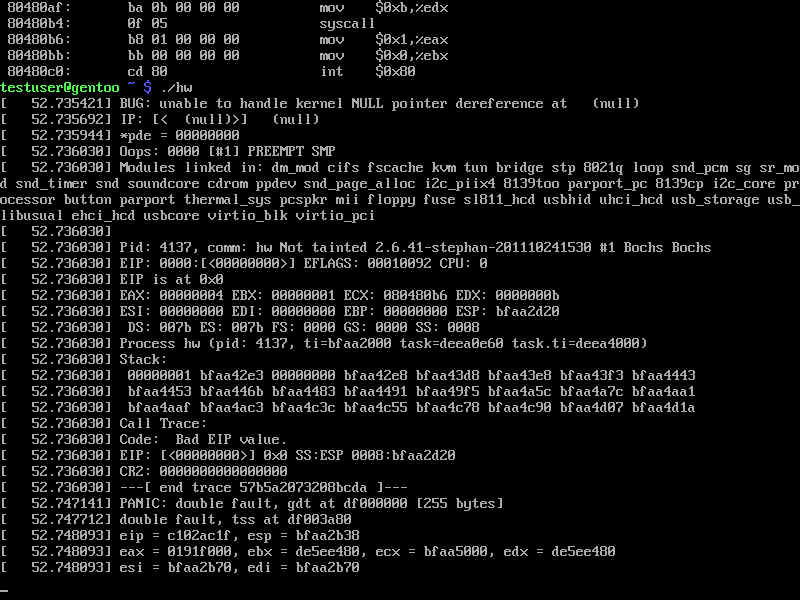
> >> On hosts without this patch, 32bit guests will crash
> >> (and 64bit guests may behave in a wrong way) for
> >> example by simply executing following nasm-demo-application:
> >>
> >>     [bits 32]
> >>     global _start
> >>     SECTION .text
> >>     _start: syscall
> >>
> >> (I tested it with winxp and linux - both always crashed)
> >>
> >>     Disassembly of section .text:
> >>
> >>     00000000 <_start>:
> >>        0:   0f 05                   syscall
> >>
> >> The reason seems a missing "invalid opcode"-trap (int6) for the
> >> syscall opcode "0f05", which is not available on Intel CPUs
> >> within non-longmodes, as also on some AMD CPUs within legacy-mode.
> >> (depending on CPU vendor, MSR_EFER and cpuid)
> >>
> >> Because previous mentioned OSs may not engage corresponding
> >> syscall target-registers (STAR, LSTAR, CSTAR), they remain
> >> NULL and (non trapping) syscalls are leading to multiple
> >> faults and finally crashs.
> >>
> >> Depending on the architecture (AMD or Intel) pretended by
> >> guests, various checks according to vendor's documentation
> >> are implemented to overcome the current issue and behave
> >> like the CPUs physical counterparts.
> >>
> >> (Therefore using Intel's "Intel 64 and IA-32 Architecture Software
> >> Developers Manual" http://www.intel.com/content/dam/doc/manual/
> >> 64-ia-32-architectures-software-developer-manual-325462.pdf
> >> and AMD's "AMD64 Architecture Programmer's Manual Volume 3:
> >> General-Purpose and System Instructions"
> >> http://support.amd.com/us/Processor_TechDocs/APM_V3_24594.pdf )
> >>
> >> Screenshots of an i686 testing VM (CORE i5 host) before
> >> and after applying this patch are available under:
> >>
> >> http://matrixstorm.com/software/linux/kvm/20111229/before.jpg
> >> http://matrixstorm.com/software/linux/kvm/20111229/after.jpg
> >>
> >> Signed-off-by: Stephan Baerwolf <[email protected]>
> >> ---
> >>  arch/x86/include/asm/kvm_emulate.h |   15 ++++++
> >>  arch/x86/kvm/emulate.c             |   92
> >> ++++++++++++++++++++++++++++++++++-
> >>  2 files changed, 104 insertions(+), 3 deletions(-)
> >>
> >> diff --git a/arch/x86/include/asm/kvm_emulate.h
> >> b/arch/x86/include/asm/kvm_emulate.h
> >> index b172bf4..5b68c23 100644
> >> --- a/arch/x86/include/asm/kvm_emulate.h
> >> +++ b/arch/x86/include/asm/kvm_emulate.h
> >> @@ -301,6 +301,21 @@ struct x86_emulate_ctxt {
> >>  #define X86EMUL_MODE_PROT     (X86EMUL_MODE_PROT16|X86EMUL_MODE_PROT32| \
> >>                     X86EMUL_MODE_PROT64)
> >>
> >> +/* CPUID vendors */
> >> +#define X86EMUL_CPUID_VENDOR_AuthenticAMD_ebx 0x68747541
> >> +#define X86EMUL_CPUID_VENDOR_AuthenticAMD_ecx 0x444d4163
> >> +#define X86EMUL_CPUID_VENDOR_AuthenticAMD_edx 0x69746e65
> >> +
> >> +#define X86EMUL_CPUID_VENDOR_AMDisbetter_ebx 0x69444d41
> >> +#define X86EMUL_CPUID_VENDOR_AMDisbetter_ecx 0x21726574
> >> +#define X86EMUL_CPUID_VENDOR_AMDisbetter_edx 0x74656273
> >> +
> >> +#define X86EMUL_CPUID_VENDOR_GenuineIntel_ebx 0x756e6547
> >> +#define X86EMUL_CPUID_VENDOR_GenuineIntel_ecx 0x6c65746e
> >> +#define X86EMUL_CPUID_VENDOR_GenuineIntel_edx 0x49656e69
> >> +
> >> +
> >> +
> >>  enum x86_intercept_stage {
> >>      X86_ICTP_NONE = 0,   /* Allow zero-init to not match anything */
> >>      X86_ICPT_PRE_EXCEPT,
> >> diff --git a/arch/x86/kvm/emulate.c b/arch/x86/kvm/emulate.c
> >> index f1e3be1..3357411 100644
> >> --- a/arch/x86/kvm/emulate.c
> >> +++ b/arch/x86/kvm/emulate.c
> >> @@ -1877,6 +1877,94 @@ setup_syscalls_segments(struct x86_emulate_ctxt
> >> *ctxt,
> >>      ss->p = 1;
> >>  }
> >>
> >> +static bool em_syscall_isenabled(struct x86_emulate_ctxt *ctxt)
> >> +{
> >> +    struct x86_emulate_ops *ops = ctxt->ops;
> >> +    u64 efer = 0;
> >> +
> >> +    /* syscall is not available in real mode                            */
> >> +    if ((ctxt->mode == X86EMUL_MODE_REAL) ||
> >> +        (ctxt->mode == X86EMUL_MODE_VM86))
> >> +        return false;
> >> +
> >> +    ops->get_msr(ctxt, MSR_EFER, &efer);
> >> +    /* check - if guestOS is aware of syscall (0x0f05)                  */
> >> +    if ((efer & EFER_SCE) == 0) {
> >> +        return false;
> >> +    } else {
> >> +      /* ok, at this point it becomes vendor-specific                   */
> >> +      /* so first get us an cpuid                                       */
> >> +      bool vendor;
> >> +      u32 eax, ebx, ecx, edx;
> >> +
> >> +      /* getting the cpu-vendor                                         */
> >> +      eax = 0x00000000;
> >> +      ecx = 0x00000000;
> >> +      if (likely(ops->get_cpuid))
> >> +          vendor = ops->get_cpuid(ctxt, &eax, &ebx, &ecx, &edx);
> >> +      else    vendor = false;
> >> +
> >> +      if (likely(vendor)) {
> >> +
> >> +        /* AMD AuthenticAMD / AMDisbetter!                              */
> >> +        if (((ebx==X86EMUL_CPUID_VENDOR_AuthenticAMD_ebx) &&
> >> +             (ecx==X86EMUL_CPUID_VENDOR_AuthenticAMD_ecx) &&
> >> +             (edx==X86EMUL_CPUID_VENDOR_AuthenticAMD_edx)) ||
> >> +            ((ebx==X86EMUL_CPUID_VENDOR_AMDisbetter_ebx) &&
> >> +             (ecx==X86EMUL_CPUID_VENDOR_AMDisbetter_ecx) &&
> >> +             (edx==X86EMUL_CPUID_VENDOR_AMDisbetter_edx))) {
> >> +
> >> +              /* if cpu is not in longmode...                           */
> >> +              /* ...check edx bit11 of cpuid 0x80000001                 */
> >> +              if (ctxt->mode != X86EMUL_MODE_PROT64) {
> >> +                eax = 0x80000001;
> >> +                ecx = 0x00000000;
> >> +                vendor = ops->get_cpuid(ctxt, &eax, &ebx, &ecx, &edx);
> >> +                if (likely(vendor)) {
> >> +                  if (unlikely(((edx >> 11) & 0x1) == 0))
> >> +                      return false;
> >> +                } else {
> >> +                    return false; /* assuming there is no bit 11        */
> >> +            }
> >> +              }
> >> +              goto __em_syscall_enabled_noprotest;
> >> +        } /* end "AMD" */
> >> +
> >> +
> >> +        /* Intel (GenuineIntel)
> >> */
> >> +        /* remarks: Intel CPUs only support "syscall" in 64bit longmode
> >> */
> >> +        /*          Also an 64bit guest within a 32bit compat-app
> >> running*/
> >> +        /*          will #UD !!
> >> */
> >> +        /*          While this behaviour can be fixed (by emulating)
> >> into*/
> >> +        /*          an AMD response - CPUs of AMD can't behave like
> >> Intel*/
> >> +        /*          because without an hardware-raised #UD there is no
> >> */
> >> +        /*          call in em.-mode (see x86_emulate_instruction(...))!
> >> */
> >> +        /* TODO: make AMD-behaviour configurable
> >> */
> >> +        if ((ebx==X86EMUL_CPUID_VENDOR_GenuineIntel_ebx) &&
> >> +            (ecx==X86EMUL_CPUID_VENDOR_GenuineIntel_ecx) &&
> >> +            (edx==X86EMUL_CPUID_VENDOR_GenuineIntel_edx)) {
> >> +              if (ctxt->mode != X86EMUL_MODE_PROT64)
> >> +                  return false;
> >> +              goto __em_syscall_enabled_noprotest;
> >> +        } /* end "Intel" */
> >> +
> >> +      } /* end vendor is true */
> >> +
> >> +    } /* end MSR_EFER check */
> >> +
> >> +    /* default:                               */
> >> +    /* this code wasn't able to process vendor */
> >> +    /* so apply  Intels stricter rules...      */
> >> +        pr_err_ratelimited("kvm: %i: unknown vcpu vendor - assuming
> >> intel\n",
> >> +                        current->tgid);
> >> +
> >> +    if (ctxt->mode == X86EMUL_MODE_PROT64) goto
> >> __em_syscall_enabled_noprotest;
> >> +    return false;
> >> +
> >> +__em_syscall_enabled_noprotest:
> >> +    return true;
> >> +}
> >> +
> >>  static int em_syscall(struct x86_emulate_ctxt *ctxt)
> >>  {
> >>      struct x86_emulate_ops *ops = ctxt->ops;
> >> @@ -1885,9 +1973,7 @@ static int em_syscall(struct x86_emulate_ctxt *ctxt)
> >>      u16 cs_sel, ss_sel;
> >>      u64 efer = 0;
> >>
> >> -    /* syscall is not available in real mode */
> >> -    if (ctxt->mode == X86EMUL_MODE_REAL ||
> >> -        ctxt->mode == X86EMUL_MODE_VM86)
> >> +    if (!(em_syscall_isenabled(ctxt)))
> >>          return emulate_ud(ctxt);
> >>
> >>      ops->get_msr(ctxt, MSR_EFER, &efer);
> > Stephan,
> >
> > I think only the 2-line check to inject UD if EFER_SCE is not set is
> > missing in em_syscall. The guest is responsible for setting a proper
> > MSR_STAR for EIP only if it enables SCE_EFER.
> >
> > Can you please test & resend that patch? Thanks.
> >
> >
> >
> This wouln't work correctly on 64bit longmode guest
> running an app in 32bit compat.
The AMD pseudo-code, in volume 3 "General-Purpose and System
Instructions", says:

SYSCALL_START:

IF (MSR_EFER.SCE = 0) // Check if syscall/sysret are enabled.
    EXCEPTION [#UD]

IF (LONG_MODE)
    SYSCALL_LONG_MODE
ELSE // (LEGACY_MODE)
    SYSCALL_LEGACY_MODE

> (Even on AMD in some special conditions.)
> The reason is, in 64Bit compat the MSR_EFER_SCE is still
> enabled but syscall is not always available by cpu in such modes.
> (I also compared always with a physical computer's behaviour.)
> See Intel or even AMD-doku
> (http://support.amd.com/us/Processor_TechDocs/APM_V3_24594.pdf) page 376.
>
> Of course in 64bit it should NOT crash (and indeed I haven't
> observed it, yet) but if I have cpuid GenuineIntel it should behave
> like Intel cpu and not like some special AMD.
> (Otherwise I could overwrite the vendor and then the patch will
> emulate AMD...)
>
> ??What could be a good speedup: Reordering the EFER check and the
> real-mode checks
> (I would have to check doku, but EFER is 0 in realmode, isn't it?), then
> checking if (not)longmode and then:
>
> I think, the patch ->only<- (and only!?) becomes a little bit slower
> exactly
> in this situation (32bit compat under 64bit long) because in every other
> case?
> the first ifs (testing the MSR_EFER and the mode) should decide to #UD...
> (At all it should be faster at the end, then it is now ?)
>
> ...I'll prepare a patch for what I mean...
>
> I am looking forward to your response,
>
> regards Stephan

How about this:

diff --git a/arch/x86/kvm/emulate.c b/arch/x86/kvm/emulate.c
index 05a562b..4e8e534 100644
--- a/arch/x86/kvm/emulate.c
+++ b/arch/x86/kvm/emulate.c
@@ -1907,6 +1907,9 @@ static int em_syscall(struct x86_emulate_ctxt *ctxt)
        ops->get_msr(ctxt, MSR_EFER, &efer);
        setup_syscalls_segments(ctxt, &cs, &ss);

+       if (!(efer & EFER_SCE))
+               return emulate_ud(ctxt);
+
        ops->get_msr(ctxt, MSR_STAR, &msr_data);
        msr_data >>= 32;
        cs_sel = (u16)(msr_data & 0xfffc);
--
To unsubscribe from this list: send the line "unsubscribe kvm" in
the body of a message to [email protected]
More majordomo info at  http://vger.kernel.org/majordomo-info.html