http://www.marxist.com/where-is-the-venezuelan-revolution-going.htm
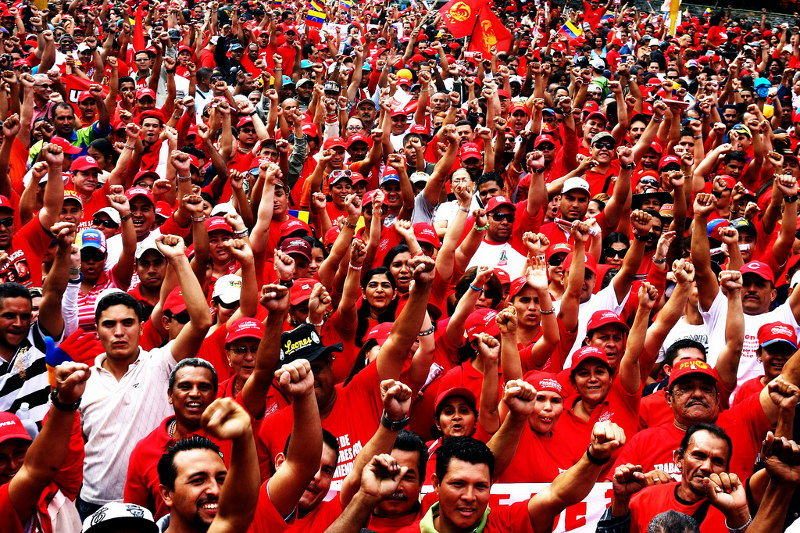
Where is the Venezuelan Revolution going? A contribution to the discussion on property and the tasks of the revolution<http://www.marxist.com/where-is-the-venezuelan-revolution-going.htm> Written by Alan Woods Friday, 29 October 2010 [image: Print]<http://www.marxist.com/where-is-the-venezuelan-revolution-going/print.htm#> The September elections have posed some serious questions before the Bolivarian Revolution. The opposition has organized a noisy campaign in the media to present themselves as "winners", despite the fact that they lost. What is the purpose of this campaign? A minority cannot turn itself into a majority, no matter how loud it shouts. But such a campaign can be advantageous to the counterrevolutionaries both inside and outside Venezuela. <http://www.marxist.com/images/stories/venezuela/que_comunismo_-_Frente_de_Trabajadores_jan_25.jpg> [image: Foto: Que Comunismo] In the outside world, the aim is to step up the campaign of disinformation about the situation in Venezuela that is being systematically organized by the imperialists and their hired media. Inside Venezuela, the opposition wants to use the election result to influence public opinion, pressing for "pluralism", "more tolerant legislation". They have even insolently demanded the "liberation of two prisoners, Biagio Pilieri and José "Mazuco" Sánchez, who were elected to the National Assembly while in prison for corruption and murder. As we predicted, the election has served to embolden the counterrevolutionaries. Added to this we have the events in Ecuador with the attempted *coup d'etat* against Rafael Correa, which is a direct warning to the Chavez government. The author of these lines has consistently supported the Bolivarian Revolution and defended it against its enemies. My personal loyalty to the Revolution cannot be doubted. But I have always spoken my mind honestly and made criticisms that I considered to be just. If these criticisms have annoyed some people, I am very sorry. But I will not cease to defend my point of view in order to avoid treading on a few toes. The fate of the Revolution is too important for it to be decided by diplomatic considerations. The Bolivarian Revolution has many friends as well as enemies. The vast majority of its friends are ordinary workers, peasants, revolutionary youths and progressive intellectuals. They are honest and loyal friends. But there are also some false friends: people who originally showed no interest in the Bolivarian Revolution, and later jumped on the bandwagon. They applaud politely when Chavez makes a speech, but in reality they show not the slightest interest in fighting for socialism. Flatterers are not real friends but hypocritical mercenaries who will desert you in the hour of need. How many flatterers have passed through Miraflores in the last eleven years, only to end up in the camp of the counterrevolution? A true friend is not somebody who constantly praises you and agrees with everything you say. A true friend is somebody who is not afraid to look you straight in the eye and say: My friend, I think you are making a mistake. The recent election results revealed both the strong and the weak points of the Bolivarian Revolution. It showed the loyalty and determination of the workers and peasants to defend the Revolution and defeat the counterrevolution. This determination of the masses has been the motor force of the Revolution from the beginning. It has saved the Revolution at every critical juncture. It saved it again in the 26 September elections. But how long can this loyalty be maintained unless the Revolution is carried through in a determined manner? What conclusions should we draw? On October 2nd, following the recent elections to the Venezuelan National Assembly, President Chavez made a speech in the Teatro Teresa Carreño at a meeting with the newly elected PSUV members of the National Assembly. The whole speech can be found online in sixteen parts: Chávez: "la extrema derecha nunca abandonará la carta del golpismo"<http://www.aporrea.org/actualidad/n166785.html> The speech makes many correct points. The President emphasised the success of the PSUV in preventing the victory of the counterrevolutionary opposition. We defeated the counterrevolution, without any doubt, he said. There is no doubt that the election result represented a victory in the sense that the Revolution successfully blocked the counterrevolution, which was attempting to win a majority of the National Assembly. After eleven years, this shows that the Revolution still has important reserves of support in the masses. But it is equally undeniable that the opposition has advanced and is in a stronger position than it was before. In the course of his speech, Chavez said that the causes for the loss of one million votes (since 2009) must be investigated and admitted that it might be a reflection of local or regional problems. Unless we recognise these problems and take steps to correct them, the consequences for the Revolution will be very serious indeed. It is therefore necessary to arrive at a balanced appreciation of the elections that really takes into account the mood of the different classes in society. What conclusions should we draw from the election results? The answer to this question depends on one's point of view. Ultimately, it will depend on the interests of which class you defend. The counterrevolutionaries who defend the interests of the oligarchy, which they attempt to disguise with a false democratic rhetoric, will argue that it shows that the Revolution is in retreat and that the opposition is now in a position to win a majority in the Presidential elections of 2012. The reformists, who represent the influence of bourgeois ideas within the Bolivarian Movement, will argue in the following way: the elections prove that we do not have sufficient support to press ahead with revolutionary policies and expropriations that will alienate the middle classes. We must therefore slow down the pace of change, take a step back and arrive at a compromise with the bourgeoisie and the opposition in the national interest. The Marxists, who represent the most consistent revolutionary trend, say that what the elections showed is a growing discontent and impatience among the masses with the slow pace of the Revolution. The bourgeoisie, which still controls key points in the Venezuelan economy, is sabotaging production, refusing to invest and closing factories. The counterrevolutionaries are taking advantage of the economic sabotage to attack and undermine the Revolution. In order to defend the Revolution, it is necessary to take serious measures against the landlords and capitalists, to end their power once and for all. It is easy to see that the first two trends are in fundamental agreement. The only difference between them is that the open counterrevolutionaries do not hide their hatred of the Revolution and their determination to overthrow it by every means at their disposal, whether parliamentary or extra-parliamentary, legal or illegal, peaceful or violent. The reformists defend the existing bourgeois order, but they conceal this fact under a hypocritical guise of moderation, the need not to go too fast, not to alienate the middle class, not to be too extreme and so on and so forth. Some, like Vice-president Elías Jaua, advocate a Great Patriotic Bloc. What does this mean? The forces that support the Revolution are very clear: the workers, the peasants, the urban poor, the revolutionary youth and the progressive intellectuals, that is to say, all the living forces of Venezuelan society. They already represent a popular bloc. What other forces do you want to include? *This ambiguous language is intended as a screen to include the so-called progressive national bourgeoisie. But such a thing does not exist and has never existed*. This is a trap for the Revolution. The next step will be to say: We cannot go too fast. We must take into consideration the views of our bourgeois allies! We must not alienate the middle class etc., etc. As we shall see, this is extremely dangerous because it will weaken the revolution and divert it from its real aim, which is a thorough transformation to the benefit of the workers and peasants. No conciliation with the bourgeoisie! In his speech, the President showed he was aware of this danger. *He stressed that there will be no reconciliation with the counterrevolutionary opposition and that there is no prospect of compromise with the bourgeoisie. *Answering the reformists who advocate a third way between capitalism and socialism, Chavez said: There is no room in this Revolution for a third way. And he warned: *There is no conciliation with the bourgeoisie and the counterrevolution.* This will be welcomed by every genuine revolutionary. But elsewhere in his speech, the President criticises what he refers to as extremist views expressed by some (unnamed) people: There are other opinions, like those who say: 'We did not reach our goal' or 'they beat us because the revolution has not advanced, because we have to expropriate all the banks and all the companies and I do not know how many other things. Let us see. I think that nobody here, honestly, should get carried away by their particular opinion or personal views. This morning in 'The Lines of Chavez' I have tried to get as close as possible to the truth, and not to get carried away either by one extreme or the other. It is self-evident that the Revolution must strive to avoid extremes. It must strive to adopt a correct line that will enable it to defeat its enemies and advance to the attainment of its fundamental goals. Impatience is a mistake and to proceed too fast, too soon can be as dangerous as to do the opposite. But what does this extremism consist of? According to the President, it is a trend that advocates expropriation of everything, including small businesses, an ultra-left policy that would alienate the middle class, and the President added: There are not four or five million oligarchs. This is obviously true. Many middle class people and small proprietors have indeed been poisoned and deceived by the opposition. It is necessary to win them away from the counterrevolution. The question is: how is this to be achieved? The question of the middle class and how to win it is obviously a key issue. It has never been the intention of the Marxists to expropriate the property of the middle classes. This was already explained in *The Communist Manifesto* where Marx and Engels speak on private property: We Communists have been reproached with the desire of abolishing the right of personally acquiring property as the fruit of a mans own labour, which property is alleged to be the groundwork of all personal freedom, activity and independence. Hard-won, self-acquired, self-earned property! Do you mean the property of the petty artisan and of the small peasant, a form of property that preceded the bourgeois form? There is no need to abolish that; the development of industry has to a great extent already destroyed it, and is still destroying it daily. Or do you mean the modern bourgeois private property? But does wage labour create any property for the labourer? Not a bit. It creates capital, *i.e.*, that kind of property which exploits wage labour, and which cannot increase except upon condition of begetting a new supply of wage labour for fresh exploitation. Property, in its present form, is based on the antagonism of capital and wage labour. Let us examine both sides of this antagonism. To be a capitalist, is to have not only a purely personal, but a social * status* in production. Capital is a collective product, and only by the united action of many members, nay, in the last resort, only by the united action of all members of society, can it be set in motion. Capital is therefore not only personal; it is a social power. When, therefore, capital is converted into common property, into the property of all members of society, personal property is not thereby transformed into social property. It is only the social character of the property that is changed. It loses its class character. These words of Marx and Engels adequately convey the position of the Marxists with regard to private property. How to win the middle class An argument often used by the reformists is that it is necessary to win over the middle class and therefore we must not go too far in attacking capitalism. The first half of this statement is correct, but it directly contradicts the second half. It is both possible and necessary to win over a large section of the middle class, but we will never succeed in doing this if we accept the policies of the reformists, which can only alienate the mass of the petty bourgeoisie and push them into the arms of the counterrevolution. In his speech the President says: "Within this bipolar Venezuelan reality [i.e. the division Between Opposition and Revolution], it is important to note that although we accept and act within this reality, we will not become a sectarian extreme. Someone told me long ago that we do not have a policy toward the middle class. It seems that we are handing the middle class over to the enemy. And there is something that we have to understand: the middle class is not an enemy of the revolution! No. Neither are the small proprietors. Just look at Cuba. It is important to analyze what is happening in Cuba. Especially when we consider the positions taken by some comrades and some revolutionary analysts who would be very happy if tomorrow I would sign a decree expropriating all small businesses and small industry. It would be madness! To propose the expropriation of all small businesses and small industry would most certainly be madness, and anyone who advocated such a thing would deserve to be referred to the nearest psychiatric clinic. But the Marxists have never advocated such a thing. *What we advocate is the expropriation of the property of the oligarchy: the big banks, monopolies and latifundia*. Neither do we consider the middle class as one reactionary mass, to be dismissed as enemies of the revolution. On the contrary, we consider it essential to develop policies that are capable of winning over important sections of the middle class and breaking the hold of the oligarchy over them. But in order to do this, we must have a correct understanding of the position of the middle class (the petty bourgeoisie) in capitalist society. The exploiting classes are a small minority of society. They could not rule without the help of a large number of sub-exploiters and sub-sub exploiters. Using their economic power and their control of the mass media, they have mobilized the mass of middle class Venezuelans to oppose the revolution. Under the false flag of democracy they have organized street riots and clashes. Their shock troops are the sons of the rich the *sifrinos* wealthy parasites, fanatically opposed to the masses. The enraged petty bourgeois resent the concessions made to the poor, which they see as a threat to their own privileges. They make a lot of noise when required, but they are really just human dust, easily scattered to the wind when confronted with the movement of the masses. However, the petty bourgeoisie is not a homogeneous class. There are contradictions within the middle class that can be expressed in splits in the opposition. The upper layers of the middle class are composed of privileged elements prosperous lawyers, university professors, bank managers and politicians who stand close to the oligarchy and are its willing servants. The lower layers the small shopkeepers, small peasants, bank clerks, etc. stand closer to the working class and can be won over. However, the way to win over the lower ranks of the petty bourgeoisie is not to make concessions to their leaders (really their political exploiters) but to take the offensive against the big bankers and capitalists, to show an attitude of absolute firmness and decision. A section of the opposition consists of people who have been deceived by the counterrevolutionaries. They can be won over to the side of the revolution. The way to win them over, however, is by carrying out measures to expropriate the big capitalists and adopting measures in the interests of the small shopkeepers and small businessmen. They must be convinced that the revolution is invincible and that their interests are best served by joining forces with the working class against the big banks and monopolies. The so-called bourgeois democracy is a gigantic fraud, behind which lurks the DICTATORSHIP OF BIG CAPITAL. This dictatorship oppresses not only the workers but also the middle class. What is needed is not the hollow fraud of formal bourgeois democracy in which real power is in the hands of the big banks and monopolies but a real democracy a democracy of the working people, based on the collective ownership of the land, the banks and industry. It must be made clear that these measures of nationalization are aimed only at the big capitalists, bankers and landowners. We have no intention of nationalizing small businesses, farms or shops. These play no independent role in the economy, since they are utterly dependent on the big banks, supermarkets, etc. We will appeal to the small shopkeepers, etc., to support the programme of nationalization, which is in their interests. The nationalization of the banks will enable the government to grant small businesses cheap and easy credit. The nationalization of the big fertilizer plants will enable it to sell cheap fertilizer to the peasants. And by eliminating the middlemen and nationalizing the big supermarkets, distribution and transport companies, we can provide the peasants with a guaranteed market and a fair price for their products, while reducing prices to the consumer. The nationalization of the commanding heights of the economy is not an act of aggression or revenge but, on the contrary, *a necessary means of defence of the revolution.* The measures taken by a revolutionary government are not aimed at the property of the workers and peasants or the small proprietors who make up nine-tenths of the population, but only against the one-tenth of the population who have the lions share of property in this society. Cuba In his speech, the President made a number of references to Cuba. At one point he says: Over there in Cuba they are making a profound self-criticism and taking bold decisions. And of course the rumours that imperialism has been circulating around, that Fidel is unhappy, that there are differences between Raul and Fidel, are absolutely false. No! I know them and know how they complement each other". Referring to the recent reforms announced by Raúl Castro he says: "The Cuban government has authorized .... and that's not a step back! It's like Raul said: 'The updating of socialism'. They have just adopted, I think, a measure that would allow 150 'self-employed'. In Cuba for all these years, the ice cream shops, the barbershops, the hairdressers, the carpenters, all this was owned by the state. Now they are opening up, they are updating their model. There is no such thing as a static model. And yet we ourselves are guilty. We make speeches that do not relate to reality. Can anyone think that the Bolivarian Revolution will nationalize the butcher shops, the grocers shops, all shops in Caracas where people buy shoes and clothes? "Sometimes we ourselves are making people to naively think this is true. And that is what the enemy bases their campaign on: 'We are going towards communism. They're going to take everything away from us'." *It would be worth dealing with what is happening in Cuba, particularly as it is a very widely discussed theme in Venezuela. However, this is not the place to deal with this in detail. But in the first place, many people in Cuba are very concerned about the impact of these measures and the danger of capitalist counterrevolution. In the second place, Venezuela has not yet carried out the expropriation of the big banks and monopolies that was achieved in Cuba decades ago, and was the basis on which the Revolution could break with capitalism and make important gains.* It is quite true that a planned economy does not need to nationalize everything, down to the last barber shop. This was always a Stalinist caricature. In Cuba the nationalization of all small and medium enterprises took place as part of the Revolutionary Offensive in 1968, when 58,000 small businesses, mainly in the cities, were expropriated. Ice cream vendors, barber shops, shoe repair shops, etc, all were nationalized. This was a completely unnecessary step, which only resulted in the creation of a further layer of bureaucracy to oversee and manage these really small productive units. In the transition towards socialism, it is inevitable that elements of capitalism will continue to exist alongside the elements of a socialist planned economy. That includes a certain number of small businesses, shops and small peasant plots, etc. In itself, that should pose no threat to socialism, *as long as the key points of the economy remain in the hands of the state, and the state and industry is in the hands of the working class*. On that condition, and only on that condition, a small private sector could and should be allowed, as long as the state maintains firm control over the commanding heights of the economy. However, there is a big difference between the Cuban economy and the Venezuelan economy. *In Cuba the Revolution nationalized the banks and other key sectors of the economy almost from the start. But in Venezuela, after eleven years in power, the Bolivarian government has not yet taken the decisive step*. Many negative consequences flow from this. There is no argument in favour of expropriating small businesses in Venezuela, Cuba or anywhere else. But equally, there is no argument against expropriating the banks and big monopolies. *This policy the policy of socialism ** is neither extremist nor utopian but the only realistic way of defending the Revolution against the systematic sabotage of the bankers and capitalists, who are determined to overthrow it by any means at their disposal*. The nature of the Venezuelan economy In the past eleven years the Bolivarian Revolution has advanced in many ways. But are we entitled to say that it has reached its fundamental goals? No, we cannot, and this fact was confirmed by the President in his speech at the Extraordinary Congress of the PSUV. An article in the bourgeois financial journal *Reporte Diario de la Economía * (February 5, 2010) revealed that the private banks had obtained US$2,615 billions in profits in 2009. 83% of this amount came from fees alone. *El Universal*, 19th July, 2010 stated: A report by the Associated Press noted that a group of economists surveyed stated that the balance between public and private sectors is almost identical to when Chavez took office, partly because the private sector grew faster than the public between 2003 and 2006, when the economy was booming. They also note that state enterprises are still a relatively modest proportion of the economy. Last year, the private sector accounted for 70% of gross domestic product (GDP), including 11% in taxes on products, according to estimates by the Central Bank of Venezuela. The public sector was 30%, a percentage slightly lower than when Chavez was elected in 2008. (Sector privado aún controla dos tercios de la economía en Venezuela<http://www.eluniversal.com/2010/07/19/eco_art_sector-privado-aun-c_1976614.shtml> ) *This is not a question of barbers shops or small businesses in general, but of key parts of the Venezuelan economy. It means that eleven years later, the Venezuelan oligarchy still exercises a stranglehold on key points of the Venezuelan economy. As long as this situation is allowed to continue, there can be no question of a planned economy, and therefore of socialism in Venezuela.* Certain things flow from this. According to a UN report, Venezuela is the fourth most unequal country in Latin America, because the richest 10% has 36.8% of the money and the richest 30% controls 65.1% of its resources, while the poorest are forced to survive on 0.9%. (Fuerte concentración de la riqueza en Colombia y América Latina, advierte la ONU<http://periodicolaregion.blogspot.com/2010/03/fuerte-concentracion-de-la-riqueza-en.html> ) *If we wish to understand the reasons why people who support the Revolution abstain in elections (and this is a vital question for the future of the Revolution), we must begin here. When a Bolivarian worker sees that his wage is not enough to last to the end of the month, and that prices are rising, whereas the rich are getting richer, he begins to lose confidence in the Revolution. This is the fundamental question that needs to be addressed.* The superiority of a nationalised planned economy was demonstrated by the colossal successes of the USSR in the past. These successes were undermined by the bureaucratic distortions that flowed from Stalinism and the corruption, swindling and mismanagement that are the inevitable consequence of a bureaucratic regime. Over a long period these things cancelled out the gains of the planned economy and undermined it. *That is what led to the collapse of the USSR, not any inherent defect of central planning.* *It was the parasitic existence of the bureaucracy, itself a consequence of the isolation of the revolution in a backward country, which finally led to the restoration of capitalism with the catastrophic social collapse which accompanied it. The bureaucratic planning of the economy led to wastage, mismanagement and corruption. Finally the bureaucracy decided to become themselves the owners of the means of production.* *The lack of genuine workers democracy, in which ordinary working people participate directly in managing the state and the economy, is one of the main threats to the revolution. It breeds demoralisation, scepticism, cynicism and generally undermines the revolutionary morale of the people. If it is combined with a situation in which the basic needs are not met, the purchasing power of wages decreases and everybody is aware of corruption and theft going on at the top of the state, then it becomes a real counter-revolutionary danger of the first order.* Agriculture The most serious failing is in the agricultural sector, which is directly connected with the supply of basic necessities: food and clothing. *Although Venezuela has a huge agricultural potential, its development was distorted by a parasitic oligarchy that derived its wealth from the oil sector, while the agricultural sector shrank, leaving the country reliant on oil exports and food imports.* The same reactionary oligarchy that was behind the 2002 lockout is now using the food scarcity/sabotage to undermine the Revolution. The 30% inflation in recent years has been driven partially by rising food prices on world markets. The government has taken some important steps in expropriating some banks and idle lands, financing producer cooperatives and state farms, and setting up a network of distributors and state-owned food markets. These are steps in the right direction, but they are not sufficient to guarantee control over Venezuelas food supply chain. Lorenzo Mendoza, the chief executive of Empresas Polar, the largest food and beverage company in Venezuela, still presides over an empire composed of 40 companies with about 17,000 employees who produce a long list of food products such as pasta, rice, oil corn, ice cream, wine, mineral water, soda, candy and snacks of all kinds. This huge monopoly produces 4 percent of Venezuela's gross domestic product (excluding oil) and its beer division is the fourteenth biggest brewery worldwide. Mendozas personal fortune is estimated at US$4.56 billion. *How is it possible to solve the problems of the food sector, while distribution of food remains in the hands of people like Mendoza and other big capitalists who are closely linked to big foreign food and drink monopolies? The expropriation of these big companies is not at all directed against the middle class, who are exploited and robbed by these big monopolies just as much as the workers.* The nationalization of Agroisleña, an agricultural supplies company that serves 70% of Venezuelas producers, was another step forward. This enabled President Chavez to announce an immediate reduction in the prices of the products of the nationalized company (now called Agropatria) by 49.3% for 12 different fertilizers, 43% for 260 agrochemicals, and an average of 41.7% in the price of seeds for black beans, corn, and rice. These price reductions for producers should be translated into good prices for the final consumer. We are rooting out the speculation problem and the capitalist robbery, said Chavez. He pointed out that these prices do not add up to a state subsidy, but are slightly more than the cost of production. The president assured supplies to all producers who contract with Agropatria, and said all previously existing credits would be guaranteed, now at a rate of 8% interest. He approved 565 million strong bolivars [US$132,000] for this purpose, to be administered by the state-owned Banco Agricola, Fondo de Desarrollo Agrario Socialista (FONDAS), and Fondo Bicentenario. Food production has gone up as a result of the Chavez governments increase in financing to the agricultural sector from less than half a billion bolivars in 1998 to 20 billion bolivars in 2009. However, demand for food has increased even more. Chavez has stressed the need for Venezuela to reduce its dependence on multinational food companies and reduce its susceptibility to global food crises. *This goal can only be achieved by carrying out an agrarian revolution, expropriating the big landowners and gradually replacing capitalist agriculture by state-owned food producers and private food monopolies by a state-owned network of food distributors and local food markets that can sell the food at regulated prices that are sometimes as much as 40% below market prices*. We cannot hand [the food] over to the usury of the capitalist model; now we have to continue constructing the socialist system of distribution and marketing, Chavez said recently. We must pick up the pace, because the future of Venezuela depends on it. We must turn Venezuela into an agro-industrial power. In order to accelerate the land reform, Chavez announced the nationalization of 200,000 hectares (495,000 acres) of land that were owned by Compañía Inglesa, a Venezuelan subsidiary of the Vestey Group, and the nationalization of the agricultural services company Agroisleña. Agricultural and Lands Minister Juan Carlos Loyo confirmed plans to nationalize 250,000 hectares (618,000 acres) of farmland in October and twice that amount in November. Let the large estate owners know that the oligopoly from which they benefited so much is over. Now is the time the agrarian revolution is going to accelerate, Chavez said. The leaders of the counterrevolutionary opposition have naturally reacted hysterically to the recent nationalizations. They say that these measures threaten to slow economic growth, which has already been in recession for six quarters. The government appears to have assumed the strategy of corralling the productive sector, said Noel Álvarez, the president of the nations largest private business chamber, Fedecámaras. This is a tremendous blow against agriculture... production will decrease. *But it is difficult to see how either private agriculture or industry can be any worse in the hands of the state than they were in the hands of the landlords and capitalists*. Everyone knows that the Venezuelan bosses are not responding to the repeated appeals to invest in Venezuela. They have organized a strike of capital that is starving the economy of investment and this is the main reason why Venezuela is finding it hard to get out of recession. The fact is that, without the state sector, the economy would be facing complete collapse. The right to private property Everybody knows what role was played by Fedecámaras in the coup of April 2002, when Carmona, the head of Fedecámaras proclaimed himself President. The men of money have always been opposed to the Bolivarian Revolution, and have always hankered after dictatorship. And in reality, they have always exercised a dictatorship over Venezuela, irrespective of who was in Miraflores: the dictatorship of Capital. Álvarez said Fedecámaras will file a case with the Supreme Court accusing the government of violating the right to private property. *But can the the right to private property of a handful of super-rich oligarchs be more important than the right of millions of ordinary Venezuelans to have a job, and to be able to feed their families*? What is necessary is to put an end to this dictatorship of Capital before it puts an end to the Revolution. The rich will protest that this is an attack against the right to private property. But this is a lie. *For us, the right to private property of 98 percent of Venezuelans is untouchable. But the property of the oligarchy that handful of parasites who have plundered the wealth of Venezuela for generations and bled the country white that is another matter altogether*. Let us take another example of the sacred right to private property: Gustavo A. Cisneros Rendiles, the Venezuelan media mogul. He is among the world's richest men according to Forbes magazine, which estimated his fortune at US$10.7 billion in 2010. And together with this obscene wealth comes tremendous power. *The New York Times* calls Cisneros, "one of Latin Americas most powerful figures" and says he and his wife, Patricia Phelps de Cisneros, have a reputation for being "a Latin American power couple in business and the global social scene." Cisneros' wealth comes from his holdings in media, entertainment, telecommunications and consumer products companies. The Cisneros Group of Companies is one of the largest Spanish-language privately-held media and entertainment companies. Gustavo Cisneros is one of the wealthiest men in Latin America. He is also the most powerful media baron of the continent. He is also a rabid opponent of Chavez and the Bolivarian Revolution. He played an active role in the 2002 coup, and has described the chavistas as mobs and monkeys. The patriotic Cisneros is not only a citizen of Venezuela: he is equally a citizen of Spain (at the personal request of King Juan Carlos), an American in New York, a Cuban in Miami, and a Dominican in the Dominican Republic, which is his principal base. We see here that Capital has no fatherland except Profit. As Venezuelanalysis points out: As one of the shadowy figures providing American capitalism with local muscle outside the United States, he is a striking illustration of why there is no national bourgeoisie in Venezuela. Cisneros is bound hand and foot to the empire, and has been handsomely repaid. (Venezuela's Murdoch<http://venezuelanalysis.com/analysis/1778> ) This multi billionaire has extended his empire across Latin America to include Chiles Chilevisión and Colombias Caracol TV, with a major stake in DirecTV Latin America, whose satellite broadcasts rubbish to twenty Latin American countries. Until the buyout of Univision, the United States' leading Spanish-language television network, Cisneros was one of the biggest shareholders on the company. He also owns Venevision International, which produces and distributes media and entertainment products throughout the world, and Venevisión, the main commercial TV channel in Venezuela. Since 1980 the Group has owned the Miss Venezuela contest and since 2001 also the Leonés del Caracas baseball team. Furthermore the group owns AOL Latin America, Galavisión and Play Boy Latin America. This monopolistic control of the media is known in the West as freedom of the press that is, the freedom of a handful of wealthy oligarchs to tell the people what to think and who to vote for. It is a direct threat to the Revolution and to democracy itself. The expropriation of the property of the Cisneros family is therefore an essential measure to defend the Revolution and to safeguard the democratic rights of the overwhelming majority of the people. We saw how all this power in the hands of a privileged minority could be used to overrule the democratic decision of the majority in April 2002. Cisneros and his gang played a crucial role in the coup détat of that year. Everybody knows how the media was cynically used as a rallying point for the coup. On the night of April 11th, after Chavez had been removed from the Miraflores Palace at gunpoint, the leading golpistas met together in Cisneross suite at Venevisión. Carmona had already announced the closure of the Congress and Supreme Court, as well as the suppression of the Constitution when Cisneros went to Miraflores to propose that the new governments communications strategy should be left to him and his media friends, an offer that Carmona gratefully accepted. Cisneros gave orders that his channels should carry no news of the overthrow of the coup, or show pictures of the mass demonstrations demanding the return of the President. Instead, the screens of Cisneross television were filled with old movies and cartoons. After Chavez returned to power, Cisneros and other opposition supporters organized the oil sabotage and, when that failed, the recall referendum in August 2004. These were all attempts to overthrow the democratically elected government by extra-parliamentary means. And what they did before, they will try to do again as soon as the conditions are given. If the 2002 coup détat had succeeded, it would have led to the swift destruction of Venezuelan democracy, and Cisneros was one of the principal architects of the assault on democracy. The day will come, Chavez declared in May 2004, at the start of the referendum campaign, when we shall have a fearless team of judges who will act in line with the Constitution and imprison these mafia dons like Gustavo Cisneros. But after all this time, the golpistas remain at liberty, and this represents a serious threat to the future of the Revolution and democracy. Surely, the time has now come to act? The banks *The big banks still have a stranglehold over the Venezuelan economy, from which they are extracting huge profits. In the ninth month of this year, no less than 91.2% of the earnings of the banks were concentrated in the top 10 banks in Venezuela. We quote from cosumid.org:* *From 1999 to date, the banking business generated a profit that surpassed the expectations of many of the owners of banks and also the earnings growth has exceeded the rate of inflation. Accumulated profits of commercial and universal banks from 1999 to September of this year, were more than 28.3 billion strong Bolivars (more than 28.3 trillion old bolivars). However, we must point out that 20 medium and small banks (all except the 10 top Venezuelan banks) have not been doing very well this year. Their earnings as of September have fell 54.2% compared with the same period last year. Even three of the top 10 banks have also seen their profits fall. Banks also felt this year, the impact of falling GDP. (**Quién es quien en la banca venezolana*<http://www.consumid.org/detalle/7952/quien-es-quien-en-la-banca-venezolana> * ).* *It is true that the government has taken some steps. The Bank of Venezuela, which used to belong to the Spanish group Santander, was recently acquired by the Venezuelan government. It accounts for 14.5% of the profits. With this acquisition, the state has strengthened its position in the Venezuelan banking system. It was an important step forward, but a big part still remains in private hands. This is not a question of small proprietors but of a key lever of the economy. Let us see who these banks are.* *Let us take Provincial. Its majority shareholder is the Spanish group BBVA. They have indicated their intention to continue operating in Venezuela, where they accounted for 22.8% of total earnings of the banks in September.* *Then there is Mercantil, one of the most important banks in the country. Its shareholders are an important part of the oligarchy, with families like the Marturets and the Vollmers. Likewise, the Capriles group also has an important stake in the institution. They accounted for 10.7% of the profits of the banks as of September.* *Then there is Banesco, an institution that was created as a result of several mergers and today is one of the major banks. Juan Carlos Escotet, its president, is its largest shareholder. Its market share in bank profits is 9.8%. Banesco is one of the first banks with Venezuelan national capital. It emerged in 1977 with the name of Banco Agroindustrial Venezolano, a name that it held until 1987 when it changed to Banco Financiero. In 1992, after having changed its name again to Bancentro, the bank was acquired by the Banesco brokerage house owned by the current Chairman of the Board Juan Carlos Escotet. The bank was renamed Banesco Financial Organization. In 1997 it was transformed into a universal bank.* *Then there is Occidental de Descuento (BOD). Its main shareholder is Víctor Vargas. It had accumulated profits as of September amounting to 9.6% of total bank profits.* *Exterior is one of the strongest banks in the country. Its main shareholder is the Spanish financial group IF. It has 6.1% of the profits of Venezuelan banking.* *Venezolano de Crédito has profits amounting to 4.9% of the system, while Bancoex State Bank, represents 4.7%. Corp Banca, an institution acquired by Victor Vargas and merged with the BOD, accounts for 4.1% of the profits and with the merger will become the third largest bank in terms of earnings, based on September figures. Finally there is Citibank, which is part of Citibank, USA. Its earnings are equivalent to 3.9% of the total.* *As long as private capital controls the lions share of the banks, all the main decisions concerning productive investment, credits to small farmers and other businesses will be in the hands of the enemies of the Revolution. Moreover, it will be impossible to introduce a genuine socialist plan of production to solve the problem of unemployment and achieve a rational distribution of goods and services and mobilize the full productive potential of Venezuela.* *The first measure that would be required to create a socialist planned economy would be the nationalization of the banks, to merge all the banks into a single state bank. This is not a measure directed against the middle classes but exclusively against the oligarchy. In fact, it would benefit the middle class and the small producers who would be guaranteed easy access to cheap credits. If this is explained properly, far from alienating the middle class, it would attract them to the side of the Revolution.* Realism of the reformists The President has said that the revolutionary process would be deeper every day. That is precisely what is required. *But we fear that this proposal will meet resistance from the bureaucrats and reformists at every step.* Victor Álvarez, an economist and former Minister of Mines of the Chavez administration, was reported by *El Universal* to have said that the goal is really not that the state should have the greatest weight in the economy. What is the goal, then? Is it to continue to allow the oligarchy to dominate the economy? And if that is really the case, what is left of the slogan *Patria, socialismo o muerte*? In a recent interview on <http://www.vtv.gov.ve/videos-emisiones-anteriores/46775>*Contragolpe<http://www.vtv.gov.ve/videos-emisiones-anteriores/46775> *, Elias Jaua (the vice-president), stated that the recognition of private property was a basic principle of the Bolivarian Movement and that expropriations were only for the monopolies and oligarchy. Very good, we agree. But he immediately confuses the issue by dragging in the question of small and medium family businesses etc. This has been dragged in by the hair to justify not carrying out the expropriation of the big banks and monopolies. It is an ABC proposition that small and medium companies have no independent role in the economy. All the main decisions are taken by the boards of directors of the big banks and monopolies. For that reason it is not at all necessary to nationalize small businesses, but it is very necessary to nationalize the big banks and monopolies. *But in the same programme comrade Jaua denied any intention to nationalize Polar*! Does anyone think that Polar is a small or medium business? If this is not a monopoly I do not know what a monopoly is! *It would seem from this interview that comrade Jaua has no intention of nationalizing anything. Instead, he talks in vague terms about the democratization of the productive apparatus, whatever that might mean. We are in a state of constant dialogue with the private sector, the comrade informs us. Yes, this dialogue has been going on for a long time and we have seen the results of it. The President calls the bosses to a meeting and appeals to them to invest. Result? Private investment declines. The bourgeois do not invest but send their money abroad. This is a strike of capital. Everybody knows it. But the reformists bury their heads in the sand and talk about the need for dialogue and a patriotic bloc and the bourgeois laugh all the way to the bank.* What is really extraordinary is that the reformists regard themselves as * realists*! I have pointed out more than once that this is the realism of a man who tries to persuade a tiger to eat lettuce instead of meat. The result of this dialogue is that the tigers carnivore tendencies remain unchanged, and the realistic vegetarian comes to a very bad end. The great challenge At what pace should the Revolution advance? There is no revolutionary cookbook that can provide an answer to this question. Chavez says that he will act with the maximum of audacity that is possible to accelerate the expansion of socialism and continue eliminating capitalism. But it is clear that time is not on our side. As long as key points of the economy remain in the hands of the bankers, landlords and capitalists, they will use their economic power to sabotage the Revolution. Therefore, there must be a sense of urgency. The great challenge will be in 2012 when the Presidential elections coincide with the elections for governors and mayors. We have a gigantic challenge, stated the President. We must see where we have made mistakes and where we must make corrections. He spoke of the third cycle of the Revolution, from 2009 to 2020 and launched the slogan: *Revisar, reactivar y relanzar* (Revise, reactivate and relaunch). Chavez warned the counterrevolution that their advance in these elections would cost them dearly. These words were a fitting answer to the reformists who argue that the Revolution has gone too far and it is necessary to slow down and make concessions to the opposition. This line of argument is disastrous for the Revolution. For every step back it takes the opposition will demand ten more. In the end, one side must win and the other side lose. There is no third way. In his speech, the President said that they had until January 4 to push new laws through the National Assembly. And he added that these laws would be far more revolutionary than what have been approved up till now. Immediately afterwards Chavez announced the expropriation of Agroisleña, the huge landowning company, part of the multinational VESTEY group. This decree was signed by Chavez just a couple of days after the speech, which shows how he is resisting the pressures of the bourgeoisie and the reformists. In addition there has been the nationalizations of chemical company Venoco and the fertilizer company Fertinitro, both having been involved in price speculation. Asdrúbal Chávez, the vice president of PDVSA, said Venoco regularly purchased basic production inputs at state-regulated prices from PDVSA, and marked up the prices of their manufactured products by as much as 50%. The measures of nationalization are aimed at guaranteeing food access, decreasing dependence on food imports, and lowering prices: Now, the people will be able to receive supplies made by Venoco at just and reasonable prices that, at the same time, help to promote industry, the vice president of PDVSA said. *That is correct, but the very same argument can be made for taking over the other banks and big monopolies that are still in private hands*. These new expropriations are moves in the right direction. They were greeted with huge enthusiasm on the part of the workers and peasants. This fact shows that this is the way to breathe new life into the Revolution and weaken its enemies. More importantly, it is the only way to put an end to sabotage and anarchy, and begin to plan the Venezuelan economy and mobilize its full productive potential in the interests of the majority of producers, not a minority of wealthy parasites. The expropriation of the monopolies is a part of the PSUV programme. But words must be translated into deeds. *I have no doubt that some people in Miraflores will be telling the President that all this is extremism and madness caused by disloyal people who only want to cause problems. Such arguments raise in my mind the following image. Imagine that a small boy on board the Titanic sees a gigantic iceberg looming out of the darkness and begins to shout a warning. He is immediately rebuked by a disapproving chorus: what are you shouting about? Be quiet, you are disturbing the passengers! Ask yourselves the question: who is being disloyal: the boy who is trying to warn the captain of imminent danger and get him to change course and so save the ship and all on board, or those who prefer to shut their eyes, ignore the danger, and allow the ship to sink?* *The International Marxist Tendency will continue to defend the Venezuelan Revolution against imperialism and the counterrevolutionary oligarchy. It will enthusiastically support every step in the direction of the expropriation of the oligarchy, every blow struck against the counterrevolution. But it will criticize every step back. It will continue to fight against the corrupt bureaucracy and the reformist Fifth Column and to call for ever more energetic action to carry out the Revolution to the end.* To the bourgeoisie and its reformist defenders who try to frighten people with the idea that socialism threatens the right to private property, we answer with the words of the *Communist Manifesto*: You are horrified at our intending to do away with private property. But in your existing society, private property is already done away with for nine-tenths of the population; its existence for the few is solely due to its non-existence in the hands of those nine-tenths. You reproach us, therefore, with intending to do away with a form of property, the necessary condition for whose existence is the non-existence of any property for the immense majority of society. In one word, you reproach us with intending to do away with your property. Precisely so; that is just what we intend. (...) Communism deprives no man of the power to appropriate the products of society; all that it does is to deprive him of the power to subjugate the labour of others by means of such appropriations. London, October 29, 2010 [Non-text portions of this message have been removed] ------------------------------------ --------------------------------------------------------------------------- LAAMN: Los Angeles Alternative Media Network --------------------------------------------------------------------------- Unsubscribe: <mailto:[email protected]> --------------------------------------------------------------------------- Subscribe: <mailto:[email protected]> --------------------------------------------------------------------------- Digest: <mailto:[email protected]> --------------------------------------------------------------------------- Help: <mailto:[email protected]?subject=laamn> --------------------------------------------------------------------------- Post: <mailto:[email protected]> --------------------------------------------------------------------------- Archive1: <http://www.egroups.com/messages/laamn> --------------------------------------------------------------------------- Archive2: <http://www.mail-archive.com/[email protected]> --------------------------------------------------------------------------- Yahoo! Groups Links <*> To visit your group on the web, go to: http://groups.yahoo.com/group/laamn/ <*> Your email settings: Individual Email | Traditional <*> To change settings online go to: http://groups.yahoo.com/group/laamn/join (Yahoo! ID required) <*> To change settings via email: [email protected] [email protected] <*> To unsubscribe from this group, send an email to: [email protected] <*> Your use of Yahoo! Groups is subject to: http://docs.yahoo.com/info/terms/