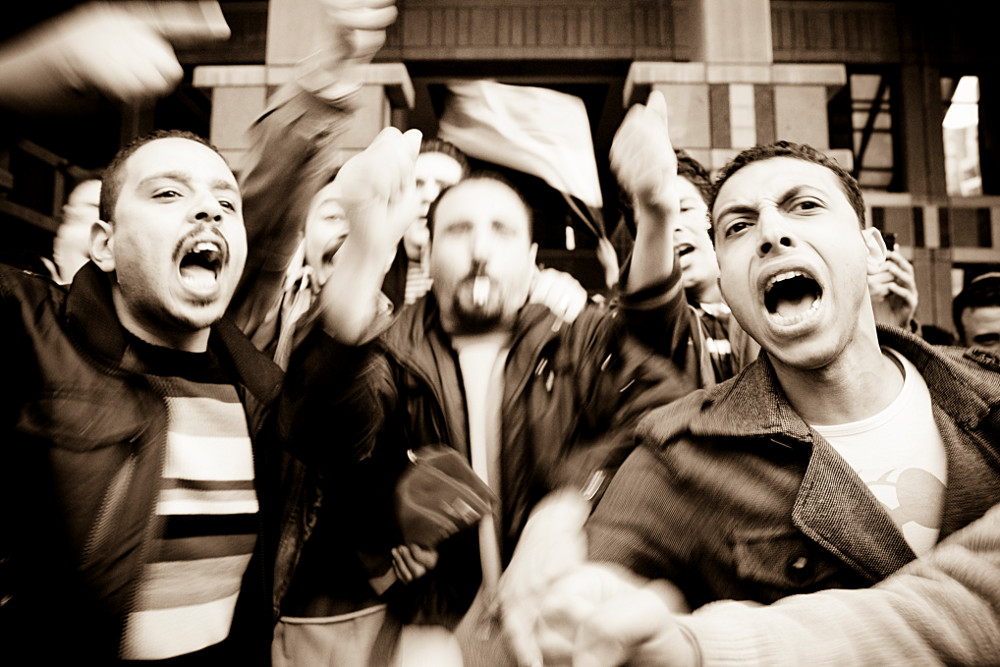
http://www.pbs.org/wgbh/pages/frontline/tehranbureau/2011/02/iran-live-blog-25-bahman-14-february.html
*Iran Standard Time (IRST), GMT+3:30* *5:15 p.m.* A series of tweets from CNN's Reza Sayah: Tehran witness - pockets of crowds along Enghelab Ave. chant "death to the dictator" Tehran witness: Clashes at Imam Hossein Square - protesters chant "Death to dictator" Tehran witness: Clashes in front of Tehran U - sec forces fire tear gas and paint balls *5:05 p.m.* More reports coming in of Isfahan protests, and now confirmation of protests in Kermanshah, as well. Estimates<http://www.radiofarda.com/content/f7_tehran_25th_bahman_demonstration_last_news/2308799.html>in those two cities and Shiraz are of thousands of participants. And we've confirmed from multiple sources that tear gas was indeed used in Tehran's Valiasr Square to disperse protesters. Additional clashes are being reported there. Hafte Tir Square has also been taken over by security forces like Azadi Square and protesters are finding it difficult to navigate through. Thousands are silently marching on Enghelab Avenue toward Azadi Square. Clashes are breaking out along the route, with protesters being beaten by security forces, but the silent march continues. *4:40 p.m.* Al Arabiya is also reporting that Mousavi and Rahnavard have joined the protesters. Here's an image they've published from the streets of Tehran today: [image: 25BahmanAlArabiya.jpg] People are now chanting, "Ya Hossein, Mir Hossein" in Enghelab Square in Tehran, where we have a report that ten people have been arrested. Rahe Sabz reports that some protesters have also gathered in Imam Hossein Square. @Persianbanoo tweets that a large crowd has also gathered in front of Amir Kabir University. Clashes are reported from Jamalzadeh, 16 Azar and Rudaki Avenues. Al Jazeera English is reporting that protesters are marching quietly and calmly toward Azadi Square, but that the "entire square is filled with police" and it is unclear what will happen when the protesters arrive. Here's an (effectively) audio-only version of the report: http://www.youtube.com/watch?v=6hXXn2r-72I&feature=player_embedded We have confirmed reports of protests in Shiraz. According to one source, "Thousands of protesters have filled Mullah Sadra Avenue and there is not an inch to spare. People are simply standing. No chants, not a lot of activity. Just thousands of protesters standing in silence. Security forces are standing close to the people, but there are no clashes." And immediately another source reports that there are clashes now. Protesters are being beaten and security is trying to disperse them. There are also unconfirmed reports of protests in Tabriz. http://www.marxist.com/some-egyptian-lessons-for-iranian-revolutionaries.htm Some Egyptian lessons for Iranian revolutionaries<http://www.marxist.com/some-egyptian-lessons-for-iranian-revolutionaries.htm> Written by Hamid Alizadeh Monday, 14 February 2011 [image: Print]<http://www.marxist.com/some-egyptian-lessons-for-iranian-revolutionaries/print.htm#> *Contrary to what the bourgeois media claim, revolutions are not made by individual agitators or small groups. They are made by the mass of people and they are prepared for years by the decay of the old system which is no longer able to take society forward. On the other hand, when a society is ripe for revolution, that is, when all the contradictions have accumulated to a critical degree, a small force can play a large role in the events that are about to unfold.* <http://www.marxist.com/images/stories/egypt/Feb_13_Oil_and_Gas_Workers_on_Strike-3arabawy.jpg> [image: 13 February, oil and gas workers on strike. Photo: 3arabawy] Last week the New York Times carried a very interesting article, called "Wired and Shrewd, Young Egyptians Guide Revolt", where the methods used by the organizers of the first Egyptian demonstrations at the end of January are highlighted. Although we do not agree with many of the political points made in the article, it serves to highlight the very effective methods used by the organizers to mobilize a mass force. These lessons must be studied by all honest Iranian revolutionaries who today enter a crucial day where demonstrations have been called in 35 cities around the country. For Marxists a serious attitude towards methods, demands and organization is crucial to facilitate victory and at the same time to assure the least amount of casualties in the process. In Egypt, just like Iran, society has been ripe for revolution for some years. Eruptions have occurred in all parts of the country, like when 55,000 tax collectors struck in 2007 or when 27,000 workers at Misr Spinning and Weaving struck for a week in the same year and won an all-out victory. Without a revolutionary part, however, to channel and generalize these struggles and to give them a national character, they have remained isolated to certain areas and groups. The overthrow of Tunisian dictator Zine El Abedine Ben Ali, was a great impulse and inspiration for the Egyptian masses. In that moment of ferment a small group of 15 courageous activists managed to play a key role in utilizing the momentum to organize the first demonstrations. A Facebook revolution It is a well-known myth that the Egyptian revolution was supposed to have been a true "Facebook-revolution". But what the article in the New York Times clearly shows is that web services such as Facebook, Twitter and GoogleChat are powerful tools, but that they cannot replace physical mobilisation and organisation. The group organizing the movement got in into contact through these mediums and used them to leak false information in order to deceive the security forces, but when it came to organizing and mobilizing the group were physically present. For the day of the first demonstration the group had reportedly sent activists to more than 50 different locations in Cairo from where different demonstrations were to start and to move towards Tahrir Square. At the same time the official starting point of the demonstration was announced on the Internet to be a completely different place in order to deceive the security forces. Democratic and social demands It is clear that the main demands of the revolution up until now have been democratic. The slogan of Down with Mubarak could unite all social forces in Egyptian society while at the same time give a clear and concrete goal for the movement. The demand for overthrow is an utmost necessity within a democratic mass movement, not only to achieve democracy, but also to mobilize the masses. Especially in a country such as Egypt or Iran people understand that a movement that does not remove the despot will be met with bloody retaliation. But at the same time the activists in Egypt discovered the value of social demands in mobilizing the working and poor masses. The article in New York Times explains: "The day of the protest, the group tried a feint to throw off the police. The organizers let it be known that they intended to gather at a mosque in an upscale neighbourhood in central Cairo, and the police gathered there in force. But the organizers set out instead for a poor neighbourhood nearby, Mr. Elaimy recalled. Starting in a poor neighbourhood was itself an experiment. We always start from the elite, with the same faces, Mr. Lotfi said. So this time we thought, lets try. They divided up into two teams one coaxing people in cafes to join them, the other chanting to the tenements above. Instead of talking about democracy, Mr. Lotfi said, they focused on more immediate issues like the minimum wage. They are eating pigeon and chicken and we are eating beans all the time, they chanted. Oh my, 10 pounds can only buy us cucumbers now, what a shame what a shame. The result was overwhelming; it revealed the forces that were waiting to explode within the working masses. One of the interviewed in the article explained: Our group started when we were 50. When we left the neighbourhood we were thousands. As the protests broke up that day, she said, she saw a man shot to death by the police. Preparations Although the activists of the group admit that they had underestimated the poorer parts of the population, it is clear that these activists weren't newcomers. They had a professional attitude to the demonstration and did not simply rely on *calling on the masses to come out*. They put actions behind their plans and ideas and left as little as possible to chance. In the week leading up to the demonstration they had a sustained stepping up of the campaign on the Internet and even made preparatory demonstrations in the poor neighbourhoods where they were not confident of support for their demonstration. Again the article explains: The night before the Friday of anger demonstration planned for Jan. 28, the group met at the home of Mr. Elaimy while Mr. Lotfi conducted what he called a field test. From 6 to 8 p.m., he and a small group of friends walked the narrow alleys of a working-class neighbourhood calling out for residents to protest, mainly to gauge the level of participation and measure the pace of a march through the streets. And the funny thing is, when we finished up the people refused to leave, he said. They were 7,000 and they burned two police cars. The role of these preparations have been crucial the demonstrations that could have ended in a bloodbath if the vanguard of the movement, the youth, had been isolated without the protection of a mass movement. At the same time the demonstrations, the biggest ones being on Fridays after Friday prayers, would start at different mosques in quieter areas and from there walk towards the main arteries of Cairo where security forces would be more concentrated. Plan for a sustained campaign In contradiction to what messrs Mousavi and Karroubi seem to imply, single day protests have proven to be much less effective than a sustained campaign where momentum is built up. One day demonstrations can only be used to measure ones forces and send a signal throughout society, while a serious offensive to change society requires a plan for a sustained campaign that is constantly stepped up. This fact is confirmed by the most successful demonstrations in Iran in the year of 2009. The first one was on the 17th June (25 Khordad), and came on top of a month long election campaign that mobilized thousands. The other was on the day of Ashura, where power virtually slipped onto the streets after a week of mobilizations (mainly because the events coincided with the death of Ayatolla Montazeri). In Egypt and Tunisia too we saw that it was a sustained campaign of mass actions that laid the foundation for the overthrow of Mubarak and Ben Ali. While carefully calculating important factors such as fatigue, the organizers of the demonstrations did not have illusions in one day demonstrations. The article explains that "The organizers disseminated a weekly schedule, with the biggest protests set for Tuesday and Friday, to conserve their energy." Although it does not appear to have been the plan, the 18 days of demonstrations in Egypt were connected with a constant stepping up of the struggle. This fact played a very big role. Like an army in battle, revolutions need to be on the move. Stagnation or standstill can lead to disorientation and in the end loss of vital morale. Therefore, besides having a clear and concrete revolutionary program it is important constantly to have a plan for stepping up the struggle and drawing in new layers of society. In the end what was crucial and gave the final push in both Tunisia and Egypt was the drawing in of the working class as an organized force with strike action. This is an important lesson for Iranian revolutionaries that must use the momentum and impulse of demonstrations to prepare and organize a general strike. The need for a leadership The Egyptian revolution has many lessons for serious revolutionaries, in this article we have chosen only to cover a small part of all this. The activists who ignited the movement in Egypt did indeed have some excellent ideas and methods. Especially their methods helped overcome a major problem that we face in Iran on how to gather a core of thousands before a crackdown. But at the same time the group had some shortcomings. Firstly, one weakness of the activists was the lack of a clear programme linking democratic and social demands in order to draw in all layers of society and to work against the propaganda of the regime who, at times with some luck, portrayed the movement as a group of people only trying to make chaos with no particular aim. Secondly, and most importantly, the group did not manage to give the movement an organized expression. In order to enforce the excellent preparations that they had made, to widen and strengthen the scope of the movement and to make it more representative, they should have worked towards setting up organizing committees in all neighbourhoods and factories and link them up on a local and national basis. This would allow for a much greater mass of people to participate in the movement and give it a far less chaotic character. At the same time such an organization would allow the masses to develop a leadership and give it a concrete representative force. It is a virtual fact that, had such a force been present in Egypt it could have overthrown Mubarak and taken power, based on the support of the majority of the people, on several occasions since the beginning of the movement. Instead the movement was faced with at least one occasion in the evening of Sunday the 6th February where disorientation and loss of morale seemed to be spreading through some layers of the masses, creating a dangerous situation where reaction could have made a bloody comeback. The revolution, however, was saved many times by the heroic acts of especially the hardest core of the movement who lost many martyrs to defend it. Also finally, although the masses had power in their hands, they did not know what to do with it and it thus slipped through their fingers and into the hands of the army. The main problem of the Egyptian, Tunisian and Iranian revolutions are, and have been and will continue to be, the lack of a revolutionary party and leadership that has studied past struggles and drawn the necessary conclusions. This fact gives the revolutionary processes a more chaotic and protracted character and at the same time will require more sacrifices from the masses. But it is not our task to laugh or weep over this fact, but merely understand that it is our historic task to build and temper this leadership amidst the raging flames of the revolution. It is not an easy task, but it has never been easier. History is on our side, the forces of reaction are historically weak and the masses are rising for struggle. We have full trust in the youth and the workers and their ability to take their destiny in their own hands. Forward until victory! [Non-text portions of this message have been removed] ------------------------------------ --------------------------------------------------------------------------- LAAMN: Los Angeles Alternative Media Network --------------------------------------------------------------------------- Unsubscribe: <mailto:[email protected]> --------------------------------------------------------------------------- Subscribe: <mailto:[email protected]> --------------------------------------------------------------------------- Digest: <mailto:[email protected]> --------------------------------------------------------------------------- Help: <mailto:[email protected]?subject=laamn> --------------------------------------------------------------------------- Post: <mailto:[email protected]> --------------------------------------------------------------------------- Archive1: <http://www.egroups.com/messages/laamn> --------------------------------------------------------------------------- Archive2: <http://www.mail-archive.com/[email protected]> --------------------------------------------------------------------------- Yahoo! Groups Links <*> To visit your group on the web, go to: http://groups.yahoo.com/group/laamn/ <*> Your email settings: Individual Email | Traditional <*> To change settings online go to: http://groups.yahoo.com/group/laamn/join (Yahoo! ID required) <*> To change settings via email: [email protected] [email protected] <*> To unsubscribe from this group, send an email to: [email protected] <*> Your use of Yahoo! Groups is subject to: http://docs.yahoo.com/info/terms/