http://www.marxist.com/egyptian-army-manoeuvres-against-worker-protests.htm
 Egyptian army manoeuvres in attempt to cut across worker
protests<http://www.marxist.com/egyptian-army-manoeuvres-against-worker-protests.htm>
Written by Fred Weston Tuesday, 15 February 2011
[image:
Print]<http://www.marxist.com/egyptian-army-manoeuvres-against-worker-protests/print.htm#>
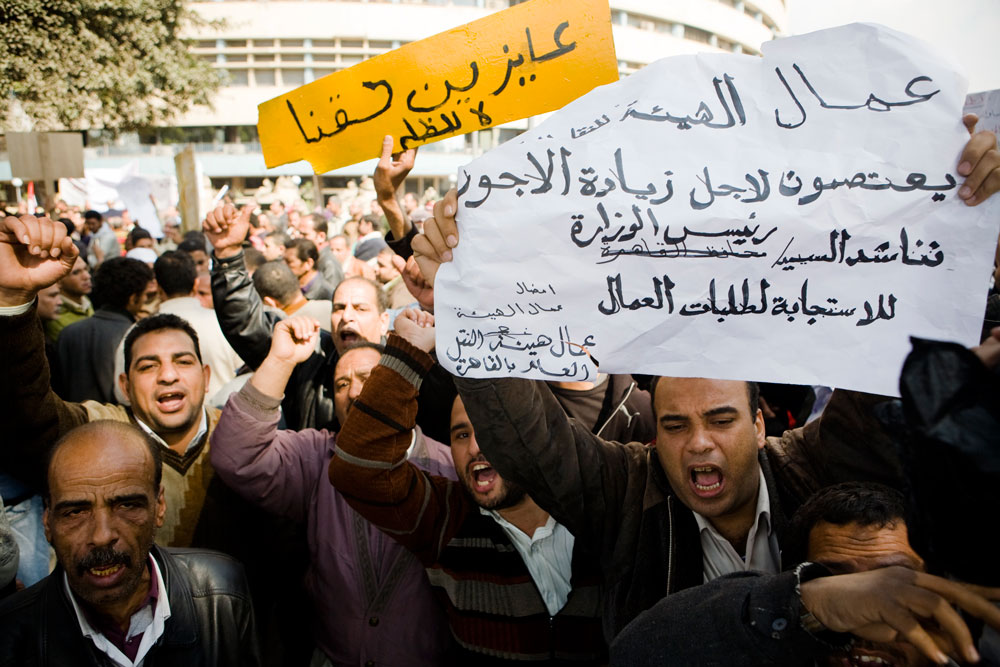
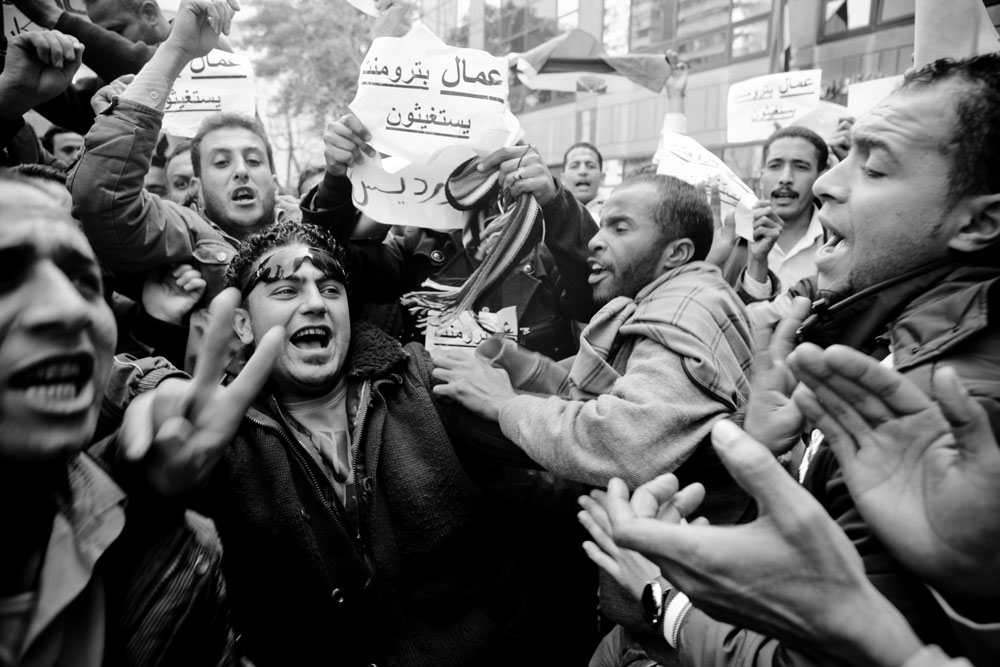
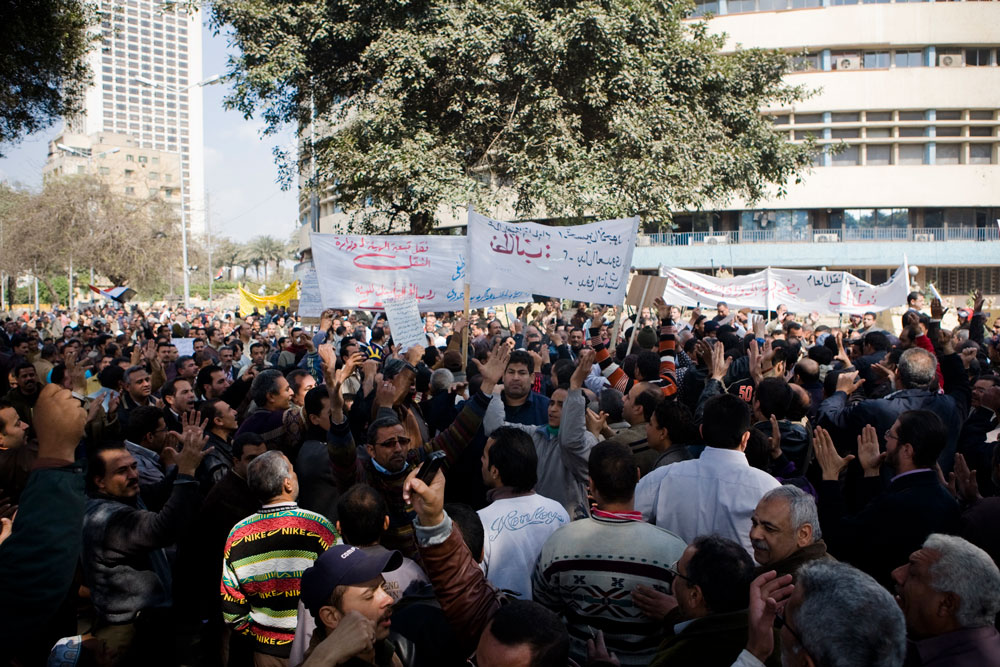
The Egyptian military top brass have taken over the running of the country and, while they are promising a transition to democracy at some stage, they are more concerned in the short term about what they see as chaos and disorder. That is, not just the rallies that have gripped all of Egypts major cities, but something far more dangerous in their view, the growing strike wave. <http://www.marxist.com/images/stories/egypt/Feb_14_public_transport_workers-3arabawy.jpg> [image: 14 February, public transport workers on strike protesting outside Ministry of Interior. Photo: 3arabawy] According to latest reports, thousands of public sector workers, including ambulance drivers and transport workers, are out protesting for better wages and conditions. Even the ordinary police have been affected by this new mood of worker militancy. Around 200 of them have been out demonstrating, demanding better pay. Oil and gas workers have been protesting, as have the workers in the national steel industries, as well as in textiles, telecoms, railways, post offices, banks, oil and pharmaceutical companies. Even the workers in the tourist industry held a protest near the Great Pyramids. Hundreds of bank workers rallied outside a branch of the Bank of Alexandria in Cairo. They were demanding that their bosses step down. As a result Tarek Amer resigned as chairman of the state-owned National Bank of Egypt, the countrys biggest commercial bank. This came after angry workers stopped him from reaching his office. So big has the strike wave been among the bank workers that the military declared Monday a bank holiday, hoping thus to defuse the strike movement. Military considered banning strikes In response to this wave of worker militancy, according to an Al Jazeera report, Egypt's military leaders yesterday were reportedly preparing to ban strikes and act against chaos and disorder in an attempt to restore order in the country following weeks of protests that led to the overthrow of President Hosni Mubarak. A military source said the Supreme Military Council would issue an order on Monday [February 14] that would ban meetings by labour unions or professional syndicates, effectively forbidding strikes, and would tell all Egyptians to get back to work. (Al Jazeera, 14 February 2011) According to the same report: Earlier in the day, pro-democracy protesters in the square said they had been told by the army to leave or face arrest. Meanwhile, the army ordered Al Jazeera and other international media outlets to stop filming in the square. This gives a clear indication of what the army is now trying to do. This is what is meant by a controlled transition to democracy. As Al Jazeera's James Bays, reporting from Cairo, said, I think the military is concerned that this could turn into a series of protests across the country. If that happened, the only way they could stop them would probably be to use force. And if they use force, that would end the respect and the legitimacy the army has in the eyes of the ordinary people. That is already beginning to happen now, as the masses see what the army chiefs are doing. They feel that the revolution could slip out of their hands and into those of the men of the old regime, unless they actively intervene to stop this from happening. That also explains why the military had to step back from its planned ban on strikes. In this we see how the army Supreme Council, together with the bourgeois opposition leaders are concerned that the fall of Mubarak is unleashing class forces that go beyond the mere demands for democracy. We have to remember that for the workers, democracy means greater rights, such as the right to organise, to assembly and to strike. These rights the workers yearn for in order to be able to fight for better wages and conditions. Precisely because these minimum democratic rights are the basic conditions that allow workers to express themselves and to organise freely, they are not prepared to delegate all powers to the military chiefs. Let us not forget that this is the same military that served Mubarak well during his 30-year dictatorship. Just as the workers do not trust the military, the Generals look with concern at the role the Egyptian working class has been playing. When it became clear that Mubarak was attempting to manoeuvre to remain in power, in spite of the mass protests shaking the country, the workers in the factories decided it was time to make their presence felt. The Generals understand full well that what gave Mubarak the final push was when the workers began to organise *as a class* and started to come out on strike, in some cases taking over their workplaces. But workers will resist <http://www.marxist.com/images/stories/egypt/Feb_14_Oil_and_Gas_Workers_on_Strike_2-3arabawy.jpg> [image: 14 February, striking oil and gas workers staging a protest. Photo: 3arabawy] Now those same workers will not be satisfied with mere promises for some form of transition to democracy. They are pressing all their social and economic demands. That explains the wave of strikes that is gripping the country. Workers want better wages, better working conditions, healthcare, pensions, decent housing. These are actually the problems that were at the root of the revolution itself. Ironically for the Egyptian bourgeois, it was the very economic success story of Egypt that has led to this situation. The working class of Egypt has been enormously strengthened by the boom of the past decade. Since 2003 Egyptian GDP has been growing by an average of 5.5% per year, some years even reaching more than 7%. This has meant the opening of many new factories. And this in turn increased the size and weight of the working class. However, economic booms do not necessarily benefit all classes equally. There was a growing social polarisation, which sooner or later had to lead to a confrontation between the classes. This explosion had been coming for some time. In the past few years we have witnessed in Egypt the biggest strike wave since the end of Second World War. We have reported on this in recent years, as for example in Egypt: The victory of Mahalla workers exposes the weakness of Mubaraks regime<http://www.marxist.com/egypt-victory-mahalla-workers041007.htm>(by Frederik Ohsten and Francesco Merli, October 4, 2007 and Unprecedented strike wave of Egyptian workers<http://www.marxist.com/strike-wave-egyptian-workers-solidarity230407.htm>(by Jorge Martin, April 23, 2007). We have consistently explained that this growing worker unrest would sooner or later lead to revolution. This has now come, and having gained a feel of their own power the workers are not going to simply go back to work as if everything has now been sorted, simply because Mubarak is no more. Army officers fill power vacuum The problem we have in Egypt is that as the revolution unfolded a power vacuum opened up, one in which the workers emerged very powerful, but through lack of a conscious and organized party of their own, they were not able to fill that vacuum. On the other hand the ruling bourgeois elite could not hold the movement back, and thus into this vacuum has stepped the military. How has this been possible? How is it that the very generals of the Mubarak regime have been able to take on this role? The answer to that can be found in the way the revolution unfolded. All revolutions in history have had an impact on the army, those bodies of armed men, as Engels described them. Bertold Brecht, in his famous and oft-quoted poem, "From a German War Primer", wrote the following: General, your tank is a powerful vehicle; It smashes down forests and crushes a hundred men; But it has one defect: It needs a driver. ( ) General, man is very useful; He can fly and he can kill; But he has one defect; He can think. These lines highlight the dilemma faced by the chiefs of the Egyptian military during the mass uprising that started on January 25. Millions of workers, men and women, and youth came out onto the streets, encouraged by what had happened in Tunisia just a few days previously. Tunisia showed that the most despotic of dictators can be overthrown once the masses move decisively. Once such a mass movement begins it starts to have an impact on the young men who make up the states repressive apparatus. In normal times the fear of being disciplined by higher ranking officers holds the army together, under the tight control of the supreme commanders at the top. To disobey orders means to be severely punished. However, this control breaks down when ordinary soldiers see their brothers and sisters, mothers and fathers, friends and neighbours, pouring out onto the streets in protest. They start to think! Soldiers are trained and educated with idea that their role is to defend the motherland and its people. They are not educated with the idea that their task is to shoot at their own people. When a revolution breaks out, therefore, the army comes under immense pressure. On the one hand it is the army of the bourgeois state and is therefore called on to defend bourgeois order. On the other hand it is made up of mainly young men who come from the same classes as the people on the streets, and thus they come under pressure to fraternise with the masses. Fraternisation This is what we saw during the Egyptian revolution. On January 28 when the masses were out on Tahrir Square the news bulletins reported that the army had been sent into the square. Initially the generals may have had the illusion that that may have been the end of the movement. But that was not possible as we very quickly found out as soon as images of Tahrir Square hit our TV screens. The soldiers went into the square waving at the crowds, hugging and kissing the protestors. They told the people in the square that they were there to protect them. Rather than the army taking over the square, the people took over the army! They fraternised, in the same way we have seen in revolutions throughout history. This explains why the army chiefs issued the statement that the army would not shoot on the people. The fact is that if the officers had given orders to shoot they would have faced a revolt in the ranks, not just of the rank and file soldiers but also of many low and middle ranking officers and even some higher up. The army would have fragmented along class lines and the revolution would have gone much further than it has done so far. If anyone wants proof of this it is sufficient to quote one report: On 4 February, the day of the most terrifying police/thug brutality in Tahrir Square, many commentators noted that the military were trying to stop the thug attacks but were not being very forceful or aggressive. Was this a sign that the military really wanted the protesters to be crushed? Since then, we have learned that the military in the square were not provisioned with bullets. The military were trying as best they could to battle the police/thugs, but *Suleiman had taken away their bullets for fear the military would side with the protesters and use the ammunition to overthrow him*. (Why Egypts Progressives Win<http://www.jadaliyya.com/pages/index/586/why-egypts-progressives-win>, published in *Jadaliyya*) [Our emphasis] The following report, Egypt army to shoot commanders?<http://www.presstv.ir/detail/164525.html> * *that appeared in Press TV on February 10, confirms Suleimans fears. It reports one activist in Egypt as saying I think some of them (the army personnel) might join [the] protesters. We have heard some of the officers and soldiers saying if we receive an order to shoot people, we would shoot whoever issued the order." When on February 2, Mubarak sent in his hired thugs, the aim was clearly to beat back the revolution, intimidate the revolutionaries and shift the balance of forces back towards the regime. Instead it had the opposite effect. Had the regime attempted to use the army to crush the people, it would have collapsed that same day and the army chiefs would have been finished as well. But what were the army doing on February 2? The army chiefs were clearly collaborating with Suleiman. The order was not to interfere, thus allowing the pro-Mubarak thugs to get into the square and attack the anti-Mubarak protestors. The ordinary rank and file soldiers in the square, on the other hand tried to defend the people, but as the above quoted report indicates they could do very little. In the end the people pushed back the reactionary thugs and the following day the protest gathered even more steam as ordinary Egyptians were enraged by the scenes of violence and came out in support of the revolution in even larger numbers. The fact that the ranks of the army sympathised for the revolution meant that the generals could not use the troops as they wished. They had to hold back their own forces for fear of these fragmenting in their hands. Thus to hold the army together and intact they were forced to appear to be with the people. That explains the slogans about the people and the army as one hand and so on. Many believed the army was genuinely on their side. Double game of top officer caste However, it was also clear to the most advanced layers that the army chiefs were playing a double game, issuing statements that the peoples demands were safe in their hands, while at the same time not moving decisively against Mubarak. However, in the end, to maintain the authority of the army, the Supreme Council was forced to push Mubarak out. The army command was thus able to exploit the genuine sympathy of the ranks of the army to raise their own authority among the people. They thus pretended to be with the people and for democracy. But we mustnt forget that these men stand at the head of the army of the state of Mubarak. Mubarak has gone, but his state apparatus remains intact. We must remember that in the final analysis the bourgeois state is made up of special bodies of armed men whose task is to defend the ruling class and its property. In the conditions created by the revolutionary uprising of the Egyptian people, the best way for the army tops to continue to play this role was to pretend to be on the side of the people, i.e. not to completely expose the real role of the military. Faced with such a situation, US imperialism stood by powerless to intervene. They had not foreseen the possibility of such a revolutionary movement and were taken completely by surprise. In reality they waited to see what would happen, to see how powerful the movement would turn out to be. Once it became clear to them that the movement was unstoppable, and that even the army could break up with large sections going over to the revolution, they suddenly became democrats and discovered the rights of the Egyptian people. They proclaimed that Egypt was a sovereign nation that had to decide on its own fate. Not quite what they were saying just a few weeks earlier. Until the masses rose up, Mubarak was a friend of America and a guarantor of stability in the region. But as each day passed it became clear that Mubarak had become a liability and thus the calls from Obama for a transition to democracy became stronger. They realised that in order to get people off the streets and the country back to some kind of normality, Mubarak had to go. The United States provides large sums of aid to Egypt, mostly in the form of military aid to be spent on equipping the army. Many Egyptian officers have been trained in the United States and have direct links to the US military. No doubt these links will have been used to get the message across. As we have pointed out in previous articles, Mubarak was not under pressure solely from the US but also from the despotic regimes in the region. Whereas Obama was making calls for a transition, leaders like the King of Saudi Arabia had other ideas. They understood that the fall of Mubarak could turn out to be the beginning of their own downfall. That explains why, according to a report that appeared on the Bikyamasr website: In a surprise move, the Saudi Arabian government announced it is looking into matching the United States estimated $1.3 billion in military aid given to Egypt annually in an effort to alleviate American pressure on the Egyptian army. (Saudi may match US military aid to Egypt <http://bikyamasr.com/wordpress/?p=26475>, Feb 10th, 2011) The Saudi regime was trying to stop the unstoppable by literally buying the Egyptian army. The problem was that the revolution was moving on and to have listened to the advice of the Saudi monarch would have meant the situation slipping out of the hands of the Egyptian military top brass. Military elites direct business interests <http://www.marxist.com/images/stories/egypt/Feb_14_public_transport_workers_2-3arabawy.jpg> [image: 14 February, public transport workers rally. Photo: 3arabawy] The Egyptian military elite is a part of the ruling class, not solely as loyal serving soldiers but also as active players in the economy. As The Independent commented on Saturday, the Egyptian military, commands a sprawling economic empire that produces a vast array of military and civilian goods and services, none of which appears in the national budget. Close observers liken Field Marshal, Minister of Defence and now head of the Higher Military Council that took control of Egypt yesterday, Mohamed Tantawi, to the CEO of the largest corporate conglomerate in Egypt. In the mid 1980s the World Bank urged that military companies be sold to civilian interests as part of the broader privatisation programme, advice that was rejected out of hand. Since then the military economy has continued to expand. Paradoxically, it has itself benefited from the privatisation programme, with formerly state owned civilian enterprises being handed over to military control. Thus the Egyptian army chiefs have a direct stake in the situation, both as defenders of the state and as owners of a significant part of the economy. Formally speaking the Supreme Council of the army has been given its powers to govern directly by Mubarak. In that sense there is a continuity of power within the same regime. The fact that they have decided to keep Mubaraks ministers in office is confirmation of this. On Sunday they dissolved parliament and suspended the constitution. No one will be too concerned about the dissolution of parliament as it was a farce in any case, the result of fraudulent elections back in October. The constitution also is not of much concern as it was that of a dictatorial regime. What people are starting to get concerned about is whether the military are not preparing to impose a clampdown on the movement. Mubaraks prime minister, the ex-General Ahmed Shafiq, has indicated that his first priorities are "peace and security" and measures to prevent "chaos and disorder". The answer to peoples concerns has come very quickly. As Robert Fisk pointed out in Mondays The Independent: ...hundreds of Egyptian troops many unarmed appeared in Tahrir Square to urge the remaining protesters to leave the encampment they had occupied for 20 days. At first the crowd greeted them as friends, offering them food and water. Military policemen in red berets, again without weapons, emerged to control traffic. But then a young officer began lashing demonstrators with a cane old habits die hard in young men wearing uniforms and for a moment there was a miniature replay of the fury visited upon the state security police here on 28 January. Different layers within the movement In this we have to understand that the protest movement that led to the overthrow of Mubarak has different layers and different wings within it. Those who made the revolution and guaranteed that its first demand was met the removal of Mubarak were the workers, the youth, the women, fighting on the streets. No political party has led this movement. Now, however, there will be no shortage of individual and groups claiming to represent the people. The movement will see a divide between those who want to go to the very end and make sure this revolution sweeps away every vestige of the old rotten Mubarak regime and those who will try to moderate the protests and channel them along safe lines. To appease the masses and get them off the streets, the army has promised free and fair elections under a revised constitution. However, it has given no clear commitment of when this would be; simply stating that it would be in charge "for a temporary period of six months or until the end of elections to the upper and lower houses of parliament, and presidential elections". Google executive Wael Ghonim and blogger Amr Salama recently met the army chiefs to, "understand their point of view and lay out our views," as they themselves explained in a note on one of the pro-democracy websites that helped launch the revolt. They said the military council vowed to rewrite the constitution within 10 days and put it to a referendum within two months, in line with the protesters' demands for democratic change. Ghonim and Salama reassured activists that the only purpose of the meeting with the Supreme Council of the armed forces was to protect and legitimise the demands of the Revolution of January 25. This is the kind of talk that is aimed at getting the masses off the streets and the workers back in their workplaces. It is the talk of people whose sole aim is some form of bourgeois democracy. But the workers, mean and women, the youth, the downtrodden poor want more than that. In reality the same old regime is still there, barely dressed in democratic clothing. The reason for its newly discovered love of democracy is that it has to tread very carefully. The balance of class forces is enormously weighed in favour of the workers and youth. The bodies of armed men in the lower ranks are still infected by the revolutionary fervour of the past few weeks. Therefore the people at the top have to use cunning and subterfuge. They promise a new constitution, democratic elections, but not immediately of course. They need time to consolidate their grip on power. If there are to be democratic elections they need to form bourgeois parties that can continue to defend the interests of the same ruling class that backed Mubarak for 30 years. In the coming period there will be a jostling for positions among all the bourgeois politicians, who will be trying to establish some form of credibility among the masses. All of them will be democrats of course. Mubaraks hated National Democratic Party will disappear, as all its members abandon it like rats jumping off a sinking ship. They will change their clothes and reappear in some other form. They will discover that they were never really with Mubarak and had always desired democracy. We have seen this before many times in history. After the collapse of Mussolini in 1943-45 many ex-fascists recycled themselves as Christian Democrats. In Spain we saw the same happen with former Franco supporters reappearing as Popular Party leaders. In Nigeria back in 1998 the hated Abacha was assassinated and the generals then proceeded to hand over to civilian rule one year later in the elections. The man who won the 1999 elections was an army general who had been dictator in the 1970s. In all these cases we saw dictatorships removed under the pressure of the mass movement, only to see power taken up again by representatives of the same class that had ruled through the dictatorship. Democracy was granted to the masses, while the economic interest of the ruling elite remained intact in essence this was a counter-revolution in democratic form. Masses feel their own strength The problem in Egypt is that Mubarak tried to hold on to power to the bitter end in spite of the fact that the imperialists were telling him it was better he should go. By doing so he further radicalized the masses and strengthened the mass movement. Now the masses feel strong after overthrowing the despot. As we have said, it was the entry onto the scene by the working class in the last few days of the Mubarak regime that finally pushed the military to remove the dictator. The conditions existed and still exist for the masses to take power. Had a call for a general strike led to the actual organization of such a strike, combined with student occupations and a conscious appeal to the soldiers to side with the masses, no force could have stopped the revolution from going all the way. If committees had been elected in all the workplaces, neighbourhoods, universities and high schools, and army barracks, and if these were linked up on a national level this would be the basis for an alternative power in the country. We saw how people took over Tahrir Square, with the same happening in other cities. We saw workers beginning to take over their workplaces. In embryonic form this was the power of working people emerging. However, the revolution has not gone so far yet. This is due to one factor, the lack of an independent mass party of the working class. That explains why we saw so much improvisation and spontaneity. This was all very good in terms of getting the masses involved and out on the streets. It achieved the objective that united everyone, the removal of Mubarak. But once he was gone, the lack of an organised workers party became very apparent. The question of who is to govern the country is posed. That is why the military can play the role of arbiter, pretending to stand above all classes. What opens now is a new period in Egyptian history, one in which the working class will press all its demands, while the bourgeois attempt to strangle the revolution. The military will not be able to destroy all the gains of the revolution. The workers have been emboldened and will press on building their own organizations, as they are doing with the trade unions. On the other hand the bourgeois will reorganize themselves on the political front, pushing forward all kinds of individuals and party who will claim to stand for the interests of all Egyptians. The point is that whoever forms a government in the future, on a capitalist basis will not be able to solve the pressing problems, of unemployment, low wages, bad housing and so on. That flows not from the Mubarak regime although it compounded the problems but from the capitalist nature of the economy. The same wealthy elite will continue to have control over the economy. What is required is a complete break with the bourgeois regime and that means expropriating the wealth of the big capitalists, starting with the clique around the Mubarak family itself. For this to be possible the Egyptian workers require a Marxist revolutionary leadership like that of the Bolshevik party in Russia in 1917. But such a party must be built and before that can happen the Marxists must get organized as a tendency within the Egyptian labour movement. Such a tendency could begin the task of providing that analysis and programme that the workers of Egypt so urgently need. [Non-text portions of this message have been removed] ------------------------------------ --------------------------------------------------------------------------- LAAMN: Los Angeles Alternative Media Network --------------------------------------------------------------------------- Unsubscribe: <mailto:[email protected]> --------------------------------------------------------------------------- Subscribe: <mailto:[email protected]> --------------------------------------------------------------------------- Digest: <mailto:[email protected]> --------------------------------------------------------------------------- Help: <mailto:[email protected]?subject=laamn> --------------------------------------------------------------------------- Post: <mailto:[email protected]> --------------------------------------------------------------------------- Archive1: <http://www.egroups.com/messages/laamn> --------------------------------------------------------------------------- Archive2: <http://www.mail-archive.com/[email protected]> --------------------------------------------------------------------------- Yahoo! Groups Links <*> To visit your group on the web, go to: http://groups.yahoo.com/group/laamn/ <*> Your email settings: Individual Email | Traditional <*> To change settings online go to: http://groups.yahoo.com/group/laamn/join (Yahoo! ID required) <*> To change settings via email: [email protected] [email protected] <*> To unsubscribe from this group, send an email to: [email protected] <*> Your use of Yahoo! Groups is subject to: http://docs.yahoo.com/info/terms/