Video-Massacre in El Salvador during Oscar Romero's funeral

http://www.youtube.com/watch?feature=player_embedded&v=EN6LWdqcyuc
--------------------------------------------
Archbishop Romero minutes after he was shot celebrating mass at a small
chapel located in a hospital called "La Divina Providencia" at around 6:30pm
on March 24, 1980.
*"Learn from History", 31st Anniversary of the Assassination of Archbishop
Oscar Romero*
*Read the newly released documents below:*
http://www.gwu.edu/~nsarchiv/NSAEBB/NSAEBB339/index.htm
---------------------------------------
http://www.marxist.com/el-salvador-assasination-of-archbishop-romero.htm
El Salvador: The Assassination of Archbishop
Romero<http://www.marxist.com/el-salvador-assasination-of-archbishop-romero.htm>
Written by Alan Woods Thursday, 25 March 2010
[image:
Print]<http://www.marxist.com/el-salvador-assasination-of-archbishop-romero/print.htm>[image:
E-mail]<http://www.marxist.com/component/option,com_mailto/link,aHR0cDovL3d3dy5tYXJ4aXN0LmNvbS9lbC1zYWx2YWRvci1hc3Nhc2luYXRpb24tb2YtYXJjaGJpc2hvcC1yb21lcm8uaHRt/tmpl,component/>
[image: Bookmark and Share] <http://www.addthis.com/bookmark.php?v=20>
<http://www.marxist.com/images/stories/el_salvador/franco_folini_-_romero_mural.jpg>
*On the night of March 24, 1980, Archbishop Oscar Arnulfo Romero was shot
through the heart by killers, carrying out orders that came straight from
the reactionary oligarchy that rules over the country. He was killed because
he was giving voice to the needs of the oppressed. To this day justice has
not been done and the masses are still waiting.*
While it is clear that our Church has been the victim of persecution during
the last three years, it is even more important to observe the reason for
the persecution... The persecution comes about because of the Church's
defence of the poor, for assuming the destiny of the poor.
"A church that suffers no persecution but enjoys the privileges and support
of the things of the earth - beware! - is not the true church of Jesus
Christ. A preaching that does not point out sin is not the preaching of the
gospel. A preaching that makes sinners feel good, so that they are secured
in their sinful state, betrays the gospel's call."
"When the church hears the cry of the oppressed it cannot but denounce the
social structures that give rise to and perpetuate the misery from which the
cry arises." (Archbishop Oscar Arnulfo Romero, March 11,1979)
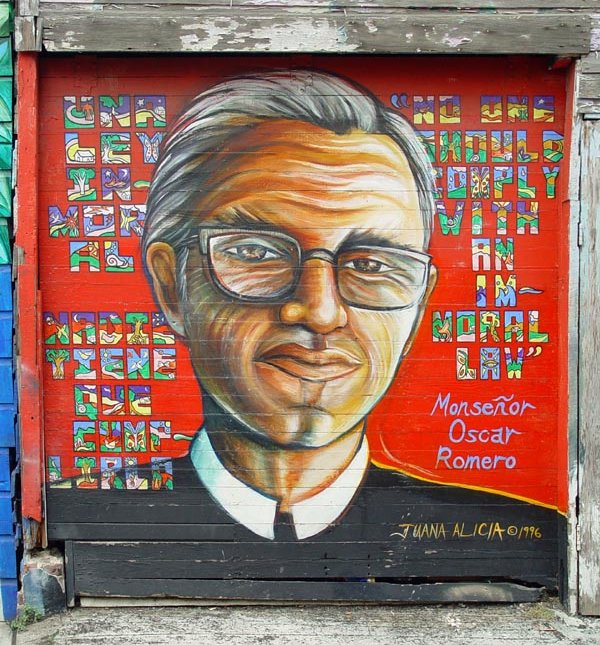
[image: Romero on a San Francisco wall. Photo by Franco
Folini.]<http://www.marxist.com/images/stories/el_salvador/franco_folini_-_romero_mural.jpg>Romero
on a San Francisco wall. Photo by Franco Folini.On the night of Monday March
24, 1980, Archbishop Oscar Arnulfo Romero was shot through the heart as he
was saying a memorial mass for a friend's mother. He died within minutes. On
March 23, 1980, the day before his death, he directly addressed the
country's soldiers in his weekly sermon, pleading, "In the name of God, in
the name of these suffering people whose cries rise to heaven more loudly
each day, I implore you, I beg you, I order you: Stop the repression."
The masses reacted angrily to the assassination. During the archbishop's
funeral services, a bomb exploded outside the cathedral in San Salvador, and
government troops then opened fire on the crowd of 50,000 who had gathered
there to pay their last respects. An estimated 40 people died and another
200 were wounded.
One day after the assassination an accusation was made of direct Cuban
involvement. But there was no question of the Cubans being involved in the
killing of the archbishop. Everybody knows who is responsible for the
murder. It was the work of the right wing reactionaries who shortly
afterwards in 1981 founded the ARENA party, set up by Roberto D'Aubuisson,
who had previously been the founder and leader of El Salvador's notorious
death squads, who personally called for Romero's murder.
The report issued in 1993 by the UN Truth Commission on El Salvador states
unambiguously:
"There is full evidence that former major Roberto D'Aubuisson gave the order
to assassinate the Archbishop and gave precise instructions to members of
his security service, acting as a death squad, to organize and supervise the
assassination."
The Archbishop was a highly popular and outspoken critic of the military
that ruled this Central American nation with an iron rod. Romero came to be
known for his courageous public denunciations of the atrocities committed by
the military in the turbulent years before El Salvador's bitter civil war.
His memory is revered by the masses of workers and peasants in El Salvador
and in all Central America. On the occasion of the 30th anniversary (March
23, 2010) of this brutal political murder, the people of El Salvador took to
the streets to celebrate the memory of this brave man.
The assassination of Monseñor Romero took place in the context of a
revolutionary situation, in which power was within the grasp of the workers
and peasants. The 1970s was a period of mass mobilizations. The workers and
peasants of El Salvador were fighting for a better life. Unfortunately, the
Communist Party (PCS) did not give the necessary lead. Instead of placing
itself at the head of the masses, basing itself on the programme of the
proletarian revolution, the leaders attempted to win over the progressive
bourgeoisie and even the army. This false policy led many revolutionary
youth to join the guerrilla organizations.
Thousands joined the ranks of mass left wing organizations like the BPR,
FAPU, LP-28, UDN y MLN, which were led by guerrilla organizations which
preached armed struggle. This reaction of the most revolutionary section of
society was entirely understandable. Counterrevolutionary violence had
racked El Salvador for many months. Workers, peasants, trade unionists and
priests were regularly arrested, tortured, killed or simply disappeared.
Romero himself had recently written to President Carter asking him not to
supply more military aid to the ruling junta until it succeeded in stopping
this. Naturally, his pleas fell on deaf ears.
The Theology of Liberation
El Salvador was, and still is, dependent on the USA, which takes most of its
exports and also is the source of remittances form a large number of migrant
workers. Like most other Central American countries, it is a backward,
mainly agricultural economy, with semi-feudal relations on the land, which
is dominated by a handful of wealthy big landowners (latifundists). The big
landowners and capitalists form a reactionary bloc, the oligarchy, which has
dominated the countrys economic and political life for generations.
Power in El Salvador is in the hands of a small and wealthy oligarchy, which
has maintained its rule through organized state terror. There was already a
growing atmosphere of tension and violence over the course of the 1970s,
which finally broke into open civil war. The ferment in society inevitably
found its reflection in the lower ranks of the Catholic Church, among the
rank and file priests who were working in close contact with the poor and
oppressed. Out of this ferment arose the movement that became known as the
Theology of Liberation.
There was nothing in Romeros early career in the Church to suggest that he
would die a martyr for the cause of the poor. He started off as a
conservative and a supporter of the right-wing Catholic organization, Opus
Dei. But, as Lenin once pointed out, history knows all kinds of
transformations. People can and do change. It would be a very bad state of
affairs if they did not!
Camillo Torres, a former Colombian priest who took up arms and was killed,
once declared:
"I have cast off the priest's habit in order to become a real priest. It is
the duty of every Catholic to be a revolutionary; it is the duty of every
revolutionary to carry out the revolution. The Catholic who is not a
revolutionary is living in mortal sin."
People like these are the worthy successors of those early Christian
revolutionaries who stood for the cause of the poor of the earth, the
sinners and the oppressed, and were not afraid to give their lives fighting
against oppression. They are the modern martyrs whose memory should be held
in respect by all who hold dear the cause of freedom and justice.
Between 1968 and 1978, over 850 priests, nuns and bishops were arrested,
tortured, murdered and killed in Latin America. The Salvadorian Jesuit
Rutilio Grande, before he was killed was quoted as saying: "Nowadays, it is
dangerous [...] and practically illegal to be an authentic Christian in
Latin America." The emphasis is on the word "authentic".
In 1968, Latin American Catholic bishops gathered at Medellin, Colombia.
They spoke of the "institutionalized sin" that afflicted and oppressed the
majority of people in Latin America, and they called the whole Church to
support the poor. At first, Romero wanted nothing to do with this. In fact,
for much of his earlier career, was politically conservative. He opposed
community-based pastoral projects that he felt were too radical and
protected the status quo.
In February 1977 Romero was named archbishop of the archdiocese of San
Salvador, a choice that was opposed by the rank and file priests, but
enthusiastically welcomed by the right wing and the oligarchy, which saw in
Romero just the man they needed to purge the Church of communists. He was
specifically chosen because of his conservative views. Romero had the
confidence of the army chiefs and the oligarchy. He had publicly criticized
the progressive stances adopted by followers of Liberation Theology, which
was becoming a growing force.
A wave of agitation swept the country in 1977. There were strikes and
demonstrations, and the peasants occupied the landlords estates. On
February 28, just a few days after the elevation of Romero, a major protest
against election fraud ended in bloodshed when a crowd of protesters were
attacked by soldiers in the town square of the capital. Romero did not
intervene or protest.
Then, on March 12, 1977, something happened that would change his outlook. A
radical Jesuit priest, Rutilio Grande, was murdered together with a young
boy and a 72-year old layman. Father Rutilo, a priest from a humble peasant
background, had been a firm supporter of the Medellin line. He was a man who
Romero knew personally, and greatly respected, and he asked why there was no
official inquiry into these deaths. He wrote a letter to the President,
which shows a touching naivety:
Knowing the friendship that you have shown me, your ability and noble
personal sentiments, I do not doubt that you will satisfy these just demands
of an eminently Catholic people, while also saving your prestige from any
shadow of complicity.
Naturally, he got no reply. From that point forward Romero continued to ask
questions that embarrassed the wealthy elite that had supported him for
archbishop. These same people were either behind the violence that
maintained their positions, or at the very least, turned a blind eye to it.
On 1 July General Carlos Romero took over the government. He had been the
Armed Forces Minister in the Molina government and was probably himself
responsible for the murder of father Rutilio Grande. The wave of strikes and
occupations continued and grew stronger. The attempts of the government to
crush the movement through repression only increased the mood of militancy.
The workers and peasants frequently occupied churches to escape from the
police. In Easter 1978 the BRP occupied the Catedral. Monseñor Romero asked
the authorities not to intervene, arguing that, although he did not agree
with the occupation, the government left the workers and peasants no
alternative.
>From the pulpit, Romero relentlessly spoke out against the violations of
human rights and repression exercised by the soldiers and death squads. He
harshly criticized the far right, and promoted pastoral work in rural
communities and slum neighbourhoods. "Political power is in the hands of the
armed forces," Romero declared in a sermon just a month before his death.
"They use their power unscrupulously. They only know how to repress the
people and defend the interests of the Salvadoran oligarchy."
Romero spoke for those who had no voice. He had the only uncensored voice in
San Salvador: a small radio station that broadcast the names of people who
were missing. A man would be taken off and never heard from again, and his
family would ask a priest for help in finding him. The archbishop's
attention would be drawn to such cases and he demanded answers. He began to
pester the authorities on a regular basis, asking why people were arrested,
where they were, and what was happening to them.
In May 1979, Romero presented the pope with seven dossiers filled with
reports and documents describing assassinations, disappearances, and human
rights abuses in El Salvador. At the same time, the revolutionary ferment in
society continued to grow and this further radicalised the archbishop. In
January 1980, the different mass organisations of the workers, peasants,
students, etc, formed a united Coordinadora Revolucionaria de Masas (Mass
Revolutionary Coordinating Committee) and called for a demonstration on
January 22, on the anniversary of the revolutionary uprising of 1932. This
was the largest ever demonstration in the history of the small country, with
up to 300,000 taking part and which was met with harsh repression. This was
followed by a series of general strikes.
Romero strongly condemned repression and even talked about the legitimate
right to insurrectionary violence on the part of the masses. In an
interview given on February 2 he said:
Christians are not afraid to struggle, they know how to fight, but they
prefer to speak the language of peace. However, when a dictatorship
seriously undermines the human rights and the common well-being of the
nation, when it becomes unbearable and all channels to dialogue are
closed... when this happens, then the Church speaks of the legitimate right
to insurrectional violence. To fix the date of the insurrection, to
determine when all channels for dialogue are closed, this is not the task of
the Church. But I warn the oligarchy: open your hands, give away your rings,
because a time will come when your hands will be chopped off.
His analysis of the economic and political situation in El Salvador also
became sharper, clearer and thus more revolutionary. It is worth quoting at
length from an interview he gave to *Prensa Latina* on February 15:
The cause of all our malaise is the oligarchy, this small nucleus of
families which do not care about the people going hungry, but on the
contrary, they rely on it for a plentiful supply of cheap labour to reap
their crops and export them. Industrial companies, national and foreign,
base their competition in the world market on the wages of hunger and that
explains their stubborn opposition to any reforms and to the trade union
organisations which seek to improve the conditions of the people. This
oligarchy cannot allow for the workers and peasants to become organised in
trade unions because they consider this as a threat to their economic
interests. For this handful of families, repression against the people is
needed in order to maintain and increase their profits, even if it is at the
expense of the growing poverty of the working classes.
However, the concentration of wealth and property also means the
authoritarian character of social, economic and political power, without
which it is not possible to keep their privileges, even at the cost of human
dignity. In our country, this is the root of the repressive violence, and in
the last instance, is the main cause of our social, political and economic
underdevelopment.
The Armed Forces are charged with guaranteeing the interests of the
oligarchy and with defending the political and economic structure under the
pretext that this is in the interest of national security. All those who
disagree with the State are declared as enemies of the nation, and with the
excuse of national security, the most despicable crimes are justified. All
is done to defend the interests of the oligarchy, an all powerful oligarchy,
which completely despise the people and its rights.
This was too much! The right-wing politicians and the oligarchy that they
represented became angry at this constant interference, which was even more
infuriating because it came from a man who they had trusted. They now saw
him as a traitor and a dangerous subversive. They needed to silence this
irritating voice. And silence it they did.
Murderers unpunished
Romeros murderers have never been caught and punished. But that is only one
case. There are tens of thousands of other cases, all well-documented. For
more than a decade the army, security forces and death squads linked to them
committed massacres, sometimes of hundreds of people at a time. Throughout
the years of armed conflict against the guerrilla forces of the Farabundo
Martí National Liberation Front (FMLN), the Salvadoran security forces and
paramilitary death squads were responsible for massacres, killings, torture
and "disappearances" on a massive scale.
The war left 75,000 dead and another 7,000 "disappeared," while an estimated
one million Salvadorans fled the violence by seeking refuge in other
countries. Among those murdered by the army and death squads were 18
Catholic priests and five nuns, four of whom were from the United States.
The UN "Truth Commission" produced a report that gives detailed examples
based on extensive testimony and investigation, responsibility for some of
the worst and most widespread violations of human rights in El Salvador
between 1980 and July 1991. The document makes interesting reading and
brings to light many facts about the horrific atrocities perpetrated by the
Salvadorian oligarchy. It states, for instance:
1. Jesuit Priests: The Commission found that in November 1989, several
members of the Salvadoran Army high command ordered the murder of the
Jesuits. Officers at the military academy organized the killings. Elements
of the army Atlacatl battalion murdered the six priests, their housekeeper
and her young daughter; then attempted to leave evidence falsely implicating
the rebel FMLN.
2. El Mozote: The Commission finds that the army killed over 200 people in
El Mozote, including women and children in 1980. It cites former Atlacatl
battalion commander Col. Domingo Monterrosa Barrios and Col. Natividad de
Jesus Caceres Cabrera, a major at the time of the massacre. The Commission
also cites Supreme Court President Mauricio Gutierrez Castro for improper
interference in the judicial proceedings concerning the investigation of the
massacre.
3. Archbishop Oscar Arnulfo Romero: The Commission finds that Major Roberto
D'Aubuisson ordered the assassination of the Archbishop and that Army Capt.
Eduardo Avila and former Capt. Alvaro Saravia, as well as Fernando Sagrera
played an active role in the assassination. The Commission further finds
that the Supreme Court of El Salvador played an active role in impeding the
extradition from the United States of Capt. Saravia.
In order to present a balanced case, the document then goes on to blame
the FMLN guerrillas for acts of violence:
4. Assassinations of Mayors by the FMLN: The Commission finds that the
General Command of the FMLN approved the killing of civilian mayors and that
the People's Revolutionary Army (ERP) of the FMLN was responsible for the
killing of at least eleven mayors. The Commission cites ERP commandantes
Joaquin Villalobos, Ana Guadelupe Martinez, Mercedes del Carmen Letona,
Jorge Melendez, and Marisol Galindo for having responsibility for the
executions.
In broad terms, the Commission finds the FMLN responsible for having
committed "grave acts of violence". The Commission calls on the FMLN to
renounce forever all forms of violence in the pursuit of political ends.
However, the document says that *the vast majority of abuses studied by the
Commission were committed by members of the armed forces or groups allied to
them*.
Is that not clear? The *vast majority of abuses* were committed by members
of the armed forces or groups allied to them, i.e. the death squads. And if
that is the case (we do not doubt that it is) how can we put on the same
level the small number of abuses committed by the insurgents with the *vast
majority* of murders and other crimes committed by the state?
The role of US imperialism
The document continues:
The Commission also is concerned that Salvadoran exiles living in Miami
helped administer death squad activities between 1980 and 1983, with
apparently little attention from the U.S. government. Such use of American
territory for acts of terrorism abroad should be investigated and never
allowed to be repeated.
Everyone knows that the United States was intervening actively and
aggressively in Central America throughout this period. In Nicaragua in 1979
the Sandinista revolutionary movement overthrew the oppressive regime of
Anastasio Somoza, whose family had ruled the country since the 1930s.
Washington immediately began to undermine the revolutionary government in
Managua, launching a vast operation of military, economic and diplomatic
aggression.
Throughout the 1980s, US imperialism waged a bloody war against the people
of Nicaragua and El Salvador as part of Reagans global war against
communism. It poured billions of dollars into these dirty wars, in which
terrorism, political murders, torture, kidnapping and disappearances were
common occurrences. Romero denounced the involvement of the U.S. government,
which sent billions of dollars in military aid to the Salvadoran government
during the civil war, as well as providing training for the country's armed
forces. Major D'Aubuisson, the notorious founder of the death squads in El
Salvador, was a graduate of the School of the Americas, a U.S. military
college specializing in counter-insurgency.
Just weeks before his death, the archbishop sent a letter to then U.S.
President Jimmy Carter, in which he wrote, "You say that you are Christian.
If you are really Christian, please stop sending military aid to the
military here, because they use it only to kill my people." The letter was
never answered.
There is nothing new or surprising here. US imperialism regards El Salvador,
and the whole of Central and South America as its back yard, and sees itself
as the owner of this important piece of real estate. And like any
responsible owner, it needs a guard dog to keep an eye on its property day
and night. That guard dog must be fierce and not afraid to bite. It is
called the Salvadorian oligarchy, which maintains a big repressive
apparatus, the army, the police, the intelligence services, the prison
warders, the torturers and hired assassins.
These individuals are linked by a thousand links to the CIA and US
imperialism. They are trained to kill and torture in places like Miami. To
request that this should not occur is like asking the owner of the yard to
dispense with his guard dog, to which he will reply with an ironic smile: I
will get rid of my guard dog when you can assure me there are no burglars in
this neighbourhood!
The authors of the report shake their heads in disapproval, like a
schoolmaster rebuking a troublesome pupil. They shake their finger at
Washington and ask it politely never to do such things again. But the US
imperialists are not impressed by such sermons. They have serious interests
to defend, and they will defend them with serious methods. The people of
Iraq and Afghanistan know all about these methods, which are being utilized
right now.
Terror is an instrument of war. It is a necessary feature of any war,
because the sole objective of war is to make the enemy submit to your will.
Where the enemy is far more numerous than your side, the use of terror
becomes even more necessary. That was the case in El Salvador, where a tiny
and parasitic oligarchy was surrounded by a sea of discontented workers and
peasants. It is the case in Iraq and Afghanistan, where the occupying forces
are heavily outnumbered by a hostile population.
The imperialists use terrorist methods against the masses in occupied
countries. The masses of those countries use terrorist methods to defend
themselves and drive out the foreign enemy. The terrorism of the Resistance
is crude, unsophisticated and frequently unsuccessful. The terrorism
employed by the imperialists is highly sophisticated, backed by vast sums of
money, and equipped with the latest resources of science and advanced
technology. The latter always kills many more people than the former.
The Ten Commandments inform us that we must not kill. But the whole history
of the world shows us that governments have never paid the slightest
attention to the Ten Commandments. And we doubt very much if they will pay
any attention to the moral lectures contained in this report.
Reconciliation?
*The Commission finds that death squads, often operated by the military and
supported by powerful businessmen, land-owners and some leading politicians,
have long acted in El Salvador and remain a potential menace*. The
Commission received testimony on more than 800 victims of death squads. This
problem is so serious that the Commission calls for a special investigation
of death squads in order to reveal and then put an end to such activity. The
Commission is especially concerned by the close relation between the
military, hired assassins and extremists within the Salvadoran business
community and some affluent families, who resorted to killing to settle
disputes.
Now we come to the most important point. Having established the existence of
a vast number of murders and other abuses committed by the forces (both
official and unofficial) of a state at war with its own people, the
question arises: *what is to be done about all this*? This is not a
secondary question, because if adequate measures are not taken now to
identify, arrest and punish the guilty parties, it can never be sure that
the same crimes cannot be committed in the future. The state must be
thoroughly purged of all those who, directly or indirectly, participated in
crimes against the people. What does the Commission propose?
This brings us to a very negative side of the document. As one could expect
from the UN, it has not a single atom of class content, and it presents the
civil war in El Salvador in hypocritical moralistic terms. It *condemns
violence in general*, without bothering to analyze the concrete content of
this violence. It deplores the fact that there was violence, but it never
tells us why there was violence, and who was the aggressor and who the
victim. In other words, it puts the victim and the aggressor on the same
level.
If a woman is attacked on the street by a man who tries to rape and murder
her, and the person concerned fights back in order to save her life, can we
condemn them both, as if the violence practiced by the rapist and the
violence that the victim is obliged to use in legitimate self-defence was
the same thing? No reasonable person would say so. But that is just what the
UN document attempts to do. It says, for instance:
It is the Commission's hope that a more just El Salvador will arise from
the ashes a war* in which all sides were unjust*. This is the kind of
hypocrisy that serves to disarm the poor and oppressed in the face of their
oppressors. *All sides were unjust*! As if the violence of the oppressed
slave who fights to defend himself against the masters whip could be put on
the same level as the violence of the slave owner!
Forgiveness also is indispensable, the UN document informs us. Then,
immediately contradicting itself, it says: The abuses and the pain
inflicted on tens of thousands of people in El Salvador will not and should
not be forgotten.
Can we expect Justice?
All this is clear enough for anybody and nobody will be surprised by it.
But, as we have said, the question that arises is: *what is to be done*?
The Commission feels justice demands punishment for the violations of human
rights. But it is not itself constituted to specify sanctions and recognizes
that the present Salvadoran judicial system is incapable of fairly assessing
and carrying out punishment. Therefore the Commission feels it cannot
recommend judicial proceedings in El Salvador against the persons named in
its report until after judicial reforms are carried out.
We are naturally in favour of any reform of the legal and judicial system
that tends to make it more democratic and more responsive to the needs and
demands of the populace. However, in the case of El Salvador, this would
mean sacking almost the entire judiciary, and putting many of the judges on
trial for complicity in war crimes! Such a judicial reform would have many
implications and could only be carried out as part of a revolutionary
reconstruction of society a total change from top to bottom.
The Commission's report noted that with regard to the Romero case, the
Salvadoran government had violated numerous international agreements on due
justice. The report further recommended
"that the State carry out a complete, impartial, and effective judicial
investigation, expeditiously, so as to identify, try, and punish all the
perpetrators, both the direct perpetrators and the planners of the
violations established, notwithstanding the amnesty decreed."
Every worker and peasant knows that the judiciary is part of the bourgeois
state, that it is composed of individuals drawn from the ranks of the rich
and powerful, that, despite all the hypocritical show of impartiality, it
is by no means impartial, and, in the last analysis, will always defend the
interests of the rich minority against the poor majority. That is the case
even in the most advanced and democratic countries. In El Salvador the
situation is a lot clearer still.
The Commission further ruled that "a state cannot rely on the existence of
provisions of internal law to elude carrying out its obligation to
investigate human rights violations, place on trial the persons responsible,
and prevent impunity." But that is precisely what the state in El Salvador
has done. The very same year the report was released, an amnesty law was
passed by the legislative assembly, which was then controlled by ARENA, the
party that was behind all the atrocities perpetrated by the army and the
death squads.
Occasionally, the ruling class will make a gesture towards justice in
order to revive the illusion in the minds of the people that the state is
impartial, and that justice will always win in the end. It may even
sacrifice certain individuals who served it in the past, but in whom they
have lost interest. Such was the case of former Salvadoran Air Force Captain
Alvaro Saravia, who was found guilty of planning Romero's murder together
with other former military officials.
Saravia had emigrated to the United States when an investigation into his
role in the assassination began. In 1987 he was detained by U.S. authorities
when Salvadoran prosecutors sought his extradition. But the Salvadoran
government and judicial system moved quickly to have the request withdrawn,
under the pretext that there was not enough evidence to lay charges, and
Saravia was set free in 1988.
Archbishop Romero's surviving family his two brothers, now in their 70s
eventually turned to the U.S. courts, filing a civil suit against Saravia in
the state of California under the Alien Tort Claims Act and the Torture
Victim Protection Act, which allow foreign nationals to be tried in the
United States for crimes committed abroad.
Saravia was ordered to pay $10 million in damages by a U.S. federal court
judge in the state of California. Saravia did not appear in court, and was
tried and sentenced in absentia. Although his exact whereabouts are unknown,
it is assumed he is still in the United States
On March 15, 2009 the people of El Salvador won a historic victory. With the
election of Mauricio Funes, the candidate of the Frente Farabundo Marti para
la Liberacion Nacional (FMLN), for the first time, the left formed a
government. Funes said he would favour the poor and the excluded. That is
very good, but it is necessary to translate words into deeds.
The people of El Salvador are determined to find out the truth, to put an
end to impunity and cover-up, and to obtain justice. The Salvadoran
Government has undertaken to conduct a full judicial inquiry to "identify,
prosecute and punish" all authors and instigators of the murder of Romero.
That was a step in the right direction, but it is far from sufficient. It is
necessary to rescind the scandalous 1993 Amnesty Act, which effectively
blocks any investigation into crimes committed during the civil war.
The murder of Archbishop Romero was a crime against the whole people. It was
a perfect example of the brutality and lawlessness of the ruling class, and
it cannot be sheltered by any law. For years the ARENA-led government hid
behind the amnesty law to avoid reopening the case. Its repeal is absolutely
necessary if the desire of the people for justice is to become a reality.
Now it has become fashionable to talk of dialogue, tolerance and
reconciliation. They talk of national reconciliation and reuniting the
Salvadoran family. The opponents of justice are never short of arguments.
"Reopening old wounds from the past would not be in the best interests of a
country looking towards the future." Reopening old wounds will do no good
to anybody. It will cause disunity, and so on and so forth.
But all this is just empty talk and hypocrisy. There is no family between
rich and poor. There can be no reconciliation between the oppressors and the
oppressed, between the exploiters and exploited, between the murderers and
the murdered. They talk of a democratic process, but what democracy can
there be when the same oppressive and corrupt oligarchy remains in control?
What justice can there be if three decades later, the murderers and
torturers are allowed to walk freely on the streets of San Salvador and
laugh in the faces of their victims?
The UN report says:
A national monument should be erected, listing the names of all the victims
of the war. A national annual holiday should be declared to remember the
dead and celebrate reconciliation. This report should be discussed and
analyzed at a national public forum in El Salvador.
That is all very well, but all this is merely skirting around the problem,
not tackling it at its roots.
It is very easy to take a serious issue, talk loudly about a solution, and
then reduce it to a farce by presenting symbols, in place of serious action.
That is just what we see here. This year there will be numerous
*official* *religious
and cultural activities* to commemorate the murdered archbishop. In 2005, on
the 25th anniversary of his assassination we saw the lighting of the eternal
flame outside the cathedral. This year the national congress agreed to
declare March 24 as Monseñor Romero Day, with the opposition of both ARENA
and the PCN.
Apart from eternal flames and cultural and religious activities, the
question that must be asked is: what concrete steps are being taken to bring
the murderers to justice? What concrete steps are being taken to purge the
army and the police of fascists, torturers and assassins? Until these
questions are answered, we can have no confidence that the events of the
past will not be repeated in the future. This is not a secondary question
for the people of El Salvador!
The election of an FMLN government was a big step forward. But it is not
enough to win an election. The government was elected by the people in order
to carry out a fundamental change in society. It is impossible to carry out
such a change while the main levers of political and economic power remain
in the hands of the reactionary oligarchy.
In the past the Stalinists defended the disastrous theory of two stages.
That is to say, the workers and peasants of El Salvador must not try to take
power, but must support the progressive bourgeoisie and limit themselves
to the fight for democratic demands. This argument was false from start to
finish. There is no progressive bourgeoisie in El Salvador, where the
landlord and capitalists constitute a reactionary bloc, standing in the way
of progress.
However, we agree that it is necessary to fight for democratic demands in El
Salvador, beginning with the most elementary demand: for the arrest and
punishment of all those responsible for atrocities against the people; for
the purging of the army, police and judiciary of fascists; for the trial and
punishment of all assassins and torturers.
These just and necessary demands will be supported by the overwhelming
majority of workers and peasants and resisted by might and main by the
oligarchy, which will see this as an attack on their power. This will mean a
serious fight. The reactionaries control the state. But the working class
and the peasants are the decisive majority of society. Once they are
organized and mobilized to change society, no force on earth can stop them.
Only a revolutionary socialist programme can offer a way out of this
impasse. The Marxist tendency represented by the BPJ offers just such a
programme. We are not utopians or anarchists. We understand that the fight
for socialism is not a single battle, but is composed of many struggles over
different issues. Only through the day-to-day struggle for different demands
including the most advanced democratic demands can the masses acquire
the strength and confidence to advance to the most decisive battle of all:
the conquest of political power.
The workers and peasants of El Salvador have already won an important battle
on the electoral front. Now they must ensure that this first victory leads
on to a decisive blow against the reactionary oligarchy. The struggle for
democracy, if it is a consistent struggle, can only lead to a struggle to
break the power of the oligarchy. That is to say, it can only lead to the
expropriation of the landlords, bankers and capitalists and the taking of
power by the working class, as the first step towards the victory of
socialism in El Salvador and in all Central and Latin America, which will be
a decisive step towards the victory of world socialism.
Home <http://www.marxist.com/> » The
Americas<http://www.marxist.com/americas/>» El
Salvador <http://www.marxist.com/el-salvador/>
[Non-text portions of this message have been removed]
------------------------------------
---------------------------------------------------------------------------
LAAMN: Los Angeles Alternative Media Network
---------------------------------------------------------------------------
Unsubscribe: <mailto:[email protected]>
---------------------------------------------------------------------------
Subscribe: <mailto:[email protected]>
---------------------------------------------------------------------------
Digest: <mailto:[email protected]>
---------------------------------------------------------------------------
Help: <mailto:[email protected]?subject=laamn>
---------------------------------------------------------------------------
Post: <mailto:[email protected]>
---------------------------------------------------------------------------
Archive1: <http://www.egroups.com/messages/laamn>
---------------------------------------------------------------------------
Archive2: <http://www.mail-archive.com/[email protected]>
---------------------------------------------------------------------------
Yahoo! Groups Links
<*> To visit your group on the web, go to:
http://groups.yahoo.com/group/laamn/
<*> Your email settings:
Individual Email | Traditional
<*> To change settings online go to:
http://groups.yahoo.com/group/laamn/join
(Yahoo! ID required)
<*> To change settings via email:
[email protected]
[email protected]
<*> To unsubscribe from this group, send an email to:
[email protected]
<*> Your use of Yahoo! Groups is subject to:
http://docs.yahoo.com/info/terms/