http://www.marxist.com/bailing-out-irish-banks-again.htm
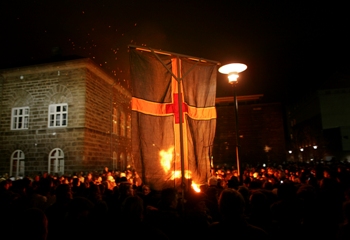
Bailing out the Irish Banks... again <http://www.marxist.com/bailing-out-irish-banks-again.htm> Written by Tony Healy Tuesday, 05 April 2011 [image: Print]<http://www.marxist.com/bailing-out-irish-banks-again/print.htm#> The announcement that the Irish banking sector needs another 24 billion, thats 24,000,000,000 in real numbers or another 5,500 for every Irish man, woman and child, is another sign of the capitalist crisis in the state. Standard and Poors one of the main international credit agencies has now downgraded Ireland by a further point. The democracy of Parliament is in short the democracy of Capitalism. Capitalism gives to the worker the right to choose his master, but insists that the fact of mastership shall remain unquestioned; Parliamentary Democracy gives to the worker the right to a voice in the selection of his rulers but insists that he shall bend as a subject to be ruled. The fundamental feature of both in their relation to the worker is that they imply his continued subjection to a ruling class once his choice of the personnel of the rulers is made... (James Connolly, Parliamentary Democracy, 1900) The state seems to be heading full steam for the rocks, a mere 6 weeks after FF walked the plank and Captain Enda lashed himself to the wheel. The fact that there was still a crisis wont be a surprise to anyone, but the scale of the problem is very significant. Lenihans pronouncement that AIB would need 34 billion (but it could be 46 billion) was seen as clear evidence of a government on the slide. But the new information from the Central Bank is part of a jigsaw that will become increasingly clear as the pieces fall into place over the next period. Fine Gael and Labour have come into power in the midst of an economic cyclone and the coalition will be a government of crisis from its inception. The same conditions that prevailed in the economy before the election still exist, but if anything the latest stress tests demonstrate that FF didnt give the full story when the bailout was negotiated at the end of last year. The price of houses is now reported to have fallen by 51% over the last three years, unemployment is still a huge issue and the has increased in value against the £ making exports more difficult and the lure of Newry more attractive for Irish shoppers. The increase in the price of oil, following on from speculation connected with the revolutions in the Middle East and North Africa, will have a big impact on the economy in Ireland, because of the heavy emphasis on trade and the remoteness of Ireland from the rest of the euro zone. The austerity measures implemented by FF and the Greens havent been reversed. Sure, there may be some tinkering at the edges, but the same pressures will be brought to bear on Michael Noonan and Enda Kenny as on Brian Cowen and Brian Lenihan. The bosses want their pound of flesh and it wont be long before the knives are out, particularly for the public sector. Despite the protestations of Eamon Gilmore and the view among the right wing of the Labour Party that Labour needed to be in government to defend the working class, it is very unlikely that Labour will be able to stem the tide. The changes in the figures for reductions in the public sector workforce in the Programme for Government might sound promising, but it has to be borne in mind that the shifting sands and turbulent currents in the economy and internationally make any deal very tenuous in the extreme. Labours left argued that a principled opposition was better than a sorry compromise with Fine Gael and that position should gain ground over the next period. But it will only gain support if it develops a clear class alternative to the National Government position of Gilmore. Ideally, the United Left Alliance can play a significant role in that process, but there is a risk that the ULA will fail to develop into a significant force as a result of sectarian baggage. Ireland has a significant tradition to the left of Labour, but it is fragmented and weak. There is no equivalent of the Spanish Izquierda Unida, the German Die Linke or the Greek Synaspizmos. The ULA organises around a handful of individuals. The battles against austerity in Ireland will be fought by trade union members and young people. Sooner or later that pressure will be reflected in the Labour Party also. To transform Ireland along socialist lines the workers of Ireland need to wrest control of their organisations from the bureaucrats and time servers, the careerists and the ideas of reformism. There are no short cuts. The crisis in Ireland will transform the consciousness of working people, time and time again. Its time to think big. ...But the freedom of the revolutionist will change the choice of rulers which we have to-day into the choice of administrators of laws voted upon directly by the people; and will also substitute for the choice of masters (capitalists) the appointment of reliable public servants under direct public control. That will mean true democracy the industrial democracy of the Socialist Republic. (James Connolly, Parliamentary Democracy, 1900) ---------------------------------------------------------- http://www.marxist.com/letter-on-icesave.htm Letter from Iceland on IceSave<http://www.marxist.com/letter-on-icesave.htm> Written by In Defence of Marxism Tuesday, 05 April 2011 [image: Print] <http://www.marxist.com/letter-on-icesave/print.htm>[image: E-mail]<http://www.marxist.com/component/option,com_mailto/link,aHR0cDovL3d3dy5tYXJ4aXN0LmNvbS9sZXR0ZXItb24taWNlc2F2ZS5odG0=/tmpl,component/> Share <http://www.facebook.com/sharer.php?u=http%3A%2F%2Fwww.marxist.com%2Fletter-on-icesave.htm&t=Letter%20from%20Iceland%20on%20IceSave&src=sp> In yet another turn of the IceSave saga, the people of Iceland are to vote on Saturday in yet another referendum on whether to accept collective responsibility for the debts of the failed Icelandic bank IceSave. We have received a following letter from a group of Icelanders which we republish here with our comments. [image: Protests that brought down government two years ago. Photo: Finnur Malmquist]<http://www.marxist.com/images/stories/iceland/mass_protests-bring-down-government-1.jpg>Protests that brought down government two years ago. Photo: Finnur Malmquist In December 2009, the Icelandic parliament attempted to saddle its people with the debts amounting to £3.6 billion, or £11,700 per Icelander to cover for IceSave deposits. The people of Iceland have since persistently refused to approve any plans by the Icelandic government to accept liability. We wrote about the sorry affair in detail<http://www.marxist.com/iceland-government-must-abandon-icesave-deal.htm>in January last year, arguing for a rejection of the proposed treaty. Since then, the Icelanders rejected the initial proposal and a new one has been reached with the UK and the Netherlands. We have not been able to study details of the new proposal but the principle involved is fairly clear. The UK and the Netherlands are both facing serious difficulties with their state finances and are having difficulties implementing the cuts that they see as necessary to balance the books. The latest demonstration of half a million workers and youth in London<http://www.marxist.com/britain-after-march-26-struggle-towards-general-strike.htm>shows precisely this. The bosses are asking the working class to pay for the crisis and the workers are beginning to fight back. Clearly the British and Dutch governments are trying to offload some of their own domestic problems on Iceland by making them cover the IceSave deposits. To this end they have bullied the island with anti-terror legislation, freezing of assets and other measures. This behaviour is disgraceful and only serves to plunge the Icelandic economy into further misery. The point that we made a year ago, before the last referendum, is that working class people must unite across borders against the austerity packages that the crisis have brought about. The crisis that we face is not a crisis of the banking system or a crisis of a particular nation state. It is not caused, as the Capitalist press would have it, by workers living beyond their means, whether in Iceland or in Britain. It is a global crisis of Capitalism. Therefore, the Icelanders can not put their trust in the European Union or any of the European governments. They are clearly prepared to take all kinds of austerity measures against their own population, never mind someone else's. The Icelanders would do right to refuse to repay this debt. They should make an appeal to the workers of Europe who will be sympathetic to such a stance, much more so than the heads of the European Union. The struggles against austerity in Greece, Ireland, France, Portugal etc. show that the people of Iceland are not alone. The letter below explains well how the British and Dutch governments are running roughshod over international law and treaties. It also explains some of the consequences of their actions and the proposed treaty that is to be voted on this coming Saturday. ------------------------------ An important letter about Icesave from Icelandic citizens to the president of EU A group of Icelandic citizens wrote the President of the EU the attached letter. In it we briefly went over the Icesave in present and past and ask the officials of EU and EFTA questions about the legal side of the contract, its precedent and the effects if present agreement will be rejected. The group that stands behind this letter has the common goal to stand against the plan to transport debts of private companies over to the common public. The letter is written with the purpose to draw attention to the Icesave dispute and the consequences it will have on the public of Iceland and its finances, to bear the debt that will follow if the Icesave contract will be agreed upon. The consequences do not only concern the Icelandic nation because if this contract will be forced upon us we have a precedents for all other nations in the world. Its not only the president of the EU that will get this letter. A copy has been sent to several officials within the EU and the EFTA, the concerning ministeries of the United Kingdom, the Netherlands and Iceland and additionally to both Icelandic and several foreign media. With regards on behalf of the group, Rakel Sigurgeirsdóttir Icelandic teacher in Reykjavík ------------------------------ *Reykjavik 18.03.2011* Mr Herman Van Rompuy President of the European Council European Council Rue de la Loi 175 B-1048 Brussels Belgium Dear Mr Van Rompuy, The Icelandic banks (90%) collapsed in autumn 2008 and with the banks Landbanki's subsidiaries in London and Amsterdam (the Icesave deposits). According to the principal rule of the European Economic Area Treaty, the concept of market equality is the basis of co-operation within the European Community as stated in the Agreement on the EEA Part I: Objectives and principles, article 2, item e: the setting up of a system ensuring that competition is not distorted and that the rules thereon are equally respected . (Highlighted by signatories) It is clearly stated that the principal rule of the EEU co-operation is to prevent distortion of competition. In this light, British and Dutch authorities were obliged to ensure that Landsbanki branches in London and Amsterdam had satisfactory securities from The Depositors and Investors Guarantee Funds within their own borders. If that were not the case, it would have been marketing distortion. The United Kingdom and the Netherlands unilaterally decided to make the Icesave deposits a political issue instead of a legal one. On that basis, they have demanded that Icelandic taxpayers pay the Icesave deposits which under EU regulations should have been covered by British and Dutch Depositors and Investors Guarantee Funds, as is clearly stated in European Economic Area treaty. The first reaction of the Icelandic government was that Iceland was being bullied and the Icesave dispute should be resolved in courts. The United Kingdom and the Netherlands refused but prior to that the British government had taken the unprecedented action to use anti-terrorism legislation against Iceland and Landsbanki. As a consequence, Kaupthing bank operations (Singer & Friedlander) in The United Kingdom were closed down and with it fell Icelands biggest bank. Due to these harsh actions taken by British and Dutch governments all flow of capital to and from Iceland was stopped. Iceland state finances were taken hostage by a foreign power. As a consequence, Iceland was forced to negotiate the Icesave deposits if the country was to get assistance from the International Monetary Fund. The IMF demanded that Iceland negotiated the Icesave deposits due to pressure from The United Kingdom, the Netherlands and the European Union countries. The current Icesave agreement can cost Iceland up to half of its state budget. If the Emergency law of October 2008 will not stand up in court of laws, the Icesave deposits will amount to double state budget. The people of Iceland have found it hard to accept being forced to pay for actions made by reckless and irresponsible bankers: burdens which according to EEA-regulations actually belong to British and Dutch Depositors and Investors Guarantee Funds as applied to fair and equal competition within the European Economic Area. The Icelandic nation will vote in a referendum on the latest Icesave-agreement on the 9th of April 2011. We refused to accept the last one in a referendum. We therefore feel compelled to get answers to the following questions before the referendum. 1. What is the moral value of an agreement between three parties (latest Icesave-agreement) where two parties (The United Kingdom and the Netherlands) force the third party (Iceland) to the negotiation table when the matter should be on the table of The Depositors and Investors Guarantee Funds in The United Kingdom and the Netherlands? 2. Why has Iceland not been able to defend itself in courts of law against British and Dutch claims? 3. In the light that Landsbanki had to apply to British law, why was the bank allowed to open saving accounts before it had made the necessary arrangements with the Depositors and Investors Guarantee Funds? 4. Did it not distort competition as Landsbanki was not obliged to make arrangements with the Guarantee Funds in The United Kingdom and the Netherlands? 5. Was the interest of British and Dutch consumers not looked after, as Landsbanki did not have to pay to the Guarantee Funds like its competitors? 6. Is the European Union going to let The United Kingdom and the Netherlands violate the principals of the EEA-treaty on equality of competition? 7. Is it in accordance with EU policy to let the taxpayers bear the burden when private banks go bankrupt? 8. Are Depositors and Investors Guarantee Funds of any country within the European Union strong enough to guarantee deposits in the case of (90%) banking collapse? 9. What will be the reaction of the European Union if the people of Iceland reject the latest Icesave agreement on the 9th of April 2011? Sincerely and with requests for good answers Ásta Hafberg, student business management Baldvin Björgvinsson, certified electrician, teacher Björn Þorri Viktorsson, supreme court attorney Elinborg K. Kristjánsdóttir, journalist, student Elías Pétursson, CEO Guðbjörn Jónsson, retired consultant Guðmundur Ásgeirsson, software developer Gunnar Skúli Ármannsson, cand med Haraldur Baldursson, technologist Helga Garðasdóttir, student Helga Þórðardóttir, teacher Inga Björk Harðardóttir, teacher, artist Karólína Einarsdóttir, biologist and teacher Kristbjörg Þórisdóttir, cand. Psych. Kristján Jóhann Matthíasson, retierd fisherman Pétur Björgvin Þorsteinsson,deacon, Evang.Lutheran Church Rakel Sigurgeirsdóttir, teacher Sigurjón Þórðarson, biologist Sigurlaug Ragnarsdóttir, bachelor of fine arts Steinar Immanúel Sörensson, ideologist Þorsteinn Valur Baldvinsson Hjelm, surveillance officer Answers and/or questions should be sent to Gunnar Skúli Ármannsson Cand. Med. Seiðakvísl 7 110 Reykjavík Iceland e-mail: [email protected] A copy of the letter has been sent to several officials within the EU and EFTA as to the ministeries of the United Kingdom, the Netherlands and Iceland to whom this case belongs. A copy has also been sent to several European newsmedia. Home <http://www.marxist.com/> » Europe <http://www.marxist.com/europe/> » Iceland <http://www.marxist.com/iceland/> [Non-text portions of this message have been removed] ------------------------------------ --------------------------------------------------------------------------- LAAMN: Los Angeles Alternative Media Network --------------------------------------------------------------------------- Unsubscribe: <mailto:[email protected]> --------------------------------------------------------------------------- Subscribe: <mailto:[email protected]> --------------------------------------------------------------------------- Digest: <mailto:[email protected]> --------------------------------------------------------------------------- Help: <mailto:[email protected]?subject=laamn> --------------------------------------------------------------------------- Post: <mailto:[email protected]> --------------------------------------------------------------------------- Archive1: <http://www.egroups.com/messages/laamn> --------------------------------------------------------------------------- Archive2: <http://www.mail-archive.com/[email protected]> --------------------------------------------------------------------------- Yahoo! Groups Links <*> To visit your group on the web, go to: http://groups.yahoo.com/group/laamn/ <*> Your email settings: Individual Email | Traditional <*> To change settings online go to: http://groups.yahoo.com/group/laamn/join (Yahoo! ID required) <*> To change settings via email: [email protected] [email protected] <*> To unsubscribe from this group, send an email to: [email protected] <*> Your use of Yahoo! Groups is subject to: http://docs.yahoo.com/info/terms/