http://www.marxist.com/azerbaijan-despite-repression-people-on-streets.htm
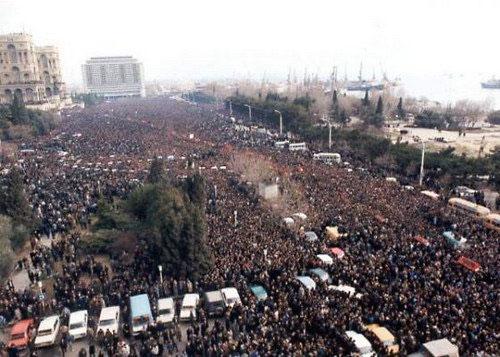
Azerbaijan: Despite repression people continue to come out on the streets<http://www.marxist.com/azerbaijan-despite-repression-people-on-streets.htm> Written by our correspondent in Azerbaijan Thursday, 14 April 2011 [image: Print]<http://www.marxist.com/azerbaijan-despite-repression-people-on-streets/print.htm#> *Inspired by the revolutionary movements in the Arab world the last few weeks have also seen protests in the Caucasus republic of Azerbaijan: against the elite in Baku, against the lack of genuine democratic rights and the violations of freedom of speech and against corruption.* [image: 13_feb_crowd_azerbaijan]<http://www.marxist.com/images/stories/asia/13_feb_crowd_azerbaijan.jpg>Azerbaijan was one of the most important sources of oil for the Soviet Union, even today the country is well known mainly for its rich oil resources. In spite of that, large sections of the population live in poverty. In Baku itself many people don't have warm water for the whole day; sometimes there is a shortage of gas and electricity. The country is one of the most expensive places in the world: rents are approximately as high as in central Europe, food prices even higher, while the average income is around 400 a month. The high level of corruption within the state is seen by many as being the reason for the unaffordable prices. Corruption is in fact rampant in Azerbaijan. Last year Transparency International ranked Azerbaijan as 134thout of 178 countries in its Corruption Perceptions Index, making it one of the most corrupt countries in the world. Also, elections never take place without some form of manipulation and rigging. President Ilham Aliyev basically inherited his position from his father Heydar Aliyev in 2002. The parliamentary elections of 2005 were just another example of rigged elections that have taken place here with ballot papers disappearing. There can be doubt that Ilham Aliyev could not have kept power otherwise. Political and economic power is one and the same thing. Many companies belong to the Aliyev clan. The YAP (New Azerbaijan Party) defends the interests of the new bourgeoisie which has evolved and enriched itself by looting former collective state owned property after the collapse of the Soviet Union. Since 1992 the conflict with bordering Armenia has remained unsolved. The reason for the dispute is Nagorno-Karabakh, a territory which both states claim as theirs and which was occupied by Armenia. That dispute and the ceasefire (not: peace!), which has lasted since 1994, serves the rulers to channel the rage of the people via warmongering and also to distract their attention away from the social problems. On the one hand the official propaganda is constantly reminding the people about the external enemy, while on the other hand depicting an idyllic picture of life in Azerbaijan. Huge national flags and portraits of the two presidents (sometimes both father and son) can be seen everywhere in Baku. Their politics is constantly praised in public meetings (attend them is, however, not always a free choice for the audience), and the state-controlled media spreads information which is useful to the ruling class. If we look at the question of freedom of the press and freedom of speech, we see that Azerbaijan is one of the least free states in the world. In 2009 the two bloggers Emin Milli and Adnan Hajizade were arrested because they posted critical comments on Facebook and videos on YouTube<http://www.youtube.com/watch?v=Aaecvg7xCIk&feature=related>. For their calls for democracy and their short videos both spent a year in prison. In the last few weeks the two reporters Ramin Deko and Seymur Haziyev were abducted and beaten up by men in civilian clothes (that one can presume belonged to the secret police). Because of the level of repression, so far protests have been confined to very few young people who are frustrated with the general situation, but under the surface of an apparent calm, discontent and social unrest is building up. Spring awakening and state violence Inspired by the movements in the Middle East and Northern Africa a Facebook call was launched for protests on March 11 under the slogan of the Great People's Day. Those who did not dare go onto the streets personally could express their sympathy with the March 11 protest on Facebook. Before the events unfolded, the activist Bachtiyar Hajiyev was arrested, officially because he had refused to do his military service. He was the only one of the organizers who is not living abroad. In prison he was tortured and threatened with rape. Also other activists were arrested before the demonstration. Jabbar Salavan was picked up by the police while he was distributing leaflets. He was accused of possession of drugs and sentenced to two months in prison. One activist was arrested for hooliganism, another one for acting rudely towards a lady on the street. It is common practise in Azerbaijan to arrest people with the excuse of an offence against public order in order to silence them. The propaganda in the official media helps the state repression to isolate activists. Bachtiyar was called a traitor to his nation. He was compared to the national hero Mubariz Ibragimov, a soldier who is celebrated for crossing the line of control in June 2010 and killing four Armenian soldiers. In a report of the state TV there is an allusion to Bachtiyar's surname: Anti-Chiyar, the last word is a vulgar expression for the male genitals. This is the appalling level of the criticism of people who don't support the regime! A TV-show invited Murad Isayev, a psychiatrist, who stated that the young people who call for protests on Facebook or Twitter wouldn't have any social life apart from the internet and that they suffered from mental disorders. Time for freedom! In spite of these conditions, 3,000 people expressed their solidarity with the March 11 protest on Facebook. Until the very end it was not clear where the demonstrations were going to take place. Only shortly before noon were people informed there would be one at the May 28 Square, and another at the Nizami shopping centre. Forty-three people were arrested, some of them surrounded by police and journalists for going in small groups onto the streets shouting Azadliq! (Freedom!). To carry out such an action while being fully aware that an arrest was not just possible, but likely to happen is something heroic, there can be no doubt about it. Amongst those arrested were also six young people who had just come out of a tea house nearby, which is a well-known meeting place for students and activists. And in spite of the harsh repression, around 300 people gathered again the following day, March 12. They assembled in the city centre at the Fountain Square. Again, fifty people were arrested. There were many policemen and they acted with brute force: while the state media claimed that people were slowly walked to the police cars, the truth is that people were beaten on the head and You-Tube videos show people being pulled roughly into cars by several policemen. Most of the protesters and of those who were in the wrong place at the wrong time were released on the same day; others were kept in jail for 7 or 8 days. However, all these attempt to scare the people failed, as the whole opposition called for another protest for April 2. This time the government chose another tactic: the assembly would be allowed, but on condition that it take place on the outskirts of Baku. The official explanation for this was that a demonstration in the city centre would endanger the citizens. Again, 17 activists were arrested in the few days leading up to the announced protest. Three of them were given prison sentences ranging from 5 to 10 days because of disturbing public order or resistance to the police. The trials were closed to the public. In spite of all this, the plan to gather at the Fountain Square was kept to. By noon the police had surrounded Fountain Square, and young people sitting in the cafés were told to leave. After a while nobody was allowed to enter the area. (In spite of these facts, later news.az was claiming that there was free access to the city centre for everybody.) First everything seemed calm apart from the huge crowd of policemen. Suddenly small groups of people started to shout Azadliq! (Freedom!) and Istifa! (Resign!) and this time it was not just youth activists, even pensioners were among them. In total, several hundred people took part in the protest. A precise number is hard to give, especially considering that there were plenty of plainclothes security officers mixing with the mass of protestors. It is very clear that plainclothes police played the role of agents provocateurs and that they were responsible for shop windows being smashed. The police was even more violent than during the March demonstrations. It is difficult to tell what happened exactly on that day, especially since many journalists were not allowed through by the police barricading the areas where these events took place. However, 174 people were arrested, and taken by the police to busses that had been placed in waiting for that purpose. One photograph shows that police spraying teargas into the windows of a bus full of activists. There are reports that rubber bullets were also used. One can find statements online describing how a journalist was threatened with a knife by a plainclothes police officer. It is a fact (the evidence is on video) that people were beaten with batons and kicked. One could see police armed with rifles running through the streets. Three activists were sentenced to two months, 13 others to 3-8 days of prison. The state owned media lied that the police arrested the illegal demonstrators without resorting to any violence. The faces of rebellion It seems this Land of Fire (as Azerbaijan is sometimes referred) is not going to be silenced soon. Even though the active layer of the people is still clearly a minority, one can feel the government's fear of these people. There is one important question: who is going to speak out and give a lead in this silence of the graves? On the one hand there are various oppositional parties and NGOs which, however, do not have a fundamentally different approach from that of the ruling YAP. They are in favour of a capitalist system with a nobler outlook; they want liberalisation to continue and the most visible forms of corruption to disappear. Some of those organisations are sponsored directly by the USA (who are definitely not in a position to play the role of judge when it comes to human rights). Similar forces played a big role in the Rose Revolution in Georgia and in the Orange Revolution in the Ukraine. The crucial question is whether the US wants a colour revolution in Azerbaijan or not. The US government can live with Aliyev as well as without him as long as the oil from the Caspian Sea keeps flowing. US politicians have never had any problems in doing business with dictators, but they have also not hesitated in dropping their erstwhile allies once these face being toppled by mass unrest. For now, however, all that Washington is prepared to do is express some mealy-mouthed words about democracy and a legal state when it comes to dealing with Aliyev. One the other hand there are those activists, especially among the youth, who are not happy with the situation in Azerbaijan and want genuine change. Amongst them are individual left leaning people, but also activists of various left-wing groups. They want the opportunity to get good education, to have a better life, to have the power to decide the fate of their country. Some hark back to what was positive about the old Soviet Union: a working infrastructure, financial security, and the high cultural level; they want to be able to live and work without permanent competition. However, they do not want the bureaucracy of the old regime back in power. The next question many people here in Azerbaijan and abroad may ask themselves is: why if the conditions are that bad are there only so few who are waging protests? The answer to that question can be sought in the repression. Many are frightened of participating in a demonstration if it is not just possible, but actually quite likely that one will be arrested, especially if one considers the fact that spending any time in prison means for many losing their jobs. At the Baku State University and at the Academy of Public Administration under the President of the Republic, students were threatened with being expelled from university if they took part in protests. Anyone who takes part in demonstrations also risks seeing the police or the secret police knocking at the door of friends and family members. However, activists are not only subjected to repression and discrimination, but also enjoy wider sympathy This can be seen from the lines of a tweet of April 2: We're hiding from the police and the people let us into their houses, offering us tea and water. We're thankful. One has to keep in mind that movements develop in a dialectical process. It takes more than one swallow to make a summer, but it would be very stupid to think that simply because only one swallow has arrived so far that this ushers in an eternal winter. Also in Egypt, hardly anybody had foreseen the movement; many believing that it would be impossible for the regime to be overthrown. It is indeed possible, that soon also in Azerbaijan not just a few hundred will go onto the streets, but so many that it will be impossible for the state machinery to stop them. A further demonstration has been announced for April 16. An end of the protest is not in sight. Carrot and stick But the system here cannot continue to rule by fooling the people and repressing those not willing to be fooled. That is why it has to make some concessions to the masses. That the government fears it could be overthrown can be seen from the fact that they that have taken measures against corruption starting at the time when the events in Egypt and Tunisia were unfolding. But especially in the last days and weeks one can see that something is happening: after the March protests all of a sudden basic food items became cheaper eggs for example now cost 12 qepik instead of 20 to 25, and the prices of dairy and wheat products have also been coming down. In January the head of the state water supply company was sacked. But big business has hardly been hit by these measures, i.e. the measures against corruption have only affected the lower levels. The traffic police for example are now forbidden from collecting fines in cash and have to hand out written notifications instead. The Ministry of Education has published a list of people that are to be sacked for corruption. It is a pity that even a cursory glance at the list leads one to wonder why names of deceased people are on it... On April 2 the state-owned TV showed happy citizens praising the president for the fall in prices. At the same time police had surrounded Fountain Square. The newspapers were full of articles blaming the opposition for disobeying the law, claiming they do not represent a majority while at the same time praising Aliyev more than usual. And since it would be too impertinent of the President to get his own media to celebrate him for doing nothing, he promised to fight unemployment, to build schools in the shabby suburbs, to create a better infrastructure and also to defer the payment of gas and water bills, on condition that they will be paid in the future. The people, however, will soon become fed up of being beaten with the stick one day for the sake of getting some carrots the next. Sooner or later a movement will develop that is strong enough not just to kick some minor living (and dead) bureaucrats out of office, but also the President and the rest of the oligarchy! [Non-text portions of this message have been removed] ------------------------------------ --------------------------------------------------------------------------- LAAMN: Los Angeles Alternative Media Network --------------------------------------------------------------------------- Unsubscribe: <mailto:[email protected]> --------------------------------------------------------------------------- Subscribe: <mailto:[email protected]> --------------------------------------------------------------------------- Digest: <mailto:[email protected]> --------------------------------------------------------------------------- Help: <mailto:[email protected]?subject=laamn> --------------------------------------------------------------------------- Post: <mailto:[email protected]> --------------------------------------------------------------------------- Archive1: <http://www.egroups.com/messages/laamn> --------------------------------------------------------------------------- Archive2: <http://www.mail-archive.com/[email protected]> --------------------------------------------------------------------------- Yahoo! Groups Links <*> To visit your group on the web, go to: http://groups.yahoo.com/group/laamn/ <*> Your email settings: Individual Email | Traditional <*> To change settings online go to: http://groups.yahoo.com/group/laamn/join (Yahoo! ID required) <*> To change settings via email: [email protected] [email protected] <*> To unsubscribe from this group, send an email to: [email protected] <*> Your use of Yahoo! Groups is subject to: http://docs.yahoo.com/info/terms/