http://www.marxist.com/iran-crisis-at-the-top-workers-move.htm
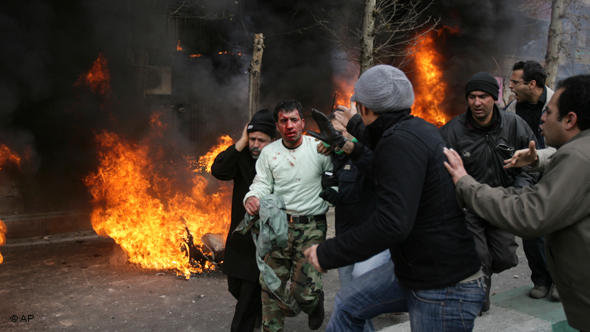
Iran: crisis at the top of the regime workers start to move<http://www.marxist.com/iran-crisis-at-the-top-workers-move.htm> Written by Hamid Alizadeh Tuesday, 24 May 2011 [image: Print]<http://www.marxist.com/iran-crisis-at-the-top-workers-move/print.htm#> *The last few weeks have seen an unprecedented public dispute between the president Mahmoud Ahmadinejad and the supreme leader Ali Khamenei. The dispute officially erupted over Ahmadinejads dismissal of Heydar Moslehi, the minister of intelligence who was fired by Ahmadinejad (officially he resigned himself) on April 17, but was then reinstated later the same day by a direct decree from Khamenei. Following Khameneis decision to reinstate Moslehi that was done in a particularly humiliating manner first in a personal letter to Moslehi and then in a public address Ahmadinejad embarked on an 11 day boycott of his cabinet meetings and many other official meetings.* [image: Protests in the beginning of 2010] <http://www.marxist.com/images/stories/iran/22_bahman_2.jpg>A public war immediately erupted between different media outlets loyal to one of the two sides. On the one side there were the media outlets close to Ahmadinejad, the most prominent of those being IRNA (Islamic Republic News Agency), which tried to downplay the conflict claiming that there had been no confrontation between Khamenei and Ahmadinejad. On the other side were the pro-Khamenei papers led by Kayhan the most influential conservative paper that is also under the direct control of the supreme leaders office which embarked on a fierce campaign against the president. Contradictory allegations of fraud and shady agreements flooded the pages of almost all newspapers. Many websites, especially on Ahmadinejads side were blocked, hacked or filtered. The conflict though was not confined to the media alone. Two people close to Ahmadinejads main ally, Esfandiar Mashaeir, have been arrested. At the same time in Parliament, a motion was passed by 216 of the 290 members of parliament demanding the impeachment of the president. Although such motions and resolutions do not necessarily mean that an impeachment is imminent, they serve to underline the depth of the conflict. Real threats were also sent out by all sides. Major General Mohammad Ali Jafari, the Revolutionary Guards' top commander said: "the perverted team will definitely rise up against the Revolution." [The "perverted team" is a phrase recently adopted by Ahmadinejad's critics to refer to the presidents chief of staff and close ally Esfandiar Rahimi Mashaei and his supporters.] Jafari added, "They will definitely be defeated, but how this will happen is not clear yet." The Ahmadinejad side was not passive either. In an article on Dolat-e Yar by an unknown author, the president's critics were threatened. One version of the article divided those critics into three groups: (1) those who expected him to grant them concessions, especially economic, and have been attacking him because he refused; (2) those who sense that Iran is going to experience very difficult economic conditions this year and are therefore trying to distance themselves from him; and (3) those who want to paralyze his administration. The article then threatened that since Ahmadinejad is not prepared to make any concessions, we may soon see an "astounding confrontation in the nation, compared to which the sedition [Green Movement] will be child's play." At least three versions of the article appeared over a 24-hour period perhaps marking a farcical retreat by the Ahmadinejad camp. The second version warned that Ahmadinejad "will destroy" his critics. The third version posed the rhetorical question, "Will Ahmadinejad destroy his critics? Only the future will answer the question, and people are waiting for the answer." Although the truthfulness of all media reports is under question in these times in Iran, a report on Saham News, a website close to Mehdi Karroubi and his National Trust Party, gives a good picture of scope of the crisis within the state. The website reported a clash between supporters of Ahmadinejad and Khamenei near the annual book fair exhibition hall. They reportedly attacked each other with belts and other items, causing many injuries, according to the report, and cursed at each other using extremely profane language. Police reportedly stood aside and watched. Most of the clashes occurred at the subway station exit next to the exhibition. When a reporter said to the police sarcastically that, "You have made a great effort [to separate the two sides]," a policeman responded, "What are we supposed to do?" The run up Clearly the split goes beyond the dismissal of the intelligence minister. In fact it has been brewing under the surface ever since the presidential elections in 2009 where it initially developed. But once matured, the split has developed a logic of its own. Only a few months after the elections, when the regime was still tied up in crushing the movement on the streets, the first signs of this division were seen when Khamenei issued an order overruling Ahmadinejad's appointment of Esfandiar Rahimi Mashaei as his first vice president (there are eight vice presidents in Iran). Mashaei, whose daughter is married to Ahmadinejad's son, has since then been the centre of a series of disputes including the present one. For instance Brigadier General Mohammad Ali Jafari, Revolutionary Guards commander said a few weeks ago: "[A] diversionary trend [Mashaei] is hiding behind a popular, accepted and beloved figure [President Mahmoud Ahmadinejad] This movement will definitely act against the [Islamic] revolution in the future." The reason for Mashaei being the target for most the attacks of Ahmadinejads opponents are not just because he is Ahmadinejads closest ally. Most importantly for his opponents, Ahmadinejad is too difficult to attack. Firstly the conservative faction put their full weight behind Ahmadinejad during the election campaign making it hard for them all of a sudden to turn 180 degrees against him. Secondly, unlike most parts of the regime, Ahmadinejad has a certain following amongst some layers of the population, although a very weak and small one. Ahmadinejad was pulled up from relative obscurity by the conservatives, probably on the basis of a compromise between the different factions within the regime, as a presidential candidate in 2005, but he started to develop his own base through a series of populist measures. As a result he also demanded more control over the state apparatus and the budget. It was this endeavour that was blocked by Khamenei in the summer of 2009. It was clear that Ahmadinejad wanted a bigger share of power than Khamenei and the rest of the conservative faction (consisting of everyone else, from the speaker of the parliament to the high command of the Revolutionary Guards) could offer. But that didnt mean that Ahmadinejad and Mashaei have given up their ambitions. Over the last two years there has been an increasing attempt at consolidating power in the office of Ahmadinejad. When Ahmadinejad realized he could not appoint just any minister he wanted, he appointed special presidential emissaries to the different ministries. He tried to do the same in the Iranian embassies around the world, although he was blocked by Khamenei. In practice he tried to develop parallel state structures directly loyal to him. At the same time he tried to install loyal elements in all the existing ministries. For instance his foreign minister Manouchehr Mottaki, who was believed to be more loyal to the supreme leader, was humiliatingly fired in a public statement while he was on an official visit to Senegal. It has also been clear that Mashaei was being primed in order to run for president in 2013. When asked about this, Mashaei responded: "Ask about my candidacy for the presidential election six months before the elections" Challenging the clergy In his quest for state power Ahmadinejad understood that he needed to have a social base of his own. The protests over the elections were a great warning for him that he had to differentiate himself from the rest of the regime, especially the clergy. Thus over the last few years Ahmadinejad has stepped up his nationalist profile in contrast to the Islamic one. While underplaying the role of the supreme leader he has underlined his own role. An important step in this plan was the recent release and wide distribution of a DVD entitled the appearance is imminent [The appearance implies the appearance of the Imam Mahdi, who is supposed to return to earth before judgement day to rid the world of wrongdoing, injustice and tyranny.] In the Islamic Republic the supreme leader or the vali-e faghih is the representative of the Imam on earth until he appears. In the DVD it is said that the Imam will return and that his main aides on earth will be Khamenei, Ahmadinejad and Nassrallah (the leader of Lebanese Hezbollah). To imply in this manner that Ahmadinejad, a religious commoner, is equally close to the Imam as Khamenei is clearly a challenge, not only to Khameneis legitimacy, but to the legitimacy of the clergy and the rule of the clergy as a whole. Through these actions, Ahmadinejad has clearly alienated a great part of the clergy and isolated himself. In the last weeks all larger Friday prayer sermons have attacked Ahmadinejad and Mashaei. Most significantly though, the recent row has turned Ahmadinejads avowed spiritual guide Mohammad Taghi Mesbah Yazdi, against him. Criticizing Ahmadinejad and Mashaei without naming them, Mesbah said, "If we act lazily, when we wake up that darkness has spread everywhere and realize that we actually trained those who created the sedition [the Green Movement]. What is the reason for all the nationalistic talk of an Iranian school of thought, especially when an Islamic movement is taken shape in the Islamic world? What is the motivation...? Winning the battle in the short term As an act of defiance, Ahmadinejad has fired three ministers in the last few days and handed control of the ministries to people loyal to him, but it is clear that the first round of the battle has been won by Khamenei. Weather there will be a coup detat shaped in the form of an impeachment of the president or another form of transition we dont know, but it is clear that Khamenei is now in a favourable position to gain stronger control over the state apparatus. But what is the cost? The Islamic republic has never been in a deeper crisis and Khameneis i.e. the institution of the supreme leaders legitimacy has never been lower. These measures and conflicts have been the norm in the Islamic Republic ever since its bloody inception. The difference today though is that the revolutionary mass-movement has destroyed all equilibrium within the regime. In our article The Character of the present lull and the tasks of the Marxists we explained the process last year: Contrary to what they had hoped for, the regime has not been able to unite and consolidate itself since it was continuously shaken severely from June until December. On the contrary, internal splits and conflicts keep devouring the regime from within. ( ) In "normal" times all these events [splits, divisions and scandals] might have been ignored or even accepted, but in a situation where the regime is trying to keep its base, their constant undermining of the system puts enormous strains on the relationship between its different sectors. They are all forced to attack and reveal each other in order to justify their own existence and defend their legitimacy. Over the last period Ahmadinejad has clearly tried to distance himself from Khamenei and the revolutionary guards to whom he tried to give all the credit of crushing the green movement. This process has developed to a critical point today and the present crisis is the product of this. Crisis in the economy The second and utmost important factor pushing the rulers to attack each other like cannibalistic scavengers is the economy that is no longer expanding like during the boom years. The Iranian economy is chronically ill and the latest period with political instability, international sanctions and global fall in demand and investment has brought to the fore all its weaknesses. Lately the IMF has reportedly put the growth of the last two years to between 0% and 1%. Their prospect for the next year is close to zero per cent growth. Although investment in the Iranian economy has multiplied, this was from a record low of almost $0 in 2009-10. According to the Tehran Bureau, HSBC, a heavyweight in the world of finance known for its recommendations for investments in Iran, has recently published a harsh criticism of the Iranian economy confirming everything that we have previously written on these pages. The Tehran Bureau writes: The exchange rate for the rial has been kept relatively stable even as inflation has continued to register double digits every year. The overvalued currency has increased imports to unprecedented levels, bankrupting thousands of domestic producers. All of this contributes to a decline in total productivity and rising unemployment. As the report notes, real GDP growth has been slowing every year since Ahmadinejad first took office, spiraling to "less than 1.5 percent in 2009/2010." The lethal combination of slow growth and high inflation places Iran at risk of stagflation, a harbinger of serious economic crisis. Inflation has been an endemic problem for post-revolutionary Iran. At an official rate of 13.5 percent, it is now the highest in the region. While this is caused by numerous factors, including a populist economic policy, the report names superfluous government spending as the biggest culprit. "In the last four years, total liquidity has more than doubled," the report states. In addition, the government's debt to the banking system has increased substantially, while non-performing assets held by state banks have "reached record levels," and "nearly 7,000 businesses have failed to service their debts." Although the present rise in oil prices gives Iran a temporary cushion, it is not enough to stop the disintegrating economy. According to Fars News Agency the state budget of last Iranian calendar year fell short close to $15b. Of course while the rulers fight over the big pieces of the cake the crums left for the masses are became scarcer by the day. In the last month, the price of bread rose by another 25 percent, as subsides were further cut. In the last year food prices have risen by an average of 25 percent. Eggs have risen 97.6 percent, fruit 43.5 (apples 111 percent), dairy products 5 percent, cooking oil 20 percent, rice 13.4, chicken 12.6 and sugar 9.6. Onions were the only items that fell 31 percent. According to reformist deputy Mohammad Reza Khabbaz, the inflation rate could reach 40-50 percent soon. At the same time the minimum wage was only raised by a meagre 9 percent this year. According to Alireza Mahjoub, secretary-general of Worker's House [the only official and state trade union federation], said that every year, 1.2 million people join the ranks of the unemployed in Iran. Other Majlis deputies have stated that the real rate of unemployment is about 24 percent. It is clear that this economic situation not only drastically reduces the room for manoeuvre for the regime, it also brings more and more layers into opposition to the regime. The state of the movement The revolutionary movement that erupted after the elections was effectively, though only temporarily, derailed by the leadership of Mirhossein Mousavi and Mehdi Karroubi who at every step sabotaged the only practical and logical way forward for the movement the overthrow of the dictatorship. In spite of their thorough sabotage they were effectively side-lined by the youth in the movement after the revolutionary overthrow of the Mubarak dictatorship. The result was the demonstrations on February 14th, 21st, March 1st 8th and 15th 2011. These days, with hundreds of thousands in the streets, clearly showed the potential of the movement and its support amongst the masses. But the constant sabotage of the top brass of the Reformists played a treacherous role. Especially their deliberate and firm opposition to developing a clear programme of social demands and to the call for a sustained campaign of days of action, managed to hold the movement back just enough for it not to catch the momentum it received by the overthrow of the Mubarak and Ben Ali dictatorships. Despite the obvious tiredness and disorientation within the movement, the regime, being itself caught up in a crisis, has not been able to crack down to consolidate itself. Thus the door has not been closed yet for the masses to take steps forward and we have seen a continuation of eruptions in different areas. The working class steps onto the scene As we could see during the days of action in February and March new layers started bringing their demands to the movement. A very important factor was the linking up of national movements in Azerbaijan and Kurdistan which participated massively in the days of action. But more important than anything was the stepping in of the working class onto the scene as an independent force. Firstly the phase III construction workers of the strategically crucial Abadan refinery went on strike on February 14 the first day of action and quickly won their demands. Then the workers of Alborz Tire, who have been one of the most militant groups within the last years used the February 21 demonstrations as a cover to setup their own protest on the Tehran Karaj highway, although their protests lasted a longer period. But the real breakthrough though was the 1800 temporary workers at Tabriz petrochemical factory who won a full victory after a thirteen day strike starting on March 3rd demanding permanent employment for all and end of temporary contracts. The victory clearly inspired workers in the rest of the country. The petro-chemical industry plays a strategically important part in the regimes attempts to fight against the international sanctions imposed by the US. Thus it is no surprise that the workers in this sector, experiencing increasing employment and a higher priority of their work, feel strong and confident enough to embark on large scale struggle. Tabriz, though would only be the beginning. After the Tabriz victory many companies came out. Alborz Tires, joining hands with some workers from Isfahan Steel Complex, continued its struggle staging an 800 strong protest in front of parliament and thus winning a promise of receiving all unpaid back wages. Also 1,000 workers at the Pars Paper Mill in southwestern Iran similarly launched a strike on April 9. But overshadowing all these strikes was the strike at the Mahshahr Petrochemical Complexes, part of the Mahshahr Special Economic District. Starting from the Bandar Imam unit on the 10th of April, the strike quickly spread to the whole complex covering more than 10,000 petro-chemical workers. The Free Trade Union of Iran reports: The workers strikes at the Bandar Imam petrochemical complex in Mahshahr, Iran continued yesterday; however, a new and interesting development has unfolded: workers from other sectors within the Petrochemical Special Economic Zone in Mahshahr left their own factories to come together in front of the Bandar Imam petrochemical complex to join the 2,000 workers already on strike and physically show their support. The Free Union of Iranian Workers reports that this escalation in the strike happened yesterday morning. The workers from other sectors who marched to support the Bandar Imam petrochemical workers were confronted on arrival by security forces who tried to prevent the newcomers from joining the strikers inside the complex. The workers from other factories, with their placards and posters already in hand proclaiming their demands, gathered outside the fences of Bandar Imam factory and raised those demands: demands for workers rights, demands for their wages. From inside the complex, the petrochemical strikers answered the newcomers by chanting their gratitude: Thank you! Thank you! According to the latest news from the Free Union of Iranian Workers, the security staff of the Bandar Imam petrochemical compound have been supplied with firearms. The employers, among them the head of National Iranian Petrochemical Company (government-owned) who is at the same time the Deputy Minister of Industry, have hastily flown to Mahshahr to try to manage the situation. Despite the best efforts of the government and the workers employer, this strike continues to gain momentum and is becoming stronger and stronger as it continues. This massive strike, demanding the end of temporary contracts as its main demand, shook the whole of Iran and won its demands within 11 days of striking. After the Mahshahr strike, several other strikes have started with their results not yet reported. Most significantly it was reported that a strike at an Iron ore mine in the city of Bafgh had started with 4000 workers who had organized a demonstration of more than 40,000 in the city to support them. It is clear that the working class are ready to struggle, but it is lacking a national focal point. If the workers were linked up with the mass movement on the streets in the cities the days of the regime would be numbered, but yet again on May Day when the opportunity was ripe, the so-called leaders at the top of the reformist organisations refused to call for demonstrations. Instead they called for all to "discuss the sad conditions of the workers [sic]" First as a tragedy then as a farce In spite of the treachery of the reformist leaders, in whom we have never had any illusions, the revolutionary potential of the movement is not exhausted yet. New layers continue to come on to the scene not because they are attracted to the liberal programme of the reformists, but because their living conditions do not give them any other option. Friedrich Engels once remarked that history repeats itself, first as a tragedy and secondly as a farce. Whereas Khomeini resting on different factions, classes and layers succeeded in crushing one of the biggest revolutionary movements of the last century, his successor Ali Khamenei, like an elephant in a China shop, is exposed as powerless in acting against the rising revolutionary wave of the Iranian masses without straining his own base, his alliances and the state apparatus and in doing so reviving the same movement that he intended to crush. The difference though is not rooted in the personal characteristics of the two men rather it is the other way round. Khomeini represented counter-revolution that had not only the backing of world imperialism, but even a certain social base. This was within the middle- and peasant classes the lumpen and, thanks to the Stalinists party leaderships, even within some layers of the working class. Hence, Khomeini, the confident man drowning the revolution in blood, had something to base his confidence on. On the other side Khamenei, represents the naked and bare counter-revolution, devoid of the effects of its demagogy, exposed for what it is in action and unable to feed its own supporters. Paranoid and helpless, like a scared and cornered animal, he looks out of the thick glasses with his small staring eyes with no confidence because he has not been able to crush the mass-movement more than to a superficial degree. He might be relieved over his temporary victory in the internal power struggle, but it is too soon to celebrate, for although there might be order in Iran now, revolution is luring right beneath the surface. To officially take part in the running of the country immediately means taking responsibility for its crisis and placing oneself as the main target for the masses who are hungry, not only for food but also for a new society. [Non-text portions of this message have been removed] ------------------------------------ --------------------------------------------------------------------------- LAAMN: Los Angeles Alternative Media Network --------------------------------------------------------------------------- Unsubscribe: <mailto:[email protected]> --------------------------------------------------------------------------- Subscribe: <mailto:[email protected]> --------------------------------------------------------------------------- Digest: <mailto:[email protected]> --------------------------------------------------------------------------- Help: <mailto:[email protected]?subject=laamn> --------------------------------------------------------------------------- Post: <mailto:[email protected]> --------------------------------------------------------------------------- Archive1: <http://www.egroups.com/messages/laamn> --------------------------------------------------------------------------- Archive2: <http://www.mail-archive.com/[email protected]> --------------------------------------------------------------------------- Yahoo! Groups Links <*> To visit your group on the web, go to: http://groups.yahoo.com/group/laamn/ <*> Your email settings: Individual Email | Traditional <*> To change settings online go to: http://groups.yahoo.com/group/laamn/join (Yahoo! ID required) <*> To change settings via email: [email protected] [email protected] <*> To unsubscribe from this group, send an email to: [email protected] <*> Your use of Yahoo! Groups is subject to: http://docs.yahoo.com/info/terms/