http://www.marxist.com/paris-commune-140th-anniversary.htm
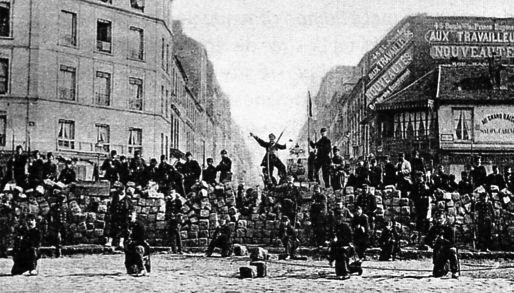
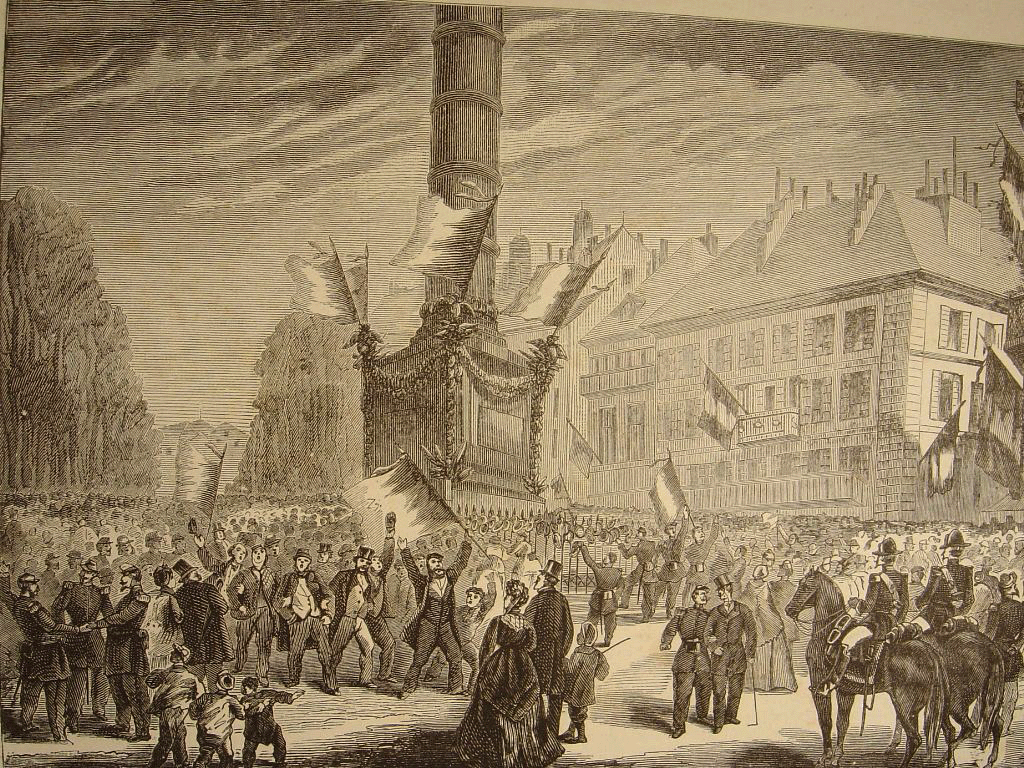
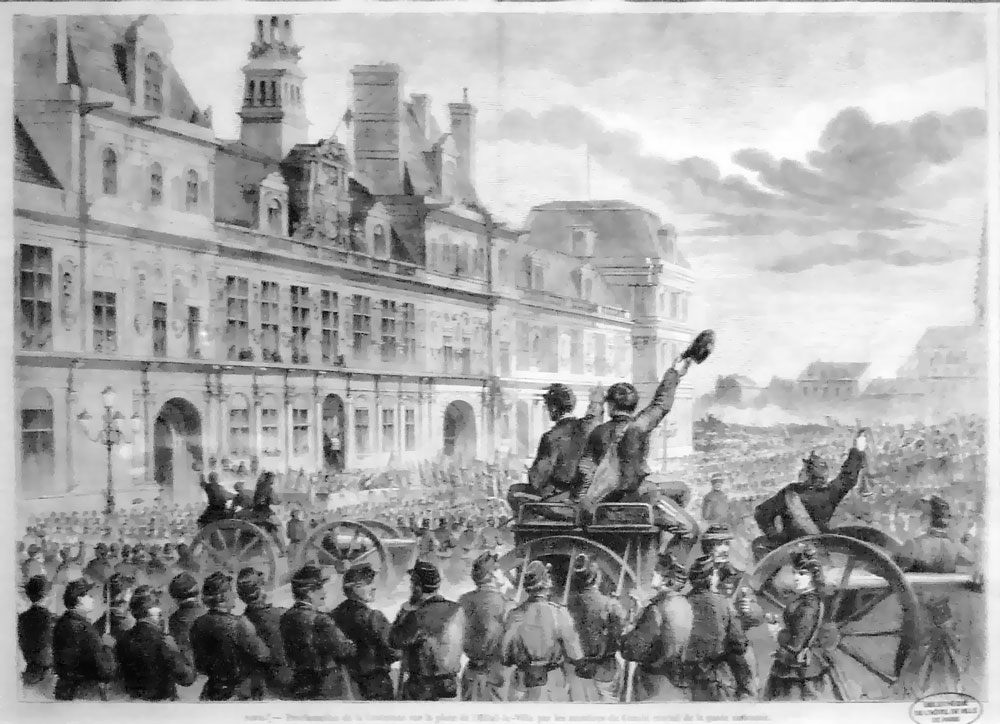
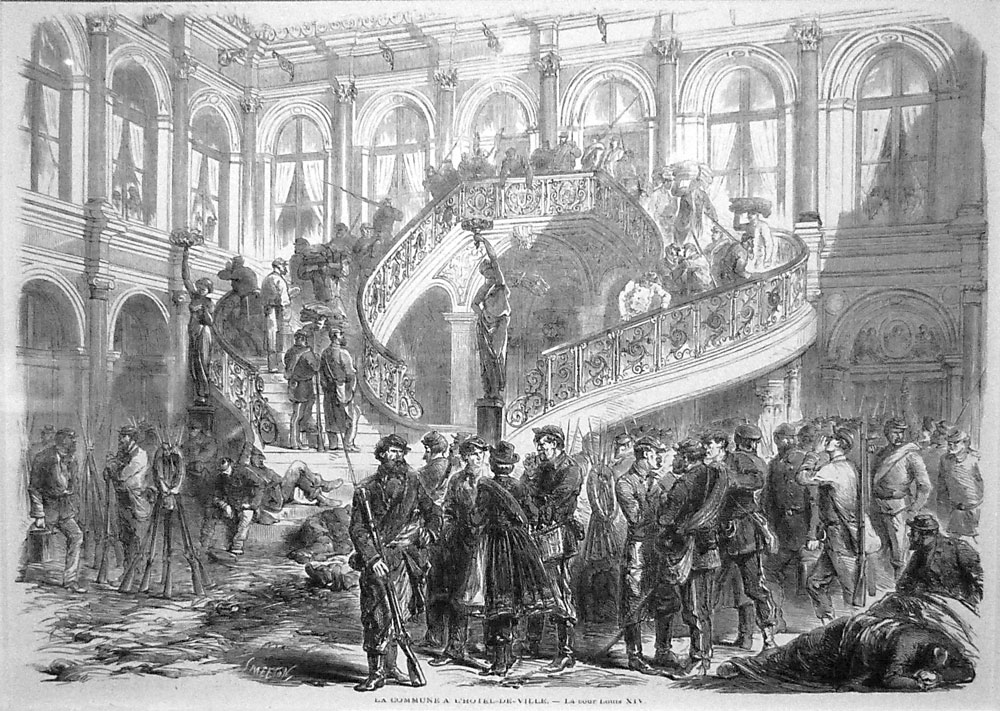
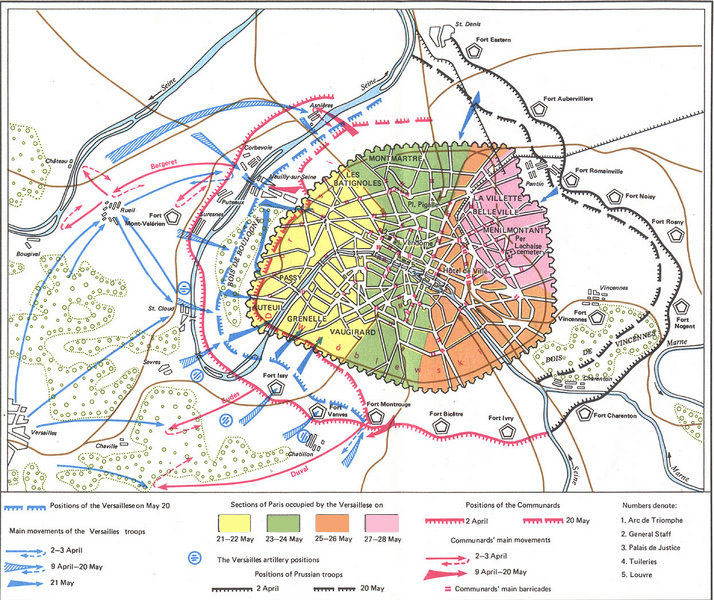
140th anniversary of the Paris Commune<http://www.marxist.com/paris-commune-140th-anniversary.htm> Written by Greg Oxley Friday, 27 May 2011 [image: Print]<http://www.marxist.com/paris-commune-140th-anniversary/print.htm#> *The Paris Commune of 1871 was one of the greatest and most inspiring episodes in the history of the working class. In a tremendous revolutionary movement, the working people of Paris replaced the capitalist state with their own organs of government and held political power until their downfall in the last week of May. The Parisian workers strove, in extremely difficult circumstances, to put an end to exploitation and oppression, and to reorganise society on an entirely new foundation. The lessons of these events are of fundamental importance for socialists today. We publish this article ahead of the 140th anniversary of the Commune's suppression, tomorrow, 28 May.* [image: 18 March, 1871] <http://www.marxist.com/images/stories/history/Paris_Commune_Barricade18March1871.jpg>Twenty years before the advent of the Commune, following the defeat of the workers uprising in June 1848, the military coup of 2nd December 1851 brought Emperor Napoleon III to power. Initially, the new bonapartist regime seemed unshakeable. The workers were defeated, their organisations outlawed. By the late 1860's, however, the revival of the labour movement combined with exhaustion of the economic upswing, had seriously weakened the regime. Napoleon drew the conclusion that only a new - and rapidly successful - war would allow him to maintain power. The war, he thought, would bring territorial gains, weaken France's rivals, and put an end to the crisis in finance and industry. In August 1870, the imperial army marched against Bismarck. It often happens that war leads to revolution. This is not accidental. A war wrenches the working people out their daily routine. The actions of the state, of generals, of politicians, of the press, come under the scrutiny of the mass of the population to an infinitely higher degree than is normally the case in times of peace. This is particularly the case in the event of defeat, and, as events turned out, the attempted invasion of Germany came to a rapid and inglorious end. On 2nd September, near Sedan on France's eastern border, the Emperor was captured by Bismarck's army together with 100,000 troops. When the news of the defeat reached Paris, mass demonstrations poured through the streets of the city, demanding the overthrow of the Empire and a its replacement democratic republic. The so-called republican opposition was terrified by this revolutionary movement, but was nonetheless forced to inaugurate the republic on the 4th September. A new "Government of National Defence" was installed, in which the key figure was general Trochu. Jules Favre, also in the government and a typical representative of capitalist republicanism, proclaimed that "not one inch of territory, nor one stone of our fortresses" would be ceded to the Prussians. Bismarck directed his armies towards Paris, and the city was rapidly encircled under siege. [image: Place de la Bastille] <http://www.marxist.com/images/stories/history/Paris_Commune_Place_de_la_Bastille.gif>The people initially supported the new government in the name of "national unity" against the foreign enemy. But this unity would very soon break down. In spite of its public declarations, the Government of National Defence did not believe it was possible to defend Paris. Besides the regular army, the National Guard was ready to defend Paris. But the revolutionary mood of the workers within Paris were a far greater threat to class interests of the French capitalists than the foreign army at its gates. The government decided it would be best to capitulate to Bismarck as soon as possible, but it could not state this openly because of the opposition of masses. Trochu had to gain time. The people were hungry. The blockade meant that no food could be brought into the city. The poorest ate dogs and rats to survive. Trochu counted on the social and economic effects of the siege to dampen the resistance of the Parisian workers, and engaged in secret negotiations with Bismarck. As the weeks went by, suspicion and hostility towards the government grew. Rumours about negotiations with Bismarck were rife. On 8th October, the fall of Metz sparked off a new mass demonstration. On the 31st, several contingents of National Guards from the Belleville area, under the command of Flourens, attacked and temporarily occupied the Hôtel de Ville. At this stage, however, the mass of the workers was not yet ready for decisive action against the government. The insurrection was isolated. Blanqui fled into hiding and Flourens was imprisoned. In Paris the famine and poverty brought on by the siege was having disastrous consequences, and the need to break the siege was felt all the more acutely. The sortie aimed at taking the village of Buzenval on 19th January ended in yet another defeat. Trochu resigned. He was replaced by Vinoy, who, in his first proclamation, wrote that Parisians should be "under no illusions" as to the possibility of defeating the Prussians. It was now clear that the government intended to capitulate. The political clubs and the Vigilance Committees called on the National Guards to arm themselves and march on the Hôtel de Ville. Other detachments went to the prisons to free Flourens. Under growing pressure from below, the middle class democrats of the Alliance Républicaine demanded a "popular government" to organise effective resistance against the Prussians. But when the National Guards arrived at the Hôtel de Ville, Chaudry, representing the government, shouted furiously at the delegates from the Alliance. This was enough to make the republicans agree to disperse immediately. Breton guards on the side of the government shot down national Guards and demonstrators who tried to oppose this betrayal. The National Guards returned fire, but were eventually forced to retreat. After this first armed clash with the government, the revolutionary movement temporarily subsided. But at the same time, it meant the collapse of any remaining illusions in the Alliance Républicaine. On the 27th January, the Government of National Defence finally went ahead with the capitulation it had planned since the beginning of the siege. Rural France was in favour of peace, and the votes of the peasantry in the elections to the National Assembly in February gave a massive majority to the monarchist and conservative candidates. The Assembly nominated a hardened reactionary, Adolphe Thiers, as head of government. A clash between revolutionary Paris, and the reactionary "rural" majority in the Assembly was inevitable. Open counter-revolution had raised its head, and was now to act as a spur to the revolution. Prussian soldiers would soon enter the capital in triumph. The lull in the movement now gave way to a new and more powerful upsurge of protest. Armed demonstrations of the National Guard took place, massively supported by the workers and the poorer sections of the population. Thiers and the monarchists were denounced as traitors. The masses were for "a fight to the death" *la guerre à outrance* in defence of their liberty. The events of 31st October and of 22nd January were but mild foretastes of the new revolutionary upsurge that was now underway. [image: Announcement of election results, 28 March.] <http://www.marxist.com/images/stories/history/Paris_Commune_election_results_28_mars_1871.jpg>The National Assembly constantly provoked the Parisians, referring to them as cut-throats and criminals. It waged a campaign of propaganda to arouse the peasantry against Paris. It cancelled the already very low pay of the National Guards unless they could prove that they were "incapable of work". The siege had made many workers unemployed, and their allowance for service in the National Guard was all that stood between them and starvation. Arrears in rents and all debts were declared to be payable within 48 hours. This threatened small businessmen with immediate bankruptcy. Paris was deprived of its status as capital city of France, which was transferred to Versailles. These measures, and many others, hit the poorest sections of society particularly hard, but also led to a radicalisation of middle class Parisians, whose only real hope of salvation was now in the revolutionary overthrow of Thiers and the National Assembly. The Parisian working class was now building up towards a new insurrection against the threat of Prussian domination, and also against Thiers and the National Assembly. The surrender to the Prussians and the threat of monarchist restoration led to a transformation in the National Guard. A "Central Committee of the Federation of National Guards" was elected, representing 215 battalions, equipped with 2000 canons and 450,000 firearms. New statutes were adopted, stipulating "the absolute right of the National Guards to elect their leaders and to revoke them as soon as they loose the confidence of their electors." Essentially, the Central Committee and the corresponding structures at battalion level were an historical anticipation of the soviets of workers and soldier's deputies which arose in the course of the revolutions of 1905 and 1917 in Russia. The new leadership of the National Guard was to rapidly test its authority. When the Prussian army was to enter Paris, tens of thousands of armed Parisians gathered with the intention of attacking the invader. The Central Committee intervened to prevent an unequal struggle for which it was not yet prepared. The success of the Central Committee firmly established its authority as the recognised leadership of the mass of the people. Clément Thomas, the commander nominated by the government, had no alternative but to resign. The Prussian forces occupied part of the city for two days, and then withdrew. Thiers had promised the Rurals in the Assembly to restore the monarchy. His immediate task was had to put an end to the situation of "dual power" in Paris. The canons under the command of the National Guard - and particularly those on the heights of Montmartre overlooking the city - symbolised the threat the capitalist "law and order". At 3 o' clock in the morning, on March 18th, several thousand regular soldiers were sent to seize these canons, under the command of general Lecomte. The canons were seized without difficulty. However, the expedition had set off without thinking of the need for harnesses to haul the canons away. At 7 o'clock, still no harnesses had arrived. The troops now found themselves surrounded by a thickening crowd of workers, including women and children. National Guards now arrived on the scene. The unarmed crowd, the National Guards and Lecomte's men were pressed against one another in the dense gathering. Some of the soldiers openly fraternised with the guards. Seeing that the situation was getting out of control, Lecomte ordered his men to fire on the crowd. Nobody fired. The soldiers and the National Guards threw up a cheer and embraced each other. Apart from a brief exchange of fire at Place Pigalle, the army collapsed without offering any resistance to the Guards. Lecomte and with Clément Thomas, the former commander of the National Guard who had fired on workers back in 1848, were arrested. Angry soldiers executed them shortly afterwards. Thiers had not foreseen the mass defection of his troops. Panic-stricken, he fled from Paris. He ordered the army and the civil services to completely evacuate the city and the surrounding forts. Thiers wanted to save what he could of the army by taking them away from "contagion" by revolutionary Paris. The remnants of his forces, many of them openly insubordinate, chanting revolutionary songs and slogans, were marched off to Versailles. With the old state apparatus out of the way, the National Guard took over all the strategic points in the city without meeting any significant resistance. The Central Committee had not played any role in the events of the day. And yet, on the evening of the 18th, it discovered that it was now at the head of a new revolutionary regime based on the armed power of the working people! The first task that the Central Committee set itself was to relinquish the power that was in its hands. They had no "legal mandate" to govern! After much discussion, it was agreed to stay in the Hôtel de Ville for "a few days" during which municipal (communal) elections could be organised. With the cry of "Vive la Commune!", the members of the Central Committee were greatly relieved that they would not have to exercise power for any length of time! The problem immediately before them was that of Thiers and the army on its way to Versailles. Eudes and Duval proposed that the National Guard pursue them in order to shatter what remained of the forces in Thiers' hands. Their appeals fell on deaf ears. The Central Committee was composed for the most part of very moderate men, completely unprepared in temperament and in ideas for the tasks which history had placed upon them. The Central Committee began negotiations with the former Mayors and with various "conciliators" over the date of the elections. This absorbed its attention until the election finally took place on 26th March. Thiers put this valuable time to great use, and, with the help of Bismarck, the numbers, the arms and the morale of the soldiers were strengthened in readiness for an attack against Paris. On the eve of the election of the Commune, the Central Committee of the National Guard published a remarkable declaration which sums up the personal integrity and the healthy democratic and revolutionary attitude towards politics of the leadership: Our mission is complete. At the Hôtel de Ville, we will make way for your newly elected representatives. [ ] Do not lose sight of the fact that those who will serve you best are those that you will choose among yourselves, who live as you do, and suffer from the same ills. Beware of the ambitious and place-seekers [ ], beware of talkers who are incapable of action. [image: Inside Hotel de Ville] <http://www.marxist.com/images/stories/history/Paris_Commune_Hotel_de_Ville.jpg>The newly elected Commune replaced the leadership of the National Guard as the official government of revolutionary Paris. It was mainly composed of people associated with the revolutionary movement in one way or another. The majority might be described as "left republicans", steeped in idealised nostalgia for the Jacobin regime at the time of the French Revolution. Out of its 90 members, 25 were workers, and 13 were members of the Central Committee of the National Guard, and 15 or so were members of the International Workingmens' Association. Between them the Blanquists energetic men always ready for dramatic and extreme measures but with only the vaguest political ideas and the Internationalists made up about one quarter of the Commune. Blanqui himself was in a provincial prison. The few right-wing members who were elected resigned their positions on various pretexts. Others were arrested on the discovery of their names in police files identifying them as former spies for the imperial regime. Under the Commune, all privileges for state functionaries were abolished. It was decreed that no representative of the people should be paid more that the average wage of the workers. The Commune was the only really honest government France has ever had. Moreau, one of the members of the Central Committee, declared that in his view, it was *immoral to expect any kind of payment in the service of the people. We have lived until now on thirty pence, and they will suffice from now on. *Rents were frozen, abandoned workshops were placed under the control of the workers, measures were taken to limit night-work, to guarantee subsistence to the poor and the sick. The Commune declared its aim as "ending the anarchic and ruinous competition between workers for the profit of the capitalists", and the "dissemination of socialist ideals". The National Guard was open to all able-bodied men, and organised, as we have seen, along strictly democratic lines. Standing armies "separate and apart form the people" were declared illegal. The Church was separated from the state. Religion was declared "a private matter". Homes and public buildings were requisitioned for the homeless. Public education was opened to all, as were the theatres and places of culture and learning. Foreign workers were considered as brothers and sisters, as soldiers for the "universal republic of international labour". Meetings took place day and night, were thousands of ordinary men and women debated how various aspects of social life should be organised in the interests of the "common good". The social and political character of the society that was gradually taking shape under the aegis of the National Guard and the Commune was unmistakably socialist. The lack of any historical precedent, the absence of a clear program, combined with the social and economic dislocation of a besieged city, necessarily meant that the workers were obliged to improvise in dealing with the concrete requirements of organising society in their own interests. A great deal has been written about the confusion, the half-measures, the wasted time and mistaken priorities of the Parisian people during their ten weeks of power within the walls of a beleaguered city. It must be said that the communards made many mistakes. Marx and Engels were particularly critical of their failure to take control of the Bank of France, which continued to pay millions of francs to Thiers with which he was preparing an army to march against Paris. However, all the most important initiatives taken by the workers pointed in the direction of complete social and economic emancipation of the wage-working population as a class. The tragedy of the Commune was that it lacked time. The process in the direction of socialism was cut short by the return of the Versailles army and the terrible bloodbath that ensued. [image: Map of troop movements. Illustration: Wikimedia/ Fourscore] <http://www.marxist.com/images/stories/history/Paris_Commune_map_of_troop_movements.jpg>The threat from Versailles was clearly underestimated by the Commune, which not only did not attempt to attack them, but did not even seriously prepare to defend itself. From March 27th onwards, occasional exchanges of fire between the forward positions of the Versailles army and the ramparts around Paris had occurred. On April 2nd, a communard detachment moving in the direction of Courbevoie, was attacked and pushed back. The prisoners taken by Thiers' forces were summarily shot. The following day, under pressure from the National Guard, the Commune finally launched a three-pronged offensive against Versailles. However, in spite of the enthusiasm of the communard battalions, the lack of serious political and military preparation (clearly it was thought that, as on March 18th, the Versailles army would come over to the Commune at the sight of the National Guard) condemned this belated sortie to failure. This defeat cost not only the dead and wounded, who included Flourens and Duval, both slaughtered upon their capture by the Versailles army, but also the fainter-hearted elements within Paris. The fatalistic optimism of the first weeks gave way to a sense of the imminent danger of defeat, accentuating the divisions and rivalry at all levels of the military command. Finally, the Versailles army entered Paris on 21st May 1871. At the Hôtel de Ville, having failed to organise any serious military strategy, now, at the decisive hour, the Commune simply ceased to exist, abdicating all responsibility to a completely ineffective "Committee of Public Safety". The National Guards were left to fight "in their localities". The lack of centralised command prevented any serious concentration of communard forces to check the advance of the Versailles troops. The communards fought with tremendous courage, but were gradually pushed towards the east of the city and finally defeated on the 28th May. Thiers forces conducted a terrible slaughter of anything up to 30,000 men, women and children, with perhaps another 20,000 killed in the following weeks. Firing squads were at work well into the month of June, killing anyone suspected of having cooperated in any way with the Commune. Marx and Engels followed the Commune closely and drew many lessons from this first attempt at the construction of a workers' state. Their conclusions are contained in the writings published under the title *The Civil War in France *, with a particularly remarkable introduction by Engels. They enthusiastically supported the struggle of the workers from the outset, although they were conscious of the extremely precarious situation in which they would find themselves if they took power. Before the 18th March, they had declared that, given the unfavourable circumstances, seizing power would be "a desperate folly". The events of March 18th placed the power in the hands of the workers, and Marx and Engels supported them in their struggle to maintain it and defeat the reaction. The workers of Paris struggled not only for immediate aims. They fought under the red flag of internationalism. They struggled, as they termed it, for a "universal social republic", free of exploitation, of class divisions, of reactionary militarism and national antagonisms. Their cause is our cause. In modern France, as in all the industrialised countries in the world, the material conditions for the achievement of these great aims are incomparably more favourable now than they were in 1871. We must now establish on a firm foundation the society for which the men and women of the Commune fought and died. *This article was published in a previous version in 2001.* [Non-text portions of this message have been removed] ------------------------------------ --------------------------------------------------------------------------- LAAMN: Los Angeles Alternative Media Network --------------------------------------------------------------------------- Unsubscribe: <mailto:[email protected]> --------------------------------------------------------------------------- Subscribe: <mailto:[email protected]> --------------------------------------------------------------------------- Digest: <mailto:[email protected]> --------------------------------------------------------------------------- Help: <mailto:[email protected]?subject=laamn> --------------------------------------------------------------------------- Post: <mailto:[email protected]> --------------------------------------------------------------------------- Archive1: <http://www.egroups.com/messages/laamn> --------------------------------------------------------------------------- Archive2: <http://www.mail-archive.com/[email protected]> --------------------------------------------------------------------------- Yahoo! Groups Links <*> To visit your group on the web, go to: http://groups.yahoo.com/group/laamn/ <*> Your email settings: Individual Email | Traditional <*> To change settings online go to: http://groups.yahoo.com/group/laamn/join (Yahoo! ID required) <*> To change settings via email: [email protected] [email protected] <*> To unsubscribe from this group, send an email to: [email protected] <*> Your use of Yahoo! Groups is subject to: http://docs.yahoo.com/info/terms/