http://www.marxist.com/greece-anger-on-streets-prepare-general-strike.htm
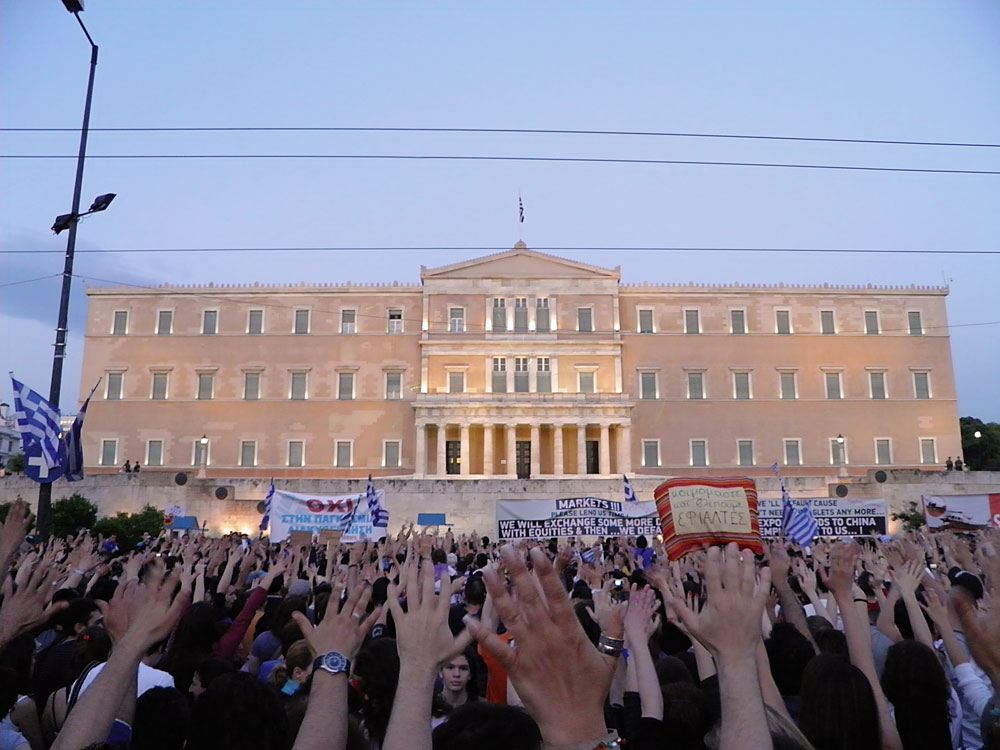
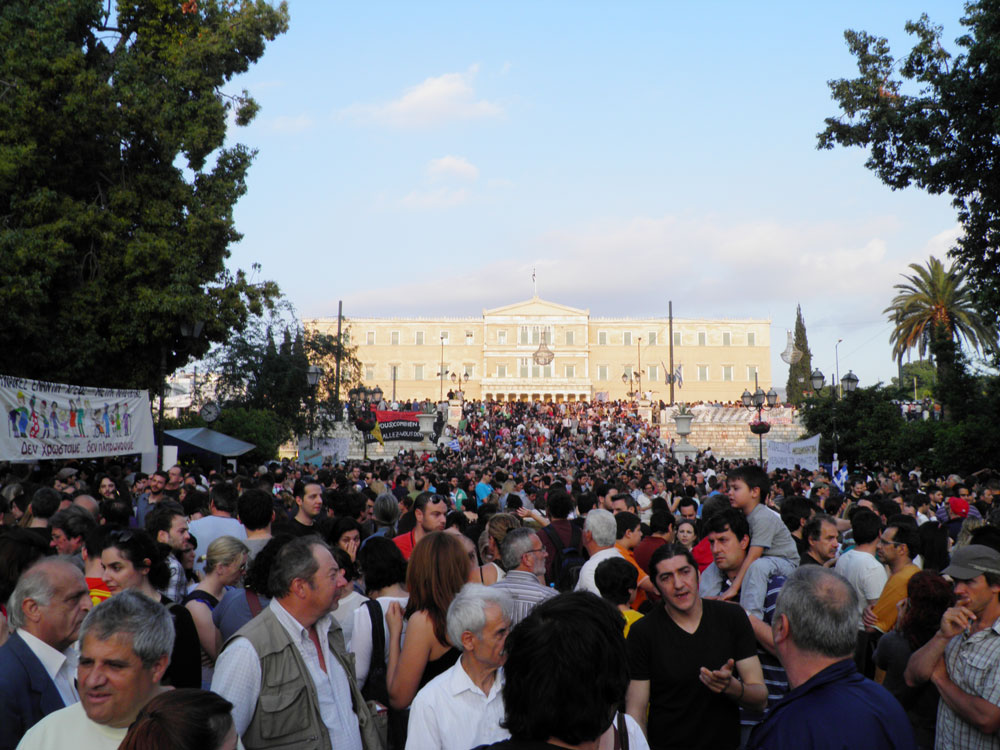
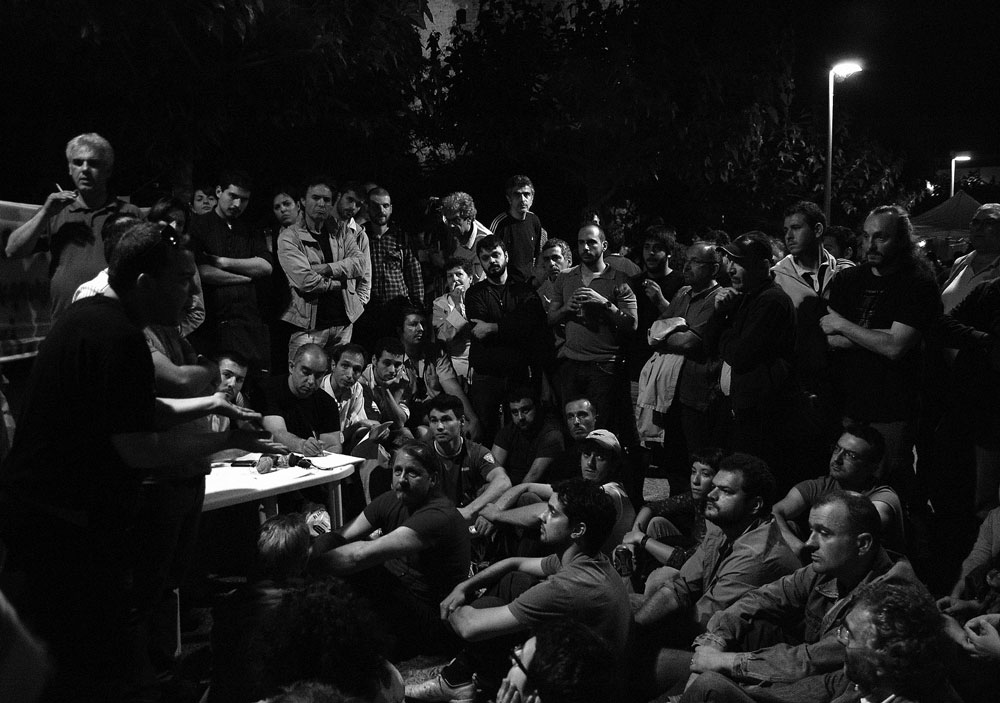
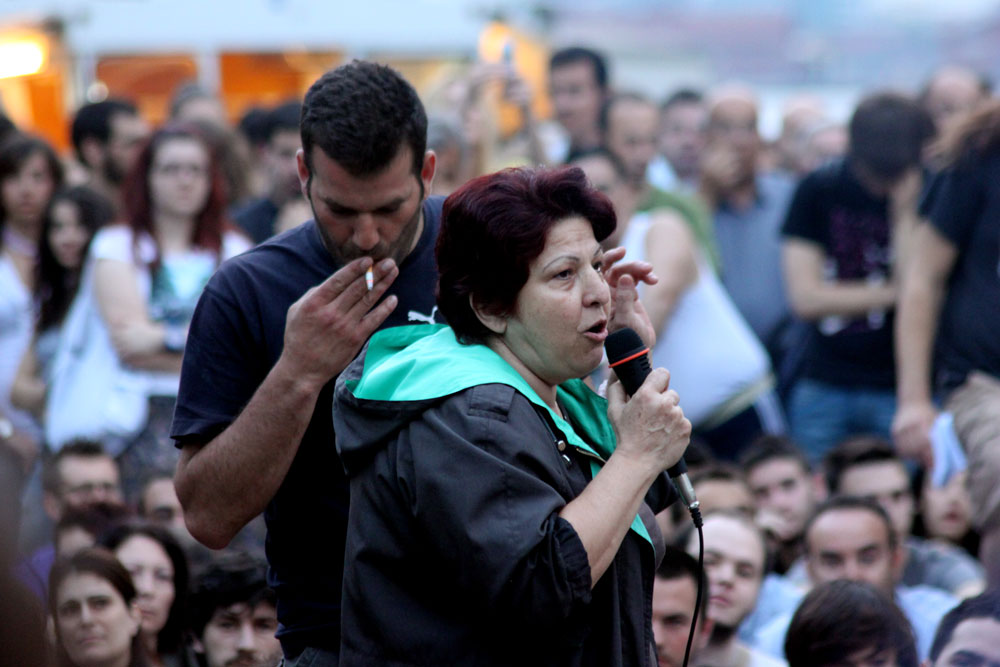
Greece: anger on the streets Prepare the political general strike!<http://www.marxist.com/greece-anger-on-streets-prepare-general-strike.htm> Written by Alan Woods Tuesday, 31 May 2011 [image: Print]<http://www.marxist.com/greece-anger-on-streets-prepare-general-strike/print.htm#> *The situation in Greece is growing day by day, and is moving in the direction of a revolutionary situation. Starting on Wednesday, 120-150,000 people thronged Syntagma Square and other central squares in all the main Greek towns. The masses protested the austerity policies of the government and the brutal aggression of the European Union against the people of Greece.* [image: Democracy in practice, in front of the gates of Parliament, May 28. Photo: Ionnis Poulopoulos.] <http://www.marxist.com/images/stories/greece/May_28_hands_in_front_of_parliament-Ioannis_Poulopoulos.jpg>Officials from the International Monetary Fund, the European Union and the European Central Bank are in Athens checking Greece's fiscal progress. They are to approve a 12 billion euro aid tranche -- the fifth under the current bailout -- and possibly new funding the country needs to avoid debt default. In return, the EU wants Athens to impose yet more austerity and reform, including privatizations. This amounts to the systematic looting of Greece by foreign capitalists. The 110 billion euro bailout stitched together by the European Union and IMF last year came with strings attached. Now the bill is being presented to the people of Greece. Under the terms of the bail-out, Greece was supposed to go to the financial markets to borrow 24bn Euros in 2012. However, as Greece has missed its deficit reduction targets, the chances of it being able to borrow money commercially next year, as originally planned, are negligible. A 12bn-euro ($17bn; £10bn) payment is due to be made to Greece on 29 June, 3.3bn Euros of which should come from the IMF. This is the fifth tranche of the 110bn-euro loan package from the EU and IMF and has not yet received final approval. Jean-Claude Juncker, the prime minister of Luxemburg, warns that IMF rules might stop it paying because Greece can not guarantee its solvency for the next year. The IMF was assuming that if it decided not to make the payment, the EU would step in and make it instead. But this is assuming a lot. In countries such as Germany, Finland and the Netherlands, opposition is growing and it is not clear the payments would be met. A spokesman for Juncker later said that if the EU and IMF inspectors currently in Athens could be convinced by new Greek austerity measures, there would be no problem with the next tranche of loans. Therefore merciless pressure is being put on Greece to carry out further cuts and privatizations. An IMF spokeswoman confirmed that the Fund would be unable to lend more money to Greece unless it was sure that next year's financing gap would be filled. We never lend when we don't have an assurance that there will be no gap, said Caroline Atkinson at a briefing in Washington. That is how we maintain the safety of our members money. Greek premier George Papandreou therefore finds himself between a rock and a hard place. The Greek cabinet met on Monday to discuss a doubling of budget cuts this year to 6bn euros, including public sector pay cuts, civil-service redundancies and an increase in value-added tax (VAT). The government has approached opposition leaders with a view to arriving at the four-year cross-party austerity plan demanded by Brussels. But the opposition parties are not anxious to share responsibility for further cuts. The right wing leader Samaras refused to support the plan. And the opposition from the Left was even more emphatic. I didn't come to discuss the looting of Greek society with Mr Papandreou, said Alexis Tsipras, leader of the Left Coalition Syriza. I came to tell him that he must not... go ahead with this crime against the Greek people. The PASOK government will be forced to do the dirty work on its own. It began a programme of privatizations last Thursday. It has said it will begin to sell stakes in a number of domestic corporations immediately in order to raise cash to help reduce its massive debts. These include stakes in the telecoms firm OTE, state-owned Postbank and the ports of Athens and Thessaloniki. But Luxembourg Prime Minister Jean-Claude Juncker is not impressed. He says the privatization plan needs to be more ambitious. In an interview with the Aachener Zeitung newspaper, the President of the European Central Bank, Jean-Claude Trichet, delivered the same message: Greece must implement the programme fully and rigorously; this is very important to correct the errors of the past, he is reported to have said. This arrogance has provoked a mood of fury in Greece, which has found its expression on the streets. Mass protests Last weekend, the people of Greece gave their reply to this blackmail. There was the biggest demonstration since the start of the movement and the biggest since the starting of the Greek-European debt crises, with 150.000-200.000 people in Athens and in many other big Greek towns. Tens of thousands of Greeks vented their anger at the nation's political classes in Athens on Sunday, staging the biggest in a week of protests as the government seeks backing for yet more austerity. A mood of despondency and despair is being transformed into a new and fearless spirit that is prepared to challenge the status quo. Thousands of Greek people - young and old, married and single, employed and unemployed have flooded Syntagma Square in a wave of protest. Greeks are angry. They are angry at politicians who are never punished for corruption, at bankers who cause a crisis and are rewarded by billions from public funds, at faceless European bureaucrats who take decisions that impose austerity plans on them from distant offices in Brussels. In short, they are angry at the entire economic and political system. [image: In front of Parliament, May 29. Photo: Ioannis Poulopoulos] <http://www.marxist.com/images/stories/greece/May_29_masses_in_front_of_parliament-Ioannis_Poulopoulos.jpg>The demonstrations in Syntagma Square were inspired by similar demonstrations in Spain. They were joined on Sunday night by a group of Spaniards who had come to show their solidarity, raising banners in Spanish. Openly we say that we have been inspired by the demonstrators in Spain, said Simos Adamopoulos, one of the organizers: Our motto is the battle that is never waged is never won. We will stay here, and in squares up and down the country for as long as it takes. The peaceful crowds were made up of ordinary people, some of whom brought along their children. The mass movement is drawn from the broadest layers of the population: workers and youth, the unemployed and the middle class, the political activists and the unorganized and inexperienced. Mainly they are people outside of the workers movement, without any experience of a class struggle. The core of the movement is made up of the unemployed, many of them young people who have academic qualifications but cannot find work. Some of them were carrying the Greek flag in the hands. This has been interpreted in some left circles as a sign of reactionary nationalism. That there are some reactionary elements mixed up in the protest is hardly surprising in a movement of such dimensions. But it would be entirely wrong to conclude that the mere act of carrying a Greek flag is synonymous with reaction. The repulsive spectacle of the bandits in Brussels holding the entire Greek nation to ransom, usurping the democratic rights of the Greek people to decide their own destinies is a gratuitous insult to a proud people, who express their indignation by displaying their national flag. But beyond their hatred of Brussels, this is above all a protest against the bankers, the rich and the parasites of all nations Greece included. The huge crowd packed Syntagma Square in front of the Greek parliament, booing, whistling and chanting Thieves! Thieves as they pointed at the assembly building. Weve had enough. Politicians are making fools of us. If things stay as they are, our future will be very bleak, a 22-year-old student who gave his name as Nikos told Reuters. We want our life, we want our happiness, we want our dignity, a banner declared. So out with the thieves and out with the IMF. These views are representative of a seismic shift in the psychology of the masses in Greece. However, spontaneous protests have limits. It is evident that merely to camp on Syntagma Square will solve nothing. In Spain the protests in public squares had an impact, but they are already declining. Naturally, if they have no other perspective, such a tactic will lead nowhere, although similar spontaneous protests will re-emerge continuously. The Economist notes: With the local elections over, the protests will probably fizzle for a while. But Mr Rajoy [leader of the Conservative Party in Spain] should have no illusions. Unless he unveils radical plans to improve the lot of younger Spaniards, they will be back. Inevitability of default The EU has held out the promise of a soft restructuring, but only if the government met demanding policy targets. Such restructuring would involve a delay in repayments and a cut in interest payments, to be agreed with the countrys lenders. But this was conditional on carrying out a programme of draconian cuts, as well as the wholesale plundering of the countrys assets through privatization. [image: Merkel and Papandreou in happier times. Photo: Prime Minister of Greece] <http://www.marxist.com/images/stories/greece/Prime_Minister_of_Greece_-_Merkel_and_Papandreou.jpg>Juncker emphasizes that any restructuring - and any additional rescue loans - would only be forthcoming if Greece stepped up privatizations and painful austerity measures. But none of this can succeed. Greece will never be able to pay off its debts. At the end of the day, Greece will be forced to default. Meanwhile, Greeces cost of borrowing in bond markets has continued to rise steadily, as expectations of an eventual default. The yield on Greek 10-year bonds rose another half a percentage point to 16.8% on Monday, up from 15.3% a week ago. The burden of debt is mounting inexorably. Greeks face an estimated 60bn in maturing debt in 2012 and 2013. Everything points to the inevitability of default. The only question is when. The EU, fearing the consequences of a default, may patch up some kind of new package that will postpone the evil day. But this option will meet a rising tide of opposition in the northern European states. In any case, it would merely postpone the inevitable. The final decision will be taken neither in Athens nor in Brussels but in the international money markets. A Greek default would cause enormous problems for Europe's banks, which would then have to accept billions of losses on their balance sheets. The ECB has warned that a debt restructuring, however mild, could cause a meltdown in Greece's banking system and financial panic around Europes indebted periphery. In its statement, the credit ratings agency Moodys said: It is apparent that the longer the current state of uncertainty affecting Greece persists, the greater the temptation on the part of both the Greek and the euro area authorities to try to undertake some form of debt restructuring - in other words, to allow Greece to default. Moody's believes that a default is likely to have adverse credit rating implications for Greece, possibly some other stressed European sovereigns, and the Greek banks, regardless of the efforts made to achieve an 'orderly' outcome. The full impact on Europe's capital markets would be hard to predict and harder still to control. The fallout would have implications for the creditworthiness (and hence the ratings) of issuers across Europe. It is possible that at this moment Greece would be forced to leave the euro zone. This in turn would provoke a crisis of the euro itself. Moodys has warned that any Greek debt default would hurt the credit rating of other peripheral euro zone countries. Already other countries are seeing their borrowing costs rise, as markets remain concerned that a Greek default could trigger an all-European meltdown. Leaving the euro zone would not solve Greeces problems but only exacerbate them. The reintroduction of the drachma would solve nothing. Since the only purpose of such a move would be to devalue the drachma to gain a competitive advantage for Greek exports, the international money markets would not be in a hurry to acquire the new currency. There would be a sharp downward spiral, with soaring inflation, a collapse of investment and rising unemployment. Revolutionary developments would be on the order of the day. What we see in Greece today is what we saw in Tunisia and Egypt a few months ago. The views of the protestors on Syntagma Square are as yet unclear: the movement is still in its formative stages. But their motivation is clear enough and it is firm and unwavering. Maybe they do not know exactly what they want, but they know exactly what they do not want. And that is an excellent starting point. But, says Adamopoulos, were also really disgusted with the system, with the political establishment, with all those crooks and thieves. As weve got poorer theyve got richer and that you could say is also spurring us. Political general strike The demonstrations in Sintagma and other city squares is an expression of widespread discontent with the existing political parties including the parties of the Left, and with the trade unions. We saw exactly the same phenomenon in Spain. But this mood does not necessarily mean that the people are either apolitical or anarchists. It reveals a profound discontent with the remote and haughty bureaucratic apparatuses that have long ago ceased to represent the ideas and aspirations of the masses. [image: Assembly in Thessaloniki preparing manifesto, May 27. Photo: Asteris Masouras] <http://www.marxist.com/images/stories/greece/May_27_assembly_Thessaloniki-Asteris_Masouras.jpg>The trade union leaders have been protesting the governments austerity programme with a series of one day general strikes and demonstrations. But a one day general strike is just a demonstration, a show of force. It brings the masses out onto the street and allows them to get a sense of their own collective power. This is extremely important, but in and of itself it is not enough. Under certain conditions it can put pressure on the government to change course. But such is the depth of the crisis of Greek capitalism that such demonstrations have little or no effect. The government can afford to wait until the demonstrations are over, and then continue with its plans. Worse still, the trade union leaders may use such strikes as a safety valve to allow the workers to blow off steam and then sign a deal with the government. The calling of one day general strikes is subject to the law of diminishing returns. The constant repetition of one day strikes and demonstrations that achieve nothing can demoralise the workers and tire them out, giving rise to a mood of apathy: We have done everything to make the government change its mind, but it is all useless. The workers will begin to look on one day strikes and demonstrations as a waste of time and stop responding to the call. The government and the employers will then go onto the offensive. In the Greek context the demand for an indefinite political general strike is a correct demand. The situation has gone far beyond one-day general strikes. The Greek workers have already participated in many such strikes, but in the given situation, such strikes cannot achieve any substantial results. The popular assembly of some 2-3,000 people in Syntagma Square has approved the call for a political general strike. In the given situation this can only mean an indefinite general strike. This is the text approved by the assembly: *POPULAR ASSEMBLY RESOLUTION OF CONSTITUTION SQUARE* For a long time decisions were made about us without us. We are workers, unemployed, pensioners, youth and we come to the Constitution Square to fight for our lives and our future. We are here because we know that any solutions to our problems can only come from us. We call all Athenians, workers, unemployed, youth in the Constitution Square, and the whole society to fill every square and take their life in their own hands. There, in the squares, we will be shaping all our requests and demands. We urge all workers who are to strike in the next days to come and remain in the Constitution square. We will not leave the squares until they leave; Governments, EU/IMF directors, Banks and all who exploit us. We send them a message; this debt is not ours. DIRECT DEMOCRACY NOW! EQUALITY - JUSTICE - DIGNITY! The only fight that is lost is the one that was never fought! Action committees everywhere! It is necessary to carry the protest movement to a higher level. The fact that the popular assembly voted for a political general strike reflects the general radicalization of the movement. It shows that the workers and youth are drawing lessons from their experience, they are thinking, learning and their maturity and consciousness is developing by leaps and bounds. The people have realized that the crisis is so deep that more drastic methods are necessary. [image: Woman speaking at the Thessaloniki assembly, May 27. Photo: Tom Tziros] <http://www.marxist.com/images/stories/greece/May_27_assembly_Thessaloniki-Tom_Tziros.jpg>The Greek Marxists of Marxistiki Foni have called for an immediate 48 hour strike as a step towards an indefinite general strike. But an indefinite general strike must be organized. It cannot be improvised or convened on Facebook. In order to prepare for a general strike it is necessary to go to the factories and workplaces, convene assemblies of workers to discuss strike action and elect workers committees that must be answerable to the assembly and subject to recall at all times. Pressure must be put on the unions to mobilize the full force of the Greek labour movement. The time for talking is over. Only a massive mobilization throughout Greece can save the situation! Workers in some industries threatened with privatization have already staged walk-outs. That is the correct thing to do, but it is not enough. The strike movement must be generalised. The unions must call a 48 hour general strike immediately! If the government refuses to back down, set a date for an indefinite general strike! However, we must be clear. Whereas a one day strike is only a demonstration, an indefinite strike poses the question of power. It raises the question: who is the master of the house, you or us? But who is prepared to take the power? The idea of popular assemblies is spreading, as an expression of the need to provide the mass movement with an organizational form. Many assemblies are being established in working areas of Athens. This is the way to proceed! The establishment of popular committees should lead to the setting up of broad based action committees based on the workers, tenants, women, youth, students, unemployed, small shopkeepers and peasants. Such a movement from below has the potential to overthrow the existing order, but only on one condition: that they are led by genuinely revolutionary elements. Here the confusion of the spontaneous movement can play a very negative role. Those who believe that it is possible to reform the existing social order will try to limit the scope of the assemblies to mere reformist talking shops, where nothing is ever decided on. In order that the action committees should develop to their full extent, they must be linked up, first on a local basis, then regionally and nationally. It should be made clear that the purpose of the committees is to prepare for mass action culminating in an all-Greece general strike. A national conference of delegates should be convened at the earliest date to prepare for national action. Such a body would be far more representative of the people than the present discredited government. Already a layer of protesters are drawing correct political conclusions. They are advancing correct demands such as share out the work to combat unemployment (we should add: without loss of pay), and confiscate empty and unsold properties to provide homes for people. These are excellent demands which should be concretised and generalised to include the expropriation of the banks and major industries under workers control. As an immediate demand to unite the movement and draw in the widest layers we demand the repudiation of the foreign debt. Not a single euro to the international usurers and parasites! But this demand leads logically to the demand for the expropriation of the Greek banks and the centralisation of all credit in the hands of the state. None of the problems of Greece can be solved while the dictatorship of the bankers and capitalists remains intact. Antonis Papaioannou, a 20-year old student studying mechanical engineering in Athens, says that the austerity measures have hit education. In the past year, spending cuts have led to power outages at his college, walkouts by professors that havent been paid, and even shortages of printing paper for student computers. Im indignant because all I see from the government and troika is how they are trying to squeeze the Greek people dry without spending any money on education, he said. The Greek government represents big capital, not the Greek people. That is the essence of the problem. The only way to solve the crisis is by the revolutionary overthrow of big capital, in Greece and throughout the world. The movements in Spain and Greece show that a powerful movement is developing in many countries. Once this movement is armed with the necessary programme and perspectives, nothing can stop it. *London 31 May 2011.* [Non-text portions of this message have been removed] ------------------------------------ --------------------------------------------------------------------------- LAAMN: Los Angeles Alternative Media Network --------------------------------------------------------------------------- Unsubscribe: <mailto:[email protected]> --------------------------------------------------------------------------- Subscribe: <mailto:[email protected]> --------------------------------------------------------------------------- Digest: <mailto:[email protected]> --------------------------------------------------------------------------- Help: <mailto:[email protected]?subject=laamn> --------------------------------------------------------------------------- Post: <mailto:[email protected]> --------------------------------------------------------------------------- Archive1: <http://www.egroups.com/messages/laamn> --------------------------------------------------------------------------- Archive2: <http://www.mail-archive.com/[email protected]> --------------------------------------------------------------------------- Yahoo! Groups Links <*> To visit your group on the web, go to: http://groups.yahoo.com/group/laamn/ <*> Your email settings: Individual Email | Traditional <*> To change settings online go to: http://groups.yahoo.com/group/laamn/join (Yahoo! ID required) <*> To change settings via email: [email protected] [email protected] <*> To unsubscribe from this group, send an email to: [email protected] <*> Your use of Yahoo! Groups is subject to: http://docs.yahoo.com/info/terms/